
Table of Contents
- Planning Your 48-Hour Alternative Itinerary
- Day 1: Modernist Architecture and Hidden Courtyards
- Day 2: Spiritual Heights and Subterranean Treasures
- Tbilisi’s Emerging Culinary and Wine Scene
- Essential Tips for the Off-the-Beaten-Path Traveler
Most visitors to Tbilisi follow a predictable route: the sulfur baths, Narikala Fortress, the Old Town churches, maybe a cable car ride. And those are all wonderful. But the city has been evolving fast, and if you only stick to the guidebook highlights, you’ll miss what makes the Georgian capital genuinely unforgettable in 2026. Tbilisi has become one of Europe’s most affordable city break destinations, and that affordability extends to experiences you won’t find in the typical tourist loop. I’ve spent enough time wandering Tbilisi’s backstreets, sitting in unmarked wine bars, and getting lost in crumbling courtyards to know that two days is enough to see a completely different side of the city, one that most travelers never encounter. This guide to what to see in Tbilisi in 2 days goes beyond the standard checklist and into the places that locals actually care about. We’re talking Brutalist monuments, underground bazaars, Soviet flea markets, and natural wine poured from clay qvevri in someone’s converted apartment. If you’ve already seen the postcard version of Tbilisi, or if you’d rather skip it entirely, this itinerary is for you.
Planning Your 48-Hour Alternative Itinerary
Two days sounds tight, but Tbilisi is a surprisingly compact city. Most of the spots I’m recommending sit within a 15-minute drive of each other, and a few are walkable from the same neighborhood. The key is grouping your days geographically: Day 1 focuses on the central and southern parts of the city, where modernist architecture and creative spaces cluster together. Day 2 pushes north and slightly outside the center for monuments, markets, and food experiences.
A metro ride costs 1 GEL (roughly $0.37), and the rechargeable Metromoney card works on buses too. For anything the metro doesn’t reach, Bolt rides across the city rarely exceed 8-10 GEL ($3-4). Download Bolt and Google Maps with offline maps before you arrive: the city’s street names can be confusing even with GPS, and taxi drivers sometimes rely on landmarks rather than addresses.
Best Neighborhoods to Base Your Stay
Your base matters more than you’d think for this kind of itinerary. Skip the tourist-heavy Old Town hotels and consider these alternatives instead.
Vera is my top pick. It’s a residential neighborhood with tree-lined streets, excellent wine bars, and a 10-minute walk to both Rustaveli Avenue and the creative district around Fabrika. Guesthouses here run 80-150 GEL ($30-55) per night, and you’ll be surrounded by the locals who actually make Tbilisi’s cultural scene tick.
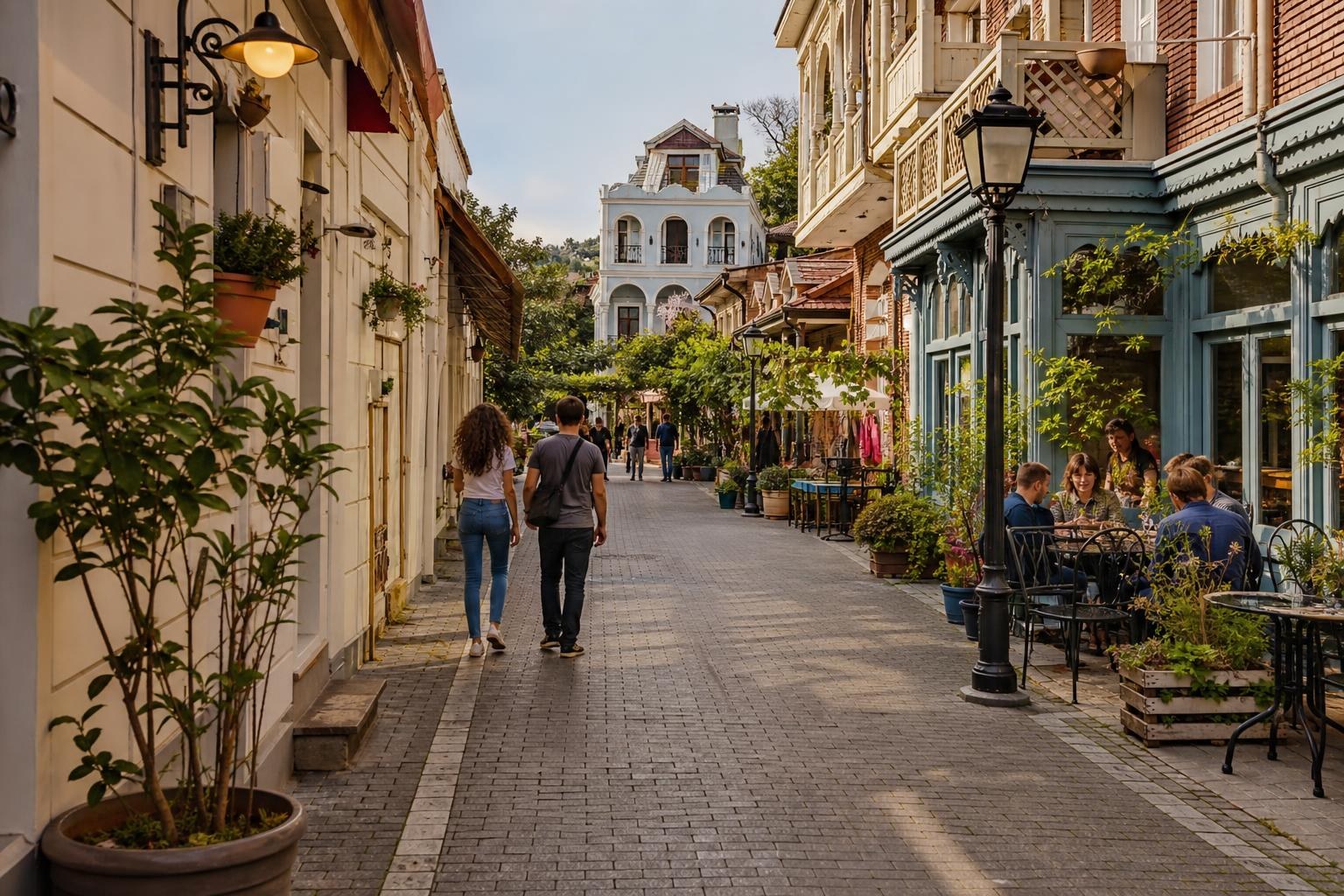
Sololaki is the second best option. It sits just above the Old Town and puts you within walking distance of the hidden courtyards I’ll describe on Day 1. The neighborhood has a faded aristocratic charm, with Art Nouveau balconies and iron staircases that feel like a film set. Expect to pay slightly more here, around 120-200 GEL ($45-75) for a decent guesthouse.
Marjanishvili, across the river, works if you want a grittier, more local feel. It’s where a lot of younger Tbilisians hang out, and the food options are excellent and cheap.
At a Glance: Logistics and Transport Table
| Detail | Info |
|---|---|
| Currency | Georgian Lari (GEL); 1 USD ≈ 2.7 GEL (2026) |
| Metro hours | 6:00 AM – midnight |
| Metro fare | 1 GEL ($0.37) |
| Average Bolt ride | 5-10 GEL ($2-4) |
| Budget meal | 12-20 GEL ($4.50-7.50) |
| Natural wine glass | 8-15 GEL ($3-5.50) |
| Best transport app | Bolt (Uber has limited coverage) |
| Language tip | Download Georgian offline pack in Google Translate |
Day 1: Modernist Architecture and Hidden Courtyards
Your first day is about seeing the Tbilisi that architecture nerds and street photographers obsess over. The city has one of the most eclectic built environments in the former Soviet world, and you can experience it all on foot with a couple of short rides mixed in. Start in the morning when the light hits Sololaki’s balconies at the right angle, and end the afternoon at Fabrika with a cold beer in a courtyard that used to produce Soviet military uniforms.
The Brutalist Beauty of the Bank of Georgia Building
Take a Bolt north to the Bank of Georgia headquarters on the Kura River. This building, designed by George Chakhava in 1975, looks like a stack of concrete Tetris blocks cantilevered over a hillside. It’s one of the most photographed examples of Soviet Brutalist architecture anywhere, and it’s still a functioning bank, so you can walk into the ground floor lobby without any special permission.
What makes this building special isn’t just its form. It represents a moment when Georgian architects were pushing back against Moscow’s standardized designs, creating something that was unmistakably local and bold. The building is best photographed from the bridge below or from the opposite bank. Give yourself 30-45 minutes here, including the walk around the exterior. There’s no admission fee, and the surrounding area, while not particularly scenic, gives you a sense of Tbilisi’s Soviet-era urban planning that the Old Town completely lacks.
Sololaki’s Secret Painted Entrances
Head back south to Sololaki and start walking. The neighborhood’s famous balconied houses are visible from the street, but the real treasures are behind the heavy wooden doors. Many of Tbilisi’s 19th-century apartment buildings have interior staircases decorated with frescoes, stained glass, and ornate plasterwork that’s been slowly crumbling for a century.
I’ll be direct: you need to be respectful here. These are people’s homes. Some entrances are open, and a few have become semi-official points of interest. The building at 7 Betlemi Street has a particularly stunning painted ceiling in its stairwell. Another favorite is the entrance at 19 Lado Asatiani Street, where the ironwork alone is worth the detour.
Walk slowly through Sololaki for about two hours. Grab a coffee at one of the small cafes on Asatiani Street and let yourself get lost. The neighborhood rewards aimless wandering more than any planned route could.
Fabrika: From Soviet Sewing Factory to Creative Hub
End your afternoon at Fabrika, a converted Soviet sewing factory in the Marjanishvili area. This place has become Tbilisi’s creative nerve center since its conversion, housing co-working spaces, artist studios, a hostel, and a courtyard ringed with food stalls and bars.
The courtyard is the main draw. On any given evening, you’ll find graphic designers working on laptops next to backpackers eating khinkali, with a DJ setting up in the corner. It’s not polished or corporate: the concrete walls are covered in murals, the furniture is mismatched, and the energy is genuinely communal. Food stalls here serve everything from Georgian street food to ramen, with most dishes priced between 10-18 GEL ($4-7). Try the lobiani (bean-stuffed bread) from any of the Georgian vendors, and pair it with a local craft beer for about 8 GEL.
Day 2: Spiritual Heights and Subterranean Treasures
Day 2 takes you to the places that require a bit more effort to reach but deliver the most memorable moments. The morning starts with a monument that rivals anything in Europe for sheer dramatic impact, and the afternoon is devoted to two markets that reveal how Tbilisians actually live, shop, and trade.
The Chronicles of Georgia: The ‘Stonehenge’ of Tbilisi
This is the single most undervisited major monument in the city. The Chronicles of Georgia, also called the Stonehenge of Tbilisi, is a cluster of massive stone pillars on a hilltop overlooking the Tbilisi Sea reservoir. Designed by sculptor Zurab Tsereteli and never officially completed, the pillars are carved with scenes from Georgian history and religious iconography.
Getting there requires a 20-minute Bolt ride from central Tbilisi, costing about 8-10 GEL. The site is free, unguarded, and usually deserted. You can walk right up to the pillars and touch the carvings. The scale is staggering: each column stands about 35 meters tall, and the detail in the relief work is extraordinary. On a clear morning, the views across the reservoir to the Caucasus foothills are some of the best in the Tbilisi area.
Plan to spend about an hour here, including the walk around the full circle of pillars. There’s no cafe or facility, so bring water. Georgia’s tourism sector has seen significant growth alongside shifting trends in recent years, but this monument still flies under the radar for most international visitors.
Dezerter Bazaar: An Authentic Sensory Overload
Back in central Tbilisi, head to Dezerter Bazaar near Station Square. This is the city’s largest and oldest market, named after the soldiers who deserted the army during the Russian Civil War and began trading here. It’s loud, chaotic, and completely unfiltered.
The ground floor is produce: mountains of tomatoes, herbs sold in bunches the size of your forearm, and churchkhela (walnut strings dipped in grape juice) hanging from every stall. The basement level is where things get interesting, with vendors selling spices, dried fruits, sulguni cheese, and homemade adjika (chili paste) from plastic tubs. A kilo of gorgeous ripe peaches costs about 3-4 GEL ($1.10-1.50), and a string of churchkhela is 2-3 GEL.
This isn’t a tourist market. Vendors may not speak English, but pointing and smiling works perfectly. Buy some spices here: Georgian blue fenugreek (utskho suneli) and dried marigold petals are both unique to the region and cost almost nothing.
Dry Bridge Market: Hunting for Soviet Curiosities
A 15-minute walk from Dezerter Bazaar brings you to Dry Bridge Market, Tbilisi’s famous open-air flea market. Spread across a park near the Dry Bridge, vendors lay out Soviet medals, oil paintings, vinyl records, antique jewelry, daggers, enamel pins, and old cameras on blankets and folding tables.
The quality varies wildly. Some stalls sell genuine antiques: Soviet propaganda posters, pre-revolution silver, and handmade Caucasian daggers that are genuinely old. Others sell mass-produced souvenirs aimed at tourists. The trick is to go slowly and dig. Prices are negotiable, and starting at about 60% of the asking price is normal. A good Soviet-era enamel pin might cost 5-10 GEL, while a quality oil painting could run 50-200 GEL depending on size and age. The market operates daily but is biggest on weekends.
Tbilisi’s Emerging Culinary and Wine Scene
Georgia’s food and wine traditions are ancient, but the way Tbilisi interprets them in 2026 is anything but old-fashioned. The city has developed a restaurant and bar scene that honors tradition while doing genuinely creative things with local ingredients. Tbilisi ranks among the top trending destinations on major travel platforms, and the food scene is a huge part of why.
Natural Wine Bars in the Vera District
Georgia is the birthplace of wine: 8,000 years of continuous winemaking, with grapes fermented in buried clay vessels called qvevri. The natural wine movement that swept through Brooklyn and Berlin? Georgians have been doing it since the Bronze Age.
The Vera district has become the epicenter of Tbilisi’s wine bar culture. Vino Underground on Tabidze Street was one of the first dedicated natural wine bars and remains the standard-bearer. A glass of amber wine, made from white grapes fermented on their skins in qvevri, costs 10-15 GEL. The staff can walk you through the differences between Rkatsiteli, Mtsvane, and Kisi grape varieties, and most bottles available by the glass are from small family producers you won’t find outside Georgia.
Nearby, g.Vino offers a slightly more upscale experience with a broader food menu. For something more casual, look for Wine Gallery on Bambis Rigi, where the atmosphere is relaxed and the pour is generous.
Modern Twists on Traditional Supra Classics
The supra, Georgia’s traditional feast, revolves around dishes that haven’t changed much in centuries: khinkali (dumplings), khachapuri (cheese bread), pkhali (walnut-vegetable pâté), and slow-cooked meats. A new generation of Tbilisi chefs is reworking these classics without losing their soul.
Shavi Lomi in the Vera district serves deconstructed Georgian dishes that would feel at home in a Copenhagen bistro but taste unmistakably local. Their smoked sulguni with walnut pesto is a standout. Cafe Littera, set in the Writers’ House courtyard, offers a tasting menu that reinterprets supra dishes with French technique, priced around 80-120 GEL ($30-45) for a full meal with wine.
For something more affordable, Tsiskvili is a local chain celebrating traditional Georgian cooking in a folksy setting. A full meal for two with wine rarely exceeds 60 GEL ($22). The khinkali here are hand-pinched and filled with spiced meat and broth: eat them by the stem, tilt, slurp the juice, and discard the top knot.
Essential Tips for the Off-the-Beaten-Path Traveler
Tbilisi is one of the safest capitals in Europe, and solo travelers, including women traveling alone, consistently report feeling comfortable walking the city at night. Police are generally helpful and increasingly English-speaking, though carrying a screenshot of your guesthouse address in Georgian script saves time.
A few practical things that will make your two days smoother:
- Carry cash in small denominations. Many market vendors and smaller wine bars don’t accept cards, and breaking a 100 GEL note at a street stall is awkward.
- Dress modestly if you plan to enter any churches. Shoulders and knees should be covered, and women will need a head covering, usually available at the entrance.
- Water from the tap is safe to drink in central Tbilisi, which saves you from buying plastic bottles.
- Learn three Georgian words: gamarjoba (hello), madloba (thank you), and gaumarjos (cheers). The last one will get you invited to tables.
- The concept of stumari ghvtisaa, meaning “a guest is a gift from God,” is not just a saying. If someone invites you to eat or drink, accept. Refusing hospitality is the closest thing to an insult in Georgian culture.
Tbilisi beyond the basics isn’t about obscure locations that require a guide or special access. It’s about shifting your attention from the monuments to the spaces between them: the courtyards, the markets, the wine bars where the tamada (toastmaster) raises a horn of wine and toasts to your journey. Two days is enough to see a city that most visitors only scratch the surface of. Come with curiosity, a willingness to get a little lost, and an empty stomach. Tbilisi will take care of the rest.