
Table of Contents
Tbilisi is one of those cities that rewards you for not planning too rigidly. You can spend a morning wandering through crumbling Art Nouveau courtyards, stumble into a natural wine bar by lunch, and find yourself soaking in a centuries-old sulfur bath by evening, all without consulting a map. The Georgian capital has been named among the world’s top 10 trending tourist destinations for 2026, and the buzz is deserved. It’s a city where fourth-century churches sit next to brutalist Soviet apartment blocks, where a traditional supra feast can last five hours, and where a single metro ride costs 1 GEL (about $0.35). If you’re figuring out what to do in Tbilisi over 3 days, the honest answer is: more than you’d expect, but less than you’ll want. Three days gives you enough time to absorb the city’s rhythm without rushing through it like a checklist. Here’s how I’d spend those 72 hours.
Planning Your 72-Hour Tbilisi Itinerary
The first thing to understand about Tbilisi is its geography. The city is split by the Mtkvari River, with the Old Town and most historical sights clustered on the right bank, and newer creative districts like Marjanishvili and Vera on the left. You can walk between most major attractions in the Old Town within 20 to 30 minutes, which makes it surprisingly manageable on foot.
Three days is the sweet spot for the city itself. You won’t need a car, and I’d actually discourage renting one for an in-city stay because Tbilisi’s driving culture is, let’s say, assertive. Instead, download Bolt on your phone. Rides across the city rarely exceed 8 to 10 GEL ($2.80 to $3.50), and the app eliminates the language barrier with drivers. The Tbilisi metro has two lines and costs just 1 GEL per ride using a rechargeable Metromoney card, which you can buy at any station for 2 GEL.
Georgia’s tourism infrastructure has been expanding rapidly. The country’s tourism revenues are projected to reach $5 billion in 2026, and Tbilisi has responded with better signage, more English-language menus, and a growing number of boutique hotels. That said, download a Google Translate offline pack for Georgian before you arrive. Outside of tourist-facing businesses, English proficiency drops off quickly. Georgia ranks in the lower third of the EF English Proficiency Index, so a few key phrases in Georgian, like “gamarjoba” (hello) and “madloba” (thank you), go a long way. Locals genuinely light up when you try.
Quick Reference: Daily Highlights and Logistics
Here’s a bird’s-eye view of how the three days break down. I’ve organized it so you’re not zigzagging across the city unnecessarily.
|
Day |
Theme |
Key Areas |
Estimated Walking |
|---|---|---|---|
|
Day 1 |
Old Town and Sulfur Baths |
Abanotubani, Narikala, Shardeni Street |
8-10 km |
|
Day 2 |
Soviet History and Modern Culture |
Rustaveli Avenue, National Museum, Fabrika |
6-8 km |
|
Day 3 |
Panoramic Views and Spirituality |
Sameba Cathedral, Mtatsminda Park |
5-7 km |
A few logistics worth knowing: Tbilisi International Airport is about 20 minutes from the city center by taxi (expect 30 to 40 GEL). Most ATMs dispense Georgian Lari, and Visa and Mastercard are accepted almost everywhere in the center. The city is generally very safe, including for solo female travelers. I’ve walked back to my guesthouse at 2 a.m. through the Old Town without a second thought. Police in Georgia are considered reliable and largely corruption-free following the sweeping reforms of the mid-2000s.
Wear comfortable shoes with good grip. Tbilisi’s Old Town is full of cobblestones, steep hills, and uneven sidewalks that will punish flimsy sandals.
Day 1: Old Town Charm and Sulfur Baths
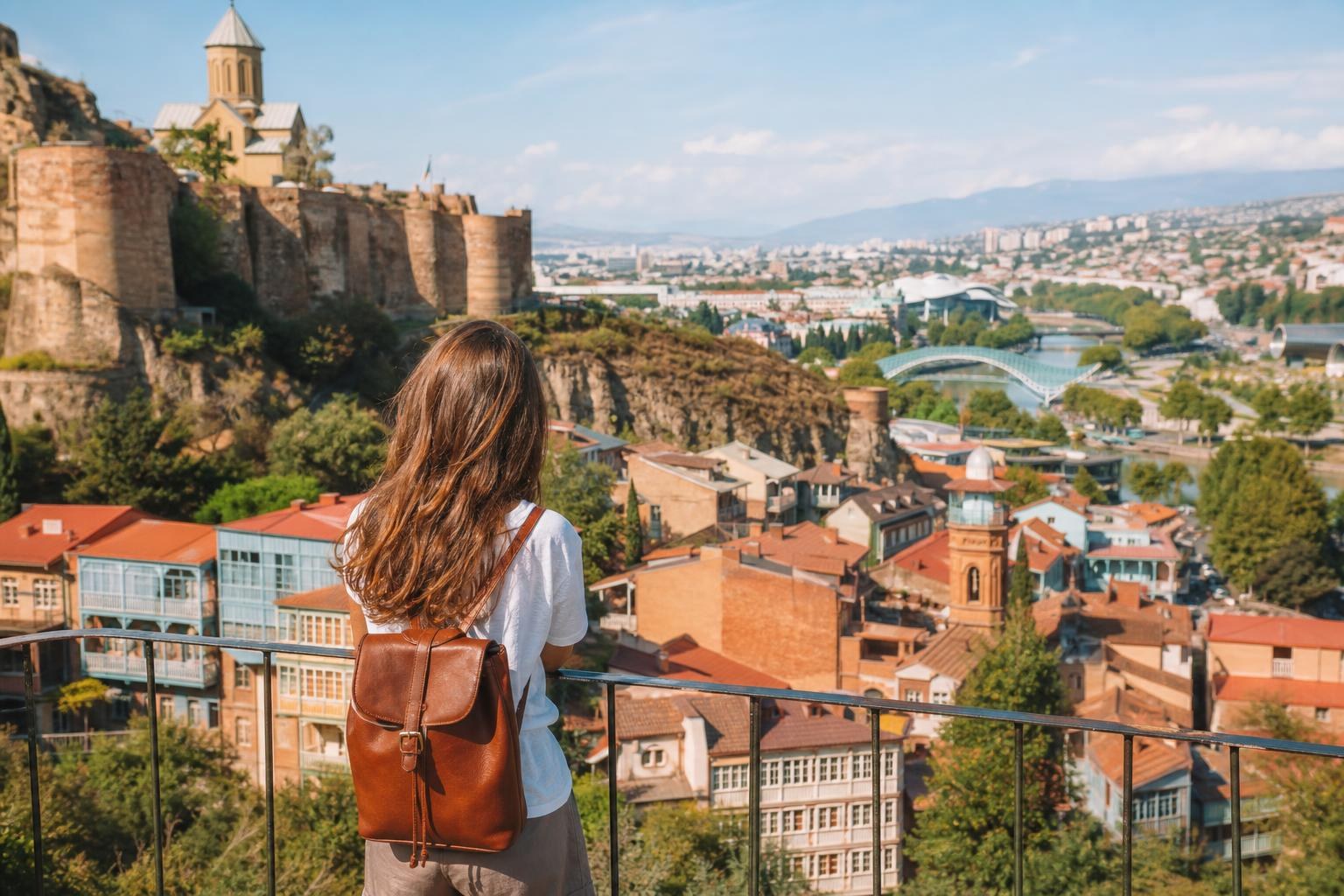
Your first day belongs to the Old Town, or “Dzveli Tbilisi” as locals call it. This is the historic heart of the city, a tangle of narrow streets, leaning wooden balconies draped in grapevines, and the constant sound of church bells mixing with the call to prayer from the nearby mosque. Tbilisi’s Old Town is one of the few places where a synagogue, a mosque, an Armenian church, and a Georgian Orthodox cathedral exist within a few hundred meters of each other, a physical reminder that this city has always been a crossroads of empires and religions.
Start your morning early, ideally by 9 a.m., before the tour groups arrive. Grab a coffee and a fresh tonis puri (traditional bread baked in a clay oven) from one of the bakeries on Kote Abkhazi Street. A loaf costs about 1 to 1.50 GEL. Eat it warm, torn by hand, the way everyone here does.
Exploring Abanotubani and Narikala Fortress
Abanotubani, the bathhouse district, is where Tbilisi gets its name. “Tbili” means “warm” in Georgian, and the natural sulfur springs that bubble up here have been in use since at least the 13th century. The domed brick bathhouses look almost Moorish in design, and the whole area carries a faint sulfur smell that you stop noticing after about ten minutes.
I’d recommend booking a private room at either Chreli Abano (the mosaic-covered one you’ve seen in every Instagram photo) or the Royal Bath House. A private room with a hot sulfur pool and a scrub-down massage runs between 80 and 150 GEL ($28 to $52) depending on the bathhouse and time of day. Weekday mornings are cheapest. The experience is genuinely therapeutic: the water is naturally heated to around 40 to 45 degrees Celsius, and the mineral content leaves your skin absurdly soft. Budget about 45 minutes to an hour.
From Abanotubani, walk uphill toward Narikala Fortress. You can take the cable car from Rike Park across the river (2.50 GEL each way), but I prefer the walking path that winds up from the botanical garden entrance near the baths. It’s steep but takes only about 20 minutes, and the views improve with every switchback. Narikala dates back to the 4th century and has been rebuilt by practically every empire that passed through: Persians, Arabs, Mongols, Ottomans, Russians. The fortress walls are free to explore, and the panoramic view of the city from the top is the single best vantage point in Tbilisi. The Kartlis Deda (Mother of Georgia) statue stands nearby, holding a sword in one hand and a wine bowl in the other, which tells you everything you need to know about the Georgian character.
The Leaning Clock Tower and Shardeni Street
After descending from Narikala, head to the Rezo Gabriadze Puppet Theatre, recognizable by its whimsical leaning clock tower. Every hour, a small angel emerges and strikes a bell. The theatre itself puts on performances that are genuinely moving even if you don’t speak Georgian, but tickets sell out fast, so check availability online a few days ahead. Performances typically cost around 30 GEL.
Shardeni Street is right around the corner, and this is where Old Tbilisi shifts from historical to social. The pedestrian street is lined with cafes, bars, and restaurants, all with outdoor seating that spills onto the cobblestones. It can feel touristy, and it is, but the atmosphere is undeniably charming in the evening when the buildings are lit and musicians play on the corners.
For dinner on Day 1, skip the Shardeni tourist traps and walk five minutes to Cafe Littera, housed in the old Writers’ House of Georgia. The menu is modern Georgian cuisine, and the courtyard setting is stunning. A full meal with wine runs about 80 to 120 GEL per person. If that’s above your budget, Machakhela on Leselidze Street serves enormous portions of traditional food for a fraction of the price: a plate of khinkali (Georgian dumplings) costs around 12 to 15 GEL for ten pieces.
Day 2: Soviet History and Modern Culture
Day two pulls you out of the medieval Old Town and into Tbilisi’s more recent past and its creative present. The contrast is part of what makes this city so compelling. One block you’re staring at a crumbling Soviet housing panel with laundry hanging from the balconies, and the next you’re in a converted factory space with a specialty coffee roaster and a contemporary art gallery.
Georgia’s relationship with its Soviet history is complicated. You’ll see it reflected in everything from the brutalist architecture to the older generation’s mix of nostalgia and resentment. The younger generation, particularly in Tbilisi, has largely turned westward, and the city’s creative scene reflects that tension between old and new in fascinating ways.
Rustaveli Avenue and the National Museum
Rustaveli Avenue is Tbilisi’s main boulevard, named after the 12th-century poet Shota Rustaveli. It stretches about 1.5 kilometers and is lined with grand 19th-century buildings, theaters, and government offices. Start at the top near Freedom Square and walk southwest.
The Georgian National Museum sits about halfway down the avenue and deserves at least two hours. The Soviet Occupation Hall on the top floor is the standout. It documents Georgia’s experience under Soviet rule from 1921 to 1991 through photographs, personal belongings, and deportation records. It’s sobering and well-curated. The ground floor houses an impressive collection of pre-Christian gold artifacts from the Colchis and Iberian kingdoms, some dating back to the 3rd millennium BCE. Entry costs 15 GEL.
Across the avenue, the Rustaveli Theatre and the old Parliament building (now a conference center) are worth a look from outside. If you’re visiting on a weekday, the Dry Bridge Market is a short detour east of the avenue. Vendors spread Soviet-era memorabilia, old paintings, antique jewelry, and random curiosities across tables and blankets. It’s part flea market, part open-air museum. You can find genuine Soviet propaganda posters for 20 to 50 GEL and old film cameras for even less. Bargaining is expected.
Fabrika: The Creative Heart of the Left Bank
Cross the river to the Marjanishvili district and head to Fabrika, a former Soviet sewing factory that’s been converted into a hostel, coworking space, and creative hub. The courtyard is the real draw: a collection of small shops, bars, tattoo studios, and food stalls that feels like a permanent street festival. On warm evenings, the courtyard fills with a mix of locals, expats, and travelers, and there’s usually live music or a DJ.
Fabrika represents a broader shift happening in Tbilisi. The city has become a magnet for digital nomads and creatives from across Europe and the former Soviet Union, drawn by the low cost of living, easy visa policies (citizens of 95 countries can stay visa-free for up to a year), and a growing cultural scene. A beer at Fabrika costs about 6 to 8 GEL, and the food stalls serve everything from Georgian street food to ramen.
From Fabrika, the surrounding Marjanishvili neighborhood is worth exploring on foot. The streets are quieter than the Old Town, with local bakeries, small wine shops, and residential courtyards that give you a more honest picture of daily life in Tbilisi. Look up as you walk: the ornate wooden balconies and crumbling facades tell stories that no museum can.
For dinner, try Shavi Lomi (Black Lion), a short walk from Fabrika. It’s a local favorite that does inventive takes on Georgian classics in a cozy, slightly eccentric setting. Reservations are smart for weekend evenings.
Day 3: Panoramic Views and Spiritual Landmarks
Your final day balances two of Tbilisi’s most visually striking experiences: the massive Sameba Cathedral and the hilltop Mtatsminda Park. These sit on opposite sides of the city, so plan your route to avoid backtracking. I’d suggest starting with Sameba in the morning, then heading to Mtatsminda in the afternoon for sunset views.
Georgia is one of the oldest Christian nations in the world, having adopted the faith as a state religion in 337 CE. That history is embedded in every corner of the city, from tiny neighborhood chapels to the towering Sameba complex. Even if you’re not religious, the spiritual architecture here is extraordinary, and understanding it gives you a much deeper appreciation for Georgian identity.
Holy Trinity (Sameba) Cathedral
Sameba is hard to miss. It’s the largest religious building in the South Caucasus, and its gold dome is visible from almost anywhere in the city. Completed in 2004, it’s relatively new by Georgian standards, but it was built to mark 2,000 years of Christianity and 1,500 years of the Georgian Orthodox Church’s autocephaly (independence).
The interior is vast and dimly lit, with enormous frescoes covering the walls and ceilings. Photography is allowed but be respectful: this is an active place of worship, not a museum. Women should cover their heads and shoulders (scarves are available at the entrance), and men should wear long pants. Entry is free.
The cathedral complex sits on Elia Hill, and the grounds include a park with views over the Old Town and the river. Spend about 45 minutes here, then grab a taxi or ride Bolt to the lower funicular station.
Mtatsminda Park via the Funicular
The Mtatsminda Funicular is one of Tbilisi’s most iconic experiences. The railway climbs 727 meters up Mount Mtatsminda, and the ride itself takes about five minutes. A round-trip ticket costs 15 GEL. The funicular was originally built in 1903 and has been renovated multiple times, most recently in 2012.
At the top, Mtatsminda Park is a mix of amusement rides, restaurants, and walking paths. The rides are geared toward families and aren’t particularly thrilling, but the views are why you’re here. On a clear day, you can see the snow-capped peaks of the Greater Caucasus to the north. The Ferris wheel (10 GEL) gives you the best 360-degree panorama.
There’s a restaurant at the top called Funicular Restaurant that serves decent Georgian food with a view, though prices are about 30% higher than in the city. A better option is to ride back down and have a late lunch at one of the restaurants along Chavchavadze Avenue, where Tbilisi’s university crowd hangs out.
The Mtatsminda Pantheon, a small cemetery near the upper funicular station, is worth a quiet visit. Georgia’s most celebrated writers, artists, and national heroes are buried here, including the poet Nikoloz Baratashvili and the writer Ilia Chavchavadze. The grave of the Russian playwright Alexander Griboyedov and his Georgian wife Nino Chavchavadze is the most visited, with a touching inscription: “Your mind and deeds are immortal in Russian memory, but why did my love outlive you?”
A Culinary Guide to Georgian Flavors
Georgian food is reason enough to visit. I say this without exaggeration: it’s one of the most underrated cuisines in the world, and eating well in Tbilisi costs remarkably little. The food culture here is deeply tied to the concept of the supra, the traditional Georgian feast presided over by a tamada (toastmaster). Even a casual dinner with friends can turn into a multi-course, wine-fueled event that lasts hours. Georgians have a saying: “stumari ghvtisaa,” meaning “a guest is a gift from God.” That generosity extends to the table.
The flavors lean heavily on walnuts, fresh herbs (tarragon, cilantro, dill), pomegranate, and a spice blend called khmeli suneli. Meat is prominent, but vegetarians actually do well here thanks to dishes like lobio (spiced bean stew), pkhali (vegetable pate with walnuts), and badrijani (eggplant rolls stuffed with walnut paste).
Must-Try Dishes: Khinkali and Khachapuri
Khinkali are Georgian soup dumplings, and eating them is a skill. You grab the twisted top knot, flip the dumpling upside down, bite a small hole, sip the hot broth inside, then eat the rest. You don’t eat the knot: it’s left on your plate so the server can count how many you’ve consumed. The most common fillings are spiced beef and pork, but mushroom and cheese versions exist. A single khinkali costs about 1 to 1.50 GEL, and ten is a standard order.
Khachapuri is cheese-filled bread, and it comes in regional varieties:
-
Imeruli: round, with a sulguni cheese filling, the most common version
-
Acharuli: boat-shaped, filled with cheese, topped with a raw egg and butter that you mix together, the Instagram-famous one
-
Megruli: like Imeruli but with extra cheese melted on top
-
Penovani: made with puff pastry, lighter and flakier
An Acharuli khachapuri at a mid-range restaurant costs about 15 to 20 GEL and is filling enough for a meal. Machakhela and Puris Sakhli are reliable chain options, but the best versions I’ve had were at small family-run spots in the Sololaki neighborhood.
Other dishes to seek out include mtsvadi (grilled pork skewers), shkmeruli (chicken in a garlic-cream sauce), and churchkhela, the candle-shaped candy made from grape must and walnuts that hangs in every market stall.
The Best Natural Wine Bars in Sololaki
Georgia has been making wine for over 8,000 years, and the traditional method, fermenting grape juice in large clay vessels called qvevri buried underground, was recognized by UNESCO as intangible cultural heritage. Natural wine here isn’t a hipster trend. It’s the original way.
Sololaki, the quiet residential neighborhood between Rustaveli Avenue and the Old Town, has become the center of Tbilisi’s natural wine bar scene. A few spots worth visiting:
-
Vino Underground: the original natural wine bar in Tbilisi, with a rotating selection from small Georgian producers. Glasses start at 8 GEL.
-
g.Vino: a more upscale wine bar and restaurant with an extensive list of qvevri wines. The sommelier is excellent and happy to guide you through unfamiliar grape varieties like Saperavi, Rkatsiteli, and Mtsvane.
-
Wine Gallery: a shop and tasting room near Freedom Square where you can sample before buying bottles to take home.
Georgian amber wine (sometimes called orange wine) is the signature style. It’s made from white grapes fermented with their skins in qvevri, producing a deep golden color and a tannic, complex flavor that surprises people expecting conventional white wine. A bottle of excellent amber wine at a shop costs 15 to 40 GEL, which is absurdly cheap by global standards.
Essential Travel Tips for Tbilisi
Georgia has been updating its tourism infrastructure significantly throughout 2025 and 2026, but Tbilisi still has quirks that can catch visitors off guard. Here are the practical details that most guides skip.
Money matters: Georgia uses the Lari (GEL), and as of early 2026, 1 USD equals roughly 2.85 GEL. ATMs are everywhere in the city center, and most accept international cards without issue. TBC Bank and Bank of Georgia ATMs tend to offer the best exchange rates. Avoid exchanging money at the airport: the rates are poor. Small currency exchange booths on Leselidze Street and near Freedom Square offer competitive rates with no commission.
Getting around: the Tbilisi metro runs from 6 a.m. to midnight and covers the main corridor from the train station through the center and out to the suburbs. For everything else, Bolt is your best friend. Yandex Go also works but has been less reliable in 2026. Regular city buses cost 1 GEL and have been modernized with digital route displays, though Google Maps doesn’t always show accurate bus schedules.
Safety: Tbilisi is remarkably safe for a capital city. Petty theft exists but is uncommon compared to Western European cities. Solo female travelers generally report feeling very comfortable. The main thing to watch for is traffic: Georgian drivers treat pedestrian crossings as suggestions, so make eye contact with drivers before stepping into the road.
Connectivity: free Wi-Fi is available in most cafes, restaurants, and hotels. For mobile data, buy a local SIM card at the airport from Magti or Geocell. A tourist SIM with 15 GB of data costs about 20 to 25 GEL and lasts 30 days.
Sensitive topics: avoid bringing up the conflicts in Abkhazia and South Ossetia in casual conversation. These are deeply painful subjects for Georgians. Similarly, be aware that Georgia’s political situation regarding its EU aspirations is a charged topic. Listen more than you speak on these issues.
The country’s tourism sector has seen substantial new developments for 2026, including improved airport facilities and new hotel openings, which means the visitor experience keeps getting smoother. But part of Tbilisi’s charm is that it hasn’t been polished into a generic tourist destination. The rough edges are features, not bugs.
One final practical note: if you have an extra half-day, consider a marshrutka (minibus) day trip to Mtskheta, Georgia’s ancient capital, just 25 minutes north. The Jvari Monastery overlooking the confluence of the Mtkvari and Aragvi rivers is one of the most photographed sites in the Caucasus, and the Svetitskhoveli Cathedral is where Georgian Christianity began. Marshrutkas leave from the Didube bus station every 15 minutes and cost 1.50 GEL each way.
Tbilisi is a city that doesn’t try to impress you. It just is what it is: ancient, chaotic, warm, occasionally crumbling, and deeply generous. Three days here won’t feel like enough, and that’s exactly the point. You’ll leave with a mental list of things you didn’t get to, neighborhoods you only glimpsed from a taxi window, and a vague plan to come back. Most people do. Pack comfortable shoes, bring an appetite, and let the city unfold at its own pace. The best moments in Tbilisi are the ones you don’t plan for: a stranger inviting you to share a glass of wine, a hidden courtyard with a hundred-year-old grapevine, the sound of polyphonic singing drifting from an open church door. That’s not a travel cliché. That’s just Tuesday in Tbilisi.