
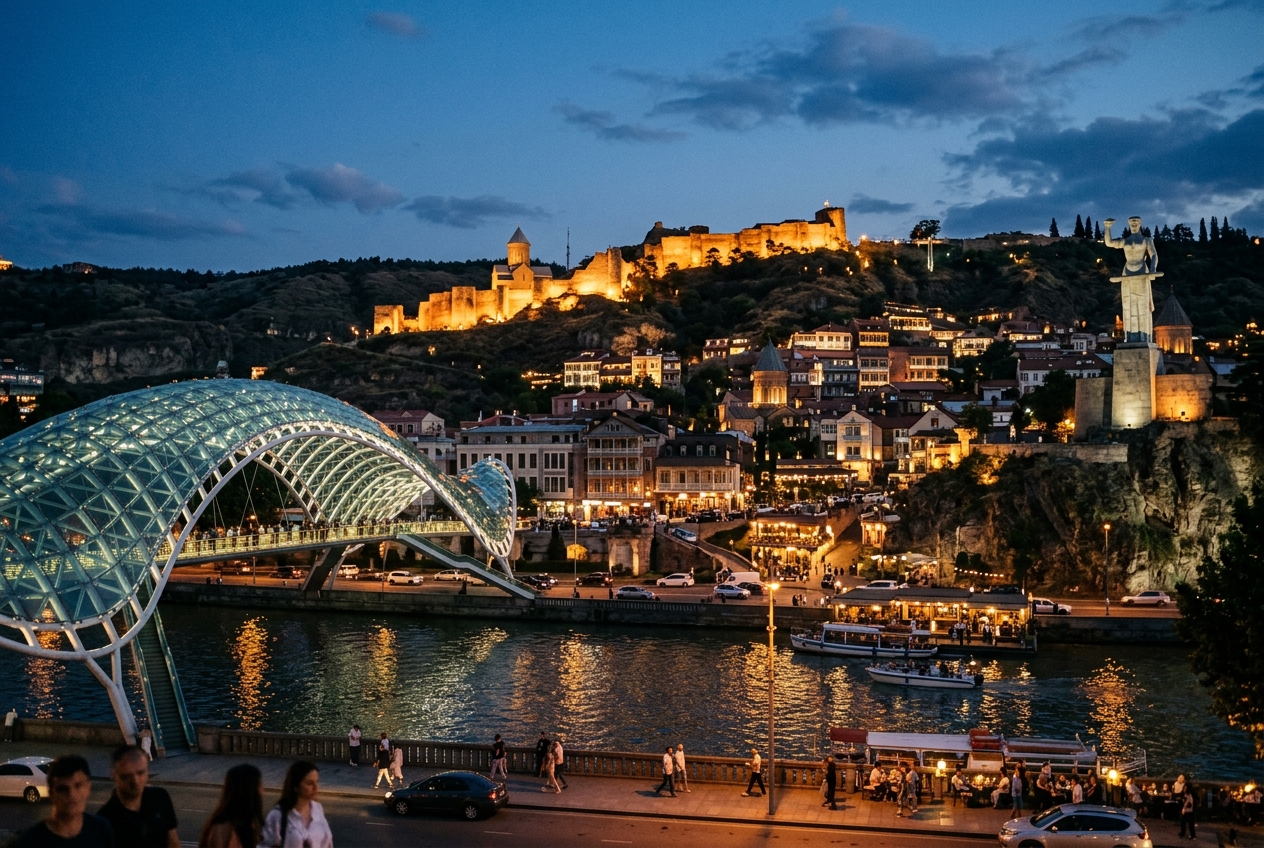
Tbilisi doesn’t really wake up until the sun goes down. That might sound dramatic, but anyone who has spent a few evenings in the Georgian capital knows exactly what I mean. The city’s daytime charm – its crumbling balconies, chaotic traffic, and churchyard cats – transforms into something entirely different after dark. Sulfur bath domes glow amber under floodlights. Wine bars tucked into courtyards fill with conversation and clinking glasses. And somewhere beneath a Soviet-era building, a bass line pulses until dawn. If you’re trying to figure out the best things to do in Tbilisi at night, the honest answer is: almost too many. This city has a nocturnal personality that rivals cities five times its size. From panoramic viewpoints and ancient fortresses lit up against the sky to some of Europe’s most respected techno clubs, the after-dark options here are genuinely world-class. What follows is a practical, opinionated guide to spending your evenings and late nights in a city that treats darkness as an invitation, not a curfew.
Panoramic Views and Illuminated Landmarks
Tbilisi sits in a valley carved by the Mtkvari River, with hills rising steeply on both sides. During the day, you notice the architecture. At night, you notice the topography – because every elevation becomes a vantage point, and every landmark gets its own lighting treatment. The city invests heavily in illumination, and the result is a skyline that feels cinematic from almost any high point.
Nighttime Vistas from Mtatsminda Park
Mtatsminda Park sits on the highest point overlooking central Tbilisi, accessible by funicular from Chonkadze Street. The ride itself is half the experience: as the car climbs, the city unfolds below you like a circuit board slowly powering on. At the top, you’ll find an amusement park (a bit kitschy, honestly, but fun if you’re traveling with kids or just feeling nostalgic) and a terrace with panoramic views stretching from the Holy Trinity Cathedral to the eastern suburbs.
The best time to go is about 30 minutes before sunset. Grab a coffee or a beer from one of the terrace cafes, watch the sky shift from orange to deep blue, and then see the city lights flicker on neighborhood by neighborhood. The funicular runs until around 2 AM on weekends, so there’s no rush. I’d recommend downloading Bolt or Yandex Go on your phone for the return trip if you’d rather skip the funicular line on the way down.
The Glowing Narikala Fortress and Peace Bridge
Two structures define Tbilisi’s nighttime silhouette: Narikala Fortress and the Peace Bridge. Narikala, a fourth-century citadel perched on a ridge above the Old Town, is bathed in warm golden light after dark. You can reach it via the aerial tramway from Rike Park, and the short cable car ride over the river at night is genuinely one of the most memorable two minutes you’ll spend in the city. The fortress walls are open (and free) to walk around, though watch your footing on uneven stone paths.
Below, the Peace Bridge – a modern glass-and-steel pedestrian span designed by Italian architect Michele De Lucchi – cycles through a light display that shifts colors across its canopy. The contrast between the ancient fortress above and the contemporary bridge below captures something essential about Tbilisi: it’s a city that doesn’t choose between its past and its future. Walking across the bridge around 10 PM, with Narikala glowing overhead, is one of those moments that doesn’t need a filter.
Experiencing the Famous Techno and Club Scene
Tbilisi’s reputation as a clubbing destination has grown enormously over the past decade. What started as a post-Soviet underground movement has become a globally recognized electronic music culture, drawing DJs and club tourists from Berlin, London, and beyond.
Dancing at Bassiani and Khidi
The two names you’ll hear most often are Bassiani and Khidi (sometimes written as KHIDI). Bassiani occupies a converted swimming pool beneath Dinamo Arena, and its cavernous acoustics and industrial aesthetic have made it a pilgrimage site for techno fans worldwide. Khidi, built into a space under the Saarbrücken Bridge along the river, has a rawer, more stripped-down feel. Both venues book international headliners alongside Georgian residents.
Here’s what catches most visitors off guard: many clubs don’t really get going until after midnight and can run until 4 to 6 AM. If you show up at 11 PM expecting a packed dance floor, you’ll be disappointed. Eat a late dinner, have some wine, and arrive at 1 AM. That’s when the energy shifts. Door policies can be selective, particularly at Bassiani – dress dark, leave the bachelor party energy at the hotel, and be patient in line.
Underground Electronic Music Culture
The club scene here isn’t just about partying. It carries real political weight. In 2018, police raids on Bassiani and another venue sparked massive street protests, with thousands of Georgians dancing outside Parliament in defiance. The clubs became symbols of personal freedom and progressive values in a country still wrestling with conservative social norms.
Tbilisi’s electronic music scene is gaining global recognition, with iconic venues like Bassiani and KHIDI earning spots on international “best clubs” lists. Smaller venues like Mtkvarze (a floating club on the river) and Café Gallery offer different flavors of the same culture. Cover charges are reasonable: weekend entry typically runs about 20 to 30 GEL, roughly $7 to $10 USD. Compare that to Berlin or Amsterdam and you’ll understand part of the appeal.
| Venue | Style | Typical Hours | Cover (Weekend) |
|---|---|---|---|
| Bassiani | Techno, minimal | 12 AM – 6 AM+ | 20-30 GEL |
| Khidi | Techno, industrial | 12 AM – 6 AM | 20-30 GEL |
| Mtkvarze | Mixed electronic | 11 PM – 5 AM | 15-25 GEL |
| Café Gallery | House, disco | 11 PM – 4 AM | 10-20 GEL |
Late-Night Dining and Wine Tasting
Georgia has an 8,000-year winemaking tradition and a food culture built around communal feasting. Both of these things translate beautifully into the nighttime hours, because Georgians simply don’t eat dinner at 6 PM. A 9 or 10 PM reservation is perfectly normal, and many restaurants stay open well past midnight.
Traditional Supra Dinners with Live Music
A supra is a traditional Georgian feast, presided over by a tamada (toastmaster) who guides the table through a series of elaborate, heartfelt toasts. While a full supra is typically a private affair for celebrations, several restaurants in Tbilisi recreate the experience for visitors with multi-course meals and live polyphonic singing.
Look for restaurants in the Sololaki or Abanotubani neighborhoods that advertise live music evenings. The combination of khachapuri pulled fresh from a tone oven, slow-cooked beef stew, and three-part vocal harmonies echoing off stone walls is the kind of thing that stays with you. If you’re out very late and need food after the clubs, Pasanauri on Baratashvili Street is open 24/7 and serves excellent khinkali – those soup-filled dumplings that are basically Georgia’s national comfort food. Order at least five. You’ll want more.
Natural Wine Bars in the Old Town
Georgia’s qvevri winemaking method – fermenting grape juice in large clay vessels buried underground – has been UNESCO-recognized since 2013, and Tbilisi’s Old Town has become a hub for natural wine bars showcasing this tradition. Vino Underground, one of the first dedicated natural wine bars in the city, pours exclusively from small Georgian producers and stays open late. The atmosphere is unpretentious: wooden tables, dim lighting, and staff who genuinely want to educate you about amber wine (white wine made with extended skin contact, giving it a deep golden color and tannic structure).
A newer addition to the scene is Baasi Wine Bar and Shop, which opened in 2026 and features live music alongside its wine program. For a more social introduction, Irine’s Pub Crawls start at Fabrika hostel and include unlimited Georgian wine and welcome shots – a solid option if you’re traveling solo and want to meet people quickly.
Relaxation in the Historic Sulfur Baths
The Abanotubani district, Tbilisi’s historic bathhouse quarter, is one of the most distinctive nighttime experiences in the city. The name “Tbilisi” itself derives from “tbili,” the Georgian word for “warm,” referencing the natural sulfur hot springs that have drawn visitors here since at least the first century AD.
Several bathhouses operate late into the evening, with some staying open until midnight or later. The most famous is Chreli Abano, recognizable by its blue-tiled facade, but I’d actually recommend the Royal Bath or Orbeliani Baths for a less tourist-heavy experience. You can book a private room (ranging from about 50 to 150 GEL depending on the bathhouse and room size) that includes a hot sulfur pool, a cold plunge, and the option to add a traditional scrub massage called a kisi.
The water smells strongly of sulfur, which takes a minute to get used to, but the mineral content is genuinely therapeutic. After a long day of walking Tbilisi’s hills, sinking into a hot sulfur pool at 11 PM while the domed ceiling echoes with dripping water is about as restorative as it gets. Bring your own towel and flip-flops unless you want to rent them. Book private rooms in advance on weekends, as they fill up fast.
Evening Strolls and Cultural Hubs
Not every great night out involves clubs or formal dining. Some of the best after-dark hours in Tbilisi are spent simply walking, people-watching, and drifting between the creative spaces that give this city its distinctive character.
The Vibrant Atmosphere of Shardeni Street
Shardeni Street and the adjacent Erekle II Street form the social heart of Tbilisi’s Old Town after dark. The narrow, cobblestoned lanes fill with cafe tables, street musicians, and a mix of locals and visitors that creates a genuinely lively atmosphere without feeling like a tourist trap. Wine bars, cocktail spots, and restaurants line both sides, and the pedestrian-only layout means you can wander freely between them.
My advice: don’t commit to the first place you see. Walk the full length of both streets, peek into courtyards (many hide excellent small bars), and settle wherever the energy feels right. Prices on Shardeni are slightly higher than elsewhere in the city, but not outrageously so. A glass of good Georgian wine will still run you 8 to 15 GEL. The younger, post-2003 generation of Georgians you’ll meet here generally speaks solid English, so striking up conversations is easy.
Fabrika: The Creative Heart of After-Hours Tbilisi
Fabrika is a converted Soviet sewing factory in the Marjanishvili neighborhood that now functions as a hostel, coworking space, and cultural hub. Its central courtyard is the real draw: on any given evening, you’ll find pop-up bars, food vendors, art installations, DJ sets, and a crowd that skews young, creative, and international.
The space hosts regular events – film screenings, markets, live music, and exhibitions – and the courtyard stays active well past midnight. It’s also a natural starting point for a night out, since several good bars and restaurants cluster in the surrounding streets. If you’re a solo traveler, Fabrika is probably the single easiest place in Tbilisi to meet people. The hostel bar practically functions as a social mixer, and the courtyard’s communal seating makes isolation almost impossible. Download Google Translate’s offline Georgian language pack before you go – while English is common among younger Tbilisians, a few phrases in kartuli (Georgian) will earn you genuine warmth.
Practical Tips for Navigating Tbilisi After Dark
Tbilisi is remarkably safe for a capital city, and nighttime is no exception. Violent crime against tourists is rare, and I’ve spoken with many solo female travelers who felt comfortable walking the central neighborhoods late at night. Police are generally reliable and responsive, though you’re unlikely to need them. A few practical notes to keep in mind:
- Taxis: Always use Bolt or Yandex Go. Street taxis will overcharge you, sometimes dramatically. A ride across the city center rarely exceeds 5 to 8 GEL by app.
- Cash vs. card: Most bars and restaurants accept cards, but smaller wine bars and the sulfur baths sometimes prefer cash. Keep some lari on hand.
- Language: The younger generation (roughly under 35) often speaks good English. Older Georgians are more likely to speak Russian. Google Translate works well for Georgian script, which looks unlike any other alphabet you’ve encountered.
- Dress codes: Clubs like Bassiani expect dark, understated clothing. Restaurants and wine bars are casual. The sulfur baths require nothing but a willingness to smell like eggs for a few hours afterward.
- Timing: Dinner at 9 to 10 PM, bars from 11 PM, clubs from 1 AM. Adjust your internal clock accordingly, or you’ll miss the best hours entirely.
Tbilisi after dark rewards the curious and the unhurried. Whether you spend your evening soaking in a centuries-old bathhouse, toasting with strangers over amber wine, or losing yourself to a bass line in a converted swimming pool, the city offers a nightlife experience that feels personal rather than manufactured. The best approach is simple: stay out later than you planned, say yes to the next glass of wine, and let the city show you what it does best after the sun drops behind Mtatsminda. You won’t regret it.