
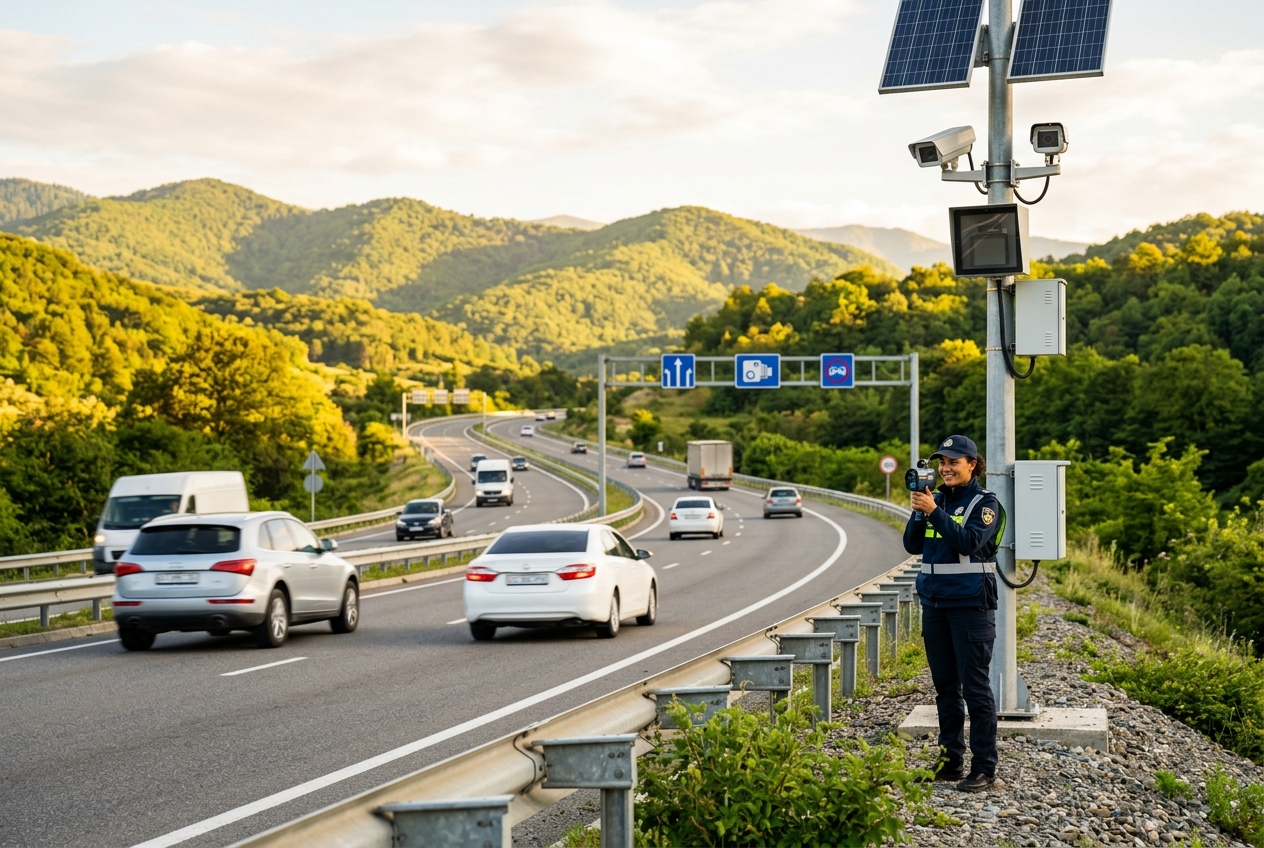
Georgia’s road network has changed dramatically over the past decade. What was once a country where traffic rules felt more like suggestions has become a place where cameras and enforcement technology are genuinely reshaping driver behavior. If you’ve driven the E60 highway between Tbilisi and Kutaisi recently, you’ve probably noticed the sleek camera poles stationed at regular intervals. These aren’t decorative. They’re part of a growing surveillance system that catches thousands of violations every month, and the fines arrive faster than most drivers expect. Understanding how speed cameras and average speed checks work in Georgia is no longer optional knowledge for anyone behind the wheel here, whether you’re a local commuter or a tourist renting a car for a road trip through the Caucasus.

Overview of Georgia’s Road Surveillance Infrastructure
Georgia’s approach to traffic enforcement has undergone a radical transformation since the Rose Revolution era. The country moved from relying almost entirely on traffic police stops to building out an automated camera network that now covers major highways, urban corridors, and school zones across the country. As of early 2024, approximately 286 school zones across Georgia were equipped with Automated Speed Enforcement cameras, representing just one piece of a much larger network that includes highway and urban installations.
The shift wasn’t purely about technology. It was about trust. During the Saakashvili-era reforms, Georgia famously dissolved its notoriously corrupt traffic police force and rebuilt enforcement from scratch. Automated cameras became a cornerstone of this new system because they removed the human element that had enabled bribery and selective enforcement for decades.
The Role of the Ministry of Internal Affairs (MIA)
The Ministry of Internal Affairs oversees the entire traffic camera network in Georgia. The MIA’s Patrol Police Department manages day-to-day operations, including camera placement decisions, violation processing, and fine issuance. Camera locations aren’t chosen randomly: they’re selected based on accident statistics, traffic flow data, and input from local municipalities.
One thing that surprises many visitors is how centralized the system is. Unlike some European countries where municipalities independently operate speed cameras, Georgia runs everything through the MIA. This means a single database handles violations from Batumi to Telavi, and fines follow the vehicle registration rather than the individual driver in most cases. If you’re driving a rental car, the rental company will pass the fine along to you, often with an administrative surcharge.
Smart City Integration and Network Expansion
Tbilisi has been rolling out what officials call a “Smart City” initiative, and traffic cameras are a major component. The capital’s camera network doesn’t just catch speeders: it monitors traffic flow, detects red-light violations, and feeds data into a centralized traffic management system. You can see the results at intersections along Rustaveli Avenue and the Kakheti Highway, where adaptive signal timing adjusts based on real-time camera data.
Outside Tbilisi, expansion has focused on the main east-west corridor and the road to Batumi. The government has announced plans to extend camera coverage to secondary roads in regions like Imereti and Samegrelo, though progress has been slower in rural areas where infrastructure challenges, including unreliable power and connectivity, complicate installation. The long-term vision is a network where virtually no major road segment goes unmonitored.
How Static Speed Cameras Operate
Static speed cameras are the most common type you’ll encounter on Georgian roads. These are the fixed installations mounted on poles or overhead gantries, typically painted in high-visibility colors or accompanied by warning signs. They capture a single snapshot of your speed at a specific point.
Most cameras in Georgia are positioned at known accident hotspots, school zones, and areas where the speed limit drops suddenly, like the transition from a 110 km/h highway zone to a 60 km/h town entrance. The cameras operate 24 hours a day, seven days a week, and they don’t take holidays.
Radar vs. Laser Measurement Technology
Georgian speed cameras primarily use radar-based measurement systems. These work by emitting radio waves that bounce off approaching vehicles. The frequency shift of the returning signal (the Doppler effect) tells the camera exactly how fast you’re traveling. Radar systems can measure speeds from several hundred meters away and work effectively in rain, fog, and darkness.
Some newer installations use laser (LIDAR) technology, which sends out pulses of infrared light and measures the time they take to return. Laser systems are more precise and can target individual vehicles in heavy traffic more accurately than radar, which sometimes struggles to distinguish between closely spaced cars in adjacent lanes. The practical difference for drivers? Laser cameras are harder to detect with consumer radar detectors, though using such detectors is itself a legal gray area in Georgia.
Automatic Number Plate Recognition (ANPR)
Every speed camera in Georgia’s network includes ANPR capability. When a vehicle exceeds the speed limit, the camera captures a high-resolution image of the license plate and cross-references it against the MIA’s vehicle registration database within seconds.
The system reads Georgian plates with very high accuracy, and it’s been upgraded to handle plates from neighboring countries like Turkey, Armenia, and Azerbaijan. This matters because cross-border traffic is significant, particularly along the Tbilisi-Sadakhlo corridor toward Armenia and the Sarpi border crossing with Turkey. Foreign-registered vehicles aren’t exempt from fines, though enforcement and collection can be more complicated for vehicles registered outside Georgia.
Understanding Section Control: Average Speed Checks
Average speed checks, known internationally as “section control,” represent the more sophisticated side of Georgian traffic enforcement. Instead of measuring your speed at a single point, these systems track how long it takes your vehicle to travel between two fixed cameras. If you cover the distance faster than the posted speed limit allows, you get fined. It’s simple math, and it’s very hard to beat.
This approach eliminates the common tactic of braking hard before a known camera and accelerating immediately after. With section control, your behavior over the entire monitored stretch matters, not just the moment you pass a camera.
The Calculation Logic Between Entry and Exit Points
Here’s how the math works. Say two cameras are placed 10 kilometers apart on a stretch of road with an 80 km/h speed limit. At 80 km/h, covering 10 kilometers should take exactly 7 minutes and 30 seconds. If your vehicle passes the exit camera in 6 minutes, your average speed was 100 km/h, and a fine is generated automatically.
The system uses ANPR at both ends to match your plate, timestamps your entry and exit, and calculates the average. There’s typically a small tolerance built in (usually around 5-7 km/h above the posted limit) to account for speedometer variations and measurement uncertainty, though the exact tolerance isn’t publicly disclosed by the MIA. The system also accounts for vehicles that exit and re-enter the monitored zone via side roads, though this varies by installation.
| Scenario | Distance | Speed Limit | Expected Time | Actual Time | Calculated Speed | Result |
|---|---|---|---|---|---|---|
| Within limit | 10 km | 80 km/h | 7 min 30 sec | 8 min | 75 km/h | No fine |
| Marginal | 10 km | 80 km/h | 7 min 30 sec | 7 min | 85.7 km/h | Possible fine |
| Clear violation | 10 km | 80 km/h | 7 min 30 sec | 5 min 30 sec | 109 km/h | Fine issued |
Key Locations for Average Speed Zones in Georgia
The most well-known average speed check zones in Georgia are on the main highway connecting Tbilisi to Kutaisi (the E60), which is the country’s busiest intercity route. Several monitored sections span 5-15 kilometer stretches through areas where the speed limit drops for towns and villages.
Other notable locations include sections of the highway approaching Batumi from the east, portions of the Tbilisi bypass, and stretches near Gori. The government has been gradually adding new zones, and signs typically warn drivers before they enter a monitored section, though the signs aren’t always as prominent as you might expect. My advice: if you see one camera, assume there’s another one ahead and drive accordingly for the next 10-15 kilometers.
Fines, Penalties, and the Point System
Getting caught by a speed camera in Georgia results in financial penalties that vary based on how much you exceeded the limit. The system is straightforward, but the consequences escalate quickly for repeat offenders and high-speed violations.
Current Fine Rates for Speeding Violations
Georgian traffic fines for speeding follow a tiered structure. Exceeding the speed limit by up to 15 km/h results in a fine of approximately 50 GEL (around 18 USD). Going 15-40 km/h over the limit pushes the fine to 150 GEL (roughly 55 USD). Exceeding the limit by more than 40 km/h carries a fine of 300 GEL (about 110 USD), and in some cases, this can be accompanied by license suspension.
These amounts might seem modest compared to Western European fines, but they’re significant relative to average Georgian salaries. For tourists, the sting often comes from the rental car company’s administrative fee on top of the actual fine, which can double the total cost.
Impact on Driver’s License Points
Georgia operates a points-based system for licensed drivers. Speeding violations add points to your record, and accumulating too many within a 12-month period can result in license suspension. Minor speeding infractions typically add 5 points, while serious violations (40+ km/h over the limit) can add 10-15 points. The suspension threshold is generally around 100 points accumulated within a year.
For foreign drivers, points aren’t applied to their home country license, but unpaid fines can create problems at border crossings if you plan to return to Georgia. The MIA database flags vehicles with outstanding violations, and this can lead to delays or requirements to settle fines before re-entering the country.
Notification and Payment Methods
One of the more modern aspects of Georgia’s traffic enforcement system is how quickly and efficiently violations are communicated to drivers. The days of finding out about a fine months later through postal mail are largely over.
SMS Alerts and Video Fine Portal
When a camera catches a violation, the registered vehicle owner typically receives an SMS notification within 24-48 hours. The message includes the violation details: date, time, location, speed recorded, and the fine amount. This system works well for Georgian-registered phones, though tourists with foreign SIM cards may not receive the SMS.
The MIA operates an online portal where drivers can view their violations, including photographic evidence and, in many cases, video footage. The portal is accessible at the Patrol Police website, and it’s available in Georgian and partially in English. You can search violations by entering your vehicle’s license plate number. I’d recommend checking this portal before returning a rental car, as it gives you a chance to dispute any errors before the rental company adds their fees.
Early Payment Discounts and Deadlines
Georgia offers an incentive for prompt payment that’s worth knowing about. If you pay your speeding fine within 10 calendar days of the violation date, you receive a 30% discount on the fine amount. This means a 150 GEL fine drops to 105 GEL if paid quickly, a meaningful savings.
Payment options include online payment through the portal, bank transfer, or in-person payment at any Bank of Georgia or TBC Bank branch. The online system accepts Georgian bank cards, and some international cards work as well. If you miss the 10-day window, the full amount applies. Failing to pay within 30 days can result in additional penalties and, for Georgian residents, potential enforcement actions like vehicle registration holds.
Future Developments in Georgian Traffic Enforcement
Georgia’s traffic camera network is still evolving. Government officials have discussed plans to expand average speed check zones to cover virtually all major intercity highways by 2027. There’s also been talk of integrating artificial intelligence into the camera network to detect additional violations beyond speeding, including tailgating, illegal lane changes, and mobile phone use while driving.
The country is also exploring integration with neighboring countries’ enforcement systems, particularly as Georgia pursues closer ties with the European Union. This could eventually mean that fines issued to vehicles registered in EU member states become enforceable across borders, similar to how the EU’s Cross Border Enforcement Directive works among member states.
Another development worth watching is the potential introduction of variable speed limits on certain highway sections, where camera-enforced speed limits change based on weather conditions, traffic density, or time of day. This technology is already common in Germany and the Netherlands, and Georgian transportation officials have studied these models.
For now, the practical advice remains simple: respect posted speed limits, assume cameras are present even when you don’t see warning signs, and check the online portal regularly if you’re driving in Georgia for an extended period. The system is designed to be fair but firm, and the combination of static cameras and average speed checks means that consistent compliance, not just momentary caution, is what keeps you fine-free on Georgian roads.