
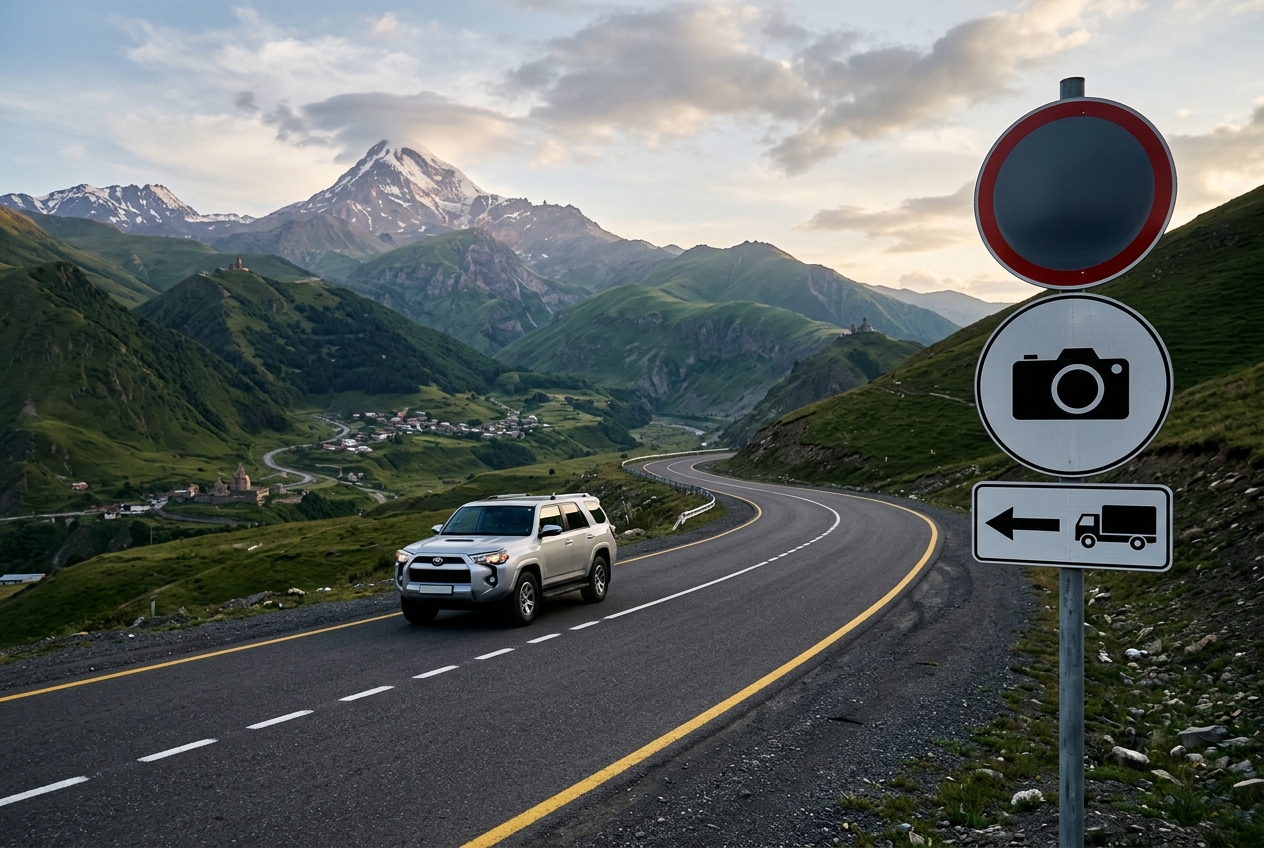
Georgia is a country where ancient mountain passes meet modern highways, where Soviet-era infrastructure blends with European-standard motorways, and where a quick drive from Tbilisi to Kazbegi can shift from six-lane asphalt to hairpin gravel switchbacks in under two hours. If you’re planning to rent a car or drive your own vehicle through Sakartvelo, understanding speed limits, traffic cameras, and road signage isn’t just a bureaucratic exercise: it’s a survival skill. The country recorded 1,466 roadway deaths in 2024, a sobering figure for a nation of roughly 3.7 million people. Speeding remains one of the primary killers, contributing to 29 percent of all traffic fatalities in 2023. Whether you’re a tourist navigating Tbilisi’s chaotic roundabouts or a local heading to Batumi for the weekend, knowing the rules of Georgia’s roads can genuinely save your life. Here’s everything you need to know about speed regulations, automated enforcement, and the signs you’ll encounter along the way.
Standard Speed Limits Across Georgia Roadways
Georgia’s speed limit system follows a tiered structure similar to most European countries, but enforcement culture and road conditions add layers of complexity that catch many drivers off guard. The limits are set by the Ministry of Internal Affairs and are posted in kilometers per hour. Ignoring them isn’t just risky from a safety perspective: fines have increased significantly in recent years, and the patrol police (sapatrulo politsia) have become more aggressive with radar enforcement.
Residential Areas and Urban Districts
Inside city limits and residential zones, the default speed limit is 60 km/h unless otherwise posted. In Tbilisi, this applies to most streets within the city center, including the busy corridors along Rustaveli Avenue and the Vake district. Some narrower residential streets in older neighborhoods like Sololaki or Avlabari may have posted limits of 40 km/h, though signage can be inconsistent.
One thing that surprises many visitors: Georgian urban driving culture is aggressive. Tbilisi alone saw 33,305 traffic crashes in 2024, averaging 91 crashes per day. Drivers frequently exceed posted limits by 10 to 20 km/h in the city, especially on wider arterial roads. The fact that others are speeding doesn’t protect you from a fine, though. Patrol police set up radar checkpoints on key urban corridors, particularly along Kakheti Highway near the airport and the Tbilisi-Rustavi expressway.
Rural Highways and Interstates
Outside urban areas, the speed limits increase based on road classification:
| Road Type | Speed Limit |
|---|---|
| Urban streets | 60 km/h |
| Rural two-lane roads | 80 km/h |
| Expressways | 100 km/h |
| Motorways (autobahn-style) | 110 km/h |
The E60 highway connecting Tbilisi to Kutaisi is one of Georgia’s best-maintained roads and allows speeds up to 110 km/h on certain stretches. But conditions change fast. The road from Kutaisi toward the Rioni Gorge narrows dramatically, and the posted limit drops to 60 or even 40 km/h through villages. Miss one of those signs and you could be looking at a fine or worse.
Rural roads in Svaneti, Tusheti, and parts of Adjara are a different beast entirely. Many are unpaved, single-lane, and cling to cliff edges without guardrails. Posted speed limits become almost irrelevant here: 20 to 30 km/h is often the fastest you can safely go, regardless of what any sign says.
School and Work Zone Regulations
School zones in Georgia carry a strict 40 km/h limit, and this is one area where enforcement has tightened dramatically in recent years. Cameras and patrol presence near schools have increased, particularly in larger cities. Work zones (road construction areas) also carry reduced limits, typically 40 km/h, though signage can appear suddenly on highways with minimal advance warning.
The yellow flashing lights used in some European school zones aren’t common here. Instead, you’ll see standard speed limit signs paired with a “children crossing” warning triangle. Pay close attention during morning hours (8:00 to 9:00) and afternoon dismissal (2:00 to 4:00), when enforcement is strictest and pedestrian traffic is highest.
The Georgia Super Speeder Law and Penalties
Georgia’s traffic fine system operates on a progressive scale, and the penalties for serious speeding offenses can be surprisingly harsh. The country has been working to align its traffic enforcement with European standards, and that means higher fines, more points, and real consequences for repeat offenders.
Thresholds for Super Speeder Fines
Georgia doesn’t use the exact term “super speeder” the way some jurisdictions do, but the fine structure functions similarly. Here’s how the penalty tiers break down:
- Exceeding the limit by up to 15 km/h: warning or fine of 50 GEL (approximately $18 USD)
- Exceeding by 15 to 40 km/h: fine of 100 GEL (approximately $37 USD)
- Exceeding by 40 to 60 km/h: fine of 150 GEL (approximately $55 USD)
- Exceeding by more than 60 km/h: fine of 300 GEL (approximately $110 USD), possible license suspension
Repeat offenses within a 12-month period double the fine amount. If you’re caught going more than 60 km/h over the limit twice in a year, you’re looking at a mandatory license suspension of up to six months. For foreign drivers, this can mean having your international driving permit confiscated and being unable to legally drive for the remainder of your trip.
Impact on Driver’s License Points
Georgia uses a demerit point system for licensed drivers. Georgian license holders start with 100 points, and violations subtract from that total. Speeding offenses deduct between 10 and 30 points depending on severity. Once your balance hits zero, your license is suspended.
For tourists driving on foreign or international licenses, the point system doesn’t directly apply. But fines absolutely do. If you’re renting a car, the rental company will charge the fine to your credit card, often with an administrative fee on top. Apps like Bolt and Yandex Go are worth considering for city travel if you’d rather avoid the stress of driving in Tbilisi altogether.
Automated Speed Enforcement and Camera Locations
Speed cameras have become one of the most contentious topics in Georgian traffic policy. The technology is relatively new compared to Western Europe, and public opinion is split between those who see cameras as lifesavers and those who view them as revenue machines.
School Zone Camera Programs
Automated speed cameras in Georgia are concentrated primarily in school zones, where they’ve had a measurable impact. In the city of Dalton (a reference point for camera program effectiveness), school zone speed cameras led to a 90 percent reduction in vehicles traveling more than 10 mph over the speed limit. Georgian cities have adopted similar programs, particularly in Tbilisi and Batumi, where school zone cameras monitor speeds during designated hours.
The cameras typically use radar-based detection and photograph both the vehicle’s license plate and the driver. Fines are issued automatically, and the system operates without a patrol officer needing to be present. In one notable example from a comparable program, ten speed cameras issued approximately 41,700 citations within three months, generating about $1.6 million in fines. Numbers like these fuel the debate about whether cameras prioritize safety or revenue.
That tension has produced legislative pushback. House Bill 225 proposed banning speed cameras in school zones entirely, citing misuse and prioritization of revenue over safety. Whether such measures gain traction remains to be seen, but for now, the cameras are active and issuing fines.
How Speeding Citations are Mailed and Processed
If a speed camera catches your vehicle, the citation is mailed to the registered owner of the car. For Georgian residents, this means a notice arrives at your registered address with a photograph, the recorded speed, the posted limit, and the fine amount. Payment is typically due within 30 days, and you can pay online through the Ministry of Internal Affairs portal or at any bank.
For rental car drivers, the process is different. The rental company receives the citation and charges the fine directly to the credit card on file. Companies like Hertz, Europcar, and local agencies such as Geo Rental typically add a processing fee of 20 to 50 GEL on top of the actual fine. Check your rental agreement carefully: some contracts include clauses about traffic violations that you might overlook.
If you believe a citation was issued in error, you can contest it within 10 days by filing an appeal with the local court. Bring your evidence: dashcam footage is increasingly accepted, and having a GPS log showing your actual speed can help your case.
Understanding Georgia Road Signs and Markings
Georgian road signs follow the Vienna Convention on Road Signs and Signals, which means they’re largely consistent with what you’d see across Europe. That said, there are quirks, and the bilingual nature of signage (Georgian script plus Latin alphabet on major routes) can create confusion for first-time visitors.
Regulatory Signs and Right-of-Way
Regulatory signs in Georgia use the standard European format: red circles for prohibitions, blue circles for mandatory instructions, and red-bordered triangles for warnings. Stop signs are octagonal with the word “STOP” in Latin letters, so they’re universally recognizable.
Right-of-way rules follow European conventions. Vehicles on the right have priority at unmarked intersections, and roundabouts give priority to vehicles already in the circle. In practice, especially in Tbilisi, these rules are treated more as suggestions than laws. Defensive driving is essential. Expect drivers to enter roundabouts without yielding and to treat red lights as optional during late-night hours.
One sign that confuses many visitors is the blue arrow sign indicating one-way streets. Tbilisi’s old town has dozens of narrow one-way streets, and GPS navigation doesn’t always reflect recent changes. Google Maps works reasonably well, but cross-reference with Waze if you’re driving in the capital.
Warning Signs and Seasonal Hazards
Warning signs for falling rocks, sharp curves, and animal crossings are common on mountain roads. Take them seriously. Livestock on the road is a genuine hazard in rural Georgia: cows, sheep, and horses wander freely across highways in Kakheti, Samtskhe-Javakheti, and virtually all mountain regions. Hitting a cow at 80 km/h is not a hypothetical scenario; it happens regularly.
Seasonal hazards add another layer. Winter driving in the Caucasus mountains requires chains or winter tires, and the Jvari Pass (the road to Kazbegi) closes periodically due to avalanche risk. Warning signs for ice and snow appear on mountain passes from November through March. The Cross Pass at 2,395 meters elevation is particularly treacherous, and patrol police will turn vehicles around if conditions are dangerous enough.
Fog is another frequent issue along the Kolkheti lowlands near Poti and Zugdidi. Visibility can drop to near zero, and many Georgian drivers don’t use fog lights. Keep your headlights on low beam and reduce speed significantly in these conditions.
The Move Over Law and Highway Safety Protocols
Georgia has adopted a version of the “move over” law that requires drivers to slow down and, when possible, change lanes when passing emergency vehicles, patrol police, or roadside assistance crews stopped on the shoulder. This applies to highways and expressways and carries a fine of 100 GEL for violations.
The law also extends to construction crews working on active roadways. If you see flashing amber lights ahead, reduce speed and prepare to merge. Georgian highway workers often operate with minimal barriers between themselves and live traffic, making compliance with this rule genuinely important for their safety.
On multi-lane highways like the E60, the move over requirement means shifting to the left lane when you see a stopped vehicle with hazard lights on the right shoulder. If lane changing isn’t possible due to traffic, slow to at least 20 km/h below the posted speed limit as you pass.
Emergency response in Georgia has improved significantly in recent years. The universal emergency number is 112, and dispatchers in Tbilisi typically speak English. Outside major cities, language barriers can be an issue: having Google Translate downloaded with the Georgian language pack offline can help communicate your location and situation.
One practical tip: if you’re involved in a minor accident with no injuries, Georgian law allows drivers to fill out a joint accident declaration form (known as a “europrotocol”) and exchange insurance information without waiting for police. This saves hours of waiting and is standard practice across the country. For anything involving injuries, do not move the vehicles and call 112 immediately.
Driving in Georgia is an experience that ranges from effortless highway cruising to white-knuckle mountain passes. The rules governing speed, cameras, and road signs are straightforward on paper, but the gap between regulation and road culture is wider here than in most of Western Europe. Respect the posted limits, watch for cameras near schools, learn the basic sign conventions, and drive defensively. Your best tools are patience, a good GPS app, and the understanding that Georgian roads reward caution far more than they reward speed. Stay alert, keep your documents accessible, and you’ll find that driving through this extraordinary country is one of the most rewarding ways to experience it.