
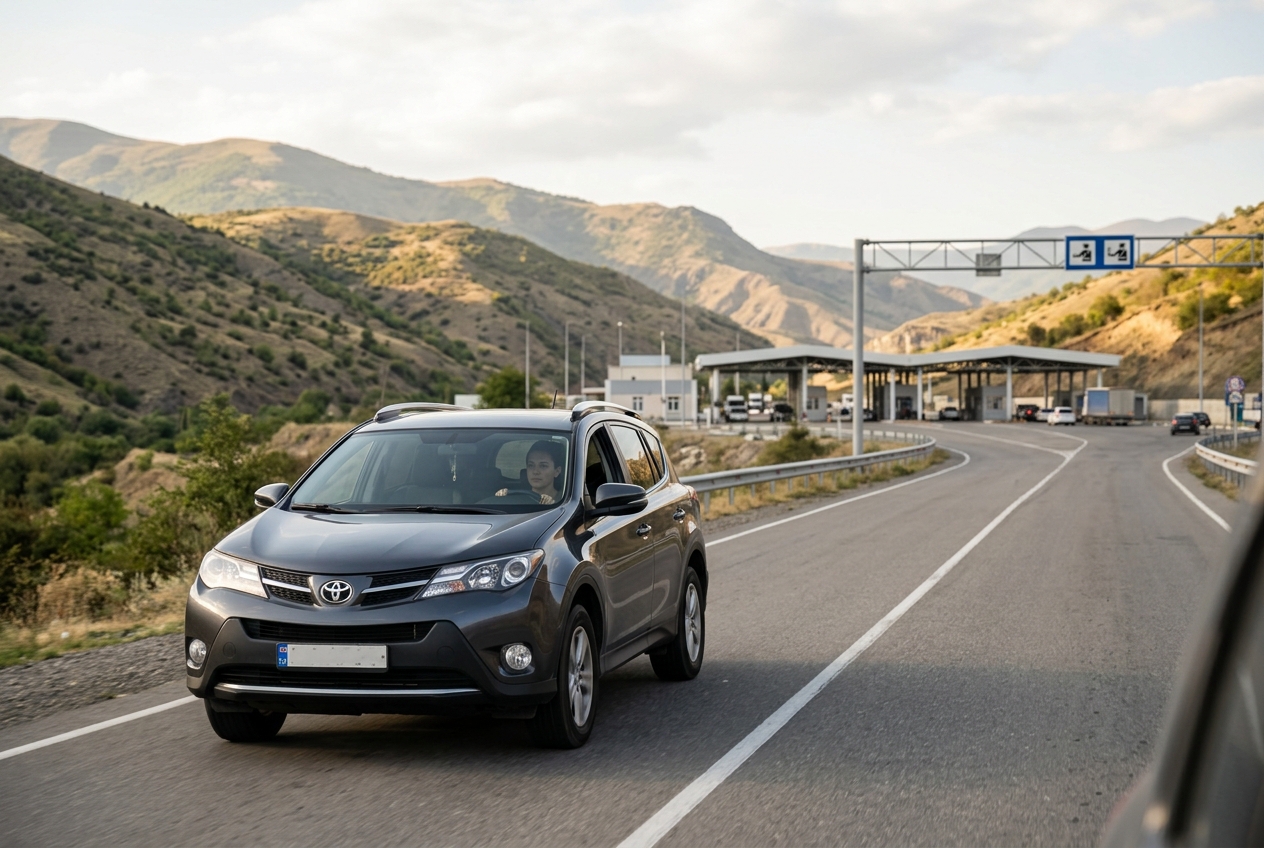
One of the most common questions travelers ask when planning a road trip through the South Caucasus is whether they can cross the border to Armenia with a rental car from Georgia. The short answer is yes, but the longer answer involves paperwork, insurance logistics, and a handful of rules that can trip you up if you’re not prepared. I’ve seen travelers breeze through the process and others get turned back at the checkpoint because they skipped a single document. The difference almost always comes down to preparation. Georgia and Armenia share a relatively short border with two main crossing points, and thousands of tourists make this drive every year. But rental companies have their own policies, the border guards have theirs, and the two don’t always align in obvious ways. This guide breaks down every step: from choosing the right rental agency to handling customs inspections, buying Armenian insurance, and dealing with the realities of Armenian roads on the other side.

Cross-Border Feasibility and Rental Policies
Driving a rental car from Georgia into Armenia is entirely legal and increasingly common among tourists exploring the Caucasus region. The route from Tbilisi to Yerevan takes roughly five to six hours by car, making it one of the most popular cross-border road trips in the area. But the feasibility of this trip hinges almost entirely on your rental company’s policies. Not every agency allows their vehicles to leave Georgia, and those that do often charge extra fees and require advance notice.
The rental car market in Georgia has matured significantly over the past few years. Local agencies and international brands now operate side by side in Tbilisi, Kutaisi, and Batumi, and competition has pushed many of them to offer cross-border options. Still, you can’t assume that any random rental desk at the airport will hand you keys and wave you toward the Armenian border.
Rental Companies Permitting Armenia Travel
Several agencies in Georgia explicitly permit travel to Armenia. Starcar, one of the larger local operators, allows cross-border travel and charges a cross-border authorization fee of around 100 euros for the Power of Attorney document. Enterprise Georgia also permits it with advance arrangements. Alamo stands out because it offers one-way rentals between Georgia and Armenia, meaning you can pick up a car in Tbilisi and drop it off in Yerevan without backtracking.
Smaller local agencies like Fstar Rent Car and a handful of others listed on aggregator sites also allow Armenia travel, though their terms vary. Some restrict which vehicle classes can cross the border, limiting you to SUVs or higher-clearance models because of Armenia’s mountain roads. Always confirm the specific vehicle you’re booking is cleared for cross-border use.
Notifying the Agency and Booking Requirements
This is non-negotiable. You must inform the rental company in advance about your intention to cross the border. Showing up on pickup day and casually mentioning you’re headed to Yerevan will either get you a flat refusal or a scramble to prepare documents that takes days, not hours.
Most agencies need at least 48 hours’ notice, and some require a week or more. The reason is the Power of Attorney document, which needs to be notarized and often translated. If you’re booking online, mention your cross-border plans in the reservation notes and follow up with a phone call or email to confirm. I’d recommend doing this at least two weeks before your trip to avoid any last-minute surprises.
Essential Documentation and Notarized Permits
Paperwork is the part of this trip that catches people off guard. You’re not just crossing a border with your passport: you’re taking someone else’s vehicle into a foreign country, and both governments want proof that this is authorized.
The Power of Attorney (Cross-Border Permit)
The single most important document for this trip is the notarized Power of Attorney, sometimes called a cross-border permit or POA. This is a legal document issued by the rental company that authorizes you, by name, to drive their vehicle outside of Georgia. Armenian border officials will ask for it, and without it, you will be turned away.
The POA must be notarized by a Georgian notary and typically includes the vehicle’s registration details, your passport information, and the specific countries you’re authorized to enter. A notarized POA can cost around 150 GEL and take at least two weeks to arrange if you’re handling it independently. Most rental companies that permit cross-border travel will prepare this document for you, but they build the cost into their cross-border fee.
Make sure the POA lists Armenia specifically. A generic “authorized for travel outside Georgia” document may not satisfy border officials. Get a copy in both Georgian and English if possible, and carry the original: photocopies are not accepted.
Personal Identification and Driving Documents
Beyond the POA, you’ll need the following at the border:
- Your valid passport (with at least six months remaining before expiration)
- Your original driving license from your home country
- An International Driving Permit (IDP), which is technically required in Armenia for non-CIS license holders
- The vehicle’s registration certificate (provided by the rental company)
- Your rental agreement
The IDP is a gray area. Some travelers report crossing without one, but Armenian traffic police can technically fine you for driving without it. An IDP costs about $20 from your home country’s automobile association, and getting one before your trip removes any ambiguity.
Mandatory Insurance and Border Fees
Insurance is the second major logistical hurdle, and it’s one where many travelers make costly assumptions.
Purchasing Armenian Mandatory Third-Party Insurance
Armenia requires all vehicles operating on its roads to carry Third Party Liability insurance. Your Georgian rental car’s insurance almost certainly does not cover Armenia. The good news is that Armenian TPL insurance is remarkably affordable at around 8 USD for a week, and you can purchase it right at the border crossing.
Insurance kiosks operate at both major crossing points. The process takes about five to ten minutes: you hand over the vehicle registration, pay the fee, and receive a paper certificate. Keep this document in the car at all times while in Armenia. Police checkpoints sometimes ask to see it, and you’ll need to present it if you’re involved in any incident.
| Cost Item | Approximate Cost | Where to Pay |
|---|---|---|
| Cross-border authorization fee | €80 – €100 | Rental company (advance) |
| Notarized Power of Attorney | ~150 GEL (~$55) | Included in rental fee or notary |
| Armenian TPL insurance (1 week) | ~$8 | Border crossing kiosk |
| International Driving Permit | ~$20 | Home country auto association |
| Total estimated extra costs | ~$160 – $200 | Various |
Understanding Rental Company Insurance Gaps
Here’s what trips people up: your Georgian rental company’s Collision Damage Waiver (CDW) or comprehensive insurance typically stops at the Georgian border. This means that if you get into an accident in Armenia, you’re personally liable for damage to the rental vehicle. The Armenian TPL you buy at the border only covers damage to other people and their property, not the car you’re driving.
Some rental companies offer extended coverage for an additional daily fee. Ask about this explicitly when booking. If extended coverage isn’t available, consider purchasing a separate travel insurance policy that includes rental vehicle coverage abroad. Companies like World Nomads and Allianz offer plans that can fill this gap, though you’ll need to verify that Armenia is covered under the specific policy.
The Border Crossing Process and Checkpoints
The actual border crossing between Georgia and Armenia is straightforward compared to many international borders, but it helps to know what to expect.
Popular Crossing Points (Sadakhlo vs. Guguti)
Two main land crossings connect Georgia and Armenia by road:
- Sadakhlo-Bagratashen: This is the primary crossing on the main highway between Tbilisi and Yerevan. It’s the busiest, best-maintained, and most commonly used by tourists. The road on both sides is paved and in decent condition.
- Guguti-Bavra: Located in the western part of the border, this crossing connects the Samtskhe-Javakheti region of Georgia with Armenia’s Shirak province. It’s less trafficked and can be useful if you’re heading to Gyumri or coming from Akhaltsikhe.
For most travelers driving from Tbilisi to Yerevan, Sadakhlo is the obvious choice. The road is a well-maintained two-lane highway for most of the route, and the border facilities are more developed.
Customs Procedures and Vehicle Inspection
The crossing itself involves two stops: the Georgian exit checkpoint and the Armenian entry checkpoint. They’re separated by a short stretch of road in a no-man’s-land between the two countries.
At the Georgian side, you’ll present your passport and vehicle documents. Officers may glance at the car but rarely conduct thorough inspections on exit. The Armenian side is slightly more involved. You’ll present your passport, the Power of Attorney, vehicle registration, and your rental agreement. Officers may inspect the trunk and ask about your travel plans. The entire process typically takes about 45 minutes to an hour, though it can stretch longer during peak summer months or holidays.
Don’t forget to purchase your Armenian TPL insurance at the kiosk on the Armenian side before driving away from the border zone. There’s usually a small building or booth clearly marked for this purpose.
Driving Conditions and Local Laws in Armenia
Once you’re through the border, the driving experience changes noticeably. Armenia’s roads and driving culture differ from Georgia’s in several important ways.
Road Infrastructure and Fuel Availability
The main highway from the border to Yerevan is in reasonable condition, though it’s narrower than what you might expect for a primary national route. Two lanes, occasional potholes, and slow-moving trucks are standard. The stretch through the Debed Canyon is scenic but winding, with sharp curves and limited visibility in places.
Outside the Yerevan-to-border corridor, road quality drops significantly. If you’re planning to visit Lake Sevan, Tatev Monastery, or destinations in southern Armenia, expect rougher surfaces and unpaved sections. This is why some rental companies restrict cross-border travel to SUVs and higher-clearance vehicles.
Fuel stations are plentiful along the main highway and throughout Yerevan. In rural areas, stations become sparser, so fill up before heading into mountainous regions. Most stations accept cash (Armenian dram) and some take cards, but don’t count on card readers working reliably outside major towns. Download the Yandex Go app for navigation: it tends to have better local mapping data than Google Maps in parts of Armenia.
Traffic Enforcement and Speed Cameras
Armenia has invested heavily in speed camera infrastructure over the past few years. Fixed cameras are common on highways and at city entrances, and they’re not always well-marked. The general speed limit is 60 km/h in urban areas and 90 km/h on highways, though specific stretches may have lower limits.
Fines are issued to the vehicle’s registered owner, which means the rental company. They’ll charge your credit card for any fines, often with an administrative surcharge. Drive at or below posted limits, and pay attention to the frequent speed limit signs that change as you pass through small towns along the highway.
Armenian drivers can be aggressive by European standards: overtaking on blind curves, tailgating, and creative lane usage are all common. Stay alert, use your mirrors constantly, and don’t feel pressured to match the pace of local drivers. Police checkpoints exist but are relatively rare for foreign-plated vehicles. If stopped, be polite, show your documents, and you’ll typically be waved through quickly.
Cost Analysis and Practical Travel Tips
Driving from Georgia to Armenia is one of the most affordable cross-border road trips you can take in this part of the world. The total extra cost for making your rental car border-legal runs between $160 and $200 on top of your base rental rate, which is modest considering the freedom it gives you.
Fuel costs for a round trip between Tbilisi and Yerevan run approximately $40 to $60 depending on your vehicle’s efficiency and fuel prices at the time. Armenian fuel is generally cheaper than Georgian fuel, so fill up once you cross. Budget about $10 to $15 per day for tolls and parking in Yerevan, where paid parking zones are expanding across the city center.
A few practical tips that save headaches: carry cash in three currencies (Georgian lari, Armenian dram, and US dollars) since exchange booths at the border offer poor rates. Download offline maps for both countries before you leave Tbilisi. Bring a printed copy of every document: your rental agreement, POA, insurance, and passport photo page. Digital copies on your phone are useful backups, but border officials and police strongly prefer paper.
If you’re planning a one-way trip and don’t want to retrace your route, check Alamo’s one-way rental option between the two countries. It costs more than a round-trip rental, but it eliminates the return drive and gives you flexibility to fly back or continue overland to Iran.
The bottom line for anyone wondering whether they can take a rental car from Georgia into Armenia: yes, absolutely, but treat the paperwork as seriously as you treat packing your passport. Start the process at least two weeks before your trip, choose a rental company that explicitly supports cross-border travel, and budget an extra $200 for the authorization, insurance, and fees. Do that, and the drive through the Debed Canyon into Armenia will be one of the highlights of your Caucasus trip.