
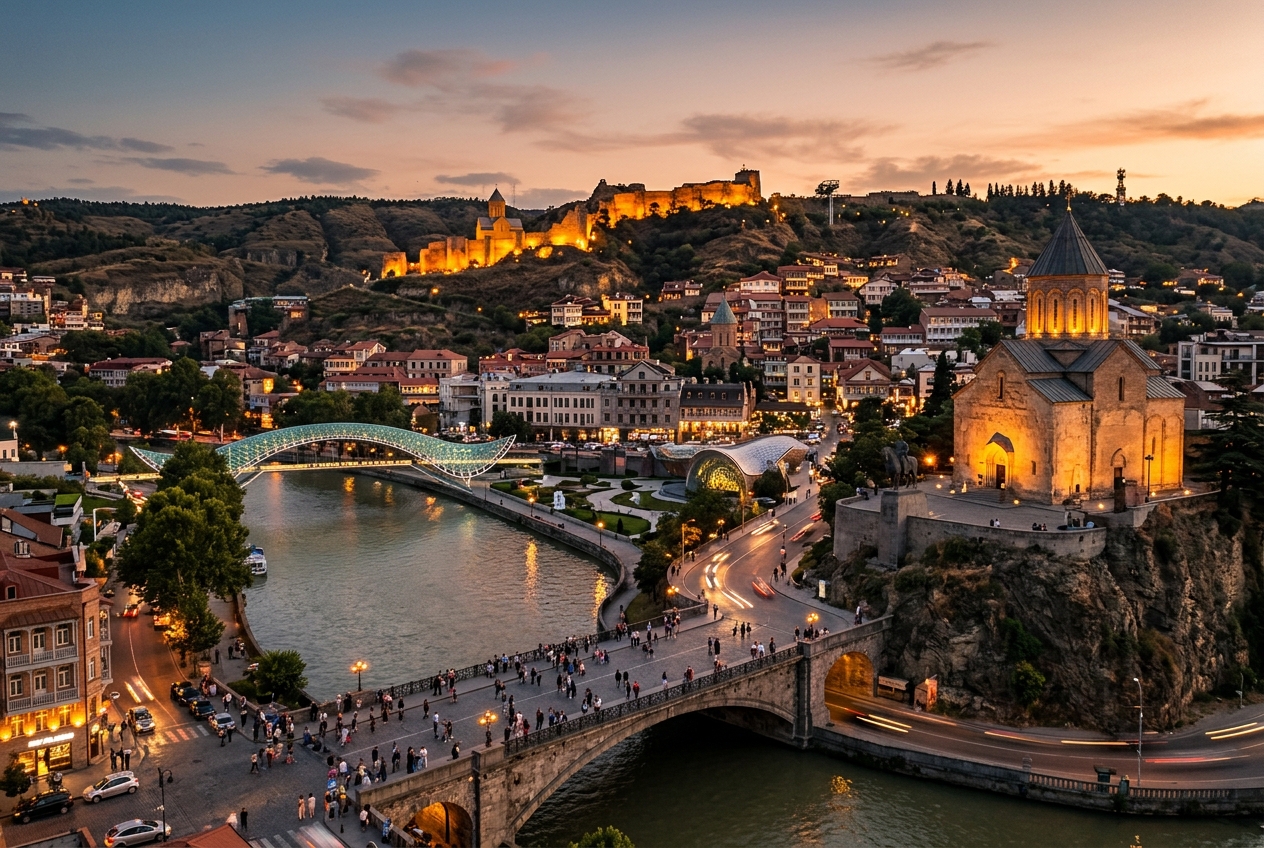
A city that straddles Europe and Asia, Tbilisi has gone from a relatively obscure post-Soviet capital to one of the most talked-about destinations on the planet. It recently ranked as the number two trending travel destination in the world for 2026, and the buzz isn’t slowing down. So why is Tbilisi so popular right now? The answer isn’t one thing: it’s a collision of ancient culture, absurdly good food, world-class nightlife, and a cost of living that makes Western European cities look like a joke. I’ve spent enough time walking its cobblestoned hills and drinking orange wine in crumbling courtyards to have some opinions on this. The city has a magnetic quality that’s hard to articulate until you’ve been there, but I’ll do my best to break it down into the forces driving this phenomenon.
The Intersection of Ancient History and Avant-Garde Style
Tbilisi is one of those rare cities where you can stand on a single street corner and see a 5th-century church, a crumbling Art Nouveau balcony, a Soviet-era apartment block, and a glass-and-steel pedestrian bridge designed by an Italian architect. The city has been conquered, burned, and rebuilt roughly 40 times throughout its 1,500-year history, and each era left its fingerprints. That layering of civilizations creates a visual texture you simply don’t find in cities that were planned on a grid.
What makes it feel alive rather than museum-like is the way Tbilisians actually inhabit these spaces. Young artists set up studios in former Soviet printing houses. Cafés operate out of carved wooden balconies that lean precariously over the Mtkvari River. Nothing feels preserved under glass: it’s all being used, argued over, and reimagined in real time.
Old Town Architecture and Sulfur Bath Culture
The Old Town, or Dzveli Tbilisi, is the emotional core of the city. Its narrow streets wind uphill toward the Narikala Fortress, past leaning houses with ornate wooden balconies called “Italian courtyards” for their open interior galleries. These aren’t reconstructions: families still live in them, hanging laundry between carved wooden pillars that date back centuries.
Below the fortress sits the Abanotubani district, home to the sulfur baths that literally gave Tbilisi its name. “Tbili” means “warm” in Georgian, a reference to the natural hot springs King Vakhtang Gorgasali supposedly discovered while hunting in the 5th century. The baths are still operating today, and they’re not a tourist trap: locals use them regularly. For about 50-80 GEL (roughly $18-30), you can book a private domed brick room with a hot sulfur pool and get a traditional scrub-down from a kisi-wielding attendant. It’s one of those experiences that connects you directly to centuries of ritual.
The Brutalist and Modernist Aesthetic Shift
Step outside the Old Town and Tbilisi’s Soviet and post-Soviet layers reveal themselves. The city is home to some of the most striking Brutalist architecture in the former USSR: the Ministry of Highways (now the Bank of Georgia headquarters) looks like a series of interlocking Jenga blocks suspended over a hillside. The Wedding Palace in Turtle Lake resembles a UFO that landed on a ridge.
These buildings have become pilgrimage sites for architecture enthusiasts and Instagram photographers alike. The newer additions hold their own too. The Bridge of Peace, a wavy glass-and-steel structure lit up at night, and the Rike Concert Hall, shaped like two giant metallic tubes, show a city that isn’t afraid of bold design choices. This tension between ancient and hyper-modern is part of what makes the city so photogenic and so hard to categorize.
A Global Culinary Destination
Georgian food has been called one of the world’s great undiscovered cuisines, though “undiscovered” is quickly becoming inaccurate. Tbilisi is where the full spectrum of Georgian cooking is on display, from hole-in-the-wall khinkali joints to fine-dining restaurants reinterpreting traditional recipes with modern technique.
The cuisine itself draws from Persian, Turkish, and Mediterranean traditions while remaining stubbornly its own thing. Walnut-based sauces, fresh herbs by the fistful, cheese baked into bread, slow-cooked stews with sour plum: it’s comfort food elevated to an art form. And the sheer variety is staggering for a country of fewer than four million people.
Traditional Supra and the Art of Georgian Hospitality
The supra is the Georgian feast, and it’s less a meal than a philosophy. Presided over by a tamada (toastmaster), a supra involves dozens of dishes, endless toasts with wine, and a structure that can last for hours. The tamada guides the table through toasts to God, to Georgia, to family, to the deceased, to love: each one building on the last in a kind of oral poetry.
The Georgian phrase “stumari ghvtisaa” translates to “a guest is from God,” and it’s not just a saying: it’s a cultural operating system. I’ve been pulled into supras by people I met an hour earlier, fed until I physically couldn’t eat more, and sent home with bags of churchkhela (walnut candy) and bottles of homemade wine. This isn’t resort-style hospitality with a transaction underneath: it’s genuine, almost aggressive generosity that catches Western visitors off guard. The older generation, raised during the Soviet era, tends to express this through Russian-language warmth, while younger Georgians born after the Rose Revolution of 2003 increasingly host in fluent English.
The Renaissance of 8,000-Year-Old Natural Winemaking
Georgia isn’t just a wine country: it may be the wine country. Archaeological evidence shows winemaking here dates back 8,000 years, making it the oldest known wine-producing region on Earth. The traditional method involves fermenting grape juice in large clay vessels called qvevri, which are buried underground. UNESCO recognized this method as Intangible Cultural Heritage in 2013.
The natural wine movement in the West rediscovered Georgian qvevri wines about a decade ago, and demand has exploded. Tbilisi is now the best place to taste them, with wine bars like Vino Underground and g.Vino offering flights of amber wines from small family producers in Kakheti and Imereti. You can drink a glass of exceptional Rkatsiteli for 8-12 GEL (about $3-4), a price that would be unthinkable in London or New York for wine of comparable quality.
The ‘New Berlin’ Techno and Nightlife Scene
The comparison to Berlin gets thrown around a lot, and it’s both accurate and incomplete. Like Berlin in the early 2000s, Tbilisi offers a combination of cheap rent, creative freedom, and a post-authoritarian energy that attracts artists, DJs, and misfits from around the world. The nightlife scene exploded in the mid-2010s and has become one of the city’s strongest draws for younger travelers.
But Tbilisi’s club culture carries a political weight that Berlin’s largely doesn’t anymore. In a socially conservative country where the Orthodox Church holds enormous influence, the queer-friendly, drug-liberal ethos of the club scene is genuinely countercultural. Raids by police in 2018 led to massive protests outside the clubs, with thousands of people dancing in the streets in solidarity. Nightlife here isn’t just entertainment: it’s a statement.
Bassiani and the Cultural Impact of Clubbing
Bassiani, located beneath Tbilisi’s Dinamo Arena, is the city’s most famous club and one of the best techno venues in the world. Its cavernous concrete interior, Funktion-One sound system, and marathon sets from both local and international DJs have earned it a spot on virtually every “best clubs” list published in the last five years. The door policy is famously selective, not based on appearance but on vibe: bouncers conduct brief conversations to gauge whether you’re there for the music.
The club’s cultural significance extends far beyond its dance floor. Bassiani’s founders have been vocal advocates for civil liberties, and the venue functions as a kind of community center for progressive Tbilisi. Café Kala, Mtkvarze, and Khidi are other venues worth knowing, each with its own sonic identity. The scene is small enough that you’ll see the same faces across multiple venues in a single weekend, which gives it an intimacy that megaclubs in Ibiza or Las Vegas can’t replicate.
Affordability and Infrastructure for Digital Nomads
Here’s where the practical appeal kicks in. Tbilisi is often described as “affordable Europe,” offering a mix of European, Middle Eastern, and Asian influences at budget-friendly prices. A full meal at a good restaurant rarely exceeds $10-15 per person. A taxi across the city via Bolt or Yandex Go costs $2-4. The average price of a one-bedroom apartment in the city center runs approximately $760 per month, which is a fraction of what you’d pay in Lisbon, Bangkok, or Mexico City for comparable quality.
| Expense Category | Tbilisi Average | Lisbon Average | Bangkok Average |
|---|---|---|---|
| One-bedroom apartment (center) | $760/month | $1,200/month | $850/month |
| Meal at a mid-range restaurant | $8-12 | $15-25 | $10-15 |
| Monthly co-working membership | $80-150 | $200-350 | $100-200 |
| Taxi (cross-city) | $2-4 | $8-15 | $3-6 |
That cost advantage, combined with fast internet and a growing creative scene, has turned Tbilisi into one of the top digital nomad hubs in the region.
Visa-Free Living and Ease of Business
Citizens of 98 countries can enter Georgia without a visa and stay for up to one full year. Read that again: one year, no visa, no paperwork. For remote workers and freelancers, this is extraordinary. Most popular nomad destinations offer 30 to 90 days before you need to do a border run or apply for extensions.
Georgia also ranks remarkably well on the World Bank’s ease of doing business index. Registering a company takes about two days and costs almost nothing. The flat income tax rate of 20% is straightforward, and there are special tax regimes for small businesses and freelancers that can bring the effective rate much lower. This combination of open borders and business-friendly policy is a huge part of why Tbilisi’s popularity has surged among location-independent workers.
Co-working Spaces and Creative Hubs like Fabrika
Fabrika is the poster child for Tbilisi’s creative economy. A converted Soviet sewing factory in the Marjanishvili district, it houses a hostel, co-working space, courtyard bar, and rotating pop-up shops from local designers and makers. Brands like Matériel and Situationist, both Georgian fashion labels with international followings, have roots in this kind of collaborative ecosystem.
Other co-working options include Impact Hub Tbilisi, Terminal, and numerous smaller spaces scattered across the Vera and Vake neighborhoods. The community is tight-knit and international: on any given day you’ll hear Georgian, English, Russian, and Turkish spoken across the same shared table. Google Translate offline packs for Georgian are worth downloading before arrival, since signage outside the central districts can be exclusively in the Georgian script, Mkhedruli, which is one of the world’s 14 unique alphabets.
A Strategic Gateway to the Caucasus Mountains
Tbilisi’s geographic position makes it an ideal base for exploring one of Europe’s last great wilderness frontiers. The Greater Caucasus Mountains, which form Georgia’s northern border with Russia, contain peaks over 5,000 meters, ancient tower villages, and multi-day trekking routes that rival anything in Nepal or Patagonia but with a fraction of the crowds.
Kazbegi (Stepantsminda) is a three-hour drive from Tbilisi along the Georgian Military Highway, one of the most scenic road trips on the continent. Svaneti, home to UNESCO-listed medieval tower houses, is reachable by a short flight or an eight-hour marshrutka ride. Tusheti, arguably Georgia’s most remote and stunning region, opens for just four months a year when the mountain pass clears of snow. Georgia received a record 5.52 million international tourist visits in 2025, and a significant portion of those visitors used Tbilisi as their jumping-off point for mountain adventures. The city’s position as a gateway to these wild places adds a dimension that pure city-break destinations can’t match.
The Future of Tbilisi as a Rising Global Capital
Tbilisi is no longer a secret, and the numbers confirm it. Total tourism expenditure in Georgia hit 15 billion GEL in 2025, and the real estate market is surging: in just January and February of 2026, Tbilisi real estate transactions amounted to $595 million. International hotel chains, direct flight routes from major European and Middle Eastern hubs, and growing media coverage are all accelerating the city’s trajectory.
The question isn’t really why Tbilisi has become so popular: it’s why it took this long. A city with 1,500 years of history, one of the world’s great food cultures, the oldest winemaking tradition on Earth, a genuinely radical nightlife scene, and a cost of living that lets you live well on a freelancer’s budget was always going to get discovered eventually. The risk, as with any rapidly popularizing destination, is that the very affordability and authenticity that draw people in could erode under the weight of demand. Prices are already climbing, and longtime residents have mixed feelings about the influx.
If Tbilisi is on your list, go sooner rather than later. The city is in a golden window right now: developed enough to be comfortable, affordable enough to be accessible, and raw enough to feel like a genuine discovery. That window won’t stay open forever. Book a sulfur bath, order too much khinkali, get lost in the Old Town at midnight, and let the city do what it does best: surprise you completely.