
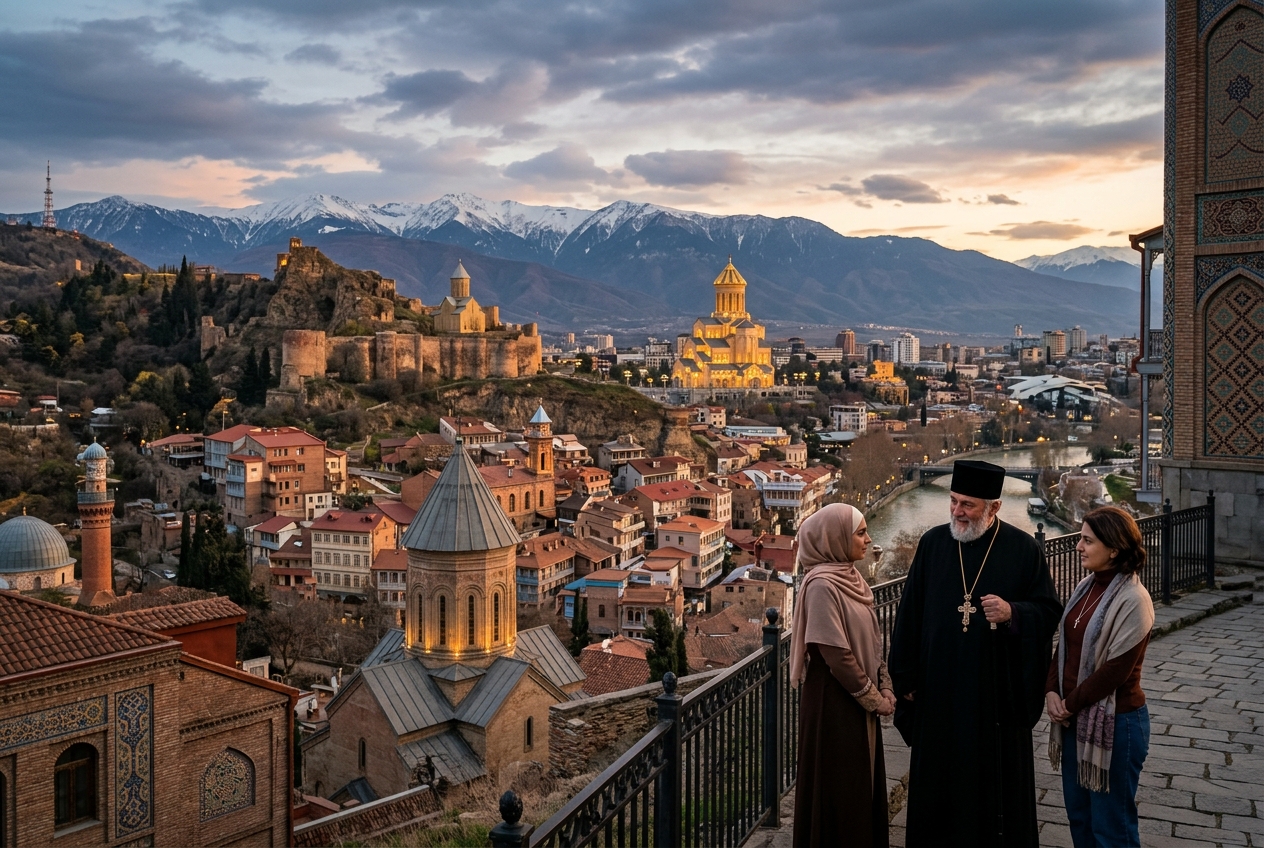
Georgia, known to its people as Sakartvelo, sits at a geographic and cultural fault line between Europe and Asia. Empires have rolled through this territory for millennia: Persian, Roman, Arab, Mongol, Ottoman, and Russian, each leaving behind traces in the gene pool, the architecture, and the prayer halls. The result is a country where a mosque can stand a few hundred meters from an Orthodox cathedral, where Azerbaijani farmers and Armenian craftsmen live in valleys just over the ridge from ethnic Georgian villages. Understanding the ethnic groups and religions in Georgia means understanding a place where identity has been forged, fractured, and reformed across thousands of years. This isn’t a simple story of one people and one faith. It’s layered, sometimes tense, and always fascinating.
Historical Context of Georgia’s Cultural Diversity
Georgia as a Crossroads of Civilizations
Geography made Georgia diverse whether it wanted to be or not. The Caucasus Mountains form a natural barrier to the north, but the lowlands to the south and east have served as corridors for armies, traders, and migrants since antiquity. The Silk Road passed through Georgian territory, bringing not just goods but people, languages, and beliefs.
The Persians controlled eastern Georgia for centuries, introducing Zoroastrian traditions and, later, Islam. Arab armies arrived in the 7th century, establishing an emirate in Tbilisi that lasted roughly 400 years. The Mongol invasions of the 13th century reshaped demographics across the South Caucasus. Ottoman Turks converted parts of southwestern Georgia (Adjara) to Islam, while the Safavid Persians exerted similar pressure in the southeast.
Each wave of conquest didn’t simply replace what came before: it added to it. Jewish communities had already been present since the Babylonian exile, making Georgia home to one of the oldest Jewish diasporas in the world. Greek traders established colonies along the Black Sea coast. This accumulation of peoples and traditions over roughly 3,000 years created the mosaic that persists today.
The Evolution of National Identity
Georgian national identity crystallized around two pillars: the Georgian language and the Orthodox Christian faith. The adoption of Christianity in 337 AD (making Georgia one of the first nations to do so) gave the culture a unifying spiritual framework. The creation of the unique Georgian alphabet, Mkhedruli, reinforced a sense of distinctness from neighboring peoples.
The medieval Georgian Golden Age under King David the Builder and Queen Tamar (11th-13th centuries) cemented Orthodoxy as inseparable from statehood. Yet even during this peak of Georgian power, the kingdom was multi-ethnic. Armenian merchants, Muslim traders, and Jewish artisans all played roles in urban life.
Russian imperial annexation in the early 19th century brought a new dynamic. Russian settlers, along with deliberate population transfers, altered the demographic balance. The Soviet period (1921-1991) simultaneously suppressed Georgian nationalism and promoted a kind of enforced multiculturalism. Ethnic minorities were given cultural institutions but little real autonomy. When independence came in 1991, the question of who “belonged” in Georgia became politically charged, contributing to the conflicts in Abkhazia and South Ossetia.
Major Ethnic Groups and Demographics
The Kartvelian Majority: Georgians and Sub-ethnic Groups
Ethnic Georgians make up roughly 86-87% of the country’s population, but this headline number masks significant internal diversity. The Kartvelian language family includes not just standard Georgian but also Mingrelian, Svan, and Laz, each spoken by distinct sub-ethnic groups with their own cultural traditions.
Mingrelians, concentrated in the western Samegrelo region, number around 500,000. Svans live in the mountainous northwest and maintain some of the oldest surviving Georgian traditions, including unique polyphonic singing styles and tower-house architecture. The Laz are mostly found across the border in Turkey, though small communities exist in Adjara. These groups generally identify as Georgian but maintain strong regional identities, something you notice immediately when traveling between Svaneti and, say, Kakheti.
Significant Minorities: Azerbaijanis and Armenians
The two largest minority groups are Azerbaijanis (roughly 6.3% of the population) and Armenians (roughly 4.5%). These aren’t recent arrivals: both communities have roots in Georgia stretching back centuries.
| Ethnic Group | Approximate % of Population | Primary Region |
|---|---|---|
| Georgians | 86.8% | Nationwide |
| Azerbaijanis | 6.3% | Kvemo Kartli |
| Armenians | 4.5% | Samtskhe-Javakheti |
| Russians | 0.7% | Tbilisi, urban centers |
| Ossetians | 0.4% | Scattered (post-conflict) |
| Kists (Chechens) | 0.3% | Pankisi Gorge |
| Greeks | 0.2% | Tsalka, Tbilisi |
Azerbaijanis are concentrated in the Kvemo Kartli region, particularly around the town of Marneuli. Most are Shia Muslims, and their villages often feel culturally closer to Azerbaijan than to Tbilisi. Armenians are centered in Samtskhe-Javakheti, especially around Akhalkalaki and Ninotsminda, where Armenian can be heard more frequently than Georgian. The Armenian Apostolic Church maintains active parishes throughout the region.
Both communities have historically faced challenges with Georgian language proficiency, which affects access to government services and higher education. This is one of the most persistent integration issues in the country.
Smaller Diasporas: Russians, Greeks, and Kists
Georgia’s Russian population has declined dramatically since independence, from several hundred thousand to roughly 26,000 today. Many left during the economic collapse of the 1990s, and the 2008 war further strained Georgian-Russian relations. Those who remain are mostly elderly or part of mixed families, concentrated in Tbilisi.
The Greek community, once numbering over 100,000, has similarly dwindled. Most emigrated to Greece in the 1990s, though a small community persists in the Tsalka district of Kvemo Kartli and in Tbilisi. Their departure left behind empty villages and abandoned churches.
The Kists are perhaps Georgia’s most intriguing small minority. Descendants of Chechen and Ingush settlers who arrived in the Pankisi Gorge in the 19th century, they number around 10,000. Predominantly Sunni Muslim, they maintain a distinct identity while generally integrating well with Georgian society. Pankisi gained international notoriety in the early 2000s due to security concerns, but the valley has since stabilized and is now a growing destination for hikers and cultural tourists.
Dominance of the Georgian Orthodox Church
Role of Orthodoxy in State and Society
The Georgian Orthodox Church isn’t just a religious institution: it’s the single most trusted institution in the country, consistently polling above the government, the military, and the media. The Patriarch, currently Ilia II (who has led the Church since 1977), holds enormous moral authority.
The Church’s influence extends well beyond Sunday services. It shapes public discourse on issues like LGBTQ+ rights, drug policy, and relations with the West. The 2002 Concordat between the state and the Church grants the Orthodox Church a privileged legal status that no other religious organization in Georgia enjoys, including tax exemptions and the right to teach religion in public schools.
That said, the religious landscape is shifting. The percentage of Georgians identifying as Christian decreased from 79% in 2014 to 67% in 2024, and experts have called this a broad-based social change rather than a temporary blip. Younger Georgians, especially in Tbilisi, are increasingly secular or nominally Orthodox without active practice.
Religious Heritage and Monastic Life
Georgia’s Orthodox heritage is physically stunning. The country has over 300 active churches and monasteries, many of them UNESCO-listed or candidates for listing. Jvari Monastery, perched above the confluence of the Mtkvari and Aragvi rivers, dates to the 6th century. The Gelati Monastery near Kutaisi was a medieval center of learning that rivaled anything in Western Europe.
Monastic life remains active. The David Gareja monastery complex, carved into the semi-desert cliffs near the Azerbaijani border, still houses monks. Alaverdi Cathedral in Kakheti hosts one of the country’s most important annual religious festivals. These sites aren’t museums: they’re living places of worship where you’ll encounter pilgrims alongside tourists, and where the smell of incense and beeswax candles is constant.
The Church also plays a significant role in winemaking. Georgian monks have produced wine using the traditional qvevri method (clay vessels buried underground) for centuries, and several monasteries continue this practice today.
Religious Pluralism and Minority Faiths
Islam in Georgia: Sunnis and Shias
Islam has been present in Georgia for over 1,300 years, and today Muslims make up roughly 10-11% of the population. The community is split between Sunni and Shia traditions along ethnic lines.
Ethnic Georgian Muslims are predominantly Sunni and concentrated in the Adjara region, particularly around Batumi and the mountainous hinterland. Their ancestors were converted during Ottoman rule, and their identity is a fascinating blend: Georgian-speaking, culturally Georgian, but Muslim. The Adjara region’s autonomous status partly reflects this distinct identity.
Shia Muslims are overwhelmingly ethnic Azerbaijanis in Kvemo Kartli. The Juma Mosque in Tbilisi, one of the few mosques in the world where Sunnis and Shias pray side by side, stands as a physical symbol of this coexistence.
Catholicism and the Armenian Apostolic Church
Roman Catholicism has a small but persistent presence in Georgia, centered in the Samtskhe-Javakheti region, where Catholic missionaries were active during the medieval period. The town of Akhaltsikhe has a Catholic church that still holds regular services for a community numbering in the low thousands.
The Armenian Apostolic Church is far more significant demographically. With roughly 150,000 ethnic Armenians in Georgia, the Church maintains several parishes, the most prominent being the Surb Gevorg (St. George) Cathedral in Tbilisi. Relations between the Armenian Apostolic and Georgian Orthodox churches have occasionally been tense, particularly over disputed church properties in Tbilisi. Several medieval Armenian churches in the capital remain in legal limbo, claimed by both sides.
Ancient Jewish Communities and Modern Secularism
Georgia’s Jewish community is one of the oldest in the world, with a continuous presence dating back roughly 2,600 years. Georgian Jews maintained a unique identity, speaking Judeo-Georgian (Kivruli) and developing their own liturgical traditions. At their peak in the mid-20th century, they numbered around 80,000.
Mass emigration to Israel in the 1970s and 1990s reduced the community to roughly 3,000-6,000 today. The Great Synagogue of Tbilisi remains active, and Georgia takes pride in its history of religious tolerance toward Jews: there are no recorded pogroms in Georgian history, a fact frequently cited in official discourse.
The secular trend is real and growing. A study from 2023-2024 found that 38% of Georgians attend religious services monthly, meaning a majority do not. Among younger urban Georgians, religious identity is increasingly cultural rather than devotional.
Geographic Distribution of Ethnic and Religious Pockets
The Multi-ethnic Urban Landscape of Tbilisi
Tbilisi has always been Georgia’s most diverse city, and walking through its old town makes this obvious. The Abanotubani district houses the Juma Mosque, the Sioni Cathedral, a synagogue, and an Armenian church within a few hundred meters of each other. This isn’t a tourist attraction: it’s how the city has functioned for centuries.
The city’s population of roughly 1.2 million includes significant Armenian, Azerbaijani, Russian, and Kurdish communities. Neighborhoods like Avlabari have historically been Armenian, while areas near the central bazaar reflect Azerbaijani commercial presence. Post-2022, a large influx of Russian emigrants has added a new layer, with Russian-language cafes and coworking spaces popping up in districts like Vera and Saburtalo.
Regional Concentrations in Kvemo Kartli and Samtskhe-Javakheti
Outside Tbilisi, ethnic diversity is highly regionalized. Kvemo Kartli, south of the capital, is home to most of Georgia’s Azerbaijani population. Towns like Marneuli and Gardabani are majority Azerbaijani, with Azerbaijani-language signage, mosques, and a cultural life oriented partly toward Baku.
Samtskhe-Javakheti, further west along the Turkish and Armenian borders, is the heartland of Georgia’s Armenian minority. Akhalkalaki and Ninotsminda are majority Armenian, and until recently, Russian (not Georgian) served as the lingua franca between Armenian and Georgian residents: a Soviet-era holdover. The region also contains pockets of Georgian Catholics and Meskhetian Turks who have partially returned after their 1944 deportation by Stalin.
These regional concentrations create what some analysts describe as “parallel societies,” where minority communities have limited daily interaction with ethnic Georgians and limited exposure to the Georgian language.
Contemporary Challenges and Cultural Integration
Language Policy and Educational Access
The Georgian language is the single biggest barrier to integration for ethnic minorities. In Kvemo Kartli and Samtskhe-Javakheti, many residents over 40 speak little or no Georgian. Government programs have expanded Georgian language education in minority schools, and a quota system allows minority students to enter Georgian universities with lower Georgian-language test scores.
Progress is real but slow. Younger generations in minority regions are increasingly bilingual, especially those who attend Georgian-language schools or move to Tbilisi for university. The government’s “1+4” program, which provides a preparatory year of Georgian language instruction before university, has been one of the more successful initiatives.
Still, practical obstacles remain. Government documents, court proceedings, and most media are in Georgian. Minority-language media exists but is limited. For someone in a rural Azerbaijani village in Kvemo Kartli, accessing state services can feel like dealing with a foreign government.
Legal Protections for Religious and Ethnic Minorities
Georgia’s constitution guarantees equality regardless of ethnicity or religion, and the country has signed most relevant international conventions. The 2014 Anti-Discrimination Law was a significant step, creating a legal framework for addressing discrimination complaints.
In practice, the picture is mixed. The Georgian Orthodox Church’s privileged constitutional status creates an uneven playing field. Minority religious groups have reported difficulties obtaining building permits for new places of worship. Jehovah’s Witnesses and some Protestant groups have documented cases of harassment, though outright violence is rare.
The Public Defender’s office regularly highlights gaps between legal protections and lived reality for minorities. Ethnic Azerbaijanis and Armenians remain underrepresented in national politics and the civil service relative to their population share. Local governance in minority regions has improved, but central government institutions in Tbilisi still feel distant to many minority communities.
Georgia’s diversity is not a problem to be solved but a reality to be managed well. The country’s history shows that coexistence is possible and even natural here: the old town of Tbilisi proves it every day. The challenges are real, from language barriers to institutional inequality, but so is the tradition of tolerance that Georgians genuinely take pride in. For anyone studying or visiting this country, grasping the ethnic and religious composition of Georgia is essential to understanding why it feels so different from its neighbors, and why a single street in Tbilisi can contain more cultural history than entire regions elsewhere. Pay attention to the details: they tell the whole story.