
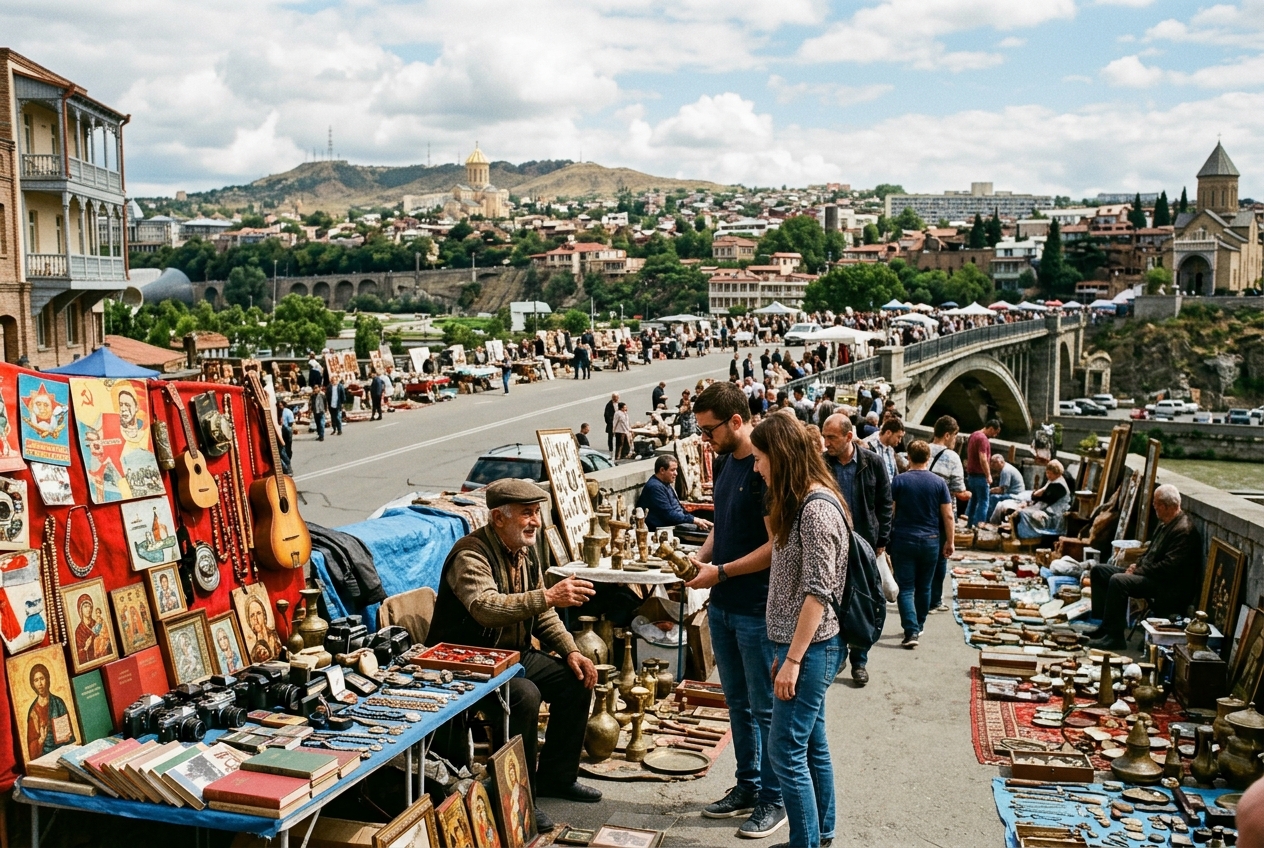
Few places in the world let you hold a piece of someone’s personal history in your hands for the price of a coffee. The Dry Bridge flea market in Tbilisi is exactly that kind of place: a sprawling, chaotic, deeply human open-air bazaar where Soviet-era medals sit next to hand-painted icons, vintage cameras lean against stacks of vinyl records, and elderly vendors tell stories about objects they once cherished in their own homes. It’s part museum, part garage sale, part living memorial to a country that survived empire, revolution, civil war, and economic collapse, and emerged with its identity fiercely intact. Whether you’re a serious collector hunting for rare finds or a casual traveler looking to absorb the spirit of old Tbilisi, this market offers something no polished souvenir shop ever could: authenticity without a price tag to match. I’ve spent entire mornings wandering its rows, picking up a dagger here, a chipped teacup there, and listening to vendors who speak a mix of Georgian, Russian, and enthusiastic hand gestures. This guide covers everything you need to know before you go.
The History and Legacy of the Dry Bridge Market
Origins During the Soviet Collapse
The market didn’t emerge from some grand plan. It was born out of desperation. After the Soviet Union dissolved in 1991, Georgia plunged into what locals still call the “dark 90s,” a period of civil war, energy crises, and economic freefall. Families who had spent decades accumulating household goods, military memorabilia, and cultural artifacts suddenly found themselves needing cash. The bridge and surrounding parkland became a gathering point where people could sell their belongings to survive.
What started as a survival mechanism gradually evolved into a permanent institution. By the mid-1990s, professional vendors began mixing with ordinary citizens, and the market took on a more structured identity. Painters set up easels along the railings. Antique dealers claimed regular spots. The generational divide you see today among vendors reflects this history: older sellers, many of them Soviet-educated and Russian-speaking, often sell items from their own pasts, while younger vendors tend to source stock from estate sales and rural villages across Georgia.
The emotional weight of the market is real. This is sometimes called “the market of memories” because so many of its objects carry personal significance. A Soviet military uniform isn’t just a costume piece; it was likely worn by someone’s grandfather. A porcelain tea set isn’t just kitchenware; it was probably a wedding gift in 1970s Tbilisi. That context makes browsing here feel different from any ordinary flea market.
The Architectural Significance of Madatovi Island
The market takes its name from the Dry Bridge itself, known locally as Mshrali Khidi. The bridge once crossed the Kura River but lost its purpose when the river’s course shifted, leaving it “dry.” It connects the Sololaki and Vera neighborhoods and sits on and around Dedaena and 9 March parks, creating a natural amphitheater for commerce and culture.
The surrounding area, sometimes referred to as Madatovi Island, has its own layered history. Named after a 19th-century Georgian nobleman, the island-like strip of land between the old and new river channels became a public park during the Russian Imperial period. Soviet planners reshaped it, and post-independence neglect left it rough around the edges. In 2021, Dedaena Park reopened after renovation and now accommodates a significant portion of the flea market, giving vendors more space and visitors a more pleasant environment.
The bridge itself is a beautiful piece of 19th-century engineering, with iron railings and stone foundations that frame the market like a stage set. Walking across it with the Caucasus foothills visible in the distance, surrounded by the clatter of commerce, feels like stepping into a living postcard of Tbilisi.
What to Find: A Treasure Trove of Curiosities
Soviet Memorabilia and Vintage Electronics
If you have any interest in 20th-century history, this section of the market will stop you in your tracks. Vendors spread military medals, propaganda posters, KGB badges, and Red Army belt buckles across blankets on the ground. You’ll find Soviet-era cameras like the Zenit and FED models, bulky transistor radios, and mechanical watches from brands like Raketa and Pobeda that still keep time.
The pricing on these items varies wildly. A common Soviet medal might cost 5-10 GEL (roughly $2-4 USD), while a rare military decoration or a functioning vintage camera could run 100-300 GEL or more. Condition matters, but so does the vendor’s assessment of your knowledge. If you know what you’re looking at, you’ll get better prices.
| Item Category | Typical Price Range (GEL) | Typical Price Range (USD) |
|---|---|---|
| Soviet medals/badges | 5 – 50 | $2 – $20 |
| Vintage cameras (Zenit, FED) | 30 – 300 | $12 – $115 |
| Mechanical watches | 20 – 200 | $8 – $75 |
| Propaganda posters | 10 – 80 | $4 – $30 |
| Vinyl records | 5 – 40 | $2 – $15 |
| Samovars | 50 – 400 | $20 – $150 |
Beyond military items, you’ll find old vinyl records spanning everything from Georgian folk music to Soviet-pressed Beatles bootlegs. Rotary telephones, typewriters with Cyrillic keyboards, and enamel pins from Soviet youth organizations round out the collection. For anyone fascinated by Cold War history or mid-century design, it’s a goldmine.
Traditional Georgian Handicrafts and Jewelry
The market isn’t all Soviet nostalgia. A significant section features traditional Georgian crafts, from cloisonné enamel jewelry (a technique Georgia has practiced for centuries) to hand-forged daggers known as kinjali. These daggers, with their ornate silver handles and leather sheaths, were historically carried by Georgian men as both tools and status symbols.
Silver jewelry is a particular highlight. Georgian silversmiths have a distinctive style, often incorporating grape motifs, crosses, and geometric patterns drawn from the country’s Christian heritage and Caucasian design traditions. You can find rings, bracelets, and pendants at prices well below what you’d pay in a shop on Rustaveli Avenue. Look for pieces stamped with the Georgian hallmark, a small crown-like symbol, which indicates genuine silver.
Handmade textiles also appear regularly: wool socks knitted in highland patterns, felt hats from the Tusheti region, and embroidered tablecloths that grandmothers once made as part of their dowry. These aren’t mass-produced souvenirs. They carry the specific aesthetic of Georgia’s mountain communities, and buying them here supports the vendors directly.
The Open-Air Art Gallery
One of the most distinctive features of the Tbilisi flea market is its art section. Dozens of painters display original works along the bridge railings and on easels set up in the park. Styles range from traditional Georgian landscapes and portraits to abstract and contemporary pieces. Some artists are formally trained graduates of the Tbilisi State Academy of Arts; others are self-taught.
Prices for original paintings start as low as 30-50 GEL for small canvases and can reach several hundred for larger, more accomplished works. I’ve seen visitors walk away with genuinely striking pieces for under $50, artwork that would cost ten times as much in a Western gallery. The trick is to take your time, talk to the artists, and trust your eye rather than any label.
You’ll also find prints, sketches, and caricatures. Several artists specialize in scenes of old Tbilisi: the wooden balconies of Abanotubani, the sulfur baths, the narrow streets of the Old Town. These make far more meaningful souvenirs than anything you’d find in a tourist shop, and buying directly from the artist means your money goes exactly where it should.
Essential Visitor Information and Logistics
Best Times to Visit and Weather Considerations
The market operates daily, generally from 10:00 AM to 5:00 PM, though the exact hours depend on weather and vendor turnout. Weekends, especially Saturdays, draw the largest crowds and the widest selection. If you want first pick of the best items, arrive by 10:00 AM. If you prefer a quieter experience with more room to browse, weekday mornings are ideal.
Tbilisi’s climate plays a major role in planning your visit. Summers (June through August) are hot, often exceeding 35°C (95°F), and the market offers limited shade. Bring water, wear a hat, and consider going early before the heat peaks. Spring (April-May) and autumn (September-October) are the sweet spots: comfortable temperatures, fewer tourists, and vendors in good spirits. Winter visits are possible but unpredictable; rain or cold can thin the market to a handful of die-hard sellers.
One practical note: the ground in the park areas can get muddy after rain. Wear shoes you don’t mind getting dirty, especially if you plan to wander off the paved paths into the less organized sections where some of the best finds hide.
Location and How to Get There
The market sits along the Dry Bridge connecting Sololaki and Vera, with overflow into Dedaena Park and 9 March Park. The closest metro station is Liberty Square (Tavisuplebis Moedani), about a 10-minute walk south along the river. From Rustaveli Avenue, head toward the Kura River and follow the signs, or simply ask anyone: locals know the market well.
Ride-hailing apps like Bolt and Yandex Go work reliably in Tbilisi and are the easiest option if you’re coming from farther away. A ride from most central hotels costs 3-7 GEL. Tell the driver “Mshrali Khidi” or “Dry Bridge” and they’ll know exactly where to drop you.
If you’re staying in the Old Town or near the sulfur baths, the walk itself is worth the trip. You’ll pass through some of Tbilisi’s most photogenic streets, with their crumbling Art Nouveau facades and vine-covered balconies. The market is well-positioned for combining with other nearby attractions like the National Gallery and the Gabriadze Puppet Theatre.
Mastering the Art of the Deal
Bargaining Etiquette and Cultural Norms
Bargaining is expected here, but the style is distinctly Georgian: warm, conversational, and never aggressive. This isn’t a Marrakech souk where theatrical haggling is part of the show. Vendors at the Dry Bridge appreciate genuine interest in their items and respond poorly to lowball offers that feel dismissive.
A good rule of thumb: offer about 60-70% of the asking price and expect to settle somewhere around 75-80%. If a vendor says 50 GEL, try 30-35 and see where the conversation goes. Smile, ask about the item’s history, and show that you value what they’re selling. Many older vendors have emotional connections to their goods, and acknowledging that goes a long way.
Buying multiple items from the same vendor almost always earns you a better price. If you’re eyeing a few things on one blanket, bundle them and ask for a package deal. Vendors appreciate the larger sale and will often throw in a small extra item as a gesture of goodwill. This is very Georgian: generosity begets generosity. The concept of stumari ghvtisaa, “a guest is a gift from God,” runs deep in this culture, and even commercial transactions carry a trace of hospitality.
Payment Methods and Currency Tips
Cash is king at the Dry Bridge. Almost no vendors accept cards, and mobile payment options are nonexistent here. Bring Georgian lari in small denominations: 5, 10, and 20 GEL notes are ideal. Vendors often struggle to break 100 or 200 GEL notes, and showing up with large bills signals that you’re unfamiliar with the market, which can work against you in negotiations.
ATMs are available within a short walk, including several along Rustaveli Avenue and near Liberty Square. Exchange offices (look for signs reading “Exchange” or “გაცვლა”) cluster around the same area and generally offer fair rates without commission. Avoid exchanging money at the airport, where rates are consistently worse.
Some vendors, particularly those selling higher-value antiques or art, may quote prices in US dollars or euros. This is common for items above 200-300 GEL. If you’re making a larger purchase, having some dollars on hand can simplify the transaction, but always confirm the exchange rate being used. The current rate hovers around 2.7 GEL per dollar, and vendors sometimes round in their favor.
One important note on exports: Georgia has restrictions on taking genuine antiques (items over 100 years old) out of the country without a permit from the Ministry of Culture. If you’re buying something that looks genuinely old, ask the vendor about documentation. Most items at the market fall well within the modern era, but it’s worth being aware of the rule, especially for icons, weapons, or very old textiles.
Capturing the Atmosphere of Old Tbilisi
The Dry Bridge market is more than a shopping destination. It’s a sensory experience that captures something essential about Tbilisi itself: the layered history, the resilience, the warmth of human connection in a city that has been conquered and rebuilt more times than most places on earth.
Stand at the center of the bridge on a Saturday morning and take it in. An elderly man in a flat cap arranges Soviet chess sets on a folding table. A young painter touches up a canvas of the Narikala Fortress. Two women debate the provenance of a silver bracelet in rapid Georgian while a street musician plays accordion nearby. The Kura River moves slowly below, and the cable car to Mtatsminda glides overhead. Tourism has become a significant contributor to Georgia’s economy, and places like this market are a major reason why visitors keep coming back.
What makes this place special isn’t any single item you can buy. It’s the cumulative effect of thousands of objects, each carrying a fragment of someone’s life, arranged in the open air of a city that refuses to forget its past while pushing hard toward its future. The Dry Bridge flea market in Tbilisi isn’t just a place to shop. It’s a place to understand Georgia, one small treasure at a time.
Bring cash, wear comfortable shoes, leave your schedule open, and let the market take you where it wants to go. You won’t regret it.