
Table of Contents
- The 8,000-Year History of Georgian Viticulture
- The Qvevri Method: Fermenting in the Earth
- Native Grape Varieties of the Georgian Micro-zones
- Ritual and Social Significance of the Supra
- Seasonal Rhythms of the Rtveli Harvest
- Preserving Homemade Traditions in the Modern Era
Few things connect you to a place like sharing a glass of wine made by someone’s grandfather, using methods his grandfather also used. In Georgia, the small Caucasus nation wedged between Europe and Asia, wine isn’t an industry or a hobby: it’s an identity. The country’s homemade wine tradition stretches back roughly 8,000 years, making it the oldest continuous winemaking culture on Earth. And unlike most ancient practices that survive only in museums, Georgian homemade wine is still produced in family cellars across the country, fermented in buried clay vessels called qvevri, poured at marathon feasts, and treated less as a beverage than as a spiritual inheritance. What makes this tradition so remarkable isn’t just its age. It’s the fact that a Georgian farmer in 2026 still uses essentially the same process as a Neolithic villager in the South Caucasus. The grapes are different, the songs around the table have evolved, but the clay, the earth, and the philosophy remain unchanged. This is a living tradition, not a museum exhibit, and understanding it means understanding Georgia itself.
The 8,000-Year History of Georgian Viticulture
Archaeological Roots and the ‘Cradle of Wine’
Georgia’s claim as the birthplace of wine isn’t romantic exaggeration: it’s backed by hard science. In 2017, a team of researchers from the University of Toronto and the Georgian National Museum analyzed residue from clay pottery shards found at two Neolithic sites south of Tbilisi, Gadachrili Gora and Shulaveris Gora. The chemical signatures, including tartaric, malic, succinic, and citric acids, confirmed that these vessels had held grape wine. Radiocarbon dating placed the pottery at approximately 6000 BCE, pushing the earliest evidence of winemaking back by several centuries.
What’s striking about these findings isn’t just the date: it’s the context. The pottery wasn’t found in a temple or a palace. It was found in domestic dwellings, suggesting that wine was already part of everyday household life eight millennia ago. Georgians call their country “Sakartvelo,” and they refer to this deep history with genuine pride, not as a marketing angle but as a fact of identity.
The term “Cradle of Wine” gets thrown around a lot, but Georgia has the strongest archaeological case for it. While Armenia, Iran, and parts of China have also yielded ancient wine evidence, none predate the Georgian findings. The country sits in a unique biogeographic zone where the wild grapevine Vitis vinifera subsp. sylvestris still grows naturally in forests, and where over 500 indigenous grape varieties have been catalogued: more than any other country on Earth.
UNESCO Recognition of Ancient Winemaking Methods
In 2013, UNESCO inscribed the traditional Georgian winemaking method in qvevri on its Representative List of the Intangible Cultural Heritage of Humanity. This wasn’t a token gesture. The recognition specifically cited the role of qvevri winemaking in Georgian community life, family traditions, and religious ceremonies. The practice of fermenting wine in large, egg-shaped clay vessels buried in the ground was acknowledged as a tradition that still shapes modern Georgia in ways that go far beyond agriculture.
That UNESCO listing had real consequences. It accelerated international interest in natural wines, brought tourism revenue to rural regions, and gave small producers a framework for protecting their methods against industrialization. Georgia’s wine output has surged in recent years: in 2025, the country produced a 30-year high of 260 million liters, a 25% increase that reflects both growing global demand and renewed domestic pride in traditional methods.
The Qvevri Method: Fermenting in the Earth
Crafting and Burying the Clay Vessels
A qvevri is not a barrel, a tank, or a crock. It’s a large, beeswax-lined clay vessel, typically holding between 800 and 3,500 liters, shaped like a pointed egg and buried up to its rim in the earth. The vessel has no handles, no spout, and no lid in the conventional sense: just a wide mouth sealed with a stone slab and clay.
Making a qvevri is a specialized craft that takes months. Artisans in the Imereti region, particularly around the village of Vardisubani, still hand-coil the clay in stages, building up the walls layer by layer and allowing each section to partially dry before adding the next. A single large qvevri can take three to four months to shape and another two weeks to fire in a wood-burning kiln at temperatures exceeding 1,000°C. The interior is then coated with beeswax to reduce porosity while still allowing micro-oxygenation through the clay walls.
Once complete, the qvevri is buried in a marani, the traditional wine cellar found in nearly every Georgian household that produces wine. The earth acts as a natural temperature regulator, keeping the vessel at a stable 14-15°C year-round: ideal for slow fermentation without refrigeration or climate control. I’ve walked into marani in Kakheti where the floor looks like a field of stone caps, each one covering a buried qvevri holding hundreds of liters of slowly aging wine. The process behind qvevri winemaking is deceptively simple in concept but demands real skill and patience.
The Role of Skin Contact in Amber Wines
The most distinctive feature of traditional Georgian wine, especially the whites, is extended skin contact. In conventional Western winemaking, white grapes are pressed quickly and the juice is separated from the skins, seeds, and stems before fermentation. Georgian winemakers do the opposite: they crush the grapes and dump everything, juice, skins, seeds, and often stems, directly into the qvevri. This mixture, called chacha (not to be confused with the distilled spirit of the same name), ferments together for five to six months.
The result is amber wine, sometimes called orange wine in Western markets. It has a deep golden-to-amber color, a tannic structure more similar to red wine than white, and complex flavors that can include dried apricot, walnut skin, honey, and tea. It’s an acquired taste for many Western drinkers raised on crisp Sauvignon Blancs, but it’s the original style of white wine, and it’s been made this way in Georgia for thousands of years.
The extended skin contact also means Georgian wines are naturally rich in polyphenols and antioxidants. There’s no added sulfur in most homemade versions, no commercial yeast, and no fining or filtering. What comes out of the qvevri in spring is raw, unmanipulated wine: the purest expression of grape and earth you’re likely to find anywhere.
Native Grape Varieties of the Georgian Micro-zones
Georgia’s geography is a winemaker’s dream and a cartographer’s headache. The country is roughly the size of West Virginia but contains dramatic variations in altitude, soil, and climate within short distances. The Greater Caucasus mountains to the north and the Lesser Caucasus to the south create sheltered valleys with unique microclimates. The result: over 500 identified indigenous grape varieties, of which about 45 are in active commercial or household use.
The eastern region of Kakheti produces roughly 70% of Georgia’s wine and is home to the most famous varieties. The western regions of Imereti, Racha-Lechkhumi, and Samegrelo favor different grapes and different styles, often lighter and more acidic. Homemade wine producers typically grow whatever varieties are native to their specific valley, and many family vineyards contain vines that are 50 to 100 years old.
Comparison of Key Indigenous Grapes (Table)
| Grape | Color | Primary Region | Flavor Profile | Common Use |
|---|---|---|---|---|
| Saperavi | Red | Kakheti | Dark cherry, plum, spice, high tannin | Dry reds, semi-sweet wines |
| Rkatsiteli | White | Kakheti | Apple, quince, herbal, medium acidity | Amber wines, dry whites |
| Mtsvane | White | Kakheti | Floral, citrus, peach | Often blended with Rkatsiteli |
| Tsolikouri | White | Imereti | Pear, melon, mineral | Lighter amber wines |
| Aleksandrouli | Red | Racha-Lechkhumi | Raspberry, pomegranate | Khvanchkara (semi-sweet) |
| Ojaleshi | Red | Samegrelo | Blackberry, violet, pepper | Rare semi-sweet reds |
Saperavi is the undisputed king of Georgian reds: a teinturier grape (meaning both skin and flesh are pigmented) that produces wines so deeply colored they’re nearly opaque. Rkatsiteli is the workhorse white, used in everything from bone-dry table wines to the classic amber style. But it’s the rarer varieties, Ojaleshi, Chkhaveri, Krakhuna, that get wine enthusiasts genuinely excited, because they produce flavors you simply can’t find anywhere else on the planet.
Ritual and Social Significance of the Supra
The Tamada: The Art of the Toastmaster
If you’ve never attended a Georgian supra, you haven’t really experienced the country. The supra is a traditional feast: a highly structured, multi-hour (sometimes multi-day) event built around food, wine, and an elaborate sequence of toasts. Every supra has a tamada, a toastmaster elected by the group, whose job is to guide the evening through a prescribed series of toasts that move from God and country to family, ancestors, the deceased, friendship, love, and hope for the future.
The tamada isn’t just making small talk. Each toast follows a specific order, and the tamada is expected to speak eloquently, often poetically, on each theme. Guests respond by drinking from a kantsi (a traditional drinking horn) or a clay cup, and they’re expected to finish the wine with each toast. The pace is relentless, which is why Georgian homemade wine tends to be lower in alcohol (10-12%) than most commercial wines: you need to survive 20 or more toasts in a single evening.
Being chosen as tamada is an honor that reflects your standing in the community. A good tamada reads the room, adjusts the emotional register of the toasts, and keeps the energy alive without letting things descend into chaos. It’s part performance, part pastoral care, and part stand-up comedy.
Wine as a Symbol of Hospitality and Identity
Georgians have a saying: “stumari ghvtisaa,” meaning “a guest is a gift from God.” This isn’t a platitude. Hospitality in Georgia operates on a level that most Western travelers find overwhelming. A stranger who knocks on a door in rural Kakheti or Imereti will likely be invited inside, seated at a table, and served homemade wine and food within minutes. Refusing is considered an insult.
Wine is the medium through which this hospitality is expressed. To understand Georgian wine, you have to understand its culture: the two are inseparable. A family’s wine is a reflection of their character, their land, and their skill. Offering it to a guest is an act of trust and generosity. Criticizing it would be like criticizing their children.
This cultural weight explains why wine production remains so deeply personal in Georgia. Even families who could buy perfectly good commercial wine continue to make their own. The marani is as essential to a Georgian household as a kitchen. The wine inside it isn’t a commodity: it’s proof that the family is connected to the land, to the seasons, and to their ancestors who did the same thing in the same place.
Seasonal Rhythms of the Rtveli Harvest
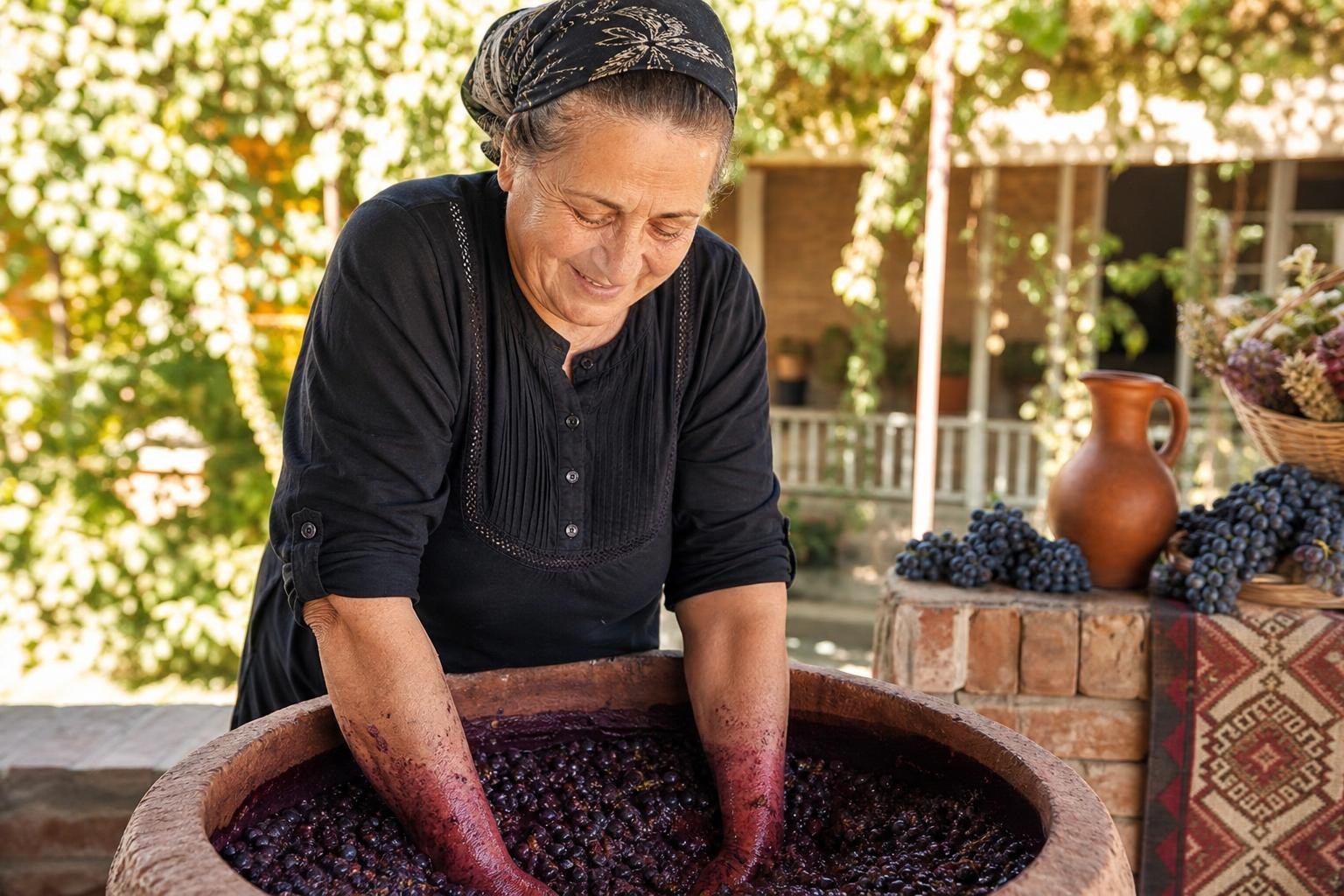
The rtveli, Georgia’s annual grape harvest, typically runs from mid-September through late October, depending on the region and grape variety. In Kakheti, where most of the country’s wine grapes grow, the harvest usually peaks in the first two weeks of October. The harvest season is a community event: families, neighbors, and even tourists pitch in to pick grapes by hand, haul them to the marani, and begin the crush.
The timing of rtveli is dictated by sugar levels in the grapes, measured by refractometer or, more traditionally, by taste. Experienced winemakers can tell by biting into a grape whether it’s ready. Once picked, the grapes are crushed, traditionally by foot in a satsnakheli (a wooden trough carved from a single log), and transferred directly into the qvevri with their skins and stems.
Rtveli is also a time of intense social activity. Families who haven’t seen each other since the previous harvest reconnect. Children are given their first tasks in the vineyard. Food is prepared in enormous quantities: churchkhela (walnut-and-grape-must candy), mtsvadi (grilled meat), and fresh bread from a tone oven. Schools in rural areas still informally adjust their schedules around the harvest, and many urban Georgians take time off work to return to their family villages.
The weeks after rtveli are quieter but equally important. The qvevri are sealed, and the wine begins its slow fermentation underground. By December, the initial fermentation is complete, and the wine settles through the winter. In spring, usually around March, the qvevri are opened, the wine is tasted, and the best batches are separated for aging or immediate consumption.
Preserving Homemade Traditions in the Modern Era
Georgia’s wine boom has created tension between tradition and scale. The 260-million-liter production high of 2025 was driven largely by commercial wineries, and some small producers worry that industrialization threatens the authenticity of Georgian wine. New vineyard regulations have drawn accusations of Soviet-style thinking from family winemakers who see bureaucratic oversight as incompatible with centuries-old household practices.
Yet the homemade tradition shows no signs of disappearing. An estimated 80% of Georgian households in rural areas still produce wine for personal consumption, and many urban families maintain small vineyards or buy grapes in bulk during rtveli to make wine in their apartment basements. The practice is so embedded in daily life that it would take a cultural catastrophe, not just market forces, to dislodge it.
International interest has also helped. The global natural wine movement has turned Georgian amber wines into a sought-after category, and wine tourists increasingly seek out family cellars rather than commercial tasting rooms. Georgia welcomed over 7 million international visitors in 2024, and wine tourism was among the fastest-growing segments. Small producers who once made wine only for their families now find themselves hosting curious visitors from Tokyo, Brooklyn, and Copenhagen.
The challenge going forward is balance: growing the commercial sector without flattening the diversity and individuality that make Georgian wine special. The best Georgian homemade wines aren’t trying to compete with Burgundy or Napa. They’re doing something entirely different, something that predates those regions by thousands of years. As long as families keep burying qvevri in their yards, crushing grapes by foot, and raising a kantsi to toast their ancestors, the tradition will endure. If you ever get the chance to sit at a Georgian table, accept the invitation. You won’t just taste wine: you’ll taste 8,000 years of unbroken human culture, one toast at a time.