
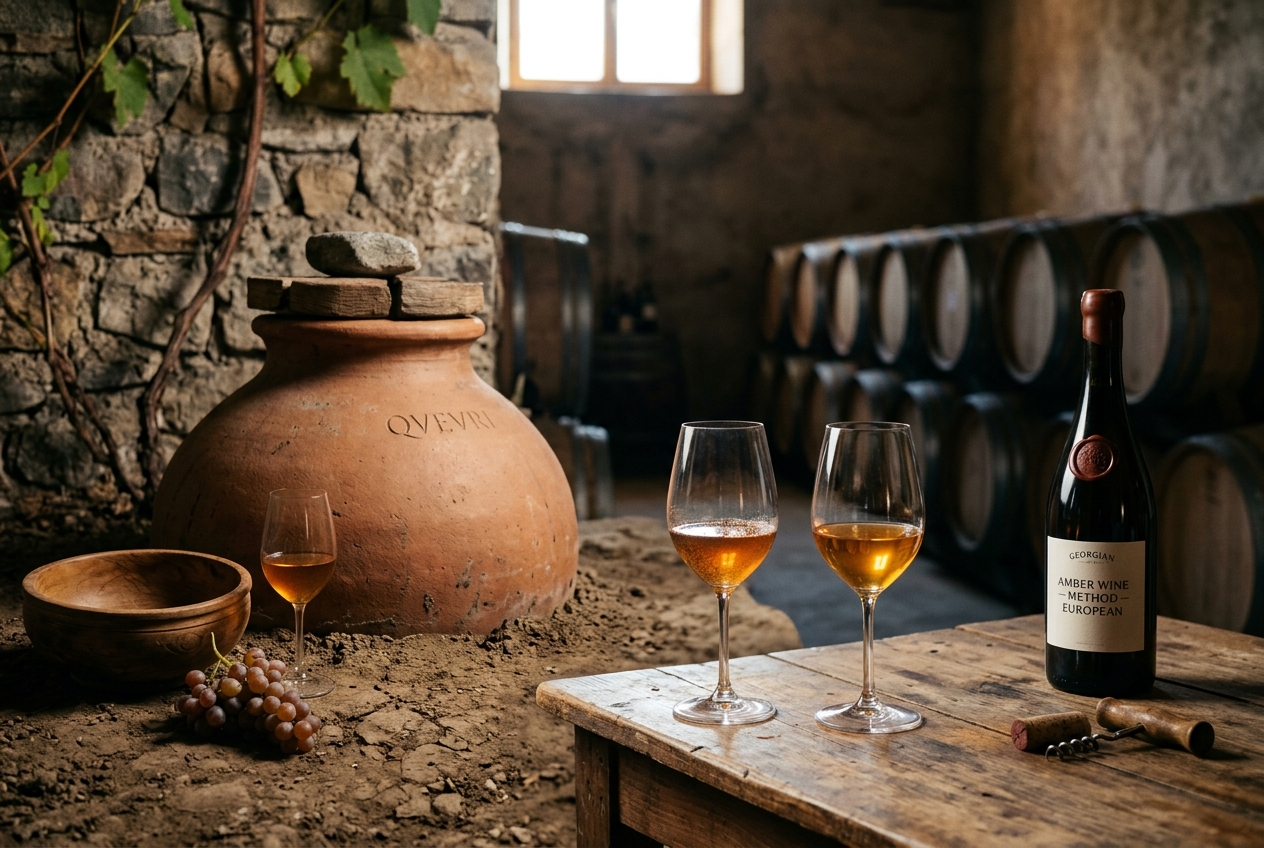
Georgia holds a singular position in the global wine story: it is, by most archaeological accounts, the place where humans first figured out how to turn grapes into something worth sharing. That 8,000-year history blending ancient Qvevri winemaking with modern European methods creates a tension you can taste in every bottle. Understanding how Georgian wine classification works, and how the Qvevri method differs from the European approach, is essential for anyone who wants to buy, drink, or talk about these wines with any real knowledge. The country produces wines that range from deeply traditional amber styles to polished, oak-aged reds that could sit comfortably on a Bordeaux shelf. What makes Georgia fascinating is that both traditions coexist, sometimes within the same winery, and the classification system tries to account for each. This isn’t just academic: the method listed on the label fundamentally changes what ends up in your glass.
Origins and Evolution of Georgian Winemaking Traditions
Georgia’s winemaking identity is inseparable from its geography and its stubbornness. Tucked between the Greater Caucasus Mountains and the Black Sea, this small country has maintained a continuous winemaking culture through invasions, Soviet collectivization, and post-independence economic chaos. The two dominant approaches to winemaking here didn’t develop in competition: one is ancient and indigenous, the other arrived as a deliberate modernization effort. Understanding both requires looking at where each came from.
The 8,000-Year History of the Qvevri Vessel
The qvevri (pronounced roughly “kwev-ree”) is a large, egg-shaped clay vessel used for fermenting, aging, and storing wine. Archaeological digs in the Kakheti and Kartli regions have unearthed qvevri fragments and grape residue dating back approximately 6,000 BCE, making Georgia the oldest known site of intentional winemaking. These vessels weren’t decorative or ceremonial: they were practical technology, refined over millennia.
A traditional qvevri can hold anywhere from 200 to 3,000 liters. Craftsmen coat the interior with beeswax to reduce porosity while still allowing micro-oxygenation through the clay walls. The vessels are buried underground up to their necks, which provides natural temperature stability during fermentation and aging. In 2013, qvevri winemaking was inscribed on UNESCO’s List of the Intangible Cultural Heritage of Humanity, recognizing it not just as a technique but as a living cultural practice tied to Georgian identity.
The word “sakartvelo” (Georgia’s name for itself) and the word “ghvino” (wine) are woven into the same cultural fabric. A Georgian supra, the traditional feast led by a tamada (toastmaster), is unthinkable without wine, and for many families, that wine still comes from qvevri buried in the backyard.
The 19th-Century Shift Toward European Styles
The European method arrived in Georgia primarily through Russian imperial influence in the 19th century. Prince Alexander Chavchavadze, a Georgian nobleman educated in St. Petersburg, is widely credited with establishing the first European-style winery at his Tsinandali estate in the 1830s. He imported French oak barrels, planted European grape varieties alongside indigenous ones, and introduced temperature-controlled fermentation techniques.
Soviet-era centralization accelerated this shift dramatically. Moscow wanted volume and consistency, not artisanal clay-pot wines. State-run factories adopted stainless steel tanks, industrial yeasts, and standardized processes. Qvevri production was marginalized, surviving mainly in rural households and a handful of stubborn traditionalists.
After independence in 1991, and especially following Georgia’s Rose Revolution in 2003, a younger generation of winemakers began reclaiming both traditions. Some returned to qvevri with renewed pride; others refined European techniques with better equipment and training. Today, both methods are formally recognized in Georgian wine law, and the export numbers reflect growing international appetite: in the first quarter of 2026 alone, Georgia exported 17.3 million liters of wine to 51 countries, generating $53.2 million in revenue.
The Qvevri Method: Ancient Clay Fermentation
The qvevri method is not simply “old-fashioned winemaking.” It is a specific, codified process with defined practices that produce wines unlike anything made in steel or oak. The Georgian government officially recognizes this as the “traditional method” on wine labels, and it carries strict production requirements.
Skin Contact and the Role of the ‘Deda’
The defining feature of qvevri winemaking is full skin contact. For white wines, this means the crushed grapes, including skins, seeds, and sometimes stems (collectively called “chacha”), ferment together inside the qvevri for anywhere from two weeks to six months. This extended maceration is what produces Georgia’s famous amber wines, sometimes called orange wines in Western markets.
The “deda” (meaning “mother” in Georgian) refers to the primary qvevri used for fermentation with skins. After maceration, the wine is typically racked off into a second, clean qvevri for further aging. The deda retains the spent grape material, which is later distilled into chacha, Georgia’s potent grape brandy.
This process creates wines with deep color, substantial tannin (even in whites), and complex flavors that include dried apricot, walnut skin, tea, and honey. It is the opposite of the reductive, fruit-forward style most Western drinkers associate with white wine.
Natural Temperature Control and Underground Aging
Burying the qvevri underground isn’t just tradition for tradition’s sake. At a depth of one to two meters, ground temperature in Kakheti stays relatively constant between 14 and 16 degrees Celsius year-round. This provides a natural cool environment that slows fermentation and aging without any electricity or mechanical cooling.
The egg shape of the qvevri also serves a functional purpose. During fermentation, convection currents circulate the wine naturally: warmer liquid rises along the walls while cooler liquid sinks through the center. Grape solids settle into the narrow bottom point, effectively self-clarifying the wine over time. No fining agents or filtration are typically needed.
Wines aged in qvevri for six months to a year develop a distinctive oxidative character that some compare to aged sherry or vin jaune, though the flavor profile is distinctly Georgian. The micro-oxygenation through the beeswax-lined clay walls contributes to this complexity.
The European Method: Modern Precision and Oak
The European method in Georgia, officially labeled as the “classical” or “European” method, follows the general principles familiar to anyone who has visited wineries in France, Italy, or California. But Georgian winemakers bring their own twist: indigenous grape varieties like Saperavi, Rkatsiteli, and Kisi respond differently to these techniques than Cabernet Sauvignon or Chardonnay would.
Stainless Steel Tanks and Controlled Fermentation
Stainless steel fermentation gives winemakers precise control over temperature, oxygen exposure, and timing. White grapes are typically pressed immediately, with only the juice (no skins) going into the tank. Fermentation temperatures are kept low, usually between 12 and 18 degrees Celsius, to preserve fresh fruit aromas and acidity.
For reds, skin contact still occurs but is carefully managed, usually lasting one to three weeks rather than the months-long maceration in qvevri. Commercial yeast strains are commonly used to ensure predictable fermentation, though a growing number of Georgian producers are experimenting with native yeasts even within the European method framework.
The result is wines that are cleaner, brighter, and more immediately approachable. A Rkatsiteli made in stainless steel tastes like a crisp, citrusy white wine with green apple notes: a completely different animal from its amber qvevri counterpart.
The Influence of French Oak Barrels on Georgian Grapes
Oak aging, particularly in French barriques, has become standard for premium Georgian reds. Saperavi, Georgia’s most important red grape, takes to oak remarkably well. Its naturally deep color, high tannin, and dark fruit character gain structure and complexity from 12 to 18 months in barrel.
Some producers use new oak for pronounced vanilla and spice notes; others prefer used barrels for subtler integration. A well-made, oak-aged Saperavi from Kakheti can rival mid-range Barossa Shiraz or Rhône Syrah in density and aging potential, often at a fraction of the price.
The domestic market reflects this split in styles. In 2024, domestic wine sales amounted to around 7.3 million bottles, with 98-99% falling into the price category below 30 GEL (roughly $11 USD). Most of these affordable bottles use the European method, which scales more easily than qvevri production.
Comparing Sensory Profiles and Wine Styles
The gap between qvevri and European-method Georgian wines is not subtle. It’s roughly equivalent to the difference between a natural, unfiltered cider and a commercial Granny Smith apple juice: same raw material, entirely different experience.
Amber Wines vs. Modern White Wines
| Characteristic | Qvevri Amber Wine | European-Method White |
|---|---|---|
| Color | Deep gold to amber-orange | Pale straw to light gold |
| Tannin | Noticeable, sometimes grippy | Minimal to none |
| Aroma | Dried fruit, walnut, honey, tea | Citrus, green apple, floral |
| Body | Medium to full | Light to medium |
| Food pairing | Grilled meats, aged cheese, nuts | Seafood, salads, light pasta |
| Aging potential | 5-15+ years | 1-5 years |
Amber wines can be polarizing. If you hand someone a glass of qvevri Rkatsiteli without context, they’ll often assume it’s a light red or a rosé. The tannin structure and oxidative notes challenge expectations of what “white wine” means. But paired with Georgian cuisine, especially walnut-based dishes like pkhali or grilled meats from a tone oven, they make perfect sense.
Tannic Structure and Oxidative Characteristics
Qvevri wines develop what sommeliers call an “oxidative” character, meaning controlled exposure to oxygen during aging creates nutty, dried-fruit, and sometimes savory flavors. This is different from a wine that has gone bad from too much oxygen: it’s intentional and adds complexity.
European-method Georgian wines, by contrast, tend toward a “reductive” style that preserves primary fruit flavors and freshness. A European-method Saperavi will taste of dark cherry, plum, and blackberry with firm tannins. A qvevri Saperavi from the same vineyard might show more earthy, dried-plum, and leather notes with softer but more persistent tannins.
Neither style is objectively better. They represent fundamentally different philosophies about what wine should be: a polished expression of fruit and terroir, or a raw, time-shaped collaboration between grape, clay, and earth.
Official Classification and Regional Designations
Georgia’s wine classification system has matured significantly since the early 2000s, driven partly by EU trade agreements and partly by the need to protect the country’s growing reputation in export markets.
Appellations of Origin (PDOs) in Georgia
Georgia currently recognizes 25 Protected Designations of Origin (PDOs), also called appellations. The most famous include Tsinandali, Mukuzani, Kindzmarauli, and Khvanchkara. Each PDO specifies permitted grape varieties, geographic boundaries, and sometimes winemaking methods.
Mukuzani, for example, must be made from 100% Saperavi grown in the Mukuzani micro-zone of Kakheti and aged for at least 12 months in oak. Tsinandali requires a blend of Rkatsiteli and Mtsvane from specific villages, aged in oak for at least two years. These rules mirror the European appellation model and give consumers reliable expectations about what’s in the bottle.
The export growth validates this system’s effectiveness. Germany, for instance, saw a 32% increase in Georgian wine imports in Q1 2026, suggesting that European consumers are gaining confidence in Georgian classification standards.
Labeling Requirements for Traditional vs. Classical Methods
Georgian wine law requires producers to declare their winemaking method on the label. Wines made in qvevri are labeled “traditional method” or carry the specific term “qvevri wine.” Wines made using stainless steel and oak are labeled “classical” or “European” method.
This distinction matters enormously for consumers. A bottle of Rkatsiteli labeled “traditional method” will be an amber wine with tannins and oxidative complexity. The same grape labeled “classical method” will be a conventional white wine. Buying one expecting the other leads to confusion and disappointment.
Some producers also use the term “natural wine” on their labels, though this is not a legally defined category in Georgia. It typically implies qvevri fermentation, native yeasts, no added sulfites, and no fining or filtration, but there’s no official enforcement body checking those claims. The qvevri designation, by contrast, carries legal weight.
Georgian wine exports grew by 5% in volume and 7% in value in Q1 2026 compared to the same period the previous year, a trend that reflects increasing international recognition of both traditional and classical Georgian wines.
Choosing Between Traditional and Contemporary Georgian Vintages
The choice between qvevri and European-method Georgian wine comes down to what you’re looking for in a glass. If you want something familiar but with distinctive character, start with a classical-method Saperavi from Kakheti or a Tsinandali blend. These wines translate easily for palates trained on French or Italian styles.
If you’re ready for something genuinely different, seek out a qvevri amber wine from a reputable producer like Pheasant’s Tears, Iago’s Wine, or Zurab Topuridze. Expect tannin, expect color, and expect flavors you may not have encountered before. Pair it with food: these wines rarely shine as cocktail-hour sippers but come alive at the table.
The best approach is to try both from the same grape variety. A side-by-side tasting of Rkatsiteli made in qvevri versus stainless steel is one of the most instructive wine experiences available anywhere. It reveals how profoundly method shapes outcome, even when the grape and the soil remain the same. Georgia’s dual winemaking identity isn’t a contradiction: it’s the country’s greatest strength, and the classification system ensures you always know which tradition you’re about to taste.