
Table of Contents
- Planning Your Self-Drive Trip to David Gareja Monastery
- The Route from Tbilisi via Sagarejo and Udabno
- Exploring the Lavra and Udabno Cave Monasteries
- Navigating the Azerbaijan Border Situation
- Essential Safety: Heat, Snakes, and Water Supplies
- Where to Eat: The Oasis Club in Udabno Village
- A Practical Checklist for Independent Drivers
- David Gareja Travel FAQ
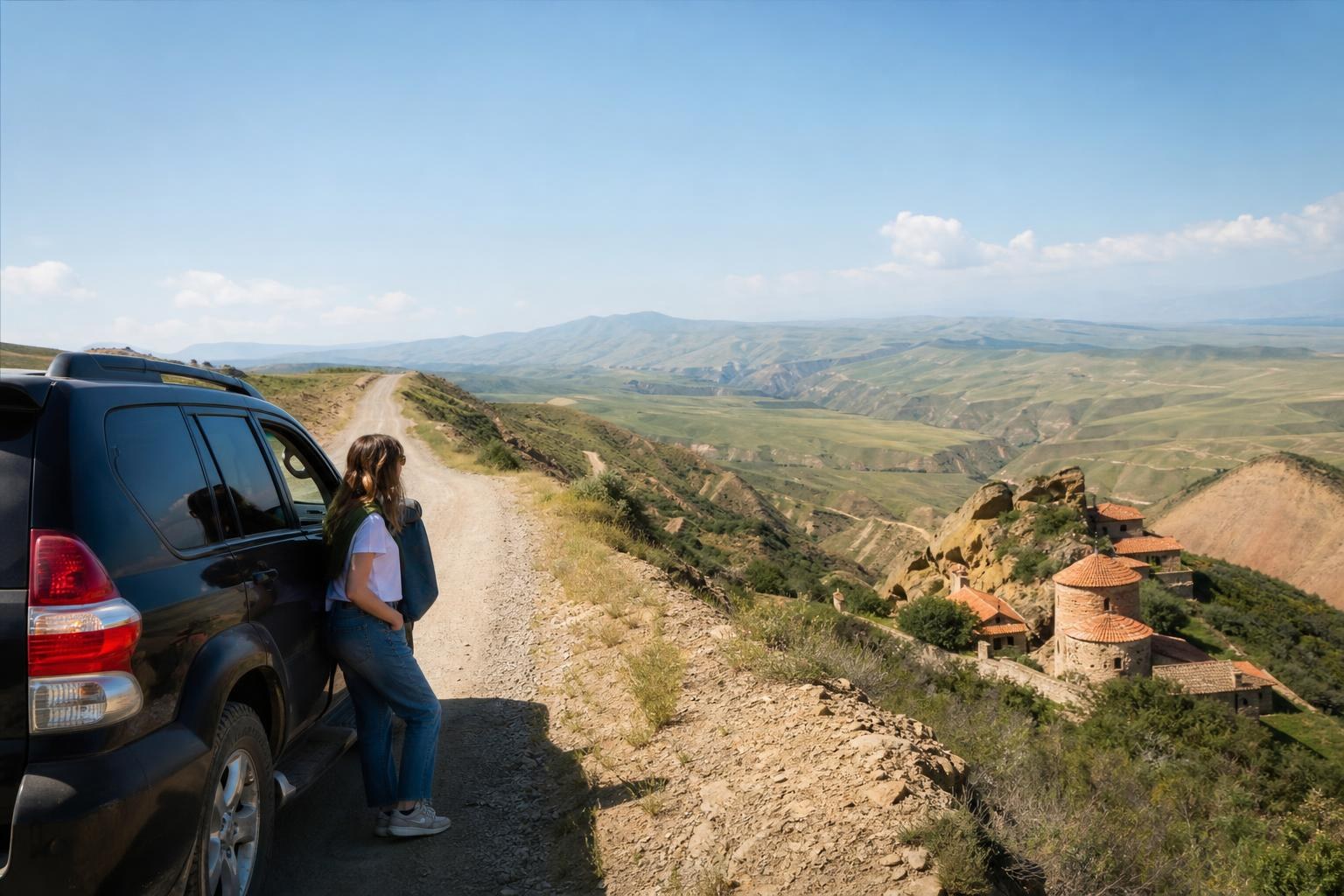
The monastery complex at David Gareja sits about 60 km southeast of Tbilisi, right on the edge of the Azerbaijani border, and it’s one of the most striking historical sites in Georgia. Getting there by car is straightforward if you know what to expect: the main route through Sagarejo and Udabno is now almost entirely paved, the drive takes roughly two hours each way, and the site itself rewards you with sixth-century cave churches, medieval frescoes, and a semi-desert landscape unlike anything else in the country. But there are real things to plan around: border sensitivity, extreme summer heat, no services for the last stretch, and a few road quirks that catch people off guard. This guide covers all of it from a driver’s perspective.
If you’re renting a car in Tbilisi or already have one through a carsharing app, this is one of the best day trips you can do. I’ve driven this route in different seasons and different vehicles, and the practical details matter more than most blogs let on. Here’s what you actually need to know before turning the key.
Planning Your Self-Drive Trip to David Gareja Monastery
The monastery complex is a day trip from Tbilisi, but not a casual one. You’ll want to leave early, ideally by 8 a.m. in summer, to avoid the worst midday heat at the site. The round trip takes five to seven hours including driving, hiking the ridge to the Udabno caves, and spending time at the lower Lavra monastery.
There’s no entrance fee to the complex itself, but a few things have changed for 2026. All foreign tourists entering Georgia now need valid health and accident insurance with minimum coverage of 30,000 GEL. Make sure your policy is sorted before you arrive in the country, not just before you drive to the monastery.
Plan to bring everything you’ll need with you. There’s no shop, no cafe, and no reliable water source at the monastery. The last place to stock up is Udabno village, about 20 minutes before the site. Pack at least two liters of water per person, sunscreen, a hat, and snacks.
Tip: The monastery is active. Both men and women must cover their knees and shoulders before entering the Lavra complex. Carry a light scarf or long-sleeved shirt even in July.
The Route from Tbilisi via Sagarejo and Udabno
The standard route runs east from Tbilisi on the main highway toward Sagarejo, then south through Udabno village to the monastery. Total distance is roughly 100 km depending on your starting point in the city.
There’s an alternative route via Rustavi that some older guides mention. Skip it. That road remains unpaved and requires a proper 4WD vehicle. The Sagarejo route is the one you want.
From Tbilisi, you’ll take the E60 highway east. The turnoff toward Sagarejo is well-signed. After Sagarejo town, the road narrows to a two-lane road heading south through increasingly dry, open steppe. The landscape shifts dramatically: green farmland gives way to brown, rolling semi-desert within about 30 minutes.
Road Conditions and Vehicle Requirements
The road from Tbilisi to Udabno village is paved and in reasonable condition as of 2026. Standard sedans handle it fine. After Udabno village, the final stretch to the monastery parking area (roughly 12-15 km) is where things get rougher. This section has been improved in recent years, but expect patches of gravel, potholes, and uneven surfaces.
A regular car with decent ground clearance can make it in dry conditions. If it has rained recently, a higher-clearance vehicle or a small SUV is a better bet. True 4WD isn’t necessary on the Sagarejo route, but low-profile city cars will scrape on the worst sections.
Important: There is no fuel station between Sagarejo and the monastery. Fill up before leaving Sagarejo, or better yet, leave Tbilisi with a full tank.
Drive Times and Distance Table
| Segment | Distance (approx.) | Drive Time | Road Surface |
|---|---|---|---|
| Tbilisi to Sagarejo | 50 km | 45-55 min | Paved highway |
| Sagarejo to Udabno village | 35 km | 30-40 min | Paved, two-lane |
| Udabno village to monastery parking | 12-15 km | 15-25 min | Partly gravel, uneven |
| Total one way | ~100 km | 1.5-2 hours | Mixed |
These times assume normal traffic leaving Tbilisi. On weekday mornings, the highway section moves quickly. Friday afternoons and holiday weekends add 20-30 minutes to the first segment.
Exploring the Lavra and Udabno Cave Monasteries
The complex has two main parts, and most visitors see both. The Lavra is the lower monastery, built into the cliff face at the base of the ridge. This is the part you reach first from the parking area, and it’s still an active monastery with resident monks.
The Lavra includes a small church, monastic cells carved into the rock, and the tomb of Saint David, the sixth-century Assyrian monk who founded the community. The atmosphere here is quiet and contemplative. Spend 20-30 minutes exploring the courtyards and cave rooms before heading up the ridge.
The second part, the Udabno cave monastery, sits on the opposite side of the ridge and requires a hike to reach. This is where the real visual payoff is: hundreds of cave cells and chapels spread across the cliff face, many containing medieval frescoes that date from the 10th to 13th centuries.
The Ridge Hike and David Gareja Frescoes
From the Lavra, a marked trail climbs steeply up the ridge. The hike takes about 20-25 minutes going up, and the path is rocky and exposed with no shade. In summer, this is the section where heat becomes a real factor.
Once you crest the ridge, the views open up dramatically: the brown, treeless steppe of Azerbaijan stretches to the horizon on one side, while the Georgian side drops away behind you. The Udabno caves are scattered along the cliff face below the ridgeline on the Azerbaijani side.
The frescoes inside these caves are the highlight of the entire trip. You’ll find scenes of the Last Supper, portraits of saints, and geometric patterns painted directly onto the rock. Some are remarkably well-preserved given their age and exposure. Others have suffered from vandalism and weathering over the centuries. The Udabno monastery sits on an undelimited section of the Georgia-Azerbaijan border, which has complicated conservation efforts for decades.
Allow at least 45 minutes to explore the Udabno caves properly. The trail loops along the cliff and eventually brings you back to the ridge path.
Navigating the Azerbaijan Border Situation
This is the part that confuses people, so here’s the plain version: the monastery complex straddles an unresolved section of the Georgia-Azerbaijan border. There are no fences or walls in most places, but there are marked border posts, and you must not cross them. Entry into Azerbaijan from this location is not permitted, and Georgian border guards or Azerbaijani patrols may be present.
The border situation has been sensitive for years. In January 2025, Azerbaijan and Armenia reached an agreement to begin delimitation from the tri-junction point where their borders meet Georgia, which could eventually affect the status of this area. As of early 2026, though, nothing has changed on the ground at the monastery itself.
In practical terms, this means: stay on marked trails, don’t wander past any signage or posts, and don’t attempt to cross the ridge into Azerbaijani territory. The Georgian side of the complex, including the Lavra and the accessible Udabno caves, is fully open to visitors. Some caves on the far end of the Udabno trail may be off-limits depending on the current situation, and it’s worth asking at the Lavra if anything has changed recently.
Note: The border situation can shift without much notice. Check with your accommodation in Tbilisi or with local sources before driving out, especially if tensions have been in the news.
Essential Safety: Heat, Snakes, and Water Supplies
The semi-desert environment around the monastery complex is genuinely harsh, particularly from June through September. Midday temperatures regularly exceed 35°C, and there is zero shade on the ridge hike or around the Udabno caves.
Three things to take seriously:
- Water: Bring a minimum of two liters per person. Three is better if you plan to hike the full ridge trail. There is no tap water or spring at the site.
- Heat exposure: Wear a hat, apply sunscreen before you start, and consider skipping the ridge hike entirely if you arrive after noon in July or August. Heatstroke is a real risk, not a theoretical one.
- Snakes: The dry steppe around the monastery is home to several snake species, including venomous vipers. Stick to marked paths, watch where you step (especially near rock walls and cave entrances), and wear closed-toe shoes. Sandals are a bad idea here.
Carry a basic first-aid kit in your car. The nearest medical facility is back in Sagarejo, which is at least 45 minutes away. Mobile phone coverage at the site is spotty: some Georgian carriers get a weak signal, but don’t count on it for emergencies.
Where to Eat: The Oasis Club in Udabno Village
Udabno village, about 15-20 minutes before the monastery, is a tiny settlement in the steppe with one standout option for food: the Oasis Club. It’s a guesthouse and restaurant run by a family that’s been hosting travelers for years, and it’s the only reliable place to eat between Sagarejo and the monastery.
The menu is simple Georgian fare: fresh salads, khachapuri, grilled meats, and homemade lemonade. Portions are generous, and the prices are lower than Tbilisi. It’s a good idea to stop here on your way back from the monastery rather than before, since you’ll want to reach the site early.
The Oasis Club also rents rooms if you want to break the trip into two days, which is worth considering if you’re combining the monastery visit with exploring the wider Kakheti region. Call ahead to confirm they’re open, especially outside peak summer months. Udabno is a small place, and operating hours can be unpredictable.
A Practical Checklist for Independent Drivers
Before you leave Tbilisi, run through this list:
- Full tank of fuel (no stations after Sagarejo)
- At least 2-3 liters of water per person
- Sunscreen, hat, and sunglasses
- Modest clothing for the monastery: knees and shoulders covered
- Closed-toe shoes with grip for the ridge hike
- Snacks and a packed lunch if you don’t plan to stop in Udabno
- Offline maps downloaded: Google Maps works, but load the route before you lose signal
- Basic first-aid kit in the car
- Valid travel insurance meeting Georgia’s 2026 requirement of 30,000 GEL minimum coverage
- Cash in GEL: there are no ATMs near the site
If you’re using Triproadwayplanner’s route guides for other Georgian road trips, the David Gareja route pairs well with a loop through Kakheti wine country on the return, adding Sighnaghi or Bodbe Monastery to make a full day of it.
David Gareja Travel FAQ
Can I visit the Gareja monastery complex without a car?
Yes, but it’s inconvenient. Marshrutkas don’t run to the site. Your options are a guided day tour from Tbilisi (several operators offer them), a private taxi (negotiate a round-trip fare including wait time), or hitching a ride from Udabno. A rental car gives you the most flexibility and lets you control your schedule, which matters given the heat.
Is the road to the monastery passable in a regular sedan?
In dry weather, yes. The Sagarejo-Udabno route is paved except for the last 12-15 km, which is rough but manageable in a standard car with reasonable ground clearance. After heavy rain, a higher-clearance vehicle is safer for the final stretch. The alternative Rustavi route requires 4WD and isn’t recommended.
When is the best time of year to visit?
Spring (April-May) and autumn (September-October) are ideal. Temperatures are comfortable, the steppe may have some green, and the ridge hike is pleasant. Summer visits work but require an early start to beat the heat. Winter is possible but cold and windy, and daylight hours are shorter.
Is it safe to hike to the Udabno caves given the border situation?
The marked trail to the Udabno caves on the Georgian side is open and safe for visitors. Stay on the trail, respect any posted signage, and do not attempt to cross into Azerbaijan. The situation has been stable for visitors in recent years, but check locally before your trip if you’ve seen recent news about the border.
Do I need to pay an entrance fee?
No. There is no entrance fee to visit the Lavra or the Udabno caves as of 2026. The monastery is an active religious site, so respectful behavior and appropriate dress are expected rather than a ticket.
The drive to the Gareja monastery complex is one of the most rewarding half-day trips you can make from Tbilisi, and doing it independently by car gives you the freedom to set your own pace. The route is straightforward, the road is mostly paved, and the site itself delivers something you genuinely can’t see anywhere else in Georgia: a sixth-century monastic community carved into desert cliffs, with medieval paintings still clinging to cave walls.
Start early, bring more water than you think you need, respect the border markers, and give yourself enough time for the ridge hike. It’s a place that earns every minute of the drive.