
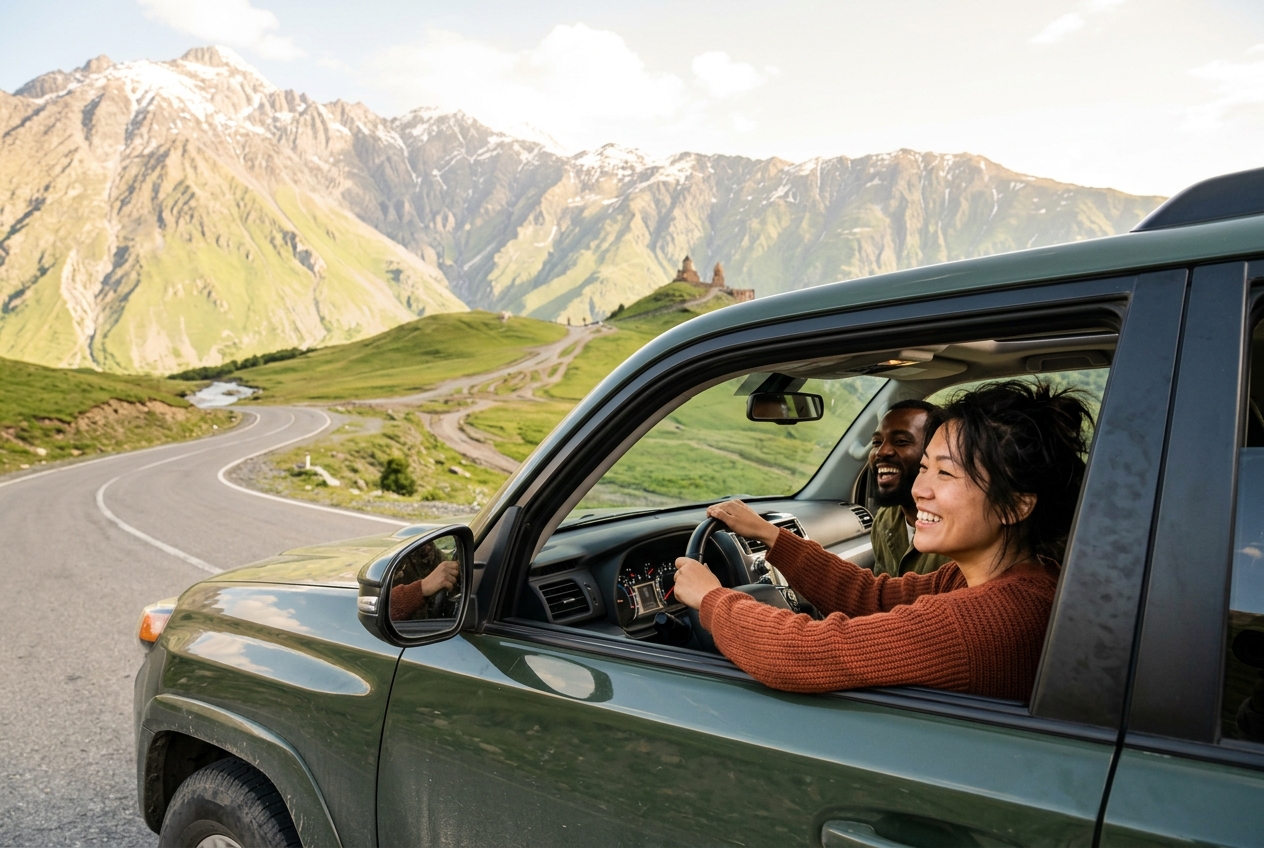
Georgia’s capital sits in a valley where Europe and Asia blur together, surrounded by mountains, monasteries, and wine country that you can reach before lunch. Having spent considerable time crisscrossing this country, I can say with confidence that the best day trips from Tbilisi by car unlock experiences no tour bus schedule can match: a fortress at golden hour with no crowds, a winery detour down a dirt road, or a hot spring soak after a canyon hike. Renting a car here is affordable, the distances are short, and the scenery between destinations often rivals the destinations themselves.
What follows are ten of the best drives you can make from the capital and return the same day, grouped by region and theme. I’ve included practical driving advice, the best seasons to go, and the honest details about road conditions that most guides skip. Whether you have three days or three weeks, these trips will shape how you remember Georgia.
| Destination | Distance from Tbilisi | Drive Time | Best For |
|---|---|---|---|
| Mtskheta | 25 km | 30 min | History, churches |
| Uplistsikhe | 100 km | 1.5 hrs | Ancient caves |
| Ananuri Fortress | 70 km | 1 hr | Fortress, reservoir |
| Kazbegi (Stepantsminda) | 155 km | 3 hrs | Mountains, hiking |
| Sighnaghi | 110 km | 1.5 hrs | Wine, views |
| Telavi | 95 km | 2 hrs | Wine estates |
| David Gareja | 100 km | 2 hrs | Cave monasteries |
| Udabno area | 100 km | 2 hrs | Painted hills |
| Borjomi | 160 km | 2.5 hrs | Mineral springs, park |
| Dashbashi Canyon | 130 km | 2 hrs | Canyon, glass bridge |
Essential Tips for Renting and Driving a Car in Georgia
Renting a car in Georgia costs between 80 and 150 GEL per day (roughly $30 to $55), depending on the vehicle. Local agencies like MyGPS and Geocar often beat international chains on price, and many include basic insurance. I’d recommend downloading the Bolt app for backup city transport and keeping Google Maps offline packs for the regions you plan to visit, since cell coverage can vanish in mountain valleys.
An International Driving Permit isn’t legally required for most nationalities for short stays, but having one avoids confusion at police checkpoints. Fuel stations are plentiful on main highways and accept cards, though cash is king at smaller rural pumps. Fill up before heading to David Gareja or Kazbegi: the last stations can be 40 to 60 kilometers before your destination.
Navigating Tbilisi Traffic and Road Conditions
Tbilisi traffic is chaotic in a way that’s hard to prepare for. Lane markings are treated as suggestions, and drivers merge aggressively. My honest advice: leave the city before 8 a.m. or after 10 a.m. to dodge rush hour, especially if you’re heading north toward the Military Highway.
Outside the capital, main highways are generally well-maintained two-lane roads. The exception is the stretch to David Gareja, where the last 20 kilometers are unpaved and rutted. Rain turns that section into a mud track. Road signage improved dramatically after 2019, with most signs now in both Georgian script (mkhedruli) and Latin letters, but a GPS remains essential for smaller village roads.
Recommended Vehicle Types for Specific Terrains
For Mtskheta, Sighnaghi, Borjomi, and the Military Highway, a standard sedan handles the roads just fine. You don’t need a 4×4 for most of these trips.
The exceptions are David Gareja and, during winter or spring, the final stretch to Kazbegi if snow lingers. For those routes, a compact SUV with decent ground clearance makes a real difference. Specifically, a Mitsubishi Outlander or Hyundai Tucson are commonly available at Georgian rental agencies and handle the terrain well. If you’re visiting only in summer and sticking to paved routes, save the money and rent a hatchback.
Historical Gems and Ancient Capitals Nearby
Two of Georgia’s most important historical sites sit within 100 kilometers of Tbilisi, making them perfect half-day or combined full-day excursions. These aren’t dusty museum stops: they’re living, atmospheric places where the country’s deep Christian heritage and pre-Christian past overlap.
Mtskheta: The Spiritual Heart of Georgia
Georgia’s ancient capital sits just 25 kilometers from Tbilisi, making it the easiest and most rewarding short drive you can take. Mtskheta served as the capital of the Kartli kingdom from the third century BC and remains the spiritual center of the Georgian Orthodox Church.
The two essential sites are Jvari Monastery, perched on a hilltop overlooking the confluence of the Mtkvari and Aragvi rivers, and Svetitskhoveli Cathedral in the town center. Jvari is the older of the two, dating to the sixth century, and the panoramic view from its terrace is one of the most photographed scenes in the country. Svetitskhoveli, where Georgian kings were crowned and buried, holds a gravity that’s hard to describe until you stand inside it. Visit Jvari first (the access road climbs steeply but is paved), then drive down into town for the cathedral. The whole visit takes two to three hours.
Uplistsikhe: Exploring the Ancient Rock-Hewn City
Continue west from Mtskheta for about 75 kilometers and you’ll reach Uplistsikhe, a rock-hewn city carved into a sandstone bluff above the Mtkvari River. People lived here from the early Iron Age through the medieval period, and the site’s scale is genuinely impressive: streets, a theater, wine cellars, and a pagan temple all carved directly from stone.
The walk through the caves takes about an hour, and the site is exposed to sun with no shade, so bring water and a hat in summer. A small on-site museum provides context, but the real experience is wandering the carved chambers and imagining the city at its peak. Combining Mtskheta and Uplistsikhe in a single day trip works well if you leave Tbilisi by 9 a.m.
Mountain Adventures Along the Georgian Military Highway
The Georgian Military Highway is the single most famous road in the country, running north from Tbilisi to the Russian border through the Greater Caucasus. You don’t need to drive the whole thing to get the best of it.
Ananuri Fortress and Zhinvali Reservoir
About 70 kilometers north of Tbilisi, the medieval Ananuri fortress complex sits above the turquoise Zhinvali Reservoir. The fortress served as the seat of the Aragvi dukes and saw several sieges in the 18th century: bullet holes still mark the outer walls.
Two churches stand inside the fortified walls, both decorated with intricate stone carvings. The reservoir below shifts color depending on the season, from deep emerald in spring to pale turquoise in late summer. This is a natural stopping point on the way to Kazbegi, but it also works as a standalone two-hour round trip if you’re short on time. There’s a small parking area just off the highway, and entry is free.
Kazbegi and the Iconic Gergeti Trinity Church
The drive from Tbilisi to Stepantsminda (still commonly called Kazbegi) takes about three hours and crosses the 2,379-meter Jvari Pass. The road is paved the entire way but includes sharp switchbacks and, in winter, can close due to avalanche risk. Summer and early fall are the safest and most scenic times.
Gergeti Trinity Church, a 14th-century stone church sitting at 2,170 meters with Mount Kazbek towering behind it, is the reason most people make this drive. You can reach it by a rough dirt track (SUV recommended) or by hiking about an hour uphill from town. The church itself is simple, but the setting is extraordinary. Have lunch in Stepantsminda at one of the family-run guesthouses serving khinkali and local cheese before heading back. Start early: this is a long day, and you want daylight for the mountain passes.
Wine Tasting and Romantic Views in Kakheti
Kakheti, Georgia’s eastern wine region, produces about 70% of the country’s wine using the traditional qvevri method, where grapes ferment in large clay vessels buried underground. Two towns here make excellent car-based day trips from the capital.
Sighnaghi: The City of Love
Sighnaghi sits on a hilltop surrounded by fortress walls, overlooking the Alazani Valley with the snow-capped Caucasus as a backdrop. The town earned its romantic nickname from a local tradition of 24-hour marriage registration, and its cobblestone streets and pastel-colored houses genuinely deliver on the charm.
Visit the Sighnaghi National Museum for a surprisingly strong collection of Niko Pirosmani paintings, then walk the fortress walls for valley views. Several small wineries in and around town offer tastings of amber-colored wines made in qvevri. The drive from Tbilisi takes about 90 minutes through rolling farmland.
Telavi and the Tsinandali Estate
Telavi is the administrative center of Kakheti and feels more like a working town than a tourist destination, which is part of its appeal. The main draw nearby is the Tsinandali Estate, the 19th-century home of poet and public figure Alexander Chavchavadze, who introduced European winemaking techniques to Georgia.
The estate includes a house museum, formal gardens, and a wine cellar where you can taste vintages from across the region. From Telavi, you can also visit the Alaverdi Monastery, one of the tallest medieval cathedrals in Georgia, about 20 kilometers north. Combining Telavi and Sighnaghi in a single day is possible but rushed: pick one unless you’re comfortable with a 12-hour outing.
Monastic Wonders and Desert Landscapes
Southeast of Tbilisi, the terrain shifts dramatically. Green hills give way to semi-arid steppe, and the landscape starts to look more like Central Asia than the Caucasus. This is where two of Georgia’s most unusual destinations hide.
David Gareja: Caves on the Azerbaijan Border
The David Gareja monastery complex stretches across a ridge right on the Georgian-Azerbaijani border, with hundreds of cave cells, churches, and refectories carved into the rock. Founded in the sixth century by one of the Assyrian Fathers, the complex once housed thousands of monks.
The drive from Tbilisi takes about two hours, and the last stretch is the rough unpaved road I mentioned earlier. Once there, the main Lavra monastery sits at the base of the ridge, while the Udabno monastery (confusingly, this is part of the David Gareja complex, not the nearby village) requires a 20-minute hike up and over the ridge. The Udabno caves contain remarkable frescoes dating to the 10th through 13th centuries, and the views from the ridge into Azerbaijan are stark and beautiful. Bring plenty of water: there’s no shade and no shops.
The Rainbow Mountains of Udabno
The village of Udabno and its surrounding hills have gained attention for their striped, multicolored rock formations, sometimes compared to the painted hills of Oregon or the Zhangye Danxia in China. The colors come from layers of sedimentary rock in reds, greens, yellows, and purples, best seen in late afternoon light.
There’s no formal park or entrance fee. You simply drive past the village and follow dirt tracks toward the colored ridges. A high-clearance vehicle helps, and it’s worth asking locals for directions since trails aren’t marked. This pairs naturally with David Gareja for a full day exploring Georgia’s most otherworldly terrain.
Nature and Wellness in Central Georgia
Head southwest from Tbilisi and the landscape turns lush: forested gorges, mineral springs, and a brand-new canyon attraction that’s become one of the country’s most popular stops.
Borjomi: Mineral Springs and National Park Trails
Borjomi is famous for its mineral water, which you’ve probably seen in bottles across Eastern Europe. The town itself is a pleasant, walkable resort with a central park where you can drink the warm, sulfurous spring water straight from the source for free. It’s an acquired taste, but trying it is part of the experience.
The Borjomi-Kharagauli National Park, one of the largest in Europe, offers well-marked hiking trails ranging from easy two-hour loops to multi-day routes. The drive from Tbilisi takes about two and a half hours through the Borjomi Gorge, which is scenic enough to justify the trip on its own. In winter, the nearby Bakuriani ski resort adds another reason to visit.
Dashbashi Canyon and the Diamond Bridge
Dashbashi Canyon, located near the town of Tsalka about two hours south of Tbilisi, is a relatively recent addition to Georgia’s tourist map. The canyon itself is ancient, carved by the Khrami River, but the glass-bottomed “Diamond Bridge” spanning it opened in 2022 and immediately became an Instagram sensation.
The bridge hangs 240 meters above the canyon floor, and walking across it is genuinely thrilling. Below, waterfalls cascade down the basalt walls. The surrounding area includes short hiking paths and viewpoints. The road from Tbilisi is fully paved and passes through high-altitude grasslands populated by grazing cattle and the occasional shepherd on horseback.
Planning Your Itinerary: Best Times to Visit
The ideal window for these day trips by car from Tbilisi runs from late April through October. May and June bring wildflowers and green valleys without the peak summer heat. September and October offer harvest season in Kakheti, golden light, and comfortable driving temperatures.
July and August work fine but can be hot in lower elevations, especially at David Gareja and Uplistsikhe, where temperatures push past 35°C. The Military Highway to Kazbegi is best from June through September, when the Jvari Pass is reliably clear. Winter driving is possible for lower-elevation destinations like Mtskheta and Borjomi, but mountain routes require chains and careful weather monitoring.
If you have a week, I’d structure it this way: Day 1 for Mtskheta and Uplistsikhe, Day 2 for the Military Highway to Kazbegi, Day 3 for Sighnaghi or Telavi, Day 4 for David Gareja and Udabno, and Day 5 for Borjomi or Dashbashi Canyon. That covers all ten destinations with rest days built in.
Georgia rewards the driver who wanders. Some of my best memories here came from pulling over at an unmarked church, buying roadside fruit from a grandmother who spoke only Georgian, or finding a viewpoint that no guidebook mentioned. Rent the car, download the offline maps, fill the tank, and give yourself permission to get a little lost. The country is small enough that you’re never far from Tbilisi, and generous enough that every detour pays off.