
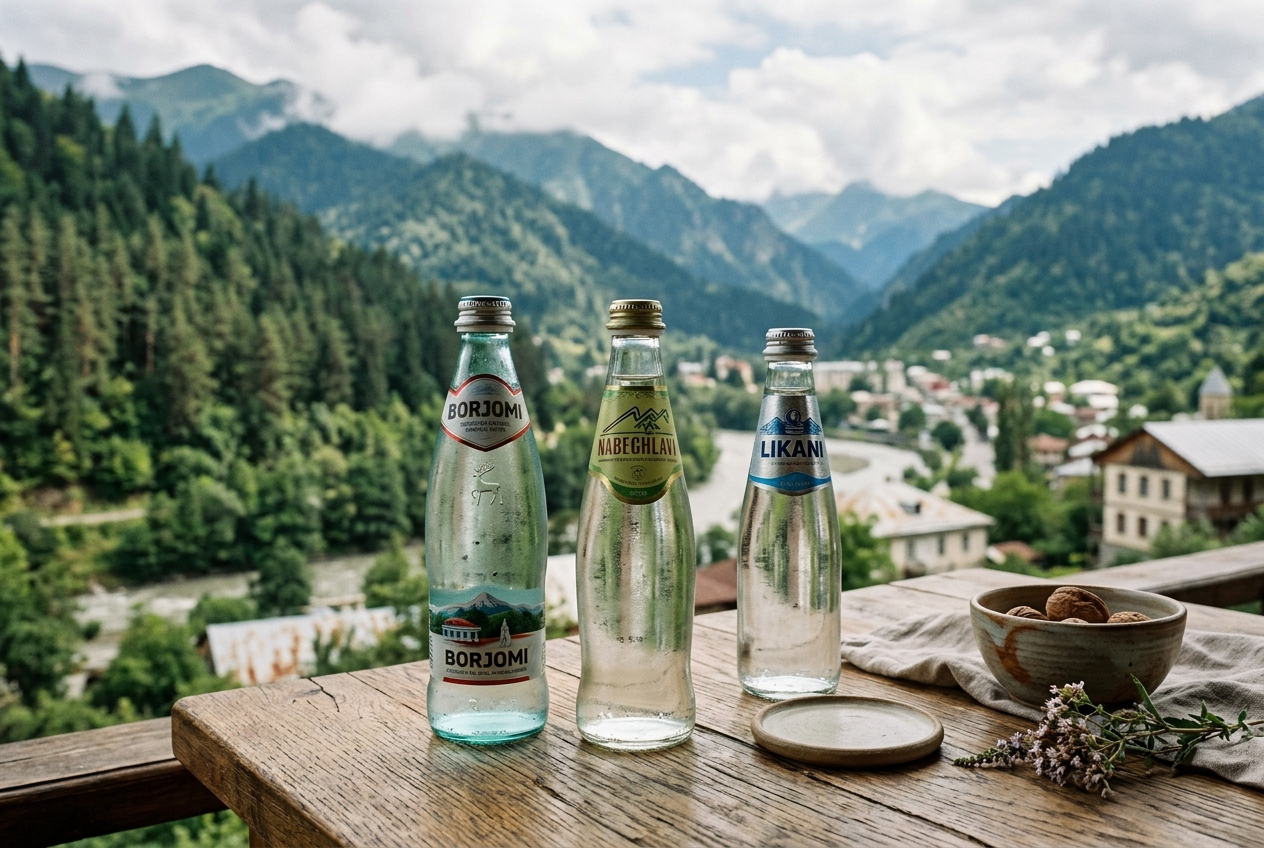
Few countries on earth can claim a relationship with water as deep and culturally significant as Georgia’s. In the Caucasus, mineral springs aren’t just a natural resource: they’re woven into the national identity, tied to centuries of healing traditions, imperial ambition, and modern commerce. The country sits atop one of the most geologically active zones in Europe, and that volcanic heritage pushes mineral-rich water to the surface in dozens of locations. Three brands stand above the rest. Georgian mineral waters like Borjomi, Nabeghlavi, and Likani each tell a distinct story about origin, taste, and purpose. Borjomi is the heavyweight, a name recognized from Berlin to Beijing. Nabeghlavi is the lighter, softer alternative beloved by Georgians themselves. And Likani occupies a quieter niche as a daily table water that doesn’t overwhelm the palate. I’ve spent enough time in Georgia to know that ordering the “wrong” water at a Tbilisi dinner table can spark a surprisingly passionate debate. Understanding what makes each of these waters different, and why Georgians care so deeply about the distinction, is a small but genuine window into the country’s culture.
The Geological Heritage of Georgia’s Volcanic Springs
Georgia’s mineral water story begins millions of years underground. The country sits at the collision point of the Eurasian and Arabian tectonic plates, and the resulting volcanic and seismic activity created a network of deep faults and fissures through which water travels extraordinary distances. Rainfall and snowmelt from the Greater and Lesser Caucasus mountains seep into the earth, sometimes descending thousands of meters before encountering superheated volcanic rock. Over decades or even centuries, this water dissolves minerals from the surrounding stone: calcium, magnesium, sodium, bicarbonate, and dozens of trace elements.
What emerges at the surface is naturally carbonated and mineral-dense, fundamentally different from the filtered tap water most of the world drinks. The specific mineral profile of each spring depends on the local geology, the depth of the water’s journey, and the temperature of the rock it contacts. This is why two springs separated by just a few dozen kilometers can produce water that tastes completely different.
Georgia has cataloged over 2,000 mineral springs across its territory, but only a handful have been commercialized at scale. The Borjomi-Kharagauli region, the Guria lowlands near the Black Sea coast, and the valleys surrounding Likani each produce water with distinct characteristics. The volcanic origin is the common thread: carbon dioxide generated deep underground naturally carbonates the water before it ever reaches a bottling plant. No artificial carbonation is added to any of the three major brands, which is a point of genuine pride for Georgian producers. This natural process gives the water a finer, more persistent effervescence than you’d get from injected CO2, and experienced drinkers can tell the difference immediately.
The geological diversity packed into a country roughly the size of South Carolina is remarkable. From sulfurous hot springs in Tbilisi’s Abanotubani district to the cold bicarbonate springs of Sairme, Georgia’s underground water network is essentially an enormous natural laboratory that has been running experiments in mineral dissolution for millennia.
Borjomi: The Crown Jewel of Soviet and Imperial History
Discovery and the Romanov Legacy
Borjomi’s recorded history begins in 1829, when Russian imperial soldiers stationed in the Borjomi Gorge reportedly discovered the springs and began using the water to treat injuries and illness. The Russian military quickly recognized the water’s therapeutic potential, and by the 1840s, the Romanov royal family had taken a personal interest. Grand Duke Mikhail Nikolaevich, the Tsar’s brother and viceroy of the Caucasus, established a summer residence in Likani (near Borjomi) and helped transform the area into a fashionable health resort.
By the late 19th century, Borjomi water was being bottled and shipped across the Russian Empire. The distinctive green bottle, which remains largely unchanged today, became a status symbol in Moscow and St. Petersburg. The Romanovs essentially turned Borjomi into the Perrier of Eastern Europe, decades before Perrier itself became fashionable in the West.
The Soviet era only amplified Borjomi’s reputation. Soviet health authorities prescribed mineral water therapy (known as balneology) with almost religious fervor, and Borjomi was the gold standard. Every Soviet sanatorium worth its salt stocked Borjomi, and the brand became one of the most recognized consumer products in the entire USSR. That legacy persists: older Georgians and Russians still associate Borjomi with health and recovery, almost like a medicinal product rather than a beverage.
Unique Mineral Composition and Volcanic Origin
Borjomi water originates from springs that draw from depths of 1,500 meters or more, where it contacts volcanic rock at temperatures exceeding 60°C. The water takes an estimated several decades to complete its underground journey, emerging with a total dissolved solids (TDS) content typically between 5,000 and 7,500 mg/L. That’s extraordinarily high: most European mineral waters fall between 500 and 1,500 mg/L.
The dominant minerals are sodium bicarbonate, which gives Borjomi its characteristic salty-alkaline taste. You’ll also find significant levels of calcium, magnesium, chloride, and sulfate. The taste is unmistakable and polarizing: first-time drinkers often describe it as intensely salty or even medicinal. Georgians who grew up with it tend to love it. Tourists sometimes need a few tries.
Borjomi Holding, the company behind the brand, posted total revenue of USD 556 million in 2024, representing a USD 120 million jump from the prior year. That figure makes Borjomi not just a water brand but one of the most commercially significant consumer products to come out of the Caucasus region. Russia remains the largest single market: the Russian Federation generated USD 300.7 million in Borjomi sales in 2023, a fact that carries complicated political undertones given the current geopolitical climate.
Nabeghlavi: The Refreshing Alternative from Guria
Bicarbonate-Sodium Profile and Health Benefits
If Borjomi is the bold espresso of Georgian mineral waters, Nabeghlavi is the smooth cappuccino. Sourced from the Guria region in western Georgia, Nabeghlavi has a lower overall mineral content than Borjomi, making it significantly easier to drink in large quantities. Its TDS typically falls in the range of 3,000 to 4,000 mg/L: still high by global standards, but noticeably lighter on the palate.
Nabeghlavi’s mineral profile is also bicarbonate-sodium dominant, but the ratios differ enough to create a softer, less salty flavor. The water contains meaningful concentrations of calcium and magnesium alongside its sodium content, and Georgian physicians have traditionally recommended it for conditions involving the urinary tract, kidneys, and digestive system. The lower sodium load compared to Borjomi makes Nabeghlavi a more practical choice for people who want to drink mineral water regularly without excessive sodium intake.
| Property | Borjomi | Nabeghlavi | Likani |
|---|---|---|---|
| Primary Type | Bicarbonate-Sodium | Bicarbonate-Sodium | Bicarbonate-Calcium |
| TDS (mg/L) | 5,000-7,500 | 3,000-4,000 | 500-1,500 |
| Carbonation | Naturally carbonated | Naturally carbonated | Naturally carbonated |
| Taste Profile | Intensely salty, mineral | Mild, slightly salty | Clean, neutral |
| Best For | Therapeutic/occasional use | Regular drinking | Daily hydration |
| Source Depth | ~1,500 m | 2,000-3,000 m | Shallower springs |
Ecological Purity of the Nabeghlavi Springs
One of Nabeghlavi’s strongest selling points is the pristine environment surrounding its source. The springs sit in a heavily forested area of Guria with virtually no industrial activity nearby. The water originates from a depth of 2,000 to 3,000 meters and is naturally carbonated by volcanic CO2 before it reaches the surface, meaning the entire journey from deep rock to bottle happens without exposure to surface-level pollutants.
The Guria region receives heavy rainfall from the Black Sea, which feeds the underground aquifer system. The thick clay and rock layers above the springs act as a natural filtration system, and the absence of agriculture or heavy industry in the immediate watershed means the water faces minimal contamination risk. Georgian producers market this ecological purity aggressively, particularly in European and Asian export markets where consumers are increasingly suspicious of water sources near urban or industrial areas.
Nabeghlavi has carved out a loyal domestic following precisely because many Georgians find Borjomi too intense for everyday consumption. At restaurants in Tbilisi, Batumi, and Kutaisi, you’ll frequently see tables split between Borjomi loyalists and Nabeghlavi drinkers, with each side mildly incredulous that anyone would prefer the other. It’s the kind of friendly rivalry that tells you something real about a country’s food culture.
Likani: The Balanced Choice for Daily Hydration
Likani occupies the gentlest position among Georgia’s major mineral water brands. Named after the village of Likani in the Borjomi municipality, this water comes from the same general region as Borjomi but from different, shallower springs with a fundamentally different mineral character. Where Borjomi hits you with a wall of sodium and bicarbonate, Likani is calm, clean, and almost neutral on the palate.
The TDS content of Likani water typically ranges from 500 to 1,500 mg/L, putting it much closer to what Europeans would recognize as a standard mineral water. The dominant minerals shift toward calcium and magnesium rather than sodium, which makes it suitable for drinking throughout the day without worrying about sodium intake. Pediatricians in Georgia sometimes recommend Likani for children and elderly patients who need mineral supplementation without the intensity of Borjomi.
Likani has gained traction as a table water in Georgian restaurants and hotels, particularly those catering to international visitors who might find Borjomi overwhelming on first encounter. It pairs well with food without competing for attention, and its mild carbonation makes it a comfortable companion for long Georgian feasts (known as supras) where you might be drinking water for hours between toasts of wine and chacha.
The Distinction Between Likani and Borjomi
People often assume Likani is simply a diluted version of Borjomi since both come from the Borjomi municipality. That’s incorrect. The springs are geologically distinct, tapping into different aquifer layers at different depths. Borjomi’s deep volcanic contact creates its extreme mineral density, while Likani’s shallower journey through different rock formations produces a fundamentally different chemical signature.
Think of it like wine from the same region: two vineyards a kilometer apart can produce dramatically different wines because of soil composition, elevation, and microclimate. The same principle applies to mineral springs. Likani and Borjomi share a postal code but not a geological profile, and treating them as interchangeable misses the point entirely.
The branding distinction matters commercially, too. IDS Borjomi International markets Likani as a separate product line specifically to capture the growing segment of health-conscious consumers who want natural mineral water but don’t want the medicinal intensity that defines Borjomi.
Therapeutic Applications and Balneological Traditions
Georgia’s relationship with mineral water as medicine predates modern chemistry by centuries. The practice of balneology, using mineral water for therapeutic bathing and drinking cures, was formalized during the Russian Imperial period but has roots in much older Georgian folk traditions. Villages built around mineral springs have served as informal healing centers for generations, with local knowledge about which spring treats which ailment passed down through families.
The Soviet Union invested heavily in balneological research, and many of the clinical studies on Georgian mineral waters date from this era. Soviet-era sanatoriums in Borjomi, Tskaltubo, and Sairme prescribed specific water regimens: a certain volume of a specific water at a specific temperature, consumed at precise intervals before meals. Some of these protocols were genuinely evidence-based, while others reflected the Soviet tendency to over-medicalize everyday life. Modern Georgian physicians still reference many of these protocols, though with somewhat more nuance.
Gastrointestinal and Metabolic Wellness
The most well-documented therapeutic applications involve the digestive system. Bicarbonate-rich waters like Borjomi and Nabeghlavi can help neutralize stomach acid, which is why Georgian doctors commonly recommend them for patients with gastritis, acid reflux, and peptic ulcers. The alkaline pH of Borjomi (typically around 6.0 to 7.0 at the source) can temporarily buffer gastric acidity when consumed before meals.
There’s also evidence that regular consumption of mineral water with high bicarbonate content can improve bile flow and support liver function. Georgian balneological traditions have long prescribed Borjomi for patients with gallbladder issues, and while the clinical evidence is stronger for some conditions than others, the underlying biochemistry is sound. Bicarbonate ions stimulate the secretion of digestive enzymes and can improve motility in the gastrointestinal tract.
Metabolic benefits are harder to pin down, but some research suggests that the calcium and magnesium content in these waters contributes meaningfully to daily mineral intake, particularly in populations with dietary deficiencies. For a country where mineral water consumption is a daily habit rather than an occasional choice, the cumulative nutritional impact over a lifetime is likely significant.
Georgia’s Liquid Gold in the Global Export Market
Georgia’s mineral water industry has become a serious economic force. The country’s bottled water production sector is projected to reach a market size of $212.7 million in 2026, and mineral water represents the premium segment of that market. Borjomi alone accounts for a substantial share of Georgia’s non-agricultural exports, and the brand’s recognition in post-Soviet countries gives it a distribution network that newer brands can only envy.
Globally, the mineral water market is projected to reach USD 449.93 billion by 2033, growing at a CAGR of 4.8%. Georgian producers are positioning themselves to capture a larger slice of this expanding pie, particularly in premium segments where provenance and natural origin command higher prices. Borjomi’s volcanic heritage and centuries-old reputation give it a compelling story that resonates with consumers willing to pay more for authenticity.
The challenge for Georgian brands is diversifying beyond Russian-speaking markets. Borjomi has made inroads in Western Europe, China, and the Middle East, but brand recognition outside the post-Soviet sphere remains limited. Nabeghlavi and Likani face even steeper climbs, as they lack Borjomi’s historical cachet and marketing budget.
For travelers visiting Georgia, the best advice is simple: try all three. Order Borjomi at a supra to experience its full medicinal punch alongside rich Georgian food. Sip Nabeghlavi on a hot afternoon in Batumi when you want refreshment without intensity. And keep a bottle of Likani on your nightstand for everyday hydration. Each water reflects a different facet of Georgia’s extraordinary geology and culture, and choosing between them is half the fun. If you find yourself in the Borjomi Gorge, visit the source springs in person: drinking the water warm and fresh from the ground, before carbonation fully develops, is an experience that no bottled version can replicate.