
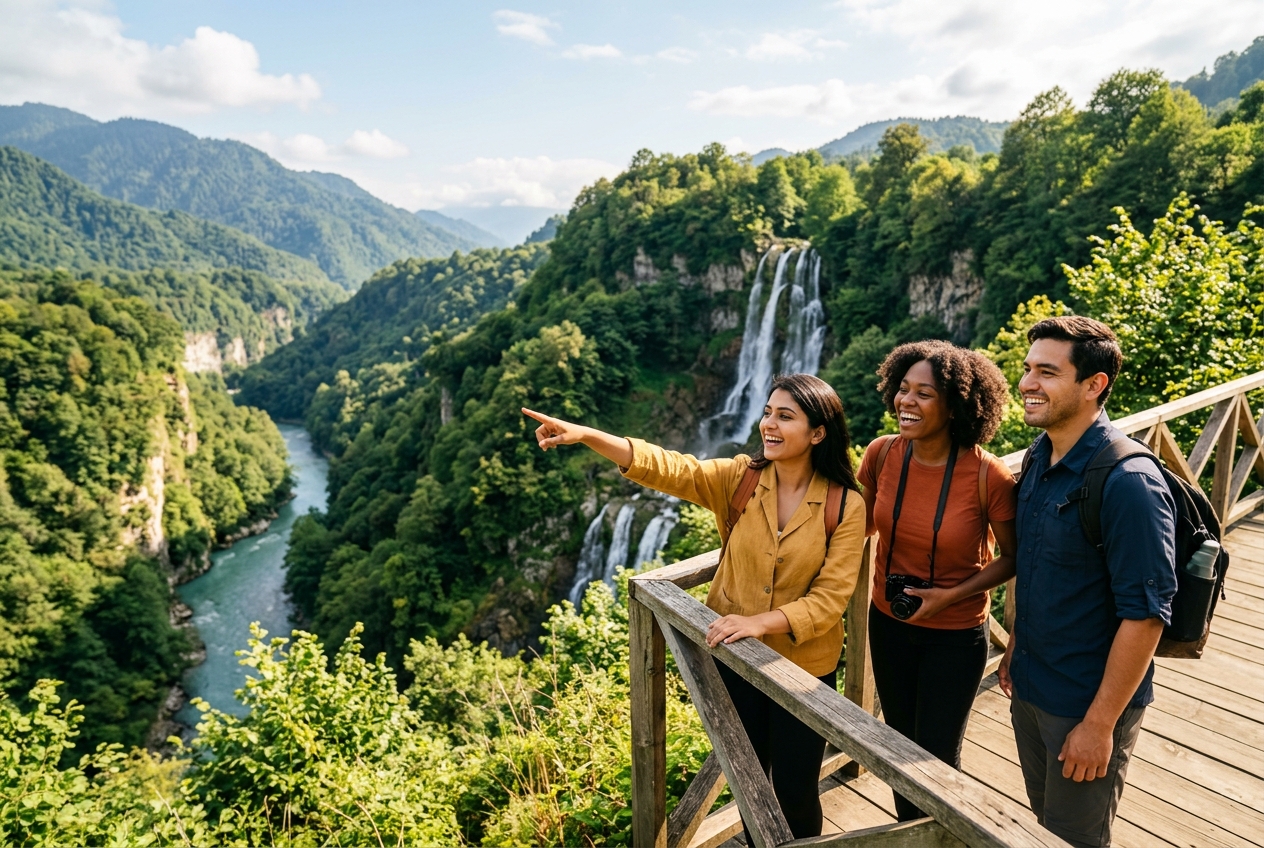
Batumi has earned its reputation as Georgia’s Black Sea party town, all palm-lined boulevards and glittering casinos. But the real magic starts when you leave the city. Within an hour or two in any direction, you’ll find yourself standing beneath thundering waterfalls, crossing medieval stone bridges, or floating through canyons so impossibly turquoise they look digitally enhanced. The mountains, canyons, and waterfalls surrounding Batumi are among the most underrated natural attractions in Europe, and the best part is that most are reachable as comfortable day trips. Georgia’s protected areas have been surging in popularity, with a record 1,250,417 visitors in 2025 alone, marking an almost 13% increase from the previous year. That momentum is well deserved. Whether you’re a hardcore hiker or someone who just wants to soak in green scenery from a café terrace, the Batumi hinterland delivers. Here’s what’s worth your time.
The Lush Landscapes of Mtirala National Park
Mtirala National Park sits about 30 kilometers east of Batumi, and it’s one of the wettest places in all of Europe. The name itself comes from “mtirala,” meaning “the crying one” in Georgian, a nod to the near-constant rainfall that feeds its dense subtropical forests. This is the kind of place where moss blankets every surface, streams crisscross the trail, and the canopy is so thick that sunlight filters through in scattered gold patches.
The park covers roughly 15,700 hectares and protects a Colchic rainforest ecosystem that has existed for millions of years. Think ancient boxwood groves, towering chestnut trees, and ferns that look like they belong in a dinosaur documentary. I’ve visited during both spring and late summer, and each season paints the forest differently: spring is all rushing water and wildflowers, while late summer offers a quieter, more contemplative atmosphere with lower water levels.
Getting there is straightforward. A marshrutka from Batumi will take you to the village of Chakvistavi, and from there it’s a short ride or walk to the park entrance. The entry fee is minimal, and the park rangers are genuinely helpful, though English can be hit or miss with the older staff. Younger rangers tend to speak decent English, a generational shift you’ll notice throughout Georgia.
Hiking to the Tsablnari Waterfall
The main attraction inside Mtirala is the hike to Tsablnari Waterfall, a roughly 7-kilometer round trip that takes most people about three to four hours. The trail is well-marked and mostly flat for the first half before climbing gently through the forest. It’s not technically difficult, but the humidity and occasional muddy patches mean proper footwear is non-negotiable. Sneakers won’t cut it here: bring hiking boots or at least sturdy trail shoes.
The waterfall itself drops around 15 meters into a small pool surrounded by mossy rocks. On a hot day, the mist coming off the falls is pure relief. The pool is swimmable in summer, though the water is bracingly cold. Pack a lunch and eat it by the falls because the setting is spectacular, and there are no cafés or vendors inside the park.
Adventure Activities: Zip-lining and Rope Parks
If you’re traveling with kids or just want something beyond hiking, the area around Mtirala’s entrance has developed a small adventure tourism scene. A rope park near Chakvistavi offers zip-lines and obstacle courses strung between the trees, and it’s surprisingly well-maintained for a rural Georgian attraction. Prices are modest: expect to pay around 20-30 GEL per person.
There’s also horseback riding available through local operators in the surrounding villages. These aren’t polished tourist ranches but rather family-run operations where a farmer leads you along mountain trails on his own horses. It’s authentic in the best sense, though don’t expect safety briefings or liability waivers. That’s part of the charm, or the terror, depending on your disposition.
Mountain Culture and History in Upper Adjara
Head south from Batumi into the Adjara highlands and you’ll enter a world that feels centuries removed from the coastal resorts. Upper Adjara is where Georgian mountain culture thrives in its most traditional form: stone villages clinging to hillsides, families making cheese by hand, and a hospitality so intense it can catch you off guard. The Georgian concept of “stumari ghvtisaa,” meaning “a guest is a gift from God,” is not a slogan here. It’s a lived practice.
The road from Batumi climbs steeply through the Acharistskali River valley, passing through villages like Keda and Khulo. Each turn reveals another postcard view: terraced hillsides, wooden balconied houses, and the ever-present backdrop of the Lesser Caucasus mountains. The entire drive takes about 90 minutes to reach the heart of the highlands, making it a perfect day trip.
The Medieval Stone Bridges of Makhuntseti
About 30 kilometers from Batumi, just off the main highway toward Keda, you’ll find the Makhuntseti Bridge, a stunning arched stone bridge dating back to the 12th century. It spans the Acharistskali River in a single graceful arc, and it’s still standing without any modern reinforcement. Queen Tamar’s era produced some remarkable infrastructure, and this bridge is a testament to medieval Georgian engineering.
Right next to the bridge, the Makhuntseti Waterfall drops about 20 meters into a natural swimming hole. In summer, this spot gets crowded with locals and tourists alike, splashing around in the pool below the falls. Small vendors sell churchkhela (the walnut-and-grape-juice candy that looks like a candle) and fresh fruit nearby. It’s a great first stop on a day exploring the highlands, and the combination of the ancient bridge and waterfall makes for excellent photos.
Wine Tasting and Traditional Cuisine in Keda
Continue up the valley to the town of Keda and you’ll find yourself in one of Adjara’s emerging wine regions. Georgian wine is famous for its qvevri method, where grapes ferment in large clay vessels buried underground, and Keda’s winemakers carry on this tradition with local grape varieties you won’t find anywhere else. Small family cellars welcome visitors for tastings, often paired with homemade cheese, fresh bread baked in a tone oven, and plates of lobiani (bean-filled bread).
The cuisine in Upper Adjara has its own distinct character. Adjarian khachapuri, the boat-shaped cheese bread topped with a raw egg and butter, originated in this region and tastes noticeably different when made by a village grandmother versus a Batumi restaurant. If a local family invites you to eat, say yes. You’ll leave stuffed, slightly drunk on homemade chacha (grape brandy), and with a genuine understanding of why Georgian hospitality is legendary.
Exploring the Canyons of Samegrelo
The Samegrelo-Zemo Svaneti region lies north of Batumi, and its canyons are among the most visually striking natural features in the entire Caucasus. Getting there requires a longer drive, roughly two to three hours each way, but the payoff is enormous. These canyons offer something you simply can’t get closer to the coast: deep limestone gorges carved by rivers over millennia, filled with water so clear and blue-green it barely looks real.
A day trip combining both Martvili and Okatse canyons is ambitious but doable if you start early. Most private drivers and tour operators in Batumi offer this as a packaged route, and it’s one of the most popular excursions from the city for good reason.
Boating Through Martvili Canyon
Martvili Canyon is the showstopper. The experience centers on a short boat ride through a narrow gorge where limestone walls rise vertically on both sides, dripping with vegetation and small waterfalls. The water beneath you is an almost unbelievable shade of turquoise, and the silence inside the canyon, broken only by the dip of paddles, is genuinely meditative.
The boat ride lasts about 15 to 20 minutes and covers roughly 300 meters of the canyon’s lower section. There’s also a walking trail along the upper canyon that takes you past additional waterfalls and viewpoints. The whole visit takes about an hour and a half. Tickets cost around 17 GEL for adults, and the boats hold four to six people. Summer weekends get packed, so arriving before 10 a.m. makes a real difference.
The Turquoise Waters of Okatse Canyon
Okatse Canyon offers a completely different perspective: instead of floating through it, you walk above it. A metal walkway bolted to the canyon wall extends about 700 meters along the rim, culminating in a viewing platform that hangs directly over the gorge. The drop below is roughly 140 meters, and if you have any fear of heights, this will test it.
The approach to the walkway involves a pleasant 2.5-kilometer forest trail from the ticket office. It’s flat and easy, suitable for most fitness levels. The canyon itself was formed by the Okatse River, and the views from the suspended platform are staggering: sheer walls, dense forest canopy, and the distant sound of water far below. Entry is around 17 GEL, and the whole visit takes about two hours including the walk in and out.
| Canyon | Distance from Batumi | Main Experience | Duration | Entry Fee |
|---|---|---|---|---|
| Martvili | ~140 km (2.5 hrs) | Boat ride through gorge | 1.5 hours | ~17 GEL |
| Okatse | ~155 km (2.5 hrs) | Suspended walkway | 2 hours | ~17 GEL |
| Mtirala (Tsablnari) | ~30 km (45 min) | Forest hike to waterfall | 3-4 hours | ~5 GEL |
The Majestic Waterfalls of Gonio and Sarpi
The coastline south of Batumi, stretching toward the Turkish border, holds a few surprises that most visitors overlook. Gonio and Sarpi are small settlements that sit in the shadow of Batumi’s urban sprawl, but they offer a quieter, more local experience alongside some genuinely impressive waterfalls and historical sites.
Gonio is best known for its Roman-era fortress, Gonio-Apsaros, which dates back to the 1st century AD and is one of the oldest fortifications in Georgia. But the surrounding hills and river valleys hide waterfalls that reward those willing to walk a bit off the beaten path.
Andrew the First-Called Waterfall
Named after the Apostle Andrew, who tradition holds preached Christianity in the Caucasus region, this waterfall sits in a lush gorge a short drive from Gonio village. The falls cascade about 10 meters over a rocky ledge into a clear pool, and the surrounding forest feels almost tropical. The hike in is short, roughly 20 minutes from the road, making it accessible even for families with young children.
The site has religious significance for many Georgian visitors, and you’ll occasionally see small offerings or candles left near the base of the falls. Georgia’s deep Orthodox Christian identity permeates even its natural landmarks, and understanding this context adds a layer of meaning to what might otherwise seem like just another pretty waterfall. The area is free to visit and rarely crowded, even in peak season.
Coastal Views from the Turkish Border
Sarpi sits right on the Georgian-Turkish border, and the contrast is striking. On one side, a small Georgian beach village; on the other, the Turkish town of Kemalpaşa. The border crossing itself is busy with commercial traffic, but the beach at Sarpi is one of the cleanest and least crowded on the Adjarian coast.
The real draw here is the dramatic coastal scenery. Cliffs drop directly into the Black Sea, and a large modernist sculpture marks the border zone. On clear days, you can see the Turkish coastline stretching south. It’s a fascinating spot to reflect on how geography and politics shape borders, especially given Georgia’s complex relationship with its neighbors. Grab a coffee at one of the small beachside cafés and watch the cargo trucks roll between countries.
Practical Tips for Your Batumi Day Trips
Planning day trips from Batumi around its mountains, canyons, and waterfalls doesn’t require a travel agent, but a few practical details can make the difference between a great day and a frustrating one. Here’s what I’ve learned from multiple visits.
Best Time to Visit and Seasonal Considerations
May through October is the prime window, with June and September hitting the sweet spot of warm weather and manageable crowds. July and August bring peak heat and peak tourism, particularly at popular spots like Martvili Canyon and Makhuntseti Waterfall. Spring visits mean fuller waterfalls and greener landscapes, but also more rain, especially around Mtirala.
Winter effectively closes many mountain routes. Upper Adjara gets snow from November onward, and some canyon walkways shut down for safety. If you’re visiting between November and March, stick to lower-elevation sites like Gonio and the coastal areas.
Transportation Options: Marshrutkas vs. Private Drivers
Georgia’s marshrutka system, those ubiquitous minibuses, connects Batumi to most nearby towns for just a few lari. They’re cheap and frequent but operate on loose schedules, and reaching trailheads or remote waterfalls often requires a second connection or a hitchhike from the nearest village. For Makhuntseti and Keda, marshrutkas work fine. For Martvili and Okatse, they’re impractical unless you have unlimited patience.
Private drivers are the better option for canyon day trips. Expect to pay 150-200 GEL for a full day with a driver who knows the roads. Apps like Bolt work in Batumi proper, but coverage drops off quickly outside the city. Your guesthouse or hotel can almost always arrange a driver, and many speak at least basic English. Negotiate the price and itinerary before departure, and confirm that fuel costs are included.
Renting a car is possible through agencies in Batumi, but Georgian mountain roads demand confidence. Narrow lanes, blind curves, and livestock on the road are standard. If you’re comfortable with that, a rental gives you maximum flexibility. If not, a local driver who knows every pothole is worth every lari.
The day trips surrounding Batumi represent some of the best value in European travel: world-class scenery, rich culture, and genuine adventure, all within a couple hours of a city with good food and cheap hotels. Whether you spend your days floating through turquoise canyons, hiking to hidden waterfalls, or eating khachapuri in a highland village, the Batumi hinterland will rewrite whatever assumptions you had about Georgia. Start with one trip. You’ll book the next before dinner.