
Georgia’s child passenger safety rules catch a lot of parents off guard. The country, nestled at the crossroads of Europe and Asia, has been modernizing its traffic regulations rapidly, and the laws governing how children ride in vehicles are stricter than many expats and visitors expect. Whether you’re a resident raising a family in Tbilisi, a newcomer adjusting to life in Batumi, or a traveler planning a road trip through the Caucasus with kids, understanding Georgia’s car seat requirements isn’t optional: it’s a legal obligation with real financial consequences. I’ve seen plenty of confused parents at rental car counters in Tbilisi International Airport, so here’s a practical breakdown of what Georgian law actually requires and how to stay compliant.
Overview of Georgia’s Child Passenger Safety Law (O.C.G.A. § 40-8-76)
Georgia’s child passenger safety statute is codified under O.C.G.A. § 40-8-76, and the core rule is straightforward: all children under the age of eight must be properly restrained in an appropriate child safety seat or booster seat. This isn’t a suggestion or a best-practice guideline. It’s enforceable law, and Georgian traffic police have become increasingly active in citing violations, especially in urban areas like Tbilisi, Kutaisi, and Batumi.
The law places responsibility squarely on the driver, not the parent. If your child is riding without the correct restraint and someone else is behind the wheel, that driver faces the penalty. This matters in Georgia, where it’s common for relatives, neighbors, or hired drivers to transport children. The “I didn’t know” defense doesn’t hold up.
One thing worth understanding is that Georgia’s traffic code has been evolving. The country has been aligning many of its road safety standards with European norms as part of its broader EU association efforts. That means the trend is toward stricter enforcement, not looser. If you’ve been getting away with holding a toddler on your lap in a marshrutka, know that the legal framework doesn’t support it, even if enforcement has been inconsistent in rural areas.
Age and Height Requirements for Booster Seats
The age threshold is eight years old, but height matters too. Children who are under 150 centimeters (about 4 feet 11 inches) tall should remain in a booster seat even if they’ve passed their eighth birthday. The booster seat positions the vehicle’s seat belt correctly across the child’s chest and lap rather than riding up against the neck or abdomen, which can cause serious injury in a collision.
Here’s a practical table summarizing the requirements:
| Age Range | Required Restraint | Key Notes |
|---|---|---|
| Birth to 1 year | Rear-facing infant seat | Must face the rear of the vehicle |
| 1 to 4 years | Forward-facing seat with harness | Five-point harness recommended |
| 4 to 8 years | Booster seat | Until child reaches 150 cm height |
| 8+ years | Adult seat belt | Only if 150 cm or taller |
If your child is small for their age, keep them in the booster. The law and basic physics both support this approach.
Exceptions for Taxis and Public Transit
This is where things get murky, and honestly, it’s the question I hear most from parents visiting Georgia. The law does provide limited exceptions for taxis and public transportation. In practice, Georgian taxis, whether hailed on the street or booked through apps like Bolt or Yandex Go, almost never have child seats available. Public marshrutkas and city buses don’t have them either.
The legal exception means you technically won’t be fined for holding your child on a bus. But “legal” and “safe” are two very different words. If you’re planning to use taxis frequently with young children, I’d strongly recommend bringing a portable travel car seat or requesting one from your rental car company. Some Tbilisi-based car rental agencies now offer child seats as add-ons, though availability varies and you should reserve well in advance.
Progression of Car Seats: From Infancy to Adolescence
Children don’t stay in one type of seat forever. Georgian law, like most modern child safety frameworks, recognizes that kids need different restraints at different stages of growth. Getting the progression right is about matching the seat to your child’s current size and developmental stage, not just checking a box for the police.
Rear-Facing Seat Guidelines for Infants
For babies from birth through at least their first year, a rear-facing infant seat is mandatory. The reason is anatomical: an infant’s head is proportionally large and heavy compared to their body, and their neck muscles are underdeveloped. In a frontal collision, a rear-facing seat cradles the head, neck, and spine, distributing crash forces across the strongest parts of the body.
Most pediatric safety experts, including those aligned with European standards Georgia references, recommend keeping children rear-facing until at least age two, or until they outgrow the rear-facing seat’s height and weight limits. The Georgian legal minimum is one year, but going beyond that is a smart call. I’ve talked to parents in Tbilisi who switched to forward-facing at exactly 12 months because they thought they had to. You don’t. Longer rear-facing is better.
When installing a rear-facing seat, make sure it’s reclined at the correct angle, typically around 45 degrees for newborns, and that the harness straps sit at or below the child’s shoulders.
Forward-Facing Seats with Five-Point Harnesses
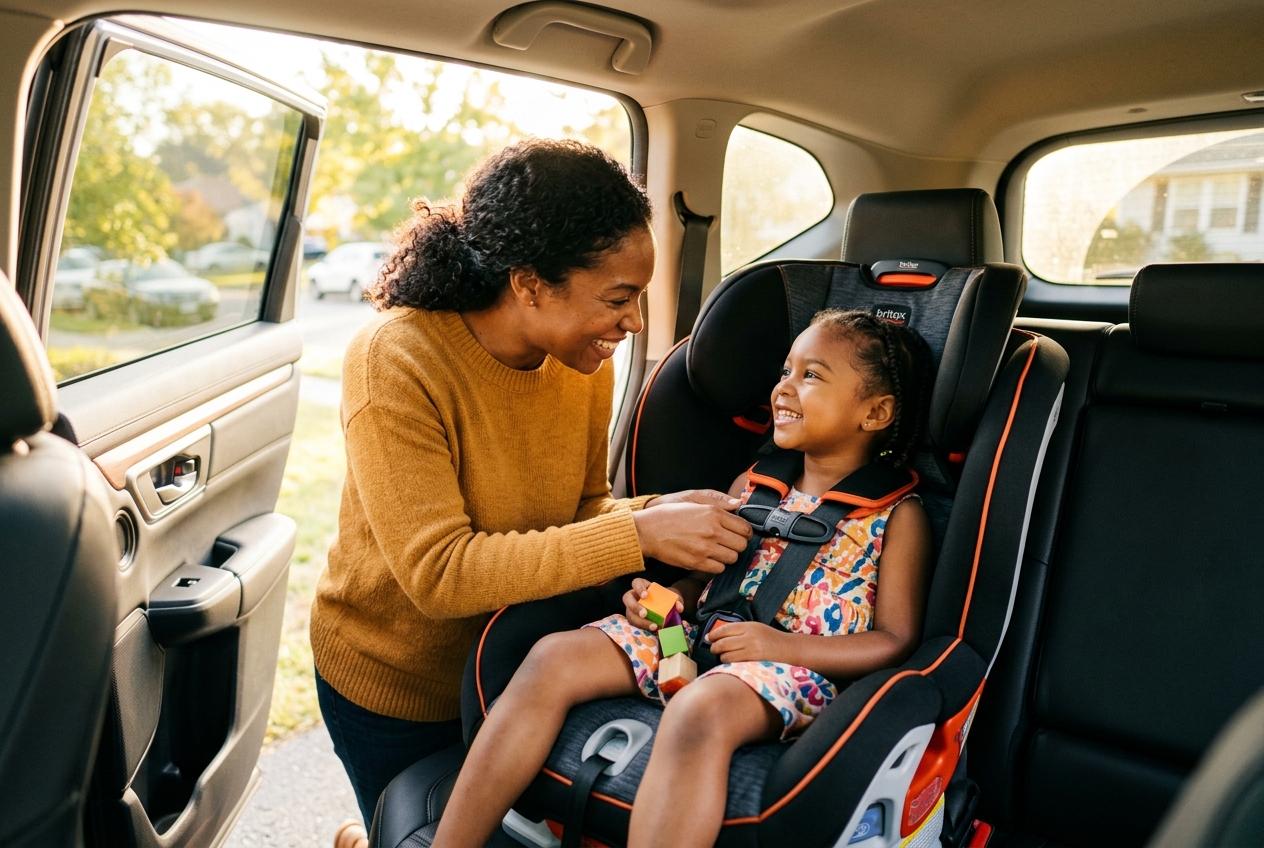
Once your child has outgrown the rear-facing seat, typically between ages one and two depending on the seat’s limits, they move to a forward-facing seat equipped with a five-point harness. The five points refer to the two shoulder straps, two hip straps, and one crotch strap, all meeting at a central buckle. This system keeps the child firmly in place and distributes crash energy across the body’s strongest skeletal areas.
In Georgia, children should use a forward-facing harnessed seat from roughly age one (or when they exceed the rear-facing seat’s limits) until about age four. The harness straps should sit at or above the child’s shoulders in forward-facing mode. A common mistake I see is parents loosening the harness for comfort. You should be able to fit only one finger between the strap and your child’s collarbone. Any looser and the seat can’t do its job.
If you’re purchasing a car seat in Georgia, you’ll find options at stores in Tbilisi’s malls and through online Georgian retailers. European-certified seats (look for the ECE R44/04 or the newer R129/i-Size labels) are your safest bet, as these align with the standards Georgia’s regulations reference.
Transitioning to Adult Seat Belts
The booster seat phase bridges the gap between the harnessed seat and the adult seat belt. A child typically moves to a booster around age four and stays in one until they’re at least eight years old and 150 centimeters tall. The booster raises the child so the vehicle’s lap-and-shoulder belt fits properly: the shoulder belt should cross the middle of the chest and shoulder, and the lap belt should sit low across the upper thighs, not the stomach.
The transition to an adult seat belt happens when the child can sit with their back flat against the vehicle seat, their knees bending naturally at the seat edge, and the belt fitting correctly without a booster. If any of those criteria aren’t met, the child needs to stay in the booster regardless of age. Most children reach this point somewhere between ages eight and twelve.
Proper Placement and the ‘Back Seat Only’ Rule
Where you put the car seat in the vehicle matters almost as much as the seat itself. Georgian traffic safety guidelines align with international best practices on this point: children belong in the back seat.
Why Children Under 13 Should Stay in the Back
The back seat is statistically the safest place in a vehicle for children. Studies on crash dynamics consistently show that rear-seat passengers face significantly lower fatality risk than those in the front, particularly in frontal collisions, which are the most common type of serious crash. The center of the back seat is the single safest position, though it only works if your vehicle has a proper three-point seat belt or LATCH/ISOFIX anchor there.
Georgian regulations strongly recommend that all children under 13 ride in the rear seat. While enforcement of the specific “under 13” guideline can vary, the underlying safety logic is unambiguous. I’ve noticed that in Georgia, cultural norms sometimes put older children or even younger ones in the front passenger seat, especially in rural areas. This is a habit worth breaking.
Airbag Safety Risks for Front-Seat Passengers
The front passenger airbag is designed for adult bodies. When it deploys, it inflates with enormous force, fast enough to protect a 70-kilogram adult but powerful enough to seriously injure or kill a small child. A rear-facing infant seat should never be placed in front of an active airbag. The force of deployment can slam the seat backward into the child with fatal consequences.
Even for older children in booster seats, the front seat is a bad idea. The airbag deployment zone is calibrated for adult chest height, and a child’s smaller frame means the bag can strike the head and neck instead. Some vehicles allow you to deactivate the front passenger airbag, but unless you’re absolutely certain the airbag is off and you have no other option, keep kids in the back. Period.
Penalties for Non-Compliance and Traffic Fines
Georgia’s traffic fine system has been modernized significantly since the Rose Revolution era, and penalties for child restraint violations are real and enforced.
Impact on Driver’s License Points
Georgian traffic law operates on a points-based system. Drivers accumulate points for various violations, and reaching the threshold triggers license suspension. A child restraint violation adds points to the driver’s record, compounding the financial penalty with longer-term consequences. For drivers who already have points from speeding or other infractions, a car seat violation could push them over the edge into suspension territory.
This is especially relevant for expats and long-term residents who hold Georgian driver’s licenses. Points don’t reset quickly, and the accumulation can sneak up on you. If you’re a frequent driver in Georgia, treating child restraint compliance as non-negotiable protects both your child and your driving privileges.
Fines for First and Subsequent Offenses
The fine for a first offense of failing to properly restrain a child passenger in Georgia is typically around 40 GEL (roughly 15 USD at current exchange rates). That might sound modest, but repeat offenses carry higher penalties, and the financial sting adds up if you’re cited multiple times. Georgian traffic police have the authority to issue fines on the spot, and traffic violations are increasingly monitored through both patrol officers and fixed camera systems in major cities.
Beyond fines, there’s the practical reality that your vehicle can be stopped and delayed during a traffic check. Georgian police conduct periodic checkpoints, particularly on major highways connecting Tbilisi to other cities, and child restraint compliance is one of the things they look for. Having the correct seat installed and your child properly buckled saves you time, money, and stress.
Installation Resources and Safety Inspections in Georgia
Owning the right car seat is only half the equation. A staggering percentage of car seats globally are installed incorrectly, and Georgia is no exception. Misrouted straps, loose installations, and incorrect recline angles are common problems that dramatically reduce a seat’s effectiveness in a crash.
Finding a Certified Child Passenger Safety Technician
In many Western countries, certified Child Passenger Safety Technicians (CPSTs) offer free seat checks. Georgia’s infrastructure for this is still developing, but it’s not nonexistent. Several NGOs focused on road safety in Georgia, particularly those funded through EU partnership programs, have trained technicians who can inspect your installation. The Safe Kids Georgia initiative and similar organizations periodically hold car seat check events in Tbilisi.
If you can’t find a certified technician nearby, your next best option is to carefully follow the car seat manufacturer’s installation manual and your vehicle’s owner manual simultaneously. Watch the manufacturer’s installation videos if available. The two most common errors are failing to lock the seat belt in “lock mode” (most seat belts have a mechanism for this) and not tightening the installation enough. A properly installed seat should not move more than 2.5 centimeters (about one inch) side to side at the belt path.
Local Fire Stations and Police Checkpoints
In Tbilisi and some larger Georgian cities, local fire stations and police stations occasionally offer informal car seat assistance. This isn’t as formalized as programs you’d find in Western Europe, but asking at your nearest fire station is worth a try, especially if you explain that you need help with a child safety seat. Georgian hospitality, rooted in the cultural principle of “stumari ghvtisaa” (the guest is a gift from God), often extends to this kind of practical help, and I’ve heard from multiple parents who received patient, hands-on assistance from local firefighters.
Police checkpoints, while primarily enforcement-oriented, can also be an opportunity. Officers at these stops are generally familiar with the car seat requirements and can point you toward local resources if you ask. Some parents find this counterintuitive, but Georgian police, particularly the younger generation trained under post-2003 reforms, are often approachable and willing to help rather than simply fine you.
Keeping Your Kids Safe on Georgian Roads
Georgia’s child car seat laws exist for a clear reason: the country’s roads, while improving, still present real risks. Mountain highways, aggressive urban driving in Tbilisi, and unpredictable rural road conditions all make proper child restraint essential rather than optional. The legal requirements under O.C.G.A. § 40-8-76 set a minimum standard, but smart parents treat them as a floor, not a ceiling.
Get the right seat for your child’s age and size. Install it correctly in the back seat. Keep your child in a booster until they genuinely fit an adult belt. And if you’re unsure about your installation, seek help from a trained technician or a local fire station. The few minutes of effort and modest cost involved are trivial compared to what’s at stake. Georgia is a beautiful country to explore with a family: just make sure everyone’s buckled in properly before you hit the road.