
Table of Contents
- Planning Your Half-Day Trip from Tbilisi to Uplistsikhe and Gori
- Getting There by Car: Route Logistics and Road Conditions
- The Gori Stop: History and Architecture
- Exploring Uplistsikhe Cave Town
- Essential Visitor Tips for the Cave Complex
- A Step-by-Step Half-Day Itinerary and Time Management
- Where to Eat and Refuel Near Gori
- Frequently Asked Questions About Visiting Gori and Uplistsikhe
The drive from Tbilisi to the ancient cave city of Uplistsikhe, with a stop in Gori along the way, is one of the most rewarding half-day road trips you can do in Georgia. You’re looking at roughly 90 minutes of driving each way, two genuinely fascinating historical sites, and a lunch stop that’ll cost you less than a decent coffee in most European capitals. If you’ve rented a car or are using a carshare service in Tbilisi, this trip requires zero planning stress: the roads are good, the route is straightforward, and you can be back in the capital by late afternoon. Here’s exactly how to pull it off.
Georgia’s tourism numbers have been climbing fast, with the country welcoming a record 5.5 million international tourists in 2025, so arriving early matters more than it used to. This guide breaks down the logistics, timing, and practical details you need to make this half-day trip smooth and worthwhile.
Planning Your Half-Day Trip from Tbilisi to Uplistsikhe and Gori
The basic structure is simple: drive west from Tbilisi to Gori, spend about an hour there, then continue 15 km east to the cave town, and loop back to the capital. The whole thing fits comfortably into five to six hours, including drive time, site visits, and a meal.
Here’s what the distance and timing look like:
| Segment | Distance | Drive Time | Time at Site |
|---|---|---|---|
| Tbilisi to Gori | ~86 km | 1 hr 10 min | 1-1.5 hrs |
| Gori to Uplistsikhe | ~15 km | 20 min | 1-1.5 hrs |
| Uplistsikhe to Tbilisi | ~98 km | 1 hr 20 min | – |
I’d recommend leaving Tbilisi by 8:30 or 9:00 AM. That puts you in Gori before 10:30, gives you time at both sites, and gets you back to the capital around 3:00 PM with a lunch break included. Summer months (June through August) get hot in the Shida Kartli region, and the cave complex has almost no shade, so morning visits are significantly more comfortable.
This trip works any day of the week, but note that the Stalin Museum in Gori is open daily. Uplistsikhe is also open every day, though hours can shift seasonally. Confirm locally before you go, especially between November and March.
Getting There by Car: Route Logistics and Road Conditions
From central Tbilisi, you’ll take the E60 highway westward. This is Georgia’s main east-west artery connecting the capital to Kutaisi and eventually Batumi, so it’s well-maintained and mostly dual carriageway. No 4×4 needed. The road surface is asphalt throughout, and you’ll pass through the Rikoti-adjacent corridor without any mountain passes on this stretch.
A few things to know about driving this route in 2026:
- Speed cameras are common on the E60. The limit is typically 110 km/h on the highway sections and drops to 60 km/h through towns. Fines arrive by mail if you’re in a rental.
- Fuel stations (Socar, Gulf, Wissol) appear every 15-20 km along the highway. Fill up before leaving Tbilisi or top off in Gori.
- The turnoff to Gori is clearly signposted. From the highway, you’ll exit south into the city center.
For the Gori-to-Uplistsikhe segment, you’ll take a local road heading east along the Mtkvari River. It’s a two-lane road in decent condition. The final stretch to the cave town has a small parking area right at the entrance. Parking is free and accommodates about 40-50 cars, but it fills up by midday in peak season.
Tip: If you’re using Google Maps or Waze, search for “Uplistsikhe Cave Town” rather than just the town name. The pin drops you right at the visitor entrance and parking lot.
The Gori Stop: History and Architecture
Gori is a small city of about 50,000 people sitting in the fertile Shida Kartli valley, and it’s been a strategic settlement for centuries due to its position at the confluence of the Mtkvari and Liakhvi rivers. For most international visitors, Gori means two things: the Stalin Museum and the hilltop fortress. Both are within walking distance of each other in the compact city center.
The city itself has a Soviet-era grid layout with a central square and tree-lined avenues. It’s not a place you’ll spend half a day wandering, but the two main sites are genuinely worth your time.
Visiting the Stalin Museum in Gori
Joseph Stalin was born Ioseb Jughashvili in Gori in 1878, and this museum, opened in 1957, occupies a large building on the city’s main avenue. It’s one of the most unusual museum experiences in the Caucasus: the exhibits are presented with a biographical, almost reverential tone that can feel jarring to Western visitors familiar with the full scope of Stalin’s legacy.
The museum houses personal belongings, photographs, documents, and one of Stalin’s death masks. Outside, you can see his childhood home (a small brick dwelling preserved under a pavilion) and his personal railway carriage. The presentation is deliberately neutral-to-positive, which itself becomes part of the experience: it tells you something about how complicated historical memory is in this part of the world.
Expect to spend 30-45 minutes here. Entrance fees are modest (typically 15 GEL for adults), though prices may adjust, so check at the ticket window. Photography is allowed inside.
Gori Fortress: Panoramic Views of the City
The Gori Fortress, known locally as Goris Tsikhe, sits on a rocky hill directly above the city center. You can see it from the museum. The walk up takes about 10 minutes from the base, and the path is paved but steep in places.
The fortress dates back to at least the early medieval period, with some archaeological evidence suggesting habitation from the Bronze Age. The walls you see today are mostly from later reconstructions. Honestly, the structure itself is partially ruined and there’s not much interpretive signage, but the views over Gori, the river valley, and the surrounding hills are excellent. Budget 20-30 minutes for the climb and a look around.
Important: Wear shoes with decent grip. The stone surfaces near the top can be slippery, especially after rain. There are no railings in several areas.
Exploring Uplistsikhe Cave Town
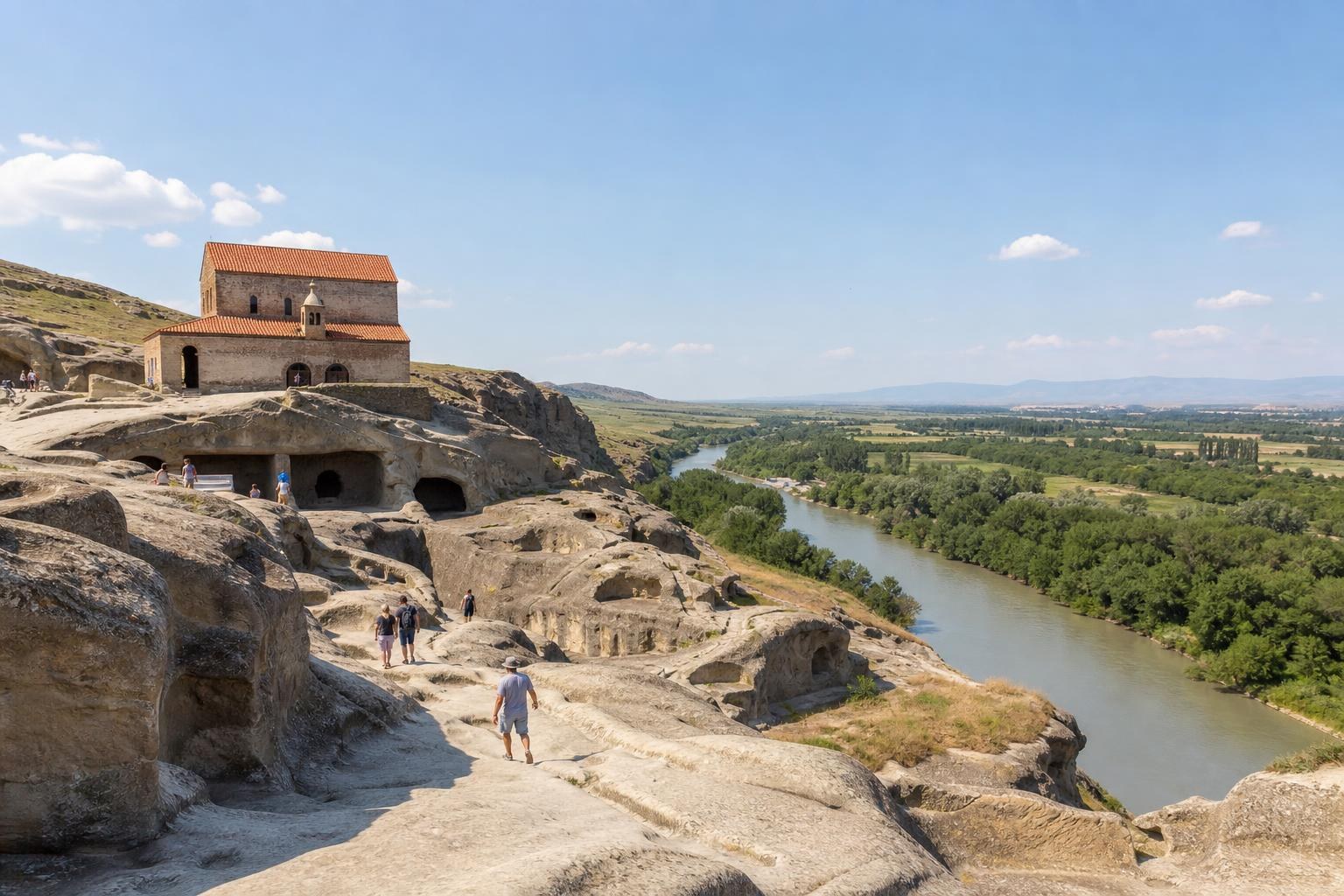
This is the highlight of the trip. The ancient rock-cut city sits on a rocky ridge above the Mtkvari River, about 15 km east of Gori. It’s one of the oldest urban settlements in the Caucasus, with evidence of habitation stretching back to the late Bronze Age, roughly 3,000 years.
The site covers a large hillside and contains the remains of streets, dwellings, a theater, ritual halls, and a Christian basilica. Unlike Vardzia (the other famous cave complex in Georgia, located much farther south), the Uplistsikhe cave town feels more like an actual city carved from sandstone rather than a monastic retreat. The scale is impressive: at its peak, this place housed thousands of people.
Ancient Rock-Cut Architecture and Key Structures
Walking through the complex, you’ll notice the sophistication of the carving. The so-called “Queen Tamar’s Hall” features a coffered ceiling carved directly into the rock, imitating wooden beam construction. There’s a large hall believed to have been a pagan temple, a wine cellar with stone qvevri pits, and what appears to have been a pharmacy.
The streets are clearly defined, with drainage channels cut into the stone. Some chambers have carved niches that likely held oil lamps. A tunnel (now partially accessible) once connected the city to the river below, serving as a secret water supply during sieges.
A 2026 study identified 168 new Bronze and Iron Age sites across Georgia, which has increased academic attention on sites like this one. The cave town sits within that same deep archaeological tradition, and ongoing preservation efforts continue to reveal new details about how these spaces were used.
Historical Significance: From Paganism to Christianity
The city’s history mirrors Georgia’s own religious transition. For most of its early existence, Uplistsikhe was a center of pagan worship, likely dedicated to a sun goddess. The large ritual halls and sacrificial chambers support this interpretation. After Georgia adopted Christianity in the 4th century, the site was gradually converted: a three-nave basilica church was built on top of the ridge, probably in the 9th or 10th century, and it still stands today.
The city reached its political peak between the 6th and 10th centuries, when it served as a major trade hub on one of the Silk Road branches. Its decline came with the Mongol invasions of the 13th century, after which the population largely abandoned the site.
The National Agency for Cultural Heritage Preservation has been implementing new monitoring and inspection frameworks for high-priority monument complexes like this one, which bodes well for the site’s long-term conservation.
Essential Visitor Tips for the Cave Complex
The site is open year-round, but conditions vary dramatically by season. Here’s what you should know before visiting:
- The standard adult entrance fee is 15 GEL (as of early 2026). Audio guides cost an additional 15 GEL, and hiring a private English-speaking guide runs about 45 GEL.
- There is no shade on the ridge. In summer, temperatures can exceed 35°C. Bring water, sunscreen, and a hat. Seriously.
- The walking paths involve uneven rock surfaces, steep inclines, and occasional drops without barriers. This is not a fully accessible site. Sturdy footwear is essential.
- The visit takes 60-90 minutes at a comfortable pace. Rushing through in 30 minutes means missing most of the interesting chambers.
Note: There’s a small shop near the entrance selling water and snacks, but prices are marked up. Bring your own supplies from Gori.
Photography is unrestricted throughout the site. Early morning light (before 11 AM) is best for photos, as the sandstone glows warm and the shadows define the carved architecture beautifully.
A Step-by-Step Half-Day Itinerary and Time Management
Here’s a practical schedule that works for a self-drive trip, assuming you’re based in Tbilisi:
- Depart Tbilisi at 8:30 AM. Take the E60 west.
- Arrive in Gori around 9:45 AM. Park near the Stalin Museum (free street parking is usually available on the surrounding blocks).
- Visit the Stalin Museum: 9:45-10:30 AM.
- Walk up to Gori Fortress: 10:30-11:00 AM.
- Drive to the cave town: 11:15-11:35 AM.
- Explore the site: 11:35 AM – 1:00 PM.
- Lunch near Gori or on the highway: 1:15-2:00 PM.
- Drive back to Tbilisi: arrive around 3:15-3:30 PM.
This schedule has buffer built in. If you’re an early riser, leaving at 8:00 AM gives you even more breathing room. If you want to linger at the cave complex, you can easily push the return to 4:00 PM and still make it back before evening traffic picks up on the E60 approach to Tbilisi.
For planning road trips like this across Georgia, resources like Triproadwayplanner can help you map out routes, check distances, and estimate realistic drive times.
Where to Eat and Refuel Near Gori
Gori has a handful of solid local restaurants, and you don’t need to overthink this. The area around the central square has several family-run spots serving standard Georgian fare: khinkali, khachapuri, grilled meats, and fresh salads. Expect to pay 15-25 GEL per person for a full meal with a drink.
A few practical pointers:
- If you’d rather not stop in Gori proper, there are roadside restaurants along the E60 between Gori and Tbilisi. Look for places with trucks parked outside: that’s usually a sign the food is cheap, filling, and decent.
- The gas stations on the highway (Wissol and Gulf are the most common) have convenience stores with coffee, sandwiches, and snacks if you just want to grab something quick.
- There’s no real restaurant at the cave town site itself, just the small kiosk mentioned earlier. Plan to eat before or after your visit.
Tip: Georgian portions are enormous. If you’re ordering khinkali, 5-6 dumplings is a full meal for most people. Don’t let the low prices trick you into over-ordering.
Frequently Asked Questions About Visiting Gori and Uplistsikhe
How long does it take to drive from Tbilisi to Uplistsikhe?
The direct drive is about 1 hour and 20 minutes via the E60 highway, covering roughly 98 km. If you stop in Gori first (recommended), add 20 minutes for the Gori-to-cave-town segment.
Do I need a guide at the cave town, or can I explore independently?
You can absolutely explore on your own. The site has some signage, though it’s limited. An audio guide (15 GEL) adds helpful context. If you’re interested in the archaeological and religious history, the 45 GEL for a private English-speaking guide is money well spent.
Is the cave complex suitable for children?
Kids generally enjoy it because it feels like exploring a real ancient city. However, the terrain is uneven and there are steep drops in places without guardrails. Keep a close eye on younger children, and consider carrying toddlers in a hiking carrier rather than a stroller.
What’s the best time of year to visit?
Spring (April to June) and early autumn (September to October) offer the best conditions: warm but not scorching, with manageable visitor numbers. July and August are hot and increasingly crowded. Winter visits are possible but the site can be slippery and exposed to cold winds.
Is the Stalin Museum controversial?
It depends on your perspective. The museum presents Stalin’s life in a biographical format without much critical commentary on the repressions, purges, or famines associated with his rule. Many visitors find this absence itself thought-provoking. Approach it as a historical artifact rather than a balanced account, and it becomes a fascinating window into how contested figures are remembered locally.
This half-day loop from Tbilisi packs a surprising amount of history into a short drive. You get a 3,000-year-old rock-cut city, a medieval fortress, a museum that challenges your assumptions, and some of the best roadside khinkali in the country. It’s the kind of trip that reminds you why having a car in Georgia opens up so much more than the capital alone can offer. Leave early, bring water, and give the cave complex the time it deserves.