
Table of Contents
- 10 Days in Georgia: The Ultimate Road Trip Route Overview
- Days 1-2: Tbilisi and the Wine Region of Kakheti
- Days 3-4: The Georgian Military Highway to Kazbegi
- Days 5-6: Cave Cities and Spas in Vardzia and Borjomi
- Day 7: Canyons and Monasteries Around Kutaisi
- Days 8-9: High Caucasus Adventure in Svaneti (Mestia)
- Day 10: The Black Sea Coast and Batumi Finish
- Essential Georgia Travel Route Logistics and Seasonal Advice
- Frequently Asked Questions About Driving in Georgia
Ten days, one rental car, and a country that packs snow-capped peaks, ancient cave cities, 8,000 years of winemaking, and a subtropical coastline into an area smaller than South Carolina. A Georgia itinerary of 10 days by car is one of the most rewarding road trips in Europe or Asia, depending on which continent you think the Caucasus belongs to. This route moves counterclockwise from Tbilisi through Kakheti’s vineyards, up the Military Highway to Kazbegi, south to the cave monasteries of Vardzia, west through Kutaisi’s canyons, into the high Svaneti mountains, and finishes on the Black Sea in Batumi. You’ll cover roughly 1,400 km of driving, sleep in seven or eight different towns, and spend less than you would on a long weekend in most Western European capitals. One critical update for 2026: all foreign tourists entering Georgia must carry health and accident insurance with minimum coverage of 30,000 GEL for their entire stay. Sort that before you land.
10 Days in Georgia: The Ultimate Road Trip Route Overview
This Georgia road trip itinerary is designed as a one-way loop starting in Tbilisi and ending in Batumi, though you can reverse it or return to Tbilisi on Day 10 if your rental agreement requires a same-city drop-off. Here’s the route at a glance:
| Stage | Route | Distance | Drive Time | Overnight |
|---|---|---|---|---|
| Days 1-2 | Tbilisi → Kakheti | ~110 km | 1.5-2 hrs | Sighnaghi or Telavi |
| Days 3-4 | Tbilisi → Kazbegi | ~155 km | 3-3.5 hrs | Stepantsminda |
| Days 5-6 | Kazbegi → Borjomi → Vardzia | ~380 km | 6-7 hrs (split) | Borjomi, then Akhaltsikhe |
| Day 7 | Akhaltsikhe → Kutaisi | ~200 km | 3.5-4 hrs | Kutaisi |
| Days 8-9 | Kutaisi → Mestia | ~240 km | 5-6 hrs | Mestia |
| Day 10 | Mestia → Batumi | ~280 km | 6-7 hrs | Batumi |
Total driving across 10 days: roughly 1,350-1,400 km. No single day exceeds seven hours behind the wheel, and most are under four. The completion of the Rikoti Pass highway has cut the Tbilisi-to-Batumi direct drive to about 4.5-5 hours, which makes the western half of Georgia far more accessible than it was even two years ago.
Tip: Download offline maps for all of Georgia before you leave Tbilisi. Cell coverage drops out in the Svaneti valleys and around Vardzia.
Days 1-2: Tbilisi and the Wine Region of Kakheti
Spend your first morning in Tbilisi getting oriented: the sulfur baths in Abanotubani, the cable car to Narikala Fortress, and a walk through the Dry Bridge flea market. Don’t try to “do” Tbilisi in a morning, but these three stops give you a strong first impression. Grab a rental car in the afternoon and head east toward Kakheti.
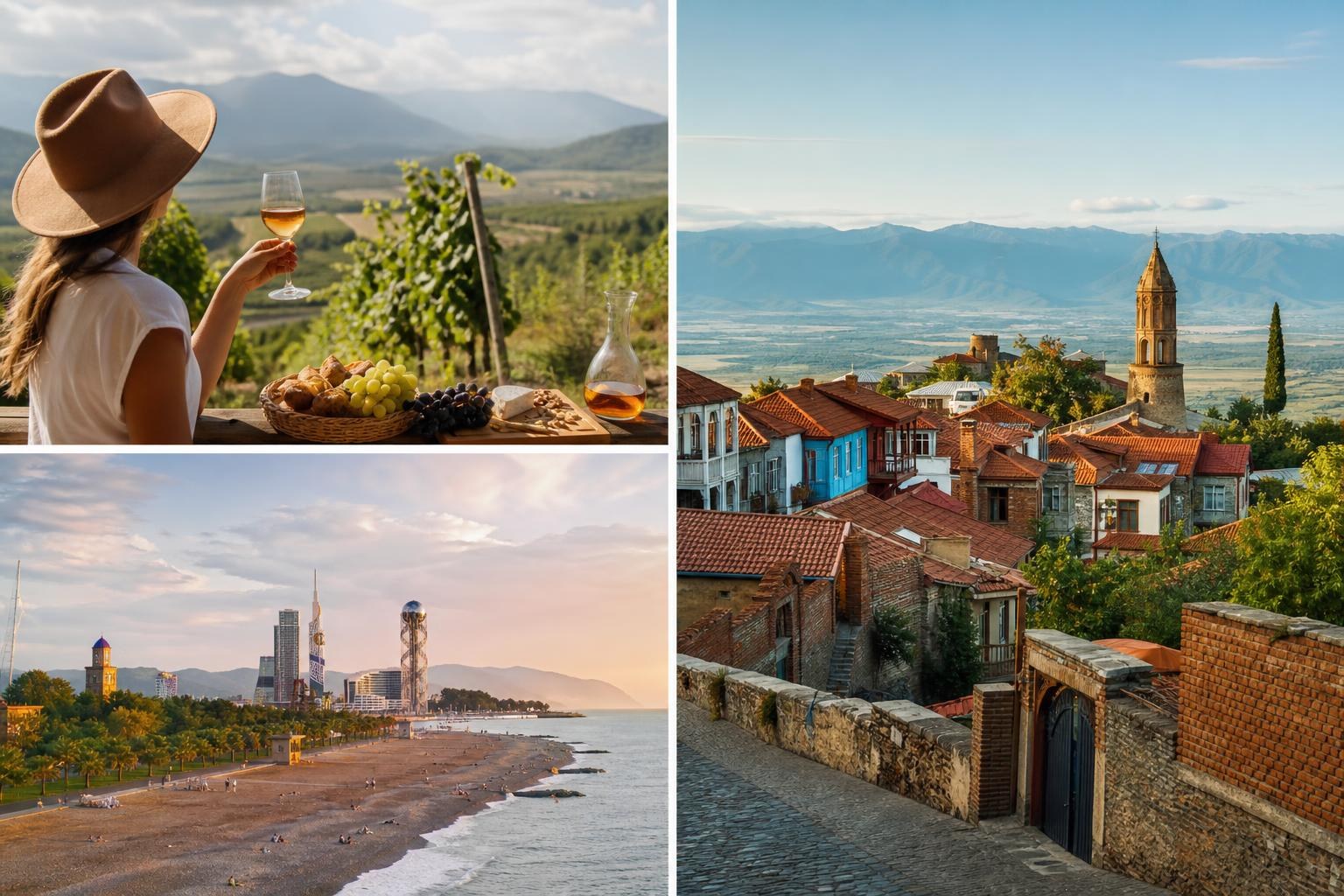
Kakheti is where Georgians have been making wine in clay qvevri vessels for roughly 8,000 years. The town of Sighnaghi sits on a ridge overlooking the Alazani Valley, and its compact old town is walkable in an hour. Day two should be spent visiting two or three family wineries: Pheasant’s Tears in Sighnaghi and Shumi or Twins Wine Cellar near Telavi are well-established names, but smaller family operations often give you a more personal tasting.
Important: Georgia takes drink-driving seriously, and enforcement has tightened under the National Road Safety Strategy 2026-2030. The legal blood alcohol limit is 0.0% for drivers. If you’re tasting wine, designate a sober driver, hire a local taxi between wineries, or stay overnight near the cellar.
Getting There by Car: Tbilisi to Sighnaghi
The drive from central Tbilisi to Sighnaghi takes about 1.5-2 hours via the E60 and then south on a well-paved two-lane road. No 4×4 needed. Parking in Sighnaghi is easy: there’s a free lot near the city wall entrance. If you’re heading to Telavi instead, add 30 minutes. The road between Sighnaghi and Telavi runs through the valley floor and is in good condition year-round.
Days 3-4: The Georgian Military Highway to Kazbegi
Return to Tbilisi from Kakheti on the morning of Day 3, then head north on the Georgian Military Highway toward Stepantsminda (still commonly called Kazbegi). This is one of the most dramatic mountain drives anywhere in the world: the road climbs from 500 m elevation in Tbilisi to the 2,379 m Jvari Pass, passing the Ananuri fortress complex and the ski resort of Gudauri along the way.
Your goal in Stepantsminda is the Gergeti Trinity Church, perched at 2,170 m with Mount Kazbek (5,054 m) towering behind it. You can hike up in about 1.5 hours or drive a 4×4 track in 20 minutes. Day four is best spent on a longer hike toward the Gergeti Glacier or exploring the Truso Valley, a less-visited gorge east of the main highway with mineral springs and abandoned villages.
A high-altitude mountain rescue integration project is set for final implementation in the Kazbegi region in late 2026, which should improve emergency response times. Still, private helicopter evacuations in this area currently run between $3,000 and $10,000 USD, so make sure your insurance covers mountain rescue.
Getting There by Car: Tbilisi to Stepantsminda
The drive is 155 km and takes 3-3.5 hours without stops, though you’ll want to stop at Ananuri and Gudauri. The road is fully paved and doesn’t require a 4×4. The Kvesheti-Kobi highway construction has progressed significantly, and the access road to Gudauri is open, reducing the risk of winter closures that used to trap travelers for days. That said, if you’re driving between November and March, carry chains and check road conditions before departing. Parking in Stepantsminda is available at most guesthouses.
Days 5-6: Cave Cities and Spas in Vardzia and Borjomi
This is the longest transfer of the trip, so I recommend splitting it. Drive from Stepantsminda back through Tbilisi and continue south toward Borjomi, arriving by late afternoon. Borjomi is famous for its mineral water (you’ll see the green bottles everywhere in Georgia), and the town’s central park has a free spring where you can fill your own bottle. The taste is aggressively mineral: love it or hate it, you have to try it.
On Day 6, drive an hour south to Vardzia, a 12th-century cave monastery carved into a cliff face by Queen Tamar. The complex originally contained over 6,000 rooms across 13 stories. What remains is still staggering: hundreds of caves connected by tunnels, with a church featuring original frescoes from the 1180s. Plan two to three hours for the site.
Getting There by Car: Kazbegi to Borjomi/Vardzia
Kazbegi to Borjomi is roughly 380 km and takes 6-7 hours if driven straight. The route goes back through Tbilisi and then southwest on the main highway toward Akhaltsikhe. The road is paved throughout, and a standard sedan handles it fine. From Borjomi to Vardzia is another 100 km on a good two-lane road. Overnight options include Borjomi (more hotels, spa facilities) or Akhaltsikhe (closer to Vardzia, with the restored Rabati Castle worth an evening visit).
Day 7: Canyons and Monasteries Around Kutaisi
Kutaisi, Georgia’s second city, is your gateway to some of the country’s most impressive natural sites. The Martvili Canyon offers boat rides through a narrow limestone gorge with turquoise water, and the Okatse Canyon has a walkway bolted to the cliff face that ends at a viewing platform hanging over a 140 m drop. You can visit both in a single day if you start early.
Don’t skip Gelati Monastery, a UNESCO World Heritage Site about 10 km northeast of Kutaisi. Built by King David the Builder in 1106, it houses some of the finest medieval frescoes in the Caucasus. The monastery is free to enter and rarely crowded on weekday mornings.
- Martvili Canyon: boat rides run from April through October, with tickets available on-site. Arrive before 10 AM to avoid tour groups.
- Okatse Canyon: the walkway is roughly 700 m long. Wear shoes with grip. Closed in heavy rain or snow.
- Prometheus Cave: if you have extra time, this illuminated show cave is 20 minutes from Kutaisi and worth a quick visit.
Days 8-9: High Caucasus Adventure in Svaneti (Mestia)
Svaneti is the wildest part of this 10-day Georgia itinerary, and it’s the stage that separates a good trip from a great one. The Mestia region sits at around 1,500 m elevation, surrounded by peaks above 4,000 m, and is famous for its medieval defensive towers: stone structures built by families to protect against blood feuds and invaders. Around 175 towers survive in the Upper Svaneti UNESCO zone.
Day 8 is best spent in Mestia itself: visit the Svaneti Museum of History and Ethnography, hike to the Chalaadi Glacier (a 3-hour round trip from the trailhead), and explore the tower-studded streets. On Day 9, drive or hike to Ushguli, one of the highest continuously inhabited settlements in Europe at 2,200 m. The road to Ushguli is rough, unpaved, and takes 2-3 hours each way by 4×4. It’s not suitable for a standard sedan.
Note: Ushguli road conditions vary wildly by season. In spring (April-May), snowmelt can make river crossings impassable. July through September is the most reliable window. Ask locally before attempting the drive.
Getting There by Car: Kutaisi to Mestia
The drive from Kutaisi to Mestia covers about 240 km and takes 5-6 hours. The first half is on a decent highway toward Zugdidi. After Zugdidi, the road narrows and climbs through the Enguri Valley, with increasingly tight switchbacks for the final 90 minutes. A 4×4 is not strictly necessary for the Kutaisi-to-Mestia road itself (it’s paved, if narrow), but you will want one if you plan to drive to Ushguli. Some travelers park their sedan in Mestia and hire a local driver with a 4×4 for the Ushguli day trip: a practical compromise.
Day 10: The Black Sea Coast and Batumi Finish
Your final day brings you from the mountains to the sea. Batumi is Georgia’s main Black Sea resort city, and it has transformed over the past decade into a surprisingly modern place with a long seaside boulevard, botanical gardens, and a growing restaurant scene. The old town retains some 19th-century charm with its wooden balconied houses, and the evening light on the waterfront is worth lingering for.
Construction began in 2025 on the “Ambassadori Island” project, which will eventually add artificial peninsulas and a forest park to Batumi’s coastline. As of 2026, it’s still a construction zone, but the city has plenty to fill an evening and morning before you catch a flight from Batumi airport or begin the 5-hour drive back to Tbilisi.
Getting There by Car: Mestia to Batumi
This is a long day: roughly 280 km and 6-7 hours of driving. The route descends from Mestia to Zugdidi, then follows the highway south along the coast through Poti and Kobuleti to Batumi. The coastal highway is flat and well-maintained. If you’re returning your rental car in Batumi, confirm one-way drop-off fees when you book: these typically range from 80 to 150 GEL depending on the company, though rates vary. Some agencies don’t allow one-way returns at all, so check before you commit.
Essential Georgia Travel Route Logistics and Seasonal Advice
The best months for this full route are mid-May through mid-October. July and August bring the most reliable access to Svaneti and the high passes, but also the most tourists and the hottest temperatures in Tbilisi (regularly above 35°C). June and September hit a sweet spot: warm enough for mountain roads, cool enough for comfortable sightseeing.
- Fuel stations are plentiful on main highways but scarce in Svaneti and around Vardzia. Fill up before entering remote areas.
- Speed cameras are common on the highway between Tbilisi and Kutaisi. The limit is typically 110 km/h on highways and 60 km/h in towns.
- Foreigners can drive with a valid national license in Latin script for up to one year from their last entry. If your license uses a non-Latin alphabet, get an International Driving Permit before you arrive.
One-Way Rentals vs. Circular Loops
If your rental company charges steep one-way fees or doesn’t offer Batumi drop-off, you have two options. First, you can reverse the last two stages: go Kutaisi → Batumi → Mestia → back to Tbilisi, though this adds a full day of backtracking. Second, you can skip the Batumi overnight entirely and drive directly from Mestia back to Kutaisi on Day 9, then Kutaisi to Tbilisi on Day 10 using the fast Rikoti highway. Triproadwayplanner’s route guides can help you compare loop options and estimate realistic drive times for each variation.
Frequently Asked Questions About Driving in Georgia
Is 10 days enough to see all of Georgia by car?
Ten days covers the highlights comfortably without feeling rushed. If you want to add Tusheti (which requires a serious 4×4 and a full extra day), or spend more time in Kakheti’s wine country, consider extending to two weeks. But 10 days is the sweet spot for a first visit.
Do I need a 4×4 for this route?
For the main route between cities, no. A standard sedan handles every paved road on this itinerary. The exception is the Ushguli road from Mestia, which absolutely requires a 4×4 or a hired local driver. If you’re renting, a compact SUV gives you the most flexibility.
How much does fuel cost in Georgia in 2026?
Fuel prices fluctuate, so check current rates when you arrive. Stations accept both cash (GEL) and cards. Premium fuel is available at most stations on main roads but not guaranteed at rural stops.
Is it safe to drive at night?
I’d strongly advise against it, especially on mountain roads. Livestock wanders onto roads after dark, lane markings are often faded or absent, and some rural sections have no street lighting. Plan your driving for daylight hours.
What happens if my car breaks down in a remote area?
Rental companies typically provide a roadside assistance number, but response times in Svaneti or the Vardzia area can be several hours. Carry a basic emergency kit, water, and a fully charged phone. In Kazbegi and Svaneti, remember that helicopter evacuations cost thousands of dollars: your mandatory travel insurance should cover mountain rescue.
Georgia rewards the self-driven trip in ways that guided tours simply can’t replicate. The freedom to stop at a roadside churchyard, detour to a family winery, or spend an extra hour watching clouds peel off Mount Kazbek is what makes this country special. Ten days, a reliable car, and a willingness to eat whatever a village grandmother puts in front of you: that’s the whole formula.