
Table of Contents
- Planning Your Self-Drive Itinerary from Tbilisi to Vardzia
- The 2-Day Southern Georgia Route Map
- Leg 1: Tbilisi to Borjomi and the Mtkvari Valley
- Exploring Rabati Castle: Akhaltsikhe’s Multi-Cultural Fortress
- The Road to Vardzia: Khertvisi Fortress and Saro Viewpoints
- Discovering the Vardzia Cave Monastery Complex
- Where to Stay: Overnight Options in Akhaltsikhe vs. Vardzia
- The Return Journey: Paravani Lake and the Javakheti Plateau
- Driving Tips for the Samtskhe-Javakheti Region
- Frequently Asked Questions About Visiting Vardzia
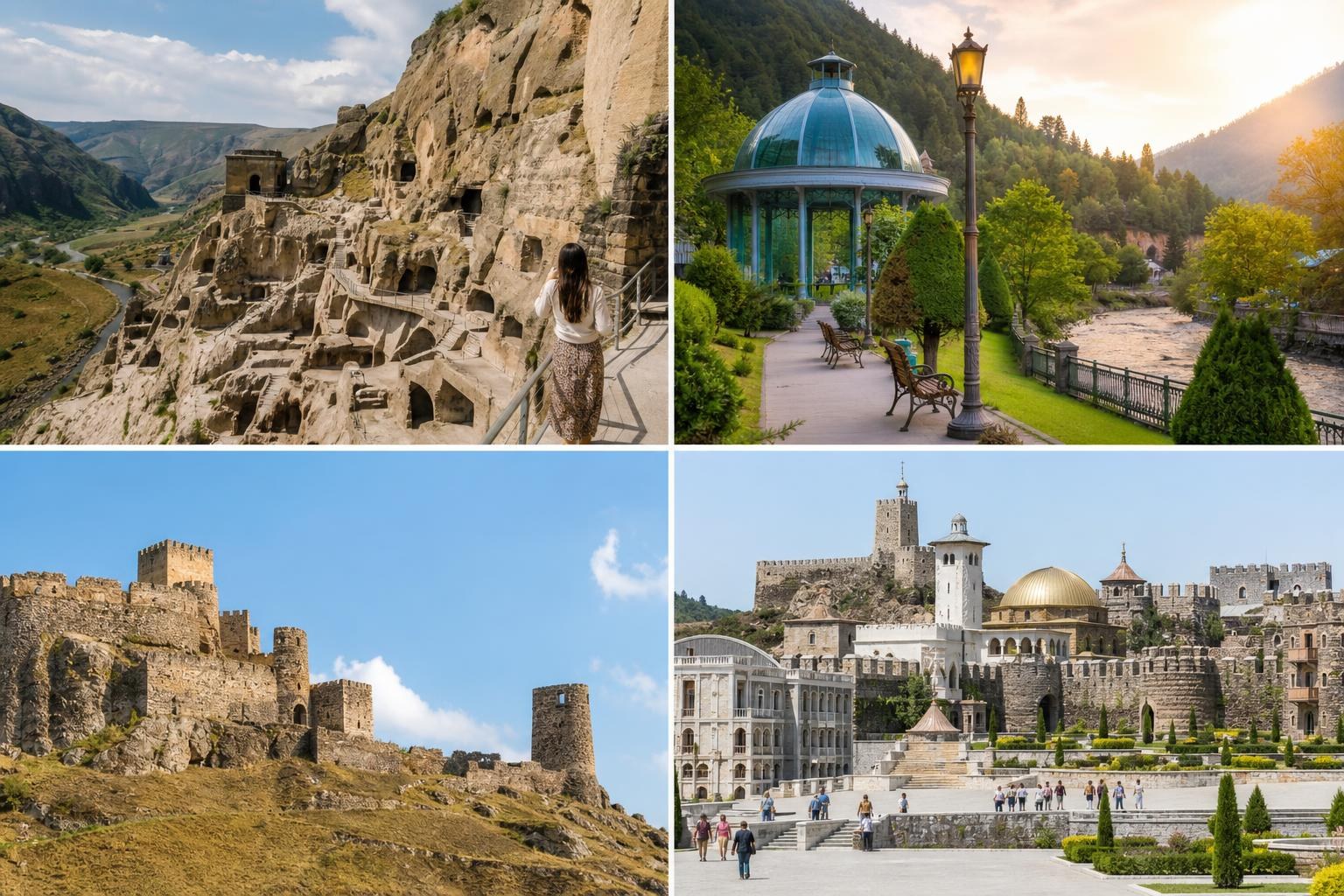
Southern Georgia’s cave city of Vardzia is one of the most extraordinary historical sites in the Caucasus: a 12th-century monastery carved into a sheer cliff face above the Mtkvari River. Getting there by car from Tbilisi takes you through Borjomi’s forested valleys, the fortress town of Akhaltsikhe, and a string of medieval watchtowers that feel like they belong in a film. I’ve driven this route multiple times, and it remains one of my favorite two-day trips in the country. The road is fully paved, the scenery shifts dramatically every hour, and the stops along the way are genuinely worth your time, not just filler between A and B. With international tourist arrivals from the EU and UK growing 14% in early 2026, this corridor is getting busier, so planning ahead matters more than it did a couple of years ago. Here’s exactly how to structure the drive, what to expect at each stop, and the practical details that most guides skip.
Planning Your Self-Drive Itinerary from Tbilisi to Vardzia
The full distance from Tbilisi to the cave monastery is roughly 280 km, and you could technically drive it in under four hours without stopping. Don’t do that. The route passes through places that deserve a proper visit, and the return leg offers an entirely different landscape if you loop back via the Javakheti Plateau.
A rental car is the most practical way to cover this route. Public marshrutkas run to Borjomi and Akhaltsikhe, but connections onward to Khertvisi and the caves are infrequent and inflexible. A standard sedan handles every kilometer of this trip: no 4×4 required. If you’re renting in Tbilisi, pick up the car the evening before so you can leave early.
Tip: Since January 1, 2026, all international tourists entering Georgia must hold health and accident insurance with minimum coverage of 30,000 GEL (roughly $11,000 USD). The policy must be in English or Georgian. Sort this before you arrive.
Two days is the sweet spot. You’ll have time to explore Borjomi, Rabati Castle, and the caves without rushing, and you’ll actually enjoy the drive rather than white-knuckling through it.
The 2-Day Southern Georgia Route Map
Here’s the route broken into its main legs. All distances are approximate and measured from center to center.
| Leg | From | To | Distance | Drive Time | Road Condition |
|---|---|---|---|---|---|
| 1 | Tbilisi | Borjomi | 160 km | 2.5 hrs | Good highway, some winding sections |
| 2 | Borjomi | Akhaltsikhe | 52 km | 45 min | Paved, good condition |
| 3 | Akhaltsikhe | Khertvisi | 30 km | 30 min | Paved, narrow in places |
| 4 | Khertvisi | Vardzia | 18 km | 20 min | Paved, river valley road |
| 5 (return option) | Vardzia | Tbilisi via Paravani | 310 km | 5 hrs | Paved but higher altitude |
Day 1 covers legs 1 through 3, with overnight in Akhaltsikhe. Day 2 hits Khertvisi, the caves, and the return journey. This pacing gives you enough time at each stop without feeling like a forced march.
Leg 1: Tbilisi to Borjomi and the Mtkvari Valley
Leave Tbilisi by 8 a.m. if you can. The first hour follows the E60 highway west before you branch south toward Khashuri. Traffic thins out quickly once you clear the capital’s sprawl, and the road climbs gently through dry scrubland before dropping into the greener Mtkvari valley.
Borjomi sits in a narrow gorge surrounded by dense pine and spruce forest. Most people know it for the mineral water (the brand is everywhere in Georgia), but the town itself is a pleasant place to stretch your legs. Walk through Borjomi Central Park, where you can fill a bottle from the warm sulfur spring for free. The water tastes like warm pennies, but it’s a tradition.
Spend about an hour here. Grab a coffee, use the restrooms in the park, and top up on snacks from the small shops near the park entrance. Khachapuri from the bakeries along the main road costs 3-5 GEL and makes a solid car snack.
Note: The Borjomi-Kharagauli National Park is one of Europe’s largest protected areas and offers excellent day hikes. If you have a third day, it’s worth adding. For this itinerary, keep moving toward Akhaltsikhe.
Exploring Rabati Castle: Akhaltsikhe’s Multi-Cultural Fortress
Akhaltsikhe is 45 minutes south of Borjomi, and Rabati Castle dominates the town from a hill above the river. This fortress complex reflects every empire that passed through: Georgian, Ottoman, Persian. You’ll see a mosque, a church, a synagogue, and a madrasa within the same walls. It’s not a ruin either: the lower section was extensively restored in 2012 and feels almost theme-park polished, while the upper citadel retains a rougher, more authentic character.
The lower courtyard is free to enter. The upper citadel costs 20 GEL for foreign visitors, and the Samtskhe-Javakheti History Museum requires a separate 15 GEL ticket. The museum closes on Mondays, so plan accordingly. Budget about 90 minutes for the full complex.
Akhaltsikhe also has the best selection of restaurants and guesthouses along this route. Eat dinner here: the local khinkali is excellent, and you’ll find several family-run restaurants within walking distance of the castle. Prices for a full meal with drinks run 25-40 GEL per person.
The Road to Vardzia: Khertvisi Fortress and Saro Viewpoints
The morning of day two, head south from Akhaltsikhe toward Khertvisi. The road follows the Mtkvari River through a narrowing valley, and the landscape shifts from gentle farmland to something starker and more dramatic. Dry cliffs rise on both sides, dotted with abandoned cave dwellings that predate the main Vardzia complex.
Khertvisi Fortress appears suddenly at the confluence of the Mtkvari and Paravani rivers. It’s one of the oldest fortresses in Georgia, with parts dating to the 10th century. The site is free to enter and takes about 20 minutes to explore. The views from the upper walls are worth the short climb. Parking is available right beside the road at the base of the fortress.
Between Khertvisi and the cave complex, watch for the Saro viewpoints. The village of Saro sits above the road on the left side, and several unmarked pulloffs offer wide views of the valley below. These are the kind of stops you’ll miss if you’re just following GPS, so keep your eyes open.
Important: The Khertvisi fortress area and the cave city are currently maintained on the UNESCO World Heritage Tentative List. This means conservation rules are strict: don’t climb on walls or remove stones.
Discovering the Vardzia Cave Monastery Complex
The first sight of the cave monastery hits differently than photos prepare you for. The cliff face stretches roughly 500 meters along the valley, honeycombed with over 600 rooms carved into the volcanic tuff. Queen Tamar commissioned the complex in the 1180s as both a monastery and a fortress city, and at its peak it housed up to 2,000 monks. An earthquake in 1283 sheared away much of the cliff face, exposing the interior rooms that had been hidden behind rock.
You’ll spend two to three hours here if you explore thoroughly. The site climbs steeply, and you’ll be walking through narrow tunnels, up uneven stairs, and along exposed cliff paths. Wear shoes with good grip: sandals and dress shoes are a bad idea. Bring water, especially in summer when temperatures in this valley regularly exceed 35°C.
Vardzia Tickets, Opening Hours, and Visitor Logistics
The adult entry fee is 15 GEL (2026 prices). An optional uphill shuttle runs for 2 GEL and saves you the steep initial climb, which is worth it if you have knee issues or are visiting in the heat. Audio guides cost 15 GEL and provide solid context for the frescoes and architecture.
- Opening hours: 10:00 to 19:00 in summer (April through October), 10:00 to 17:00 in winter
- Last entry is typically 45 minutes before closing
- Parking is free at the main lot near the ticket office
- There’s a small café and restroom near the parking area, but options are limited: bring your own snacks
Arrive before 11 a.m. to beat tour bus crowds, especially between June and September. Weekday mornings are the quietest.
Navigating the Tunnels: Key Highlights and Church of the Dormition
The Church of the Dormition is the centerpiece. Its frescoes, painted in the 1180s, include a famous portrait of Queen Tamar herself: one of the few contemporary depictions of her that survives. The colors remain remarkably vivid, with deep blues and golds that glow in the dim light filtering through the rock.
Beyond the church, follow the tunnels deeper into the cliff. You’ll pass through former wine cellars (look for the qvevri pits carved into the stone floors), living quarters with carved sleeping niches, and a network of secret passages designed for defense. The bell tower at the far end of the complex offers the best panoramic view of the valley.
A few rooms have iron gates blocking access for conservation reasons. Respect these: the tuff rock is soft and fragile, and foot traffic causes real damage over time.
Where to Stay: Overnight Options in Akhaltsikhe vs. Vardzia
Akhaltsikhe is the practical choice for overnight stays. The town has a range of guesthouses and small hotels, most clustered within a few minutes’ drive of Rabati Castle. Expect to pay 80-150 GEL per night for a clean double room with breakfast included. Several guesthouses are family-run, and dinner can often be arranged for an additional 25-35 GEL per person: homemade and usually excellent.
Staying near the cave complex itself is possible but limited. A handful of guesthouses operate in the villages of Nakalakevi and Tmogvi, closer to the site. These are quieter and more atmospheric, but they’re basic: don’t expect reliable Wi-Fi or hot water in every room. The advantage is proximity: you can be at the ticket office within minutes of opening.
If you’re driving back to Tbilisi on day two, Akhaltsikhe makes more sense logistically. If you want to linger at the caves and explore the valley at sunrise, the village guesthouses are worth the trade-offs.
The Return Journey: Paravani Lake and the Javakheti Plateau
Rather than retracing your route through Borjomi, consider the loop back via the Javakheti Plateau. From the caves, drive east through Aspindza and climb to the plateau, where the landscape transforms into high-altitude grassland dotted with volcanic lakes.
Paravani Lake sits at about 2,100 meters elevation and is Georgia’s largest lake. It’s stark and beautiful in a way that feels more like Central Asia than the Caucasus. Birdwatchers come here for the migrating pelicans and cranes. The road along the northern shore is paved but exposed: wind can be fierce, and snow closes this route from late November through March.
From Paravani, continue northeast through Tsalka and rejoin the main highway back to Tbilisi. This loop adds roughly 30 km and an extra hour compared to the Borjomi return, but the scenery justifies it completely.
Driving Tips for the Samtskhe-Javakheti Region
The roads throughout this region are paved and generally well-maintained, but a few things catch foreign drivers off guard:
- Livestock on the road is constant. Cows, sheep, and dogs wander freely, especially in the early morning and late afternoon. Slow down through villages.
- Fuel stations are spaced reasonably along the main routes, but fill up in Akhaltsikhe before heading to the caves. There’s nothing reliable between Akhaltsikhe and the Javakheti Plateau.
- Speed cameras exist on the highway between Tbilisi and Khashuri. The fine system is automated, and rental companies will charge your card if a ticket arrives.
- Georgian drivers can be aggressive on two-lane roads. Don’t feel pressured to speed up on curves: pull over briefly and let them pass.
Tip: Download offline maps for the Samtskhe-Javakheti region before leaving Tbilisi. Mobile data coverage drops to nothing in the valleys between Khertvisi and the caves. Google Maps works offline; Waze does not.
Frequently Asked Questions About Visiting Vardzia
How long does it take to drive from Tbilisi to the Vardzia cave monastery?
The direct drive is about 280 km and takes roughly 4 hours without stops. With a stop in Borjomi and a visit to Rabati Castle in Akhaltsikhe, plan for a full day of driving and sightseeing to reach the caves.
Do I need a 4×4 to reach the caves?
No. The entire route from Tbilisi is paved and accessible in a standard sedan. The only exception is the Javakheti Plateau return route in winter, which can require snow chains between December and March.
What is the best time of year to visit?
May through October offers the best weather and full opening hours. July and August are the hottest months in the valley. September and early October hit the sweet spot: warm days, fewer crowds, and golden light on the cliff face.
Can I visit the cave complex and Khertvisi Fortress in one day from Tbilisi?
Technically yes, but it’s a long day with 7-8 hours of total driving. A two-day trip with an overnight in Akhaltsikhe is far more enjoyable and lets you actually absorb what you’re seeing.
Are there guided tours available at the site?
Audio guides are available for 15 GEL at the ticket office. Private guides can sometimes be arranged on-site, but availability varies. For a guaranteed English-speaking guide, book through a Tbilisi-based tour agency in advance.
This southern Georgia route is one of the most rewarding self-drive trips in the country: a genuine mix of history, landscape, and the kind of quiet valley roads that remind you why you rented a car in the first place. The cave monastery alone would justify the drive, but the stops along the way, from Borjomi’s mineral springs to the fortress at Khertvisi, make the journey feel as rich as the destination. If you’re planning routes like this around Georgia, Triproadwayplanner’s guides cover road conditions, seasonal closures, and practical logistics that change year to year. Start early, bring good shoes, and give yourself two days. You won’t regret the extra night.