
Table of Contents
- Planning Your 7 Days in Georgia: Route Overview and Logistics
- Day 1: Arrival in Tbilisi and Exploring the Old Town
- Day 2: The Georgian Military Highway to Stepantsminda (Kazbegi)
- Day 3: Kazbegi Hikes and Returning to Mtskheta
- Day 4: Into the Wine Region of Kakheti (Sighnaghi and Telavi)
- Day 5: Crossing to Central Georgia: Gori and Uplistsikhe
- Day 6: The Cave City of Vardzia and Akhaltsikhe
- Day 7: Borjomi Spa Park and Return to Tbilisi
- Essential Driving Tips for a Georgia Road Trip
- Georgia Road Trip FAQ
Seven days, one rental car, and a country roughly the size of Ireland packed with 5,000-meter peaks, cave cities, and some of the oldest winemaking traditions on earth. That’s the pitch for a Georgia road trip, and it genuinely delivers. This plan covers a realistic loop from Tbilisi through the Greater Caucasus mountains, the Kakheti wine region, and the southern highlands, with honest drive times, overnight stops, and the kind of practical details that keep you out of trouble on Georgian roads.
I’ve organized this as a day-by-day route you can follow exactly or adapt to your pace. Every distance and drive time accounts for real 2026 road conditions, including the newly completed Rikoti Pass motorway that has shaved significant time off east-west travel. If you’re renting a car in Tbilisi, this itinerary works with a standard sedan for most days, though one stretch benefits from higher clearance. Read on for the full breakdown.
Planning Your 7 Days in Georgia: Route Overview and Logistics
Here’s the loop at a glance. You’ll start and finish in Tbilisi, heading north first, then east, then southwest, before circling back.
| Day | Route | Distance | Drive Time | Sleep |
|---|---|---|---|---|
| 1 | Tbilisi arrival + Old Town | – | – | Tbilisi |
| 2 | Tbilisi to Stepantsminda | ~155 km | 3-3.5 hrs | Stepantsminda |
| 3 | Kazbegi area + drive to Mtskheta | ~165 km | 3.5 hrs | Mtskheta |
| 4 | Mtskheta to Sighnaghi/Telavi | ~120 km | 2.5 hrs | Sighnaghi |
| 5 | Kakheti to Gori + Uplistsikhe | ~180 km | 3 hrs | Gori |
| 6 | Gori to Vardzia via Akhaltsikhe | ~200 km | 3.5 hrs | Akhaltsikhe |
| 7 | Akhaltsikhe to Borjomi to Tbilisi | ~220 km | 3.5 hrs | Tbilisi |
Total driving across the week: roughly 1,040 km. That’s manageable, with no single day exceeding four hours behind the wheel.
Bring your International Driving Permit. While licenses in Latin script are generally accepted, rental agencies and police in 2026 have increasingly been asking for an IDP during checks. Budget an extra 15-20 minutes at the airport for mandatory insurance verification procedures introduced earlier this year.
Tip: Download offline maps for all of Georgia before you leave Tbilisi. Mobile coverage drops out entirely in mountain valleys, especially between Gudauri and Stepantsminda.
Day 1: Arrival in Tbilisi and Exploring the Old Town
Most international flights land in the afternoon or evening, so Day 1 is about settling in and getting your bearings. Pick up your rental car at Tbilisi International Airport, or better yet, take a Bolt into the city and collect the car tomorrow morning. Parking in the Old Town is a headache you don’t need on your first night.
The Old Town rewards a few hours of walking. The sulfur baths in the Abanotubani district are the obvious first stop: a private room runs around 80-120 GEL in 2026 (prices vary by bathhouse, so confirm at the door). From there, walk uphill through the narrow streets to the Narikala Fortress for a panoramic view of the city. The cable car from Rike Park gets you there faster if your legs are tired from flying.
Eat at a traditional restaurant on Shardeni or Erekle II Street. A full meal with khinkali, salads, and a bottle of Saperavi will set you back roughly 40-60 GEL per person. Don’t overplan this evening: Tbilisi reveals itself best when you wander.
Day 2: The Georgian Military Highway to Stepantsminda (Kazbegi)
This is the day most people remember longest. The Georgian Military Highway runs north from Tbilisi through the Greater Caucasus, climbing to the Jvari Pass at 2,395 meters before dropping into the Tergi valley. The scenery shifts from dry lowlands to alpine meadows in under three hours.
Stop at the Ananuri fortress complex about 70 km north of Tbilisi. It sits above the Zhinvali Reservoir and takes 30-45 minutes to explore. Continue through Gudauri, Georgia’s main ski resort, and over the cross-shaped pass. In summer, the road is fully paved and fine for a sedan. In winter (December through March), chains may be required, and the pass occasionally closes for hours during heavy snow.
Getting There by Car: Tbilisi to Stepantsminda
- Distance: ~155 km
- Drive time: 3 to 3.5 hours with one stop
- Road condition: Paved two-lane highway, good condition in 2026
- 4×4 needed: No (sedan is fine May through October)
- Parking: Free lots at guesthouses in Stepantsminda
- Seasonal note: Jvari Pass can close without warning November through April
Arrive in Stepantsminda by early afternoon. Check into a guesthouse with a view of Mount Kazbek (5,054 m) and spend the remaining daylight on the 6 km drive or hike up to the Gergeti Trinity Church. The unpaved road to the church parking lot is steep and rutted: a 4×4 taxi from town costs about 50-70 GEL round trip if your rental car sits low.
Day 3: Kazbegi Hikes and Returning to Mtskheta
Start early. If you didn’t reach Gergeti Trinity Church yesterday, this morning is your chance. The hike from Stepantsminda takes about 1.5 hours up and 45 minutes down, gaining roughly 500 meters of elevation. Even non-hikers find it manageable at a steady pace.
For something more ambitious, the trail toward the Gergeti Glacier base camp continues beyond the church for another 2-3 hours. Check weather conditions locally before committing: afternoon clouds roll in fast during summer.
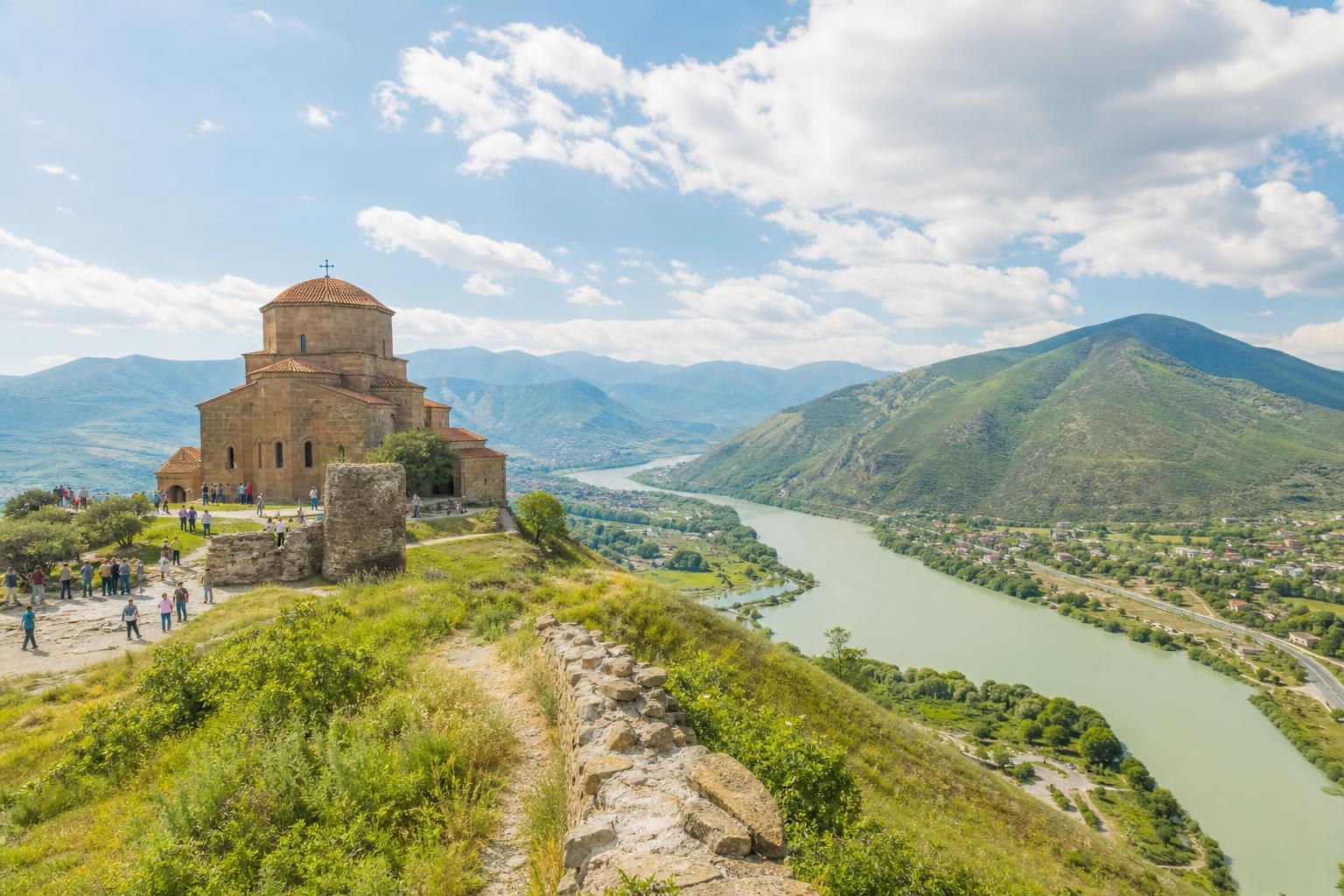
By midday, begin the drive back south. Rather than returning all the way to Tbilisi, stop in Mtskheta, Georgia’s ancient capital, about 20 km north of the city. The Jvari Monastery on the hilltop above town and the Svetitskhoveli Cathedral in the center are both UNESCO World Heritage Sites. Mtskheta is compact enough to see in two hours, and staying overnight here positions you perfectly for tomorrow’s drive east.
Important: Do not drink and drive. Georgian wine and chacha flow freely at dinners and homestays. If your hosts pour generously (they will), leave the car and walk back, or plan to stay put for the night.
Day 4: Into the Wine Region of Kakheti (Sighnaghi and Telavi)
Kakheti is where Georgia’s 8,000-year winemaking tradition lives. The region produces about 70% of the country’s wine, much of it still fermented in clay qvevri buried underground. This day is about tasting, eating, and driving through vineyard-covered valleys.
Getting There by Car: Mtskheta to Sighnaghi
- Distance: ~120 km
- Drive time: 2 to 2.5 hours
- Road condition: Paved, mostly good; some rough patches on secondary roads near Sighnaghi
- 4×4 needed: No
- Parking: Street parking in Sighnaghi is free and usually available
Sighnaghi is a small hilltop town with cobblestone streets and views across the Alazani Valley to the Caucasus mountains. Visit the Bodbe Monastery just outside town, then drive 50 km north to Telavi if time allows. Between the two towns, stop at a family winery for a qvevri wine tasting. Expect to pay 20-40 GEL per person for a tasting with snacks, though some family cellars charge nothing and simply expect you to buy a bottle or two.
Stay overnight in Sighnaghi. The town has a good selection of guesthouses and small hotels, most in the 80-150 GEL range for a double room.
Day 5: Crossing to Central Georgia: Gori and Uplistsikhe
Today you cross the country’s midsection, heading west from Kakheti to Gori. The drive takes about three hours and passes through flat agricultural land: not the most dramatic scenery, but a welcome rest for the eyes after days of mountains.
Gori is best known as Stalin’s birthplace, and the Stalin Museum remains the town’s main attraction whether you find that fascinating or uncomfortable. The museum itself is a time capsule of Soviet-era presentation, largely unchanged. Entry is around 25 GEL with a guided tour.
The real highlight sits 15 km east of Gori: Uplistsikhe, a rock-hewn cave city dating back to the early Iron Age. It’s an extraordinary site, carved into a sandstone ridge above the Mtkvari River. Budget 1.5-2 hours to explore the caves, the ancient theater, and the medieval church perched on top. Parking is free at the base, and entry costs about 15 GEL.
Sleep in Gori. Hotels are basic but affordable, typically 60-100 GEL for a clean double.
Day 6: The Cave City of Vardzia and Akhaltsikhe
This is the longest driving day, but the payoff is one of Georgia’s most impressive historical sites. Head south from Gori toward Akhaltsikhe (about 2 hours), then continue another hour to Vardzia.
Vardzia is a 12th-century cave monastery complex carved into a sheer cliff face along the Mtkvari River. Queen Tamar commissioned it, and at its peak it held around 400 rooms, 13 churches, and a complex irrigation system. An earthquake in 1283 exposed much of the interior, which is partly why it looks so dramatic today. Entry is about 15 GEL, and you’ll need 2-3 hours to explore properly.
Getting There by Car: Akhaltsikhe to Vardzia
- Distance: ~65 km one way
- Drive time: About 1 hour each way
- Road condition: Paved but narrow in places, with some sharp bends
- 4×4 needed: No
- Parking: Large free lot at the Vardzia visitor center
On your way back, stop at Akhaltsikhe’s Rabati Castle, a restored fortress complex that blends Georgian, Ottoman, and Persian architectural styles. It’s worth an hour of your time and offers good views of the town.
Stay in Akhaltsikhe, where guesthouses run 70-120 GEL per night.
Day 7: Borjomi Spa Park and Return to Tbilisi
Your final day loops back to Tbilisi through Borjomi, Georgia’s famous spa town. The drive from Akhaltsikhe to Borjomi takes about an hour on a decent road.
Borjomi Central Park is the main draw. Walk along the river to the mineral water spring, where you can fill a bottle for free. The water tastes strongly of sulfur and iron: not exactly refreshing, but it’s a Georgian tradition. The park also has a cable car to a hilltop viewpoint (about 5 GEL round trip).
From Borjomi, the drive to Tbilisi takes roughly 2.5 hours. The road passes through Khashuri and joins the main E60 highway. Thanks to the Rikoti Pass motorway that opened in December 2025, featuring 51 tunnels and 97 bridges, east-west travel through this corridor is now significantly faster and safer than it was even a year ago.
Arrive in Tbilisi by late afternoon. Drop off the car, or keep it for an extra day if you want to explore neighborhoods you missed on Day 1.
Note: If your flight departs late on Day 7, Borjomi works well as a relaxed half-day. If you fly early on Day 8, skip Borjomi and drive straight to Tbilisi to avoid rushing.
Essential Driving Tips for a Georgia Road Trip
Georgian driving culture can be startling if you’re used to Western European norms. Lane markings are treated as suggestions, overtaking happens on blind corners, and livestock wander onto highways without warning. Stay alert, drive defensively, and don’t try to match local speeds.
Speed limits are typically 60 km/h in towns, 80 km/h on rural roads, and 110 km/h on highways. As of May 2026, traffic fines have increased significantly: speeding 15-40 km/h over the limit now costs 100 GEL, and seatbelt violations are 50 GEL. Police checkpoints are common, and fines are enforced on the spot.
Road Conditions and Safety for Independent Drivers
- Fuel stations (Wissol, Gulf, Socar) are plentiful on main routes but scarce in remote southern areas. Fill up before heading to Vardzia.
- Most main roads are in good condition. Secondary roads to monasteries and viewpoints can be rough gravel.
- Headlights must be on at all times outside city limits, day and night.
- Carry cash for tolls, parking attendants, and small guesthouses that don’t take cards.
- Download the Bolt app for backup transportation in cities, and Google Maps works reliably for navigation across the country.
Resources like those at Triproadwayplanner can help you check current road conditions and seasonal closures before each leg of your trip.
Georgia Road Trip FAQ
Is a week enough to see Georgia by car?
Seven days covers the core highlights comfortably: Tbilisi, Kazbegi, Kakheti, and the southern cave cities. You won’t reach Svaneti or Batumi on this itinerary, but you’ll see the country’s greatest variety of landscapes and historical sites without exhausting yourself.
Do I need a 4×4 for this itinerary?
No. A standard sedan handles every road on this route from May through October. The only stretch where higher clearance helps is the unpaved road to Gergeti Trinity Church, and you can hire a local 4×4 taxi for that. Winter travel on the Military Highway may require chains regardless of vehicle type.
What’s the best season for a one-week Georgia road trip?
Late May through mid-October offers the most reliable weather and road access. June and September are ideal: warm but not scorching, with fewer crowds than July and August. Spring (April-May) brings wildflowers but also unpredictable rain. Winter closes some mountain passes entirely.
How much should I budget for seven days?
A realistic daily budget for two people sharing a car is 250-400 GEL, covering fuel, guesthouse accommodation, meals, and entrance fees. Rental cars in 2026 start around 100-150 GEL per day for a basic sedan, though prices fluctuate seasonally. Verify current rates before booking.
Is it safe to drive in Georgia?
Georgia’s roads are safe in terms of crime: you’re extremely unlikely to encounter any trouble. The risk is traffic behavior. Other drivers can be aggressive, and rural roads sometimes lack guardrails. Drive cautiously, avoid night driving on mountain roads, and you’ll be fine.
A seven-day Georgia itinerary by car gives you the freedom to stop at unmarked viewpoints, linger over a three-hour supra dinner, and change plans when a guesthouse owner tells you about a waterfall twenty minutes up a side road. That spontaneity is the whole point of driving here. Print this route, download your offline maps, and give yourself permission to go slow. The best moments in Georgia tend to find you when you’re not rushing to the next pin on the map.