
Table of Contents
- Exploring Kakheti’s Icons: Gremi and Nekresi Overview
- Driving to Gremi and Nekresi: A Self-Drive Guide
- Gremi Fortress: The Royal Citadel of the Lost Capital
- Nekresi Monastery: Spiritual Heights Over the Alazani Valley
- Planning Your Day Trip: Telavi, Kvareli, and Route Optimization
- Practical Tips for Visiting Kakheti Sights
- Frequently Asked Questions About Gremi and Nekresi
Gremi and Nekresi sit about 20 kilometers apart in Georgia’s Kakheti wine region, and together they tell the story of a kingdom that rose on Silk Road wealth and anchored itself in Christian faith. If you’re driving through eastern Georgia, these two sites make one of the most rewarding half-day stops in the country: a 16th-century royal fortress overlooking the Alazani Valley and a monastery complex whose oldest structure dates to the 4th century. Both are easy to reach from Telavi or Kvareli, and combining them into a single loop takes about three to four hours including driving time. Here’s everything you need to plan the visit yourself.
Exploring Kakheti’s Icons: Gremi and Nekresi Overview
Kakheti has been drawing more visitors each year, and the numbers back that up: Georgia recorded a record 7.8 million international traveler arrivals in 2025, a 5.9% jump over the previous year. A significant share of those travelers pass through Kakheti, drawn by its wineries, fortified churches, and the Alazani Valley views. Gremi and Nekresi are two of the region’s most important historical sites, and they complement each other well.
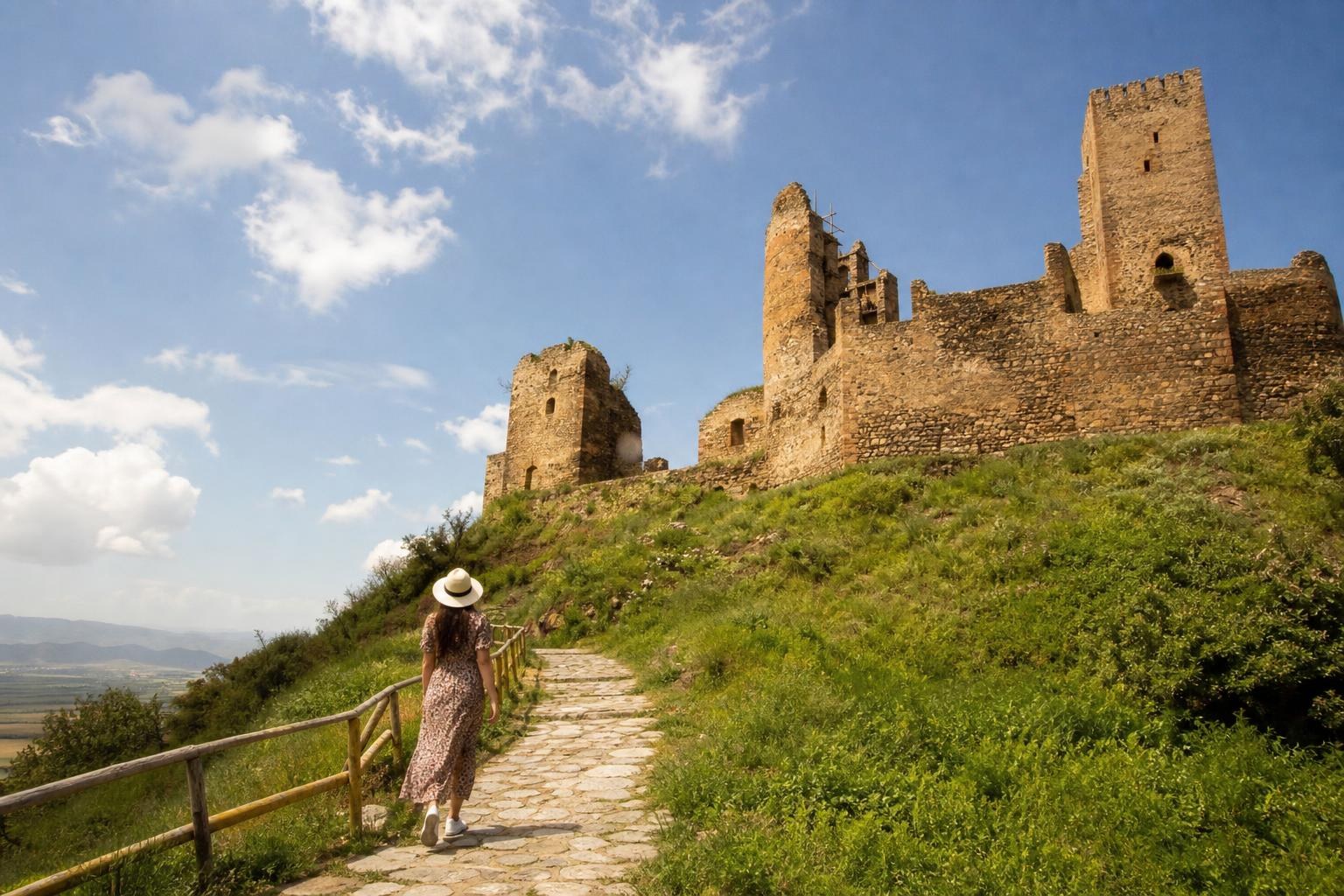
Gremi was the capital of the Kingdom of Kakheti from the late 15th century until Shah Abbas I of Persia destroyed it in 1616. What survives today is the royal citadel: the Church of the Archangels, a three-story royal tower, and the archaeological traces of a once-thriving trade city that stretched across the surrounding hillside. The Church of the Archangels is currently on Georgia’s UNESCO World Heritage Tentative List as one of 14 proposed sites.
Nekresi Monastery, perched high on a ridge above the valley, has a longer and more layered history. Its oldest surviving structure, a small basilica, is considered one of the earliest Christian churches in the Caucasus. The monastery remained active through centuries of invasions and is still a functioning religious community today.
The two sites sit on opposite sides of the main highway, making a combined visit logical whether you’re based in Telavi (about 20 km from Gremi) or Kvareli (roughly 10 km from Gremi).
Driving to Gremi and Nekresi: A Self-Drive Guide
Both sites are straightforward to reach by car, and you don’t need a 4×4 for either one.
Getting to Gremi by car:
| Detail | Info |
|---|---|
| From Telavi | ~20 km, about 25 minutes via the Sh42 highway |
| From Kvareli | ~10 km, about 12 minutes heading west on the same highway |
| From Tbilisi | ~155 km, roughly 2.5 hours via the Gombori Pass or 3 hours via the longer Sagarejo route |
| Road condition | Paved two-lane highway, good condition year-round |
| 4×4 needed? | No |
| Parking | Free lot at the base of the fortress hill |
Gremi is visible from the highway itself: you’ll spot the tower and church on the hilltop as you approach. The turnoff is well-signed. Parking is at the bottom, and you walk up a short paved path to the citadel.
Getting to Nekresi by car:
From Gremi, drive east on the Sh42 toward Kvareli for about 8 km, then turn left (north) at the signed junction toward Nekresi. The access road runs about 3 km to a lower parking area at the base of the ridge. Private cars are not allowed up the steep monastery road: you’ll either take a shuttle minibus or hike up (more on that below).
Tip: If you’re renting a car in Tbilisi, the Gombori Pass route to Kakheti is shorter in distance but slower and windier. The Sagarejo route adds 30 minutes but is less demanding. In winter (December through February), check the Gombori Pass for ice or closures before heading out.
The Sh42 highway connecting Telavi and Kvareli passes right by both sites, so the most efficient approach is to hit one on the way to the other. If you’re coming from Telavi, stop at Gremi first, then continue east to Nekresi before ending in Kvareli for lunch or a winery visit.
Gremi Fortress: The Royal Citadel of the Lost Capital
Gremi’s story is one of spectacular rise and catastrophic fall. King Levan of Kakheti established it as his capital in the 1460s, and for about 150 years it thrived as a major Silk Road trading hub. Armenian, Persian, and Georgian merchants traded silk, spices, and textiles here. The city reportedly had caravanserais, bathhouses, markets, and residential quarters spread across the hillside below the royal citadel.
Then, in 1615-1616, Shah Abbas I of Persia invaded Kakheti. The destruction was total. Gremi was sacked and burned, its population killed or deported, and the capital was eventually moved to Telavi. What remains today is the hilltop citadel complex, which gives you a concentrated sense of the kingdom’s ambition and the scale of what was lost.
Georgia’s parliament has been paying closer attention to sites like this. In November 2025, amendments to the Law on Cultural Heritage introduced a stricter framework for monitoring monuments including Gremi, which should help with long-term preservation.
Church of the Archangels and the Royal Tower
The Church of the Archangels (Mtavarangelozi) is the centerpiece. Built in 1565 by King Levan, it’s a cross-domed church made of brick with stone trim, and its interior retains fragments of 16th-century frescoes. The paintings are faded but still visible: saints, biblical scenes, and royal donor portraits. Look for the image of King Levan himself near the entrance.
Attached to the church is the three-story royal tower, which served as both a residence and a defensive structure. You can climb to the top for panoramic views of the Alazani Valley and the Caucasus foothills. The ground floor houses a small museum with archaeological finds from the site: pottery, coins, weapons, and fragments of decorative stonework.
Important: The museum and tower have limited hours, typically 10:00 to 17:00. Admission is a few GEL (check current pricing at the entrance, as fees may change in 2026). The church itself is free to enter.
Exploring the Ruins of the Silk Road City
Below the citadel, the hillside holds the archaeological remains of the old trading city. Most of what you’ll see are foundations, wall outlines, and the remnants of a wine cellar (marani) with buried clay qvevri. The site isn’t extensively excavated or signed, so without a guide you’ll need some imagination to reconstruct the city in your mind.
Walking the lower ruins takes about 20 to 30 minutes. The paths are uneven dirt trails, so wear shoes with grip. A few interpretive signs exist, but they’re minimal. If you want context, hire a local guide at the entrance or read up beforehand.
The entire Gremi fortress visit, including the church, tower, museum, and lower ruins, takes about one to one and a half hours for most visitors.
Nekresi Monastery: Spiritual Heights Over the Alazani Valley
Nekresi sits at roughly 900 meters elevation on a forested ridge, and the views alone justify the trip. But the real draw is the depth of history concentrated in this small monastic compound. The site spans over 1,600 years of continuous or near-continuous religious use, and its buildings represent multiple eras of Georgian church architecture.
The monastery is associated with Abibos of Nekresi, one of the Assyrian Fathers who spread Christianity through Georgia in the 6th century. Abibos was reportedly martyred by the Zoroastrian Persians for extinguishing their sacred fire. His story connects Nekresi to the broader narrative of Georgia’s Christian identity, which the country is celebrating in 2026 with the 1700th anniversary of the adoption of Christianity as the state religion.
The monastery is still active, with a small community of monks in residence. This means it’s a living religious site, not just a museum. Dress modestly: women should cover their heads and shoulders (scarves are usually available at the gate), and men should wear long trousers.
Navigating the Ascent: Shuttle Bus vs. Hiking
Private vehicles cannot drive up the narrow, steep road to Nekresi monastery. You have two options from the lower parking lot:
-
Shuttle minibus: Small vans run up and down the hill regularly during visiting hours. The ride takes about 10 minutes. There’s a small fee (a few GEL per person). Frequency depends on the season and visitor numbers: in summer you rarely wait more than 15 minutes, while in winter the schedule can be irregular.
-
Hiking up: The walk from the parking area to the monastery takes roughly 40 to 50 minutes uphill on a paved but steep road. It’s about 3 km with significant elevation gain. Bring water, especially in summer when temperatures in Kakheti regularly exceed 35°C.
Tip: If you hike up, you can usually catch the shuttle back down for free or a minimal charge. This saves your knees on the steep descent and lets you enjoy the walk up at your own pace.
Architectural Highlights: From the 4th Century Basilica to the Wine Cellar
The monastery compound is compact but architecturally rich. Here’s what to look for:
- The small basilica from the 4th century, possibly the oldest surviving Christian church structure in Georgia. It’s a simple, single-nave building with rough-cut stone walls. Recent archaeological research by Nodar Bakhtadze has shed new light on the architectural layout of early Christian temples in the Kingdom of Iberia, including the Chabukauri and Dolochopi basilicas near Nekresi.
- The main church, a larger 7th-century structure with a domed roof and carved stone ornamentation.
- The bishop’s palace, a multi-story stone building that now serves as part of the monastic quarters.
- A wine cellar (marani) with qvevri embedded in the ground, a reminder that Georgian monks have been making wine for centuries using the traditional clay vessel method.
The entire monastery visit takes about 45 minutes to an hour, plus travel time up and down the hill. Combined with the shuttle wait and the walk around the compound, budget two hours for Nekresi from the moment you park.
Planning Your Day Trip: Telavi, Kvareli, and Route Optimization
The most common bases for visiting both sites are Telavi and Kvareli. Here’s how the logistics break down:
| Route | Distance | Drive Time | Notes |
|---|---|---|---|
| Telavi → Gremi → Nekresi → Kvareli | ~35 km total | ~45 min driving | Most efficient loop; end with lunch/wine in Kvareli |
| Kvareli → Nekresi → Gremi → Telavi | ~35 km total | ~45 min driving | Reverse loop; end in Telavi for more dining options |
| Tbilisi → Gremi → Nekresi → Tbilisi | ~310 km round trip | ~5-6 hours driving | Long day trip; consider staying overnight in Kakheti |
If you’re doing a proper Kakheti day from Tbilisi, I’d strongly recommend spending the night in Telavi or Kvareli rather than trying to rush back. The drive over the Gombori Pass after a full day of sightseeing and possibly wine tasting isn’t ideal, and Kakheti has excellent guesthouses where the hosts will feed you homemade food and pour you wine from their own cellar.
A realistic half-day itinerary: leave Telavi by 9:30, arrive at the Gremi fortress by 10:00, spend 1.5 hours there, drive to Nekresi by 11:45, take the shuttle up, explore for an hour, shuttle back down, and arrive in Kvareli for a late lunch by 14:00. That leaves the afternoon free for a winery visit or a drive through the vineyards.
Note: Do not drink and drive. If you plan to visit wineries after Gremi and Nekresi, arrange a designated driver, book a taxi through Bolt or a local service, or save the tasting for the evening at your guesthouse.
Practical Tips for Visiting Kakheti Sights
Here are the things I wish someone had told me before my first Kakheti trip:
- Carry cash in small denominations (GEL). Some site entrance fees, shuttle buses, and roadside food stalls don’t take cards. ATMs exist in Telavi and Kvareli but are scarce between towns.
- Summer heat is serious. From June through August, the Alazani Valley bakes. Start early, carry at least a liter of water per person, and wear a hat. The exposed hilltop at Gremi and the uphill walk at Nekresi offer little shade.
- Both sites are open daily, but hours can shift seasonally. The Gremi museum typically opens at 10:00 and closes by 17:00 or 18:00. Nekresi’s shuttle service runs during daylight hours but may stop earlier in winter. Confirm locally or check Triproadwayplanner for updated schedules.
- Modest dress is required at Nekresi and expected at the Gremi church. Keep a scarf and long pants in the car even if you’re otherwise dressed for summer.
- Download offline maps (Google Maps or Maps.me) before leaving Tbilisi. Mobile data coverage in rural Kakheti can be spotty, and you don’t want to miss a turnoff.
Photography is welcome at both sites, but be respectful inside active churches. Don’t photograph monks at Nekresi without asking, and keep your voice down in the compound.
Frequently Asked Questions About Gremi and Nekresi
Can I visit both Gremi and Nekresi in one day?
Yes, easily. They’re only about 8 km apart by road. Budget 1.5 hours for the fortress and 2 hours for Nekresi (including shuttle time), plus driving. A combined visit fits comfortably into a half-day.
Is there an entrance fee for Gremi or Nekresi?
The Gremi museum and tower charge a small admission fee (a few GEL). The church is free. Nekresi monastery is free to enter, but you’ll pay a small fee for the shuttle minibus. Exact prices may change in 2026, so check at the site.
Do I need a 4×4 to reach either site?
No. Both are accessible via paved roads in any vehicle. The only restriction is that private cars can’t drive up to Nekresi monastery itself: you take a shuttle or walk from the lower parking area.
What’s the best time of year to visit?
Spring (April to June) and autumn (September to October) offer the best weather and light. Autumn is especially good because the vineyards turn gold and the harvest season (rtveli) brings festivals and fresh wine. Summer works but is hot. Winter is quiet and sometimes foggy, which gives the sites an atmospheric quality but limits shuttle frequency at Nekresi.
Is Gremi the same as Gremi Fortress?
People use the terms interchangeably. “Gremi” technically refers to the entire former capital city, most of which is now ruins or unexcavated. “Gremi Fortress” or “Gremi Citadel” usually means the surviving hilltop complex with the church and tower, which is what most visitors come to see.
Gremi and Nekresi reward the kind of traveler who slows down long enough to notice the details: a faded fresco of a medieval king, a 1,600-year-old stone wall, qvevri buried in a monastery floor. They’re not the most famous sites in Georgia, but they’re among the most honest ones, places where the history hasn’t been polished for tourists and the monks still make wine the way their predecessors did centuries ago. If you’re driving through Kakheti, give them a morning. You won’t regret it.