
Table of Contents
- Visiting the Chronicles of Georgia and Tbilisi Sea: A Quick Guide
- Understanding the Chronicles of Georgia Monument
- How to Get to Chronicles of Georgia by Car
- Parking and Navigation Logistics
- Exploring the Tbilisi Sea and Reservoir
- Best Tbilisi Viewpoints Near the Monument
- Photography Tips and Best Time for Sunset
- Combining the Trip: Holy Trinity Viewpoint and Beyond
- Essential Travel Data for the Keeni District
- Frequently Asked Questions About the Chronicles of Georgia
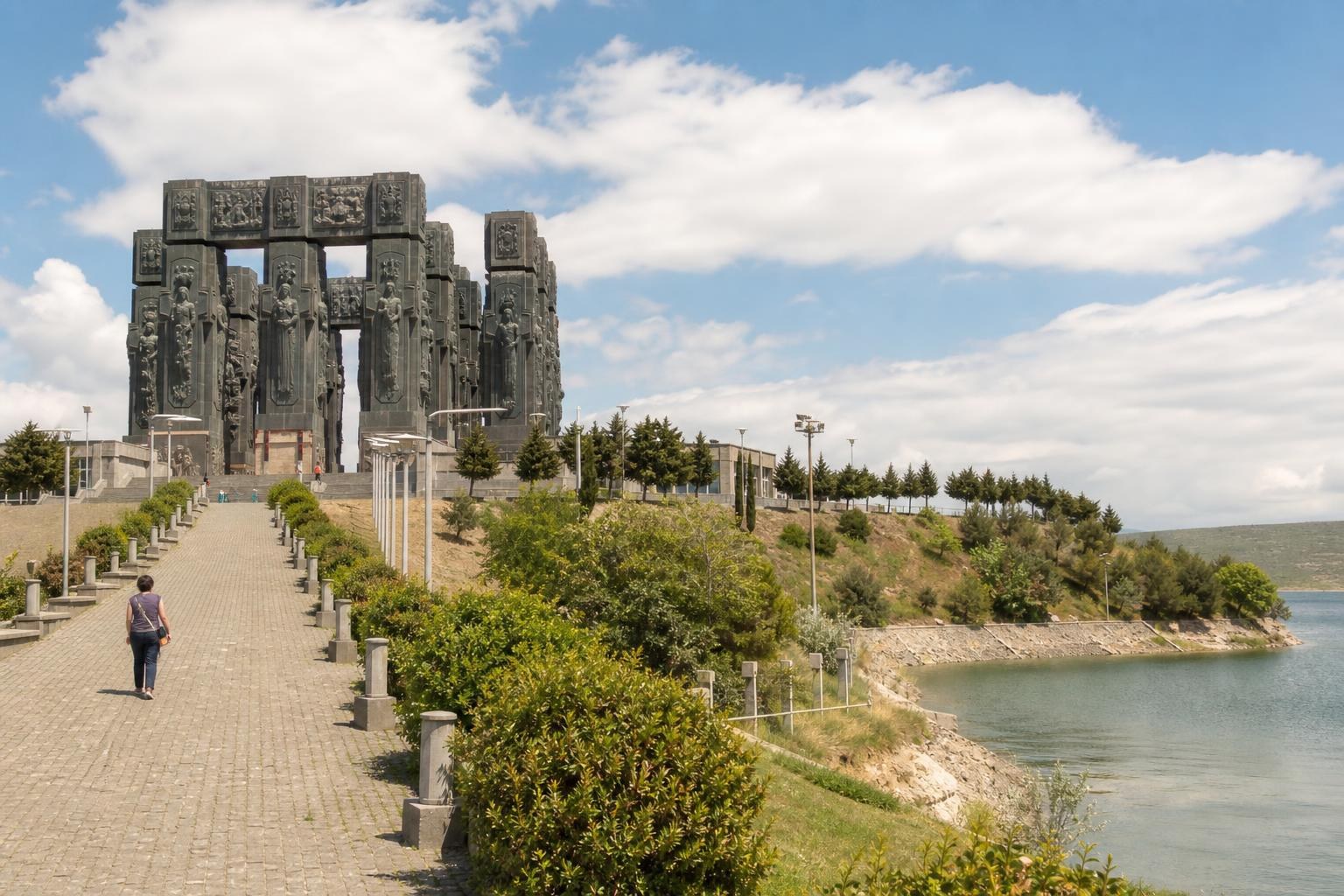
The Chronicles of Georgia monument sits on a hilltop overlooking the Tbilisi Sea, about 20 minutes by car from central Tbilisi. It’s one of the most striking things you’ll see in the country: a cluster of massive stone pillars covered in carved reliefs depicting Georgian history and biblical scenes. Most visitors combine it with a stop at the reservoir below, and the whole trip can be done in a couple of hours if you’re staying in the city.
I first drove up there on a whim after spotting the columns from across the water. No entrance fee, no ticket booth, no crowds. Just enormous carved pillars standing against the sky. That combination of easy access and genuine impact is rare, and it’s the reason I keep recommending this spot to anyone passing through Tbilisi with a rental car or even just a taxi app on their phone.
What follows is everything you need to plan the trip yourself: directions, parking, what you’re actually looking at when you get there, where to catch the best light, and how to fold in a swim at the reservoir if the weather cooperates. I’ve also included practical details on the surrounding Keeni district and a few viewpoints worth the short detour.
Visiting the Chronicles of Georgia and Tbilisi Sea: A Quick Guide
The monument and the reservoir sit northeast of central Tbilisi, in the Keeni district. From Freedom Square, the drive takes roughly 20 to 25 minutes without heavy traffic, though Tbilisi traffic can double that during rush hour. The route follows the main road toward Tbilisi Sea (locally called “Tbilisis Zghva”), and Google Maps handles navigation well here.
You don’t need a full day. A realistic schedule looks like this: drive up mid-afternoon, spend 30 to 45 minutes walking among the pillars, catch the sunset, then drive down to the reservoir for a stroll or a swim. If you’re combining it with the Holy Trinity (Sameba) Cathedral viewpoint, add another 30 minutes.
| Detail | Info |
|---|---|
| Distance from Freedom Square | ~15 km |
| Drive time (no traffic) | 20-25 min |
| Entrance fee | Free |
| Time needed at monument | 30-60 min |
| Best time of day | Late afternoon for golden light |
| 4×4 required? | No, paved road all the way |
| Parking | Free, informal lot at the base |
Tip: Weekday afternoons are quietest. Weekend mornings bring local families, and sunset hours draw photographers, though it never gets truly crowded.
Understanding the Chronicles of Georgia Monument
The monument is sometimes called “Stonehenge of Georgia,” which is a lazy comparison but gives you a sense of scale. Sixteen massive stone columns, each roughly 35 meters tall, stand in a semicircle on a hill above the Tbilisi Sea. Every surface is covered with carved reliefs showing scenes from Georgian history and Christian scripture.
The monument remains formally unfinished, standing at roughly 90% completion since construction was halted in 2003. Despite that, it feels complete enough to be powerful. The lower sections of the columns depict historical and royal figures, while the upper portions show religious scenes. A staircase runs between the pillars, and at the base you’ll find a small chapel.
Zurab Tsereteli’s Vision and Design
The monument was designed by Zurab Tsereteli, one of the most prolific and controversial sculptors of the post-Soviet world. His work spans continents: you may recognize his “Tear of Grief” memorial in New Jersey or the Peter the Great statue in Moscow. Tsereteli passed away on April 22, 2025, at the age of 91 and was buried in Tbilisi’s Mtatsminda Pantheon, among Georgia’s most honored cultural figures.
He began the Chronicles of Georgia project in 1985, intending it as a monumental chronicle of the nation’s identity. The copper-clad stone pillars were designed to be read like a book, with the narrative flowing across the columns. Construction progressed slowly through the 1990s and early 2000s before funding dried up.
Biblical Scenes and Georgian Kings
The carvings divide into two thematic layers. The lower portions of the columns feature Georgian kings, queens, and national heroes. You’ll see figures like King David the Builder and Queen Tamar, both central to the country’s golden age in the 12th and 13th centuries.
The upper sections shift to Christian themes: the life of Christ, the crucifixion, and scenes from the Old Testament. Georgia adopted Christianity in 337 AD, making it one of the earliest Christian nations, and that identity runs deep through the monument’s imagery. Even if you don’t recognize every figure, the sheer density of carving is impressive. Bring binoculars if you want to study the upper reliefs closely.
How to Get to Chronicles of Georgia by Car
From central Tbilisi, head north on the main road toward Tbilisi Sea. The most straightforward route:
- Start at Freedom Square or Rustaveli Avenue
- Head northeast on Tsereteli Avenue (yes, same name, different Tsereteli – it’s named after a 19th-century poet)
- Follow signs toward “Tbilisis Zghva” or “Tbilisi Sea”
- After passing the reservoir, look for a left turn uphill toward the monument – Google Maps labels it as “Chronicle of Georgia”
- The final stretch is a paved but narrow road winding up the hill
The road is in decent condition as of 2026. No 4×4 needed, and any rental car handles it fine. If you’re using Bolt or Yandex Go for a taxi, expect to pay roughly 20–25 GEL one way from the center, though prices fluctuate. Ask the driver to wait or arrange a return pickup, because taxis don’t hang around at the top.
Important: The monument doesn’t appear on all taxi apps by its official name. Search for “Chronicle of Georgia” or “Sakartvelos Matiane” in Georgian. Dropping a pin on the map is the most reliable method.
Parking and Navigation Logistics
Parking is free and informal. At the base of the monument, there’s a flat gravel area where 15 to 20 cars can fit comfortably. On busy weekends, you might find it full, but overflow parking along the access road works fine since the walk is short.
The final approach road has no lane markings and narrows to a single lane in spots. If another car is coming down, one of you will need to pull aside. This sounds more dramatic than it is – the road is short and traffic is light.
There are no facilities at the monument itself: no restrooms, no cafe, no water fountain. Bring water, especially in summer when temperatures regularly push past 35°C. The nearest shops and restaurants are down by the reservoir, about a five-minute drive.
- GPS coordinates for the monument parking: approximately 41.7483° N, 44.8119° E
- Cell service works fine at the top
- No entrance gate or operating hours – you can visit at any time, including after dark (though there’s no lighting)
Exploring the Tbilisi Sea and Reservoir
The Tbilisi Sea is an artificial reservoir built in the 1950s, sitting at the base of the hill below the monument. It’s a popular weekend escape for Tbilisi residents, and the shoreline is undergoing significant development. A major eco-resort project covering 30 hectares is currently under construction on the shores, and a five-star hotel complex with 276 rooms is scheduled to open in summer 2027. The area around the reservoir will look quite different in a year or two.
For now, the vibe is still relatively low-key. Local families picnic along the shore, kids splash in the shallows, and a few small cafes serve grilled meat and cold beer. The water is calm and the setting is pleasant, if not spectacular.
Swimming and Recreation Spots
Swimming in the reservoir is common and generally safe, though there are no lifeguards. The best spots for swimming are along the southern and western shores, where the banks slope gently into the water. Avoid the northern end near the dam, where currents can be unpredictable.
A few things to know before jumping in:
- Water quality is generally acceptable, but this is a city reservoir, not a mountain spring
- The bottom is muddy in places – water shoes help
- Peak swimming season runs from mid-June through early September
- There are no formal changing facilities, though some of the shoreline cafes let customers use their restrooms
Note: If you’re visiting in summer and plan to combine swimming with the monument, do the monument first (it’s fully exposed with no shade) and cool off at the reservoir afterward.
Best Tbilisi Viewpoints Near the Monument
The monument itself is one of the best viewpoints in greater Tbilisi. From the hilltop, you get a wide panorama: the reservoir below, the Caucasus foothills to the north, and the city sprawling to the south and west. On clear days, you can pick out the Sameba Cathedral, the TV tower on Mtatsminda, and the general outline of the Old Town.
A few other viewpoints worth knowing about in the area:
- The road leading up to the monument has a couple of pullover spots with unobstructed views of the reservoir
- The eastern shore of the Tbilisi Sea offers a different angle looking back toward the monument on its hill
- Mtatsminda Park, while not nearby, is the city’s most famous viewpoint and makes a good comparison if you’re collecting panoramic spots during your stay
The hilltop around the monument is open and flat, so you can walk freely and find your own angle. There are no fences or barriers around the pillars, which is great for photography but means you should watch children carefully near any edges.
Photography Tips and Best Time for Sunset
Golden hour is the reason most photographers visit. The monument faces roughly west-southwest, which means late afternoon light hits the carved surfaces beautifully and the reservoir glows below. In summer (June through August), aim to arrive by 7:00 PM. In spring and autumn, 5:00 to 5:30 PM gives you good light.
Sunset itself is dramatic from this spot, with the sun dropping behind the Tbilisi skyline. Wide-angle lenses work best for capturing the full semicircle of columns, while a telephoto lets you isolate individual carved panels. Drone photography is technically subject to Georgian aviation regulations, but enforcement at this site is minimal – use common sense and keep away from other visitors.
A few practical tips:
- The stone columns photograph best with side-lighting, not direct front light
- Bring a tripod if you want to shoot after sunset – the blue hour here is worth staying for
- The small chapel at the base of the columns makes a strong foreground element
- Silhouette shots of the pillars against the sunset sky are the classic image from this location
Combining the Trip: Holy Trinity Viewpoint and Beyond
If you’re already driving to the Chronicles of Georgia, the Holy Trinity Cathedral (Sameba) is a natural addition to the route. It sits on Elia Hill in the Avlabari district, and you’ll pass relatively close to it on your way back into the city center. The cathedral compound has its own elevated viewpoint looking across the Mtkvari River toward the Old Town.
A practical loop for a half-day trip:
- Leave central Tbilisi mid-afternoon
- Drive to the monument (20-25 min)
- Spend 30-60 min at the Chronicles of Georgia
- Drive down to the Tbilisi Sea for a walk or swim (5 min)
- Head back toward town, stopping at Sameba Cathedral (15-20 min drive from the reservoir)
- Return to center
This loop covers three of the best elevated perspectives in greater Tbilisi and takes roughly three to four hours including stops. If you’ve rented a car for exploring Georgia, this makes an ideal first-afternoon orientation drive before heading out on longer routes the next day. Triproadwayplanner’s route guides can help you plan those multi-day trips.
Essential Travel Data for the Keeni District
The Keeni district surrounds the Tbilisi Sea and is technically part of the Saburtalo administrative district. It’s a residential area that has been growing rapidly, with new apartment blocks and commercial development spreading along the reservoir’s edges.
| Detail | Info (2026) |
|---|---|
| District | Keeni (part of Saburtalo) |
| Nearest metro station | Delisi (then taxi/bus ~15 min) |
| Grocery stores | Small markets along the main road; no large supermarket at the reservoir |
| ATMs | Available along the main road before the reservoir turnoff |
| Fuel stations | Wissol and Socar stations on the approach road |
| Mobile coverage | Good (Magti, Cellfie, Beeline all work) |
| Restaurants | Small cafes at the reservoir; better options back in central Tbilisi |
The area is safe and unremarkable from a security standpoint. Standard Tbilisi precautions apply: lock your car, don’t leave valuables visible on seats.
Tip: Fill up your tank before heading to the reservoir area. The fuel stations are on the main road, and there’s nothing at the monument itself.
Frequently Asked Questions About the Chronicles of Georgia
Is the Chronicles of Georgia monument free to visit?
Yes, completely free. There’s no ticket office, no gate, and no set opening hours. You can visit at any time of day or night, though there’s no artificial lighting after dark.
How long does a visit to the monument take?
Most people spend 30 to 60 minutes. You can walk around the pillars, climb the central staircase, and look inside the small chapel in that time. Photographers and history enthusiasts often stay longer, especially around sunset.
Can I visit without a car?
Yes, but it’s less convenient. A Bolt or Yandex Go taxi from central Tbilisi costs roughly 20–25 GEL each way (2026 prices, subject to change). There’s no reliable public bus service directly to the monument. You could also take the metro to Delisi station and grab a taxi from there.
Is the monument safe for children?
The site is open and unfenced. There are no guardrails around the hilltop edges, and the stone steps can be slippery when wet. Kids love the scale of the place, but keep a close eye on younger ones near drop-offs.
Why is the monument unfinished?
Construction began in 1985 and stalled around 2003 due to lack of funding. The monument stands at roughly 90% completion. Despite this, it reads as a coherent work and most visitors don’t notice anything missing unless they know the original plans.
The Chronicles of Georgia is one of those places that rewards a short detour with an outsized impression. It costs nothing, takes less than an hour, and gives you one of the most memorable views in the Tbilisi area. Pair it with a dip in the reservoir and a stop at Sameba on the way back, and you’ve got a solid half-day that hits three of the city’s best elevated spots. If you’re picking up a rental car in Tbilisi, make this your shakedown drive before heading into the mountains.