
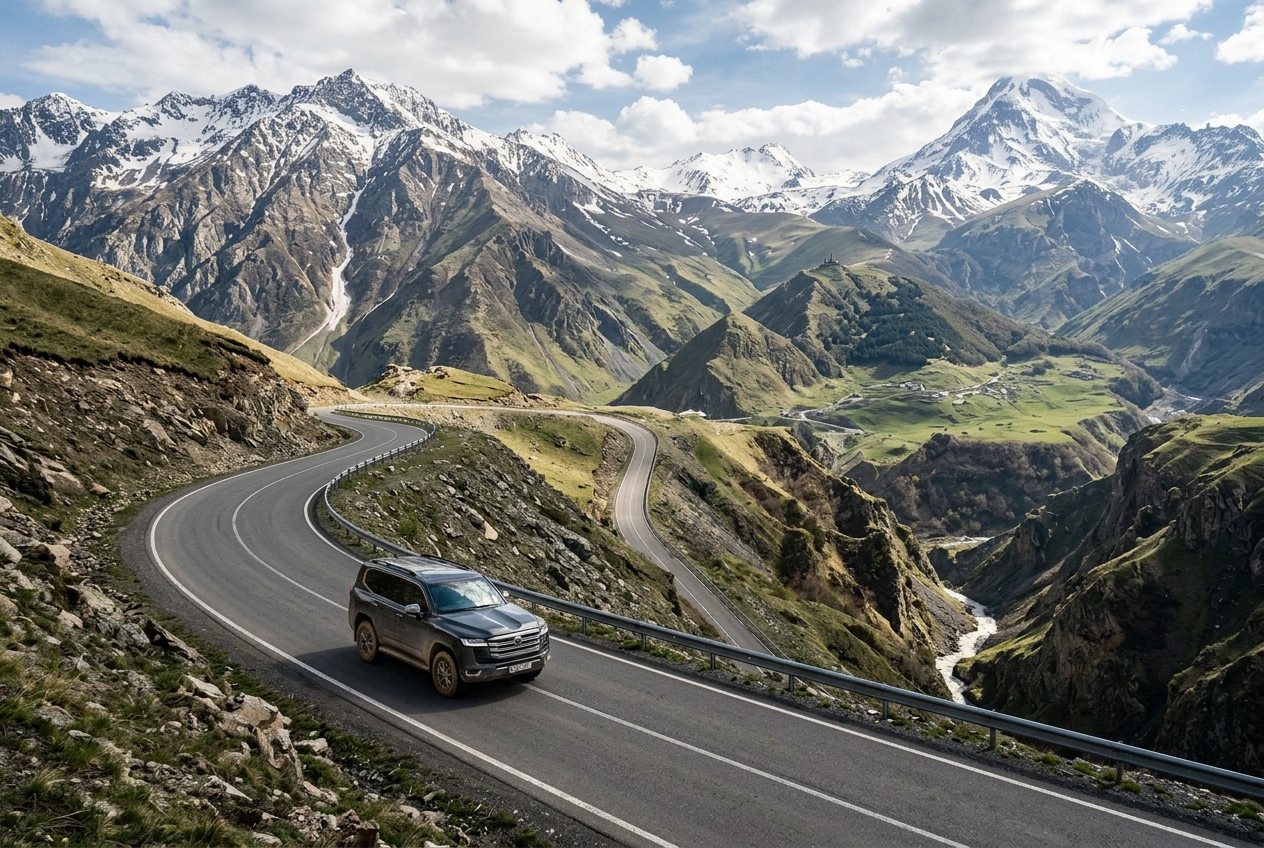
The road from Tbilisi to Stepantsminda (formerly Kazbegi) is one of those drives that rewrites your expectations of what a road trip can be. Carved through the Greater Caucasus Mountains, this ancient trade and military route passes medieval fortresses, alpine reservoirs, and volcanic plateaus before depositing you at the foot of Mount Kazbek, one of the highest peaks in the Caucasus. I’ve driven it twice now, once in a rented Mitsubishi Outlander and once in a compact Suzuki Vitara, and each time the experience was completely different depending on the season, the traffic, and the weather gods.
This practical guide to driving the Georgian Military Highway covers everything you need to plan the trip properly: timing, vehicle choice, road conditions, where to stop, what to eat, and how to stay safe on a route that is equal parts breathtaking and demanding. The highway is a 208 km (124-mile) route connecting Tbilisi to Vladikavkaz, Russia, though most travelers only drive the Georgian section, ending at Stepantsminda. Whether you’re a first-timer in the Caucasus or returning for another round, the specifics here should save you from the mistakes I made on trip one.
Essential Route Logistics and Timing
Getting the logistics right makes or breaks this drive. A poorly timed departure, the wrong vehicle, or unrealistic expectations about duration can turn a spectacular day into a stressful one. Here’s what you need to know before you set out.
Best Times of Year for the Drive
The highway is best traveled between May and October, and within that window, I’d narrow it further. June and September are the sweet spots. July and August bring the most tourists, the most tour buses, and the most traffic bottlenecks near Gudauri and Ananuri. May can still be cold at elevation, and the Jvari Pass sometimes has lingering snow. October is gorgeous but unpredictable: I caught golden light on the mountains one year, and a whiteout fog the next.
Winter driving is technically possible, but the road between Gudauri and Kobi is frequently closed due to avalanche risk and ice. Unless you have serious mountain driving experience and proper winter tires, avoid December through March entirely.
| Month | Conditions | Crowds | Recommended? |
|---|---|---|---|
| May | Cool, possible snow at pass | Low | Yes, with caution |
| June | Warm, clear skies likely | Moderate | Best month |
| July-Aug | Hot in valleys, busy roads | High | Yes, leave early |
| September | Warm days, cool nights | Moderate | Best month |
| October | Unpredictable weather | Low | Yes, with backup plan |
| Nov-Apr | Snow, ice, road closures | Very low | Not recommended |

Vehicle Requirements and Rental Advice
You don’t strictly need a 4×4 for the main highway, which is paved the entire way from Tbilisi to Stepantsminda. A standard sedan can handle it in summer. But if you want to drive up to Gergeti Trinity Church (and you will), you absolutely need a high-clearance vehicle with decent power. The track up to the church is steep, rocky, and rutted.
Renting a car offers the most flexibility for exploring the route at your own pace, and I’d recommend booking through a local agency in Tbilisi rather than an international chain. Companies like Hertz and Europcar operate there, but local outfits like GeoRent or MyRent often have better rates on SUVs. Expect to pay between 120-200 GEL per day (roughly $45-75 USD) for a compact SUV. Make sure your rental agreement explicitly covers travel on the Military Highway and the Gergeti track: some policies exclude unpaved roads.
Estimated Duration and Distance
The drive from Tbilisi to Stepantsminda covers roughly 150 km of the highway’s total length and takes about three hours without stops. But nobody should drive it without stops. You should allocate a full day for the drive and sightseeing, though 2-3 days are ideal if you want to hike near Kazbek or explore Stepantsminda properly.
My recommendation: leave Tbilisi by 8 AM, stop at Ananuri and Gudauri, arrive in Stepantsminda by early afternoon, then visit Gergeti Church in the golden light of late afternoon. If you’re doing a round trip in one day, you’ll feel rushed. Two nights in Stepantsminda is the minimum for a satisfying experience.
Must-See Stops from Tbilisi to Stepantsminda
The highway isn’t just a means of getting from point A to point B. The stops along the way are half the reason to drive it at all. Each one adds a different layer to the experience, from medieval history to Soviet-era art to raw alpine wilderness.
Ananuri Fortress and Zhinvali Reservoir
About 70 km north of Tbilisi, the Ananuri Fortress complex sits on a bluff above the turquoise Zhinvali Reservoir. This is the first major stop and it’s impossible to miss: the fortress towers are visible from the road. The complex dates to the 16th and 17th centuries and served as the seat of the Aragvi dukes, a powerful feudal dynasty.
Two churches inside the fortress walls are worth entering. The Church of the Assumption has remarkable carved stone reliefs on its facade, including grapevines, angels, and a cross flanked by dragons. The reservoir below changes color depending on the season and light, ranging from deep emerald to almost Caribbean blue. Give yourself 30-45 minutes here. There’s a small parking area and a few vendors selling churchkhela (the walnut-and-grape-juice candy that looks like a candle) and fresh fruit.
Gudauri Panorama and Russia-Georgia Friendship Monument
Gudauri is Georgia’s premier ski resort, but in summer it’s a ghost town of empty hotels and chairlifts. The real draw is just past it: the Russia-Georgia Friendship Monument, a massive Soviet-era mosaic perched on a curve overlooking the Devil’s Valley. Built in 1983 to celebrate 200 years of the Treaty of Georgievsk, the circular structure is covered in a tiled mural depicting scenes from Georgian and Russian history.
The viewpoint here is staggering. On a clear day, you can see the valley floor thousands of feet below, with the road switchbacking down toward Kobi. This is also a good spot to stretch your legs and buy tea or coffee from one of the vendors who set up along the guardrail. The altitude here is around 2,300 meters, so even in summer, bring a jacket.
Gergeti Trinity Church and Mount Kazbek Views
This is the icon, the image that sells a thousand trips to Georgia. Gergeti Trinity Church (Tsminda Sameba) sits at 2,170 meters on a ridge directly below the glaciated peak of Mount Kazbek (5,054 meters). The 14th-century church is still active, and monks live in the adjacent quarters.
You can reach it by hiking (about 1.5 hours from Stepantsminda, steep but doable) or by driving up a rough track that requires a 4×4. If you drive, expect to pay a local driver around 50-80 GEL round trip if you don’t have a suitable vehicle. The church interior is simple and dim, with a few icons and the smell of beeswax candles. But the exterior view, with Kazbek’s snow cone rising behind the stone bell tower, is one of the most photographed scenes in the entire Caucasus. Come early in the morning or late in the afternoon to avoid the tour groups that arrive between 11 AM and 2 PM.
Navigating Road Conditions and Safety
The Georgian Military Highway is well-maintained by Caucasian standards, but it’s not a European motorway. Understanding the specific hazards will keep you safe and relaxed behind the wheel.
Managing Heavy Truck Traffic and Overtaking
The single biggest headache on this road is truck traffic. Heavy cargo vehicles use the highway to transport goods between Georgia and Russia, and they move slowly on the uphill sections. Between Zhinvali and Gudauri, you’ll inevitably get stuck behind a line of trucks belching diesel exhaust.
Overtaking requires patience and good judgment. The road has some two-lane sections with decent visibility, but many stretches are winding with blind curves. Georgian drivers tend to overtake aggressively, flashing their lights and honking. Don’t feel pressured to match their pace. Wait for a straight section with clear sightlines, and only pass when you’re certain. A 13-mile tunnel is expected to open by 2026 near the Zemo Larsi-Verkhnij Lars border crossing, which should reduce some of the congestion that plagues the northern section.
Crossing the Jvari Pass Safely
The Jvari Pass (also called the Cross Pass) sits at 2,379 meters and is the highest point on the highway. In good weather, it’s straightforward. In bad weather, it’s a different story entirely. Fog can reduce visibility to near zero, and in spring and autumn, sudden snowfall isn’t uncommon.
Traffic is sometimes restricted on the Gudauri-Kobi section due to weather conditions, particularly avalanche risk in winter and early spring. Check road conditions before you leave Tbilisi. The Georgian Road Department posts updates on their Facebook page (yes, Facebook is the primary communication channel for Georgian government agencies). If the pass is closed, there’s no alternative route: you simply have to wait.
Fuel Stations and Emergency Services
Fill up in Tbilisi before you leave. There are fuel stations in Pasanauri (about halfway) and a couple near Gudauri, but they’re not always well-stocked. Stepantsminda has at least one reliable station, but prices are slightly higher than in the capital.
Emergency services are limited once you leave Tbilisi. Cell coverage is spotty between Gudauri and Kobi, and a breakdown in the Jvari Pass area could leave you waiting a while. Download offline maps on Google Maps or Maps.me before departure. Keep the following numbers saved: 112 for general emergencies, 022 for roadside assistance. Having the Bolt app installed is useful for Tbilisi, but it won’t help you on the highway. Carry a basic toolkit, a phone charger, water, and snacks.
Cultural Etiquette and Local Provisions
The highway isn’t just a scenic drive. It passes through communities where hospitality, known in Georgian as stumar-maspindzloba, is deeply ingrained. The phrase “stumari ghvtisaa” (the guest is from God) isn’t just a saying here: it’s a lived practice, especially in the smaller villages.
Dining at Roadside Taverns (Sakachapure)
Scattered along the highway are small family-run restaurants called sakachapure, which literally translates to “place of khachapuri.” These aren’t tourist traps. They’re where truck drivers, locals, and savvy travelers eat, and the food is consistently excellent and absurdly cheap.
Expect to find khachapuri (cheese-filled bread), khinkali (soup dumplings, typically filled with spiced meat or mushrooms), lobiani (bean-filled bread), and fresh salads of tomato, cucumber, and walnut. A full meal with a drink rarely costs more than 15-20 GEL ($5-7 USD). The best sakachapure I found was in Pasanauri, which is actually famous across Georgia for its khinkali. Look for places with lots of parked cars: the locals know where the good food is.
Eat khinkali with your hands. Hold the dumpling by its twisted top knot, take a small bite from the side, slurp the broth, then eat the rest. Discard the knot (it’s just dough). Using a fork is considered a minor faux pas, and spilling the broth is a tragedy.
Purchasing Local Crafts and Produce
Along the highway, particularly near Ananuri and at the entrance to Stepantsminda, you’ll find vendors selling local goods. Churchkhela is the most iconic purchase: strings of walnuts or hazelnuts dipped in thickened grape juice and dried. They last for weeks and make great gifts. Look for ones that are slightly soft and pliable, not rock-hard.
You’ll also find jars of local honey (mountain flower varieties are excellent), dried fruit, handknit wool socks, and occasionally felt hats or sheepskin papakhas. Prices are negotiable but already low: a string of churchkhela costs 2-4 GEL, and a jar of honey runs 10-15 GEL. Buying directly from roadside sellers supports families in villages where tourism is one of the few income sources. Don’t haggle too aggressively: these aren’t bazaar merchants, they’re grandmothers and farmers selling what they’ve made.
Final Preparations for Your Caucasian Adventure
Driving the Georgian Military Highway is one of the most rewarding road trips in Europe or Asia, depending on where you draw the continental line. The combination of ancient history, dramatic geology, and genuine warmth from the people you meet along the way makes it unlike anything you’ll find in Western Europe.
A few final practical notes: download an offline Georgian language pack on Google Translate, as English is uncommon outside Tbilisi and Stepantsminda. Carry cash in Georgian Lari, since card payments are unreliable at roadside stops. Start early, drive carefully, and resist the urge to rush. The highway has been here since the first century BC, and it rewards those who take their time with it.
If this is your first trip to Georgia, the Military Highway is the perfect introduction to a country that will almost certainly bring you back. Book that rental car, pack a jacket for the pass, and leave room in your bag for churchkhela. You won’t regret a single kilometer.