
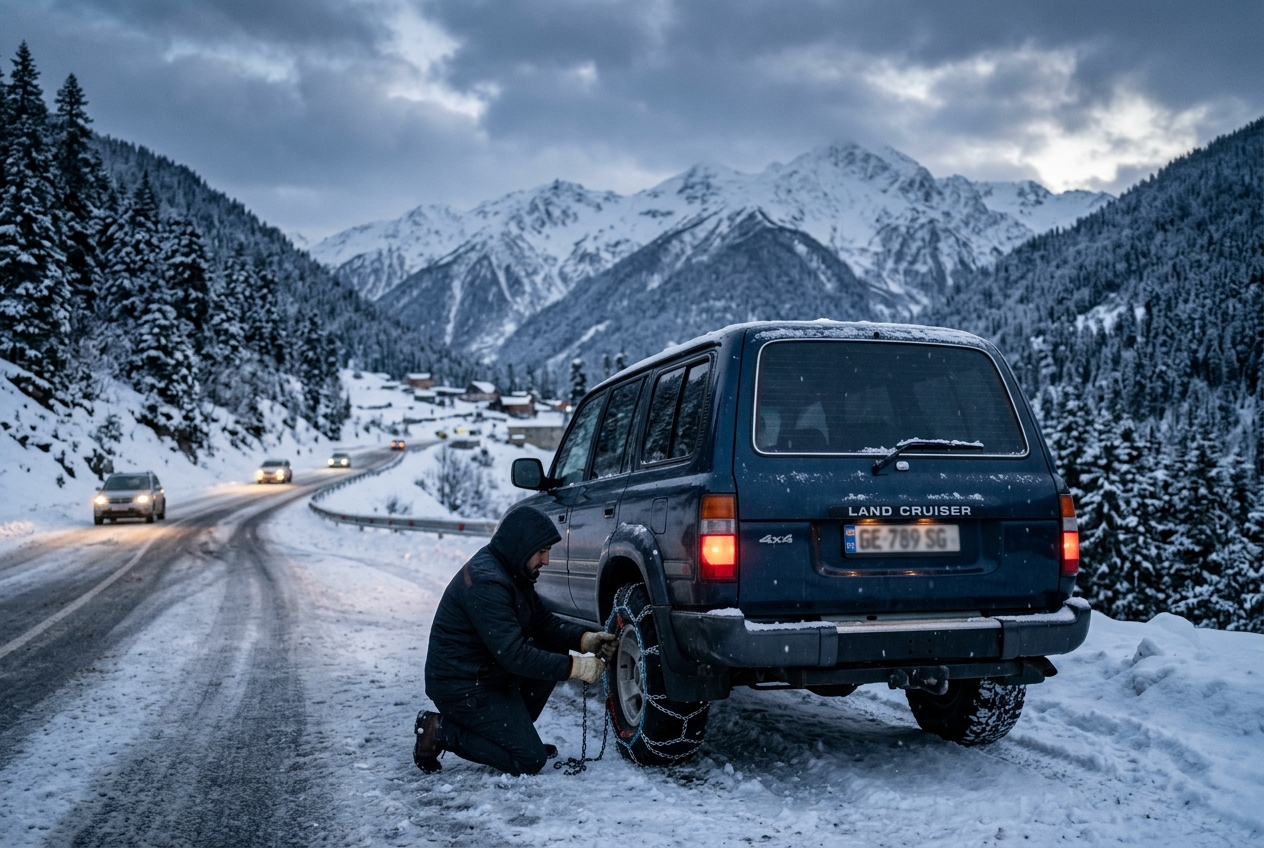
Georgia’s mountain roads are some of the most spectacular drives in the Caucasus, but between November and April, they can also be some of the most dangerous. Ice-glazed switchbacks on the way to Gudauri, whiteout conditions on the Jvari Pass, and snowdrifts blocking the road to Tusheti are not hypothetical scenarios: they happen every year. If you’re planning a winter road trip through this country, understanding snow chain requirements and cold-weather safety rules isn’t optional. It’s the difference between an unforgettable adventure and a genuinely dangerous situation. I’ve driven these routes in February, white-knuckled through fog on the Georgian Military Highway, and I can tell you that preparation matters more here than almost anywhere else I’ve traveled. This guide covers the legal requirements, the gear you need, the driving techniques that keep you alive, and the local resources that can bail you out when things go sideways.
Understanding Georgia’s Winter Road Conditions and Legal Requirements
Georgia (Sakartvelo, as locals call it) is a geographically compact country with wildly diverse terrain. You can drive from subtropical Batumi on the Black Sea coast to the 2,379-meter Jvari Pass in under eight hours, and the weather conditions along that route can shift from mild rain to a full blizzard. The Georgian government takes winter road safety seriously, especially on high-altitude corridors that serve as lifelines for mountain communities.
The legal framework around winter driving is straightforward but carries real consequences. During a declared state of emergency for inclement weather, drivers who fail to comply with chain requirements and cause an accident can face fines up to $1,000. That’s not a slap on the wrist. Georgian traffic police (known locally as “patrol police”) are active on mountain routes during winter and will stop vehicles that aren’t properly equipped.
Official Snow Chain Mandates and Signage
Georgian law permits and sometimes requires snow chains on roads covered in snow or ice. The legal definition is specific: tire chains are metal chains consisting of two circular metal loops connected by at least nine evenly spaced chains across the tire tread. This matters because some cheaper products sold at roadside stalls near ski resorts don’t meet this standard.
When chain requirements are in effect, you’ll see signage posted by the Road Department of Georgia (GeoRoad) at the base of mountain passes. These signs are typically in Georgian and sometimes in English, featuring a tire-with-chains icon. If you see this sign and don’t have chains, turn around. Police checkpoints often sit just beyond the signage, and officers will not let you pass without proper equipment.
Commercial vehicles face stricter rules. Those with four or more drive wheels must affix tire chains to at least four drive wheel tires when traveling on roads with limited access due to winter weather. If you’re renting a larger vehicle or driving a van, pay attention to this distinction.
Specific Mountain Passes Requiring Equipment
Not every road in Georgia requires chains in winter, but several critical routes almost always do during heavy snowfall. Here are the most common:
| Route | Elevation | Chain Likelihood (Dec-Mar) | Notes |
|---|---|---|---|
| Jvari Pass (Georgian Military Highway) | 2,379 m | Very High | Main route to Kazbegi/Stepantsminda |
| Goderdzi Pass | 2,025 m | High | Connects Akhaltsikhe to Batumi via mountains |
| Cross Pass to Gudauri | 2,196 m | Very High | Primary ski resort access |
| Abastumani Road | ~1,700 m | Moderate | Less trafficked, often unplowed |
| Tusheti Road | 2,926 m | Closed in winter | Typically impassable Nov-May |
The Georgian Military Highway is the most critical corridor because it connects Tbilisi to the popular Kazbegi region. This road sees heavy tourist traffic even in winter, and chain requirements are enforced regularly between December and March.
Essential Guide to Snow Chains and Anti-Skid Equipment
Picking the right traction equipment is not a trivial decision. The wrong chains can damage your tires, fail on steep grades, or simply not fit your rental car. I’ve seen tourists at the base of the Gudauri road trying to wrestle oversized chains onto a Hyundai Accent, and it’s not a scene you want to replicate.
Choosing Between Metal Chains and Snow Socks
Traditional metal chains remain the gold standard for Georgian mountain roads. They provide the best grip on compacted snow and ice, and they meet the legal definition under Georgian law. You can buy them at auto shops in Tbilisi (the area around the Eliava Market has several options) or from vendors near Gudauri. Expect to pay between 50 and 120 GEL ($18-$45 USD) for a decent set, depending on tire size.
Snow socks (textile traction devices) are lighter, easier to store, and simpler to install. They work reasonably well on light snow. However, they wear out faster on bare asphalt sections, and their legal status in Georgia during mandatory chain enforcement is ambiguous. If a police officer at a checkpoint demands to see your chains and you show them fabric covers, you might get waved through or you might not. I wouldn’t rely on them as your only option for high-altitude passes.
A practical approach: carry metal chains as your primary equipment and keep snow socks as a backup for milder conditions or lower-elevation roads. If you’re renting a car in Tbilisi, ask the rental agency about winter equipment. Some companies like Hertz Georgia and local operators include chains in their winter packages, but many do not.
Proper Installation and Maintenance Tips
Practice installing your chains before you need them. Seriously. Doing it for the first time on a dark, icy road at 2,000 meters with traffic passing you is miserable and dangerous.
- Lay the chains flat on the ground and untangle them completely
- Drape them over the drive wheels (front wheels for front-wheel-drive vehicles, which most rental cars in Georgia are)
- Connect the inner hook first, then pull the outer chain tight
- Drive forward about 20 meters and retighten: chains loosen after initial movement
- Remove chains as soon as you reach clear, dry road to prevent damage
Check your chains for broken links before every trip. Metal fatigue is common after a season of use, and a snapped chain whipping against your wheel well at speed can cause real damage. Store them in a bag in your trunk, not loose where they’ll rust into a tangled mess.
Safe Driving Techniques for Icy Georgian Terrains
Gear alone won’t save you. Georgian mountain roads demand a specific driving style that many visitors, especially those from flat or warm climates, simply haven’t practiced. The GDOT recommends reducing speed to at least half the normal speed limit in snowy or icy conditions, and honestly, even that can feel too fast on some of Georgia’s narrower mountain switchbacks.
Managing Steep Inclines and Sharp Declines
The Georgian Military Highway includes grades of 7-10% in several sections, and some secondary mountain roads are steeper. Going uphill on snow, momentum is your friend: maintain a steady speed without sudden acceleration. If your wheels start spinning, ease off the gas rather than pressing harder. Spinning wheels on ice polish the surface and make traction worse.
Descending is where most accidents happen. Shift into a lower gear (second or even first on steep sections) and let engine braking do the work. Avoid riding your brakes continuously, as this heats the brake pads and reduces their effectiveness, a phenomenon called brake fade that’s particularly dangerous on long descents like the one from the Cross Pass down toward Mleta.
If you feel the vehicle starting to slide on a downhill curve, resist the instinct to slam the brakes. Gently steer into the direction of the skid while easing off the brake pedal. ABS systems help, and most modern rental cars in Georgia have them, but they’re not magic on sheet ice.
Braking and Visibility in Heavy Snowfall
Heavy snowfall in the Georgian mountains can reduce visibility to under 50 meters within minutes. When this happens, slow down dramatically, turn on your low beams (not high beams, which reflect off snow and make visibility worse), and activate your hazard lights if you’re moving well below the speed of surrounding traffic.
Keep at least a four-second following distance from the vehicle ahead. On ice, stopping distances can be five to ten times longer than on dry pavement. A car traveling at 50 km/h on dry road stops in roughly 13 meters; on ice, that same car needs 60-70 meters.
If conditions become truly dangerous, the official recommendation from Georgia’s transportation authorities is clear: stay off the roads unless it’s an emergency. Find a guesthouse, pull into a village, or wait at a roadside café. Georgian hospitality is legendary for a reason: the concept of “stumari ghvtisaa” (a guest is from God) means that locals in mountain villages will almost always help stranded travelers, often insisting you stay for a meal or the night.
Vehicle Preparation and Emergency Kits for Remote Routes
A well-prepared vehicle is your first line of defense. Georgian mountain routes, especially secondary roads to places like Svaneti or Tusheti’s lower approaches, can leave you hours from the nearest mechanic or tow truck.
Winter Fluids and Battery Health Checks
Cold temperatures wreak havoc on vehicles that aren’t winterized. Before heading into the mountains, check these essentials:
- Coolant/antifreeze: should be rated to at least -30°C. Georgian mountain temperatures can drop to -20°C or colder at high elevation.
- Windshield washer fluid: use a winter-rated formula. Regular water-based fluid will freeze on your windshield and blind you instantly.
- Engine oil: if your car uses a heavier weight oil (like 10W-40), consider switching to 5W-30 for better cold-start performance.
- Battery: cold weather reduces battery capacity by up to 50%. If your battery is more than three years old, get it tested. Most auto shops in Tbilisi can do this for free.
Tire pressure drops in cold weather, roughly 1 PSI for every 5°C decrease in temperature. Check your pressures before departure and adjust to the manufacturer’s recommended level. Under-inflated tires reduce traction and make chain installation harder.
Survival Essentials for High-Altitude Breakdowns
If you break down on a remote Georgian mountain road in winter, help could be hours away. Pack an emergency kit that includes:
- Thermal blankets (the reflective emergency type, at minimum)
- Extra warm clothing, gloves, and a hat
- A fully charged power bank and phone charger
- Flashlight with extra batteries
- Non-perishable food and water (at least enough for 24 hours)
- A basic first aid kit
- A small shovel (collapsible ones work well)
- Jumper cables or a portable jump starter
I also recommend downloading offline maps of your route on Google Maps or Maps.me before you leave Tbilisi. Cell coverage is spotty to nonexistent on many mountain roads, and you don’t want to lose navigation at the worst possible moment.
Navigating Local Resources and Real-Time Updates
One of the biggest mistakes winter travelers make in Georgia is assuming they can just “figure it out” on the go. Real-time information about road closures and conditions is available, but you need to know where to find it.
Monitoring Road Department (GeoRoad) Alerts
The Road Department of Georgia (GeoRoad) maintains a website and social media presence where they post real-time updates on road closures, chain requirements, and pass conditions. Their Facebook page is actually the most frequently updated source, which is very Georgian: Facebook is the dominant social platform in the country, far more than Twitter or Instagram for official communications.
Check GeoRoad’s updates the morning of any mountain drive. Conditions can change overnight, and a road that was open yesterday might be closed today. The Jvari Pass on the Georgian Military Highway closes several times each winter, sometimes for days at a time, when avalanche risk is high or snow removal equipment can’t keep up.
The Yandex Go and Bolt apps, widely used in Georgia for ride-hailing, can also give you indirect intelligence. If no drivers are accepting routes toward a mountain destination, that’s a strong signal that road conditions are bad. Local taxi drivers in towns like Stepantsminda and Mestia are often the best source of real-time road information: they drive these routes daily and know conditions better than any app.
Identifying Safe Stopping Points and Shelters
Along major mountain routes, Georgia has established a network of rest stops, police checkpoints, and small roadside establishments where you can wait out bad weather. On the Georgian Military Highway, the town of Gudauri itself serves as a natural waypoint, with hotels, restaurants, and fuel stations. Between Tbilisi and Gudauri, the town of Pasanauri (famous for its khinkali dumplings) is another reliable stopping point.
For more remote routes, guesthouses in mountain villages are your safety net. In Svaneti, nearly every village has family-run guesthouses that operate year-round. The hosts speak varying levels of English (the younger generation tends to be much more proficient than their parents, a generational shift that accelerated after the Rose Revolution of 2003), but warmth and willingness to help transcend language barriers. Having Google Translate’s offline Georgian language pack downloaded is a practical lifesaver in these situations.
Keep your fuel tank at least half full at all times on mountain routes. Gas stations become scarce above 1,500 meters, and running out of fuel in freezing conditions is a genuine emergency.
Staying Safe on Georgia’s Winter Roads
Winter driving in Georgia rewards the prepared and punishes the careless. The country’s mountain roads are stunningly beautiful under snow, and reaching a place like Kazbegi with the Gergeti Trinity Church framed against white peaks is one of those travel moments you never forget. But getting there safely requires respect for the conditions, proper equipment including legally compliant snow chains, and a willingness to turn back or wait when conditions deteriorate.
Check GeoRoad before every mountain drive. Carry chains and know how to install them. Drive at half speed or slower on ice. Pack as though you might spend a night in your car, because on a remote Georgian pass in January, that’s not an unreasonable possibility. The mountains will still be there tomorrow, and Georgia’s famous hospitality means there’s always a warm guesthouse and a glass of chacha waiting while you wait for the road to clear.