
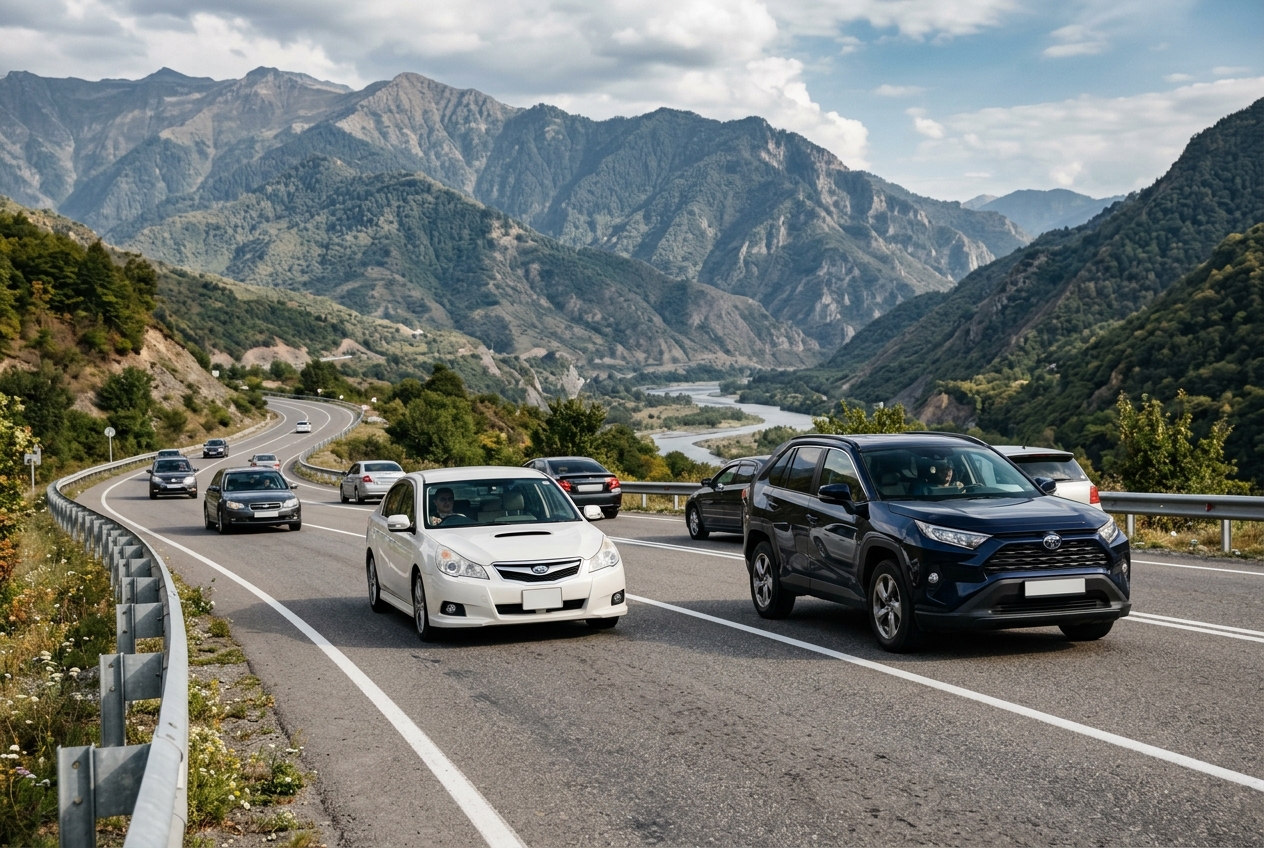
Georgia – the country, not the U.S. state – has one of the most unusual car cultures in the Caucasus region. Walk through the streets of Tbilisi, Kutaisi, or Batumi, and you’ll notice something that catches most visitors off guard: a significant number of cars have their steering wheels on the right side. In a country where traffic flows on the right side of the road, this creates an odd visual and a genuine practical question. If you’re planning to drive in Georgia, whether as a tourist renting a car or an expat buying one, understanding the difference between left-hand and right-hand drive vehicles here is essential. The mix of both types on Georgian roads tells a fascinating economic story, and knowing what to expect will save you headaches, money, and possibly a fender or two.

The Unique Coexistence of LHD and RHD Vehicles in Georgia
Georgia is one of the few right-hand traffic countries where you’ll see a genuinely high proportion of right-hand drive (RHD) vehicles sharing the road with standard left-hand drive (LHD) cars. This isn’t an accident or a quirk of geography. It’s the direct result of economic forces that shaped the country’s automotive market over the past two decades, creating a situation where Japanese-market Toyotas and Hondas sit bumper-to-bumper with German sedans and Korean hatchbacks.
Historical Context of Japanese Imports
After the collapse of the Soviet Union, Georgia’s economy went through severe hardship. Most families couldn’t afford new European or American vehicles, and the domestic car market was virtually nonexistent. Starting in the early 2000s, a flood of affordable used cars from Japan began arriving through the port of Poti on the Black Sea coast. These vehicles – primarily Toyotas, Hondas, Nissans, and Subarus – were right-hand drive, built for Japan’s left-hand traffic system.
The appeal was simple: price. A well-maintained Japanese sedan with low mileage could be purchased and shipped for a fraction of what a comparable European car would cost. Japanese auction houses offered reliable vehicles that had passed strict domestic inspections (the “shaken” system), meaning Georgian buyers were getting quality cars at bargain prices. Many RHD cars in Georgia are used imports from Japan because they’re significantly cheaper than their American or European equivalents.
By the mid-2000s, RHD Japanese imports had become a defining feature of Georgian roads. Entire businesses sprang up around the import pipeline, from shipping agents in Yokohama to customs brokers in Poti to mechanics in Tbilisi who specialized in Japanese models.
Current Market Trends and Availability
The Georgian vehicle market has been growing steadily, posting a 1% expansion in 2024 and marking its fifth consecutive year of growth. But the composition of that market is shifting. While Japanese RHD vehicles still populate roads across the country, the trend line is moving toward LHD vehicles, particularly hybrids and electric cars from Korea, Europe, and the United States.
Hybrids are especially popular because they benefit from halved import duties, while fully electric vehicles enjoy zero import fees entirely. This tax incentive has pushed many buyers toward LHD hybrid Toyotas (like the Prius, which is available in both LHD and RHD configurations) and Korean EVs. The used car market still has plenty of RHD options, but the new-registration pipeline is increasingly LHD.
| Vehicle Type | Import Duty | Typical Origin | Drive Side |
|---|---|---|---|
| Standard gasoline (new) | Full customs duty | Europe, Korea, USA | LHD |
| Hybrid | 50% reduced duty | Japan, Korea, USA | Mixed |
| Electric | Zero duty | Europe, Korea, USA | LHD |
| Used Japanese (pre-2017) | Standard duty | Japan | RHD |
Legal Framework and Import Restrictions
Understanding the legal status of RHD vehicles in Georgia requires knowing a specific date: 2018. Before that year, importing and registering right-hand drive cars was straightforward. After it, the rules changed dramatically.
The 2017 Ban on New RHD Registrations
In 2017, the Georgian government announced a ban on new registrations of right-hand drive vehicles, which took effect in early 2018. The reasoning was primarily safety-related: driving an RHD car on right-hand traffic roads creates significant blind spots, particularly during overtaking maneuvers on Georgia’s many two-lane highways.
This ban means that since 2018, you cannot import a new RHD vehicle and register it for road use in Georgia. The legislation effectively closed the pipeline that had brought hundreds of thousands of Japanese cars into the country over the previous fifteen years. Dealers who had built their entire businesses around Japanese imports had to pivot toward LHD stock from Korea, Europe, or LHD Japanese models sold in other markets.
The ban doesn’t mean RHD cars disappeared from Georgian roads overnight, though. Vehicles that were already registered before the cutoff date remain legal to drive. This is why you’ll still see plenty of right-hand drive Toyotas and Subarus in daily traffic – they’re grandfathered in.
Rules for Re-registering Existing Vehicles
If you’re buying a used RHD vehicle that’s already registered in Georgia, the process is relatively straightforward. The car can be transferred between owners and re-registered, provided it was originally registered before the 2018 deadline. You’ll need to pass a technical inspection (more on that below), pay the transfer fees, and ensure the vehicle’s documentation is in order.
One important caveat: if an RHD vehicle’s registration lapses or is deregistered for any reason, getting it back on the road can be extremely difficult or impossible under current rules. This creates an interesting market dynamic where registered RHD vehicles hold a specific kind of value simply because their registration status is irreplaceable.
For foreigners driving in Georgia on a temporary basis, the rules are different. Tourists can drive RHD vehicles registered in other countries for a limited period, typically up to one year, without needing Georgian registration. This is relevant for overland travelers passing through the Caucasus.
Practical Challenges of Driving RHD on Georgian Roads
Owning an RHD car in a right-hand traffic country isn’t just a legal question – it’s a daily practical reality that affects how you drive, where you park, and how safe you feel on the road.
Overtaking Safety on Two-Lane Highways
This is the single biggest safety concern with RHD vehicles in Georgia. The country has many two-lane highways connecting cities and towns, and overtaking slow trucks or agricultural vehicles is a regular necessity. In an LHD car, you naturally sit on the left side, giving you a clear view of oncoming traffic before you pull out to pass. In an RHD car, your view is blocked by the vehicle you’re trying to overtake.
Georgian RHD drivers have developed workarounds. Some rely heavily on passengers to spot oncoming traffic. Others use wide-angle mirrors or camera systems mounted on the left side. A common practice is to wait for a straight, open stretch with full visibility before attempting any overtaking maneuver. As one Canadian RHD import specialist noted, with proper mirror adjustments and practice, driving an RHD vehicle can be just as safe as driving LHD, though it requires more mindfulness behind the wheel.
Still, the mountain roads between Tbilisi and the regions – think the route to Mestia in Svaneti or the winding highway to Batumi – demand extra caution in any vehicle, let alone one with compromised sightlines. If you’re not an experienced driver, an RHD car on these roads adds a layer of difficulty you probably don’t need.
Navigating Tolls and Parking Barriers
Georgia doesn’t have an extensive toll road system, but it does have parking barriers, gas station kiosks, and drive-through service points designed for LHD vehicles. In an RHD car, you’ll find yourself either reaching awkwardly across the cabin or getting out of the car entirely to grab a ticket or tap a payment terminal.
This sounds minor until you’re doing it multiple times a day in Tbilisi traffic. Parking garages in malls like East Point or Galleria are designed with barriers on the left side. ATM drive-throughs (rare but they exist) are positioned for LHD drivers. Even ordering at a fast-food drive-through becomes a comedy routine. These small inconveniences add up and are worth factoring into your decision if you’re choosing between an RHD and LHD vehicle.
Economic Considerations: Price vs. Resale Value
The financial argument for RHD Japanese cars has always been their strongest selling point in Georgia. But the economics have shifted since the 2018 registration ban, and the calculation isn’t as simple as it once was.
Affordability of Pre-owned Japanese Models
A used RHD Toyota Corolla or Honda Fit that’s already registered in Georgia can still be purchased for significantly less than a comparable LHD European model. We’re talking price differences of 30-50% in some cases, depending on the model year and condition. For a Georgian family on a modest income, that gap represents real money.
The catch is that the pool of available registered RHD vehicles is shrinking. No new ones are entering the market, and older ones are gradually being retired due to age, accidents, or mechanical failure. This creates a slow squeeze on supply, which has actually propped up prices for well-maintained RHD models more than you might expect. A clean 2015 Toyota Wish with Georgian registration, for example, holds its value surprisingly well because it cannot be replaced with a new import.
Maintenance Costs and Spare Parts Access
One genuine advantage of Japanese vehicles in Georgia is parts availability. The sheer volume of Toyotas and Hondas on the road means that spare parts are abundant and affordable. Bazaars like the massive Eliava Market in Tbilisi stock everything from brake pads to full engines for popular Japanese models. Independent mechanics throughout the country are intimately familiar with these vehicles.
LHD European cars, by contrast, can be expensive to maintain. A BMW or Volkswagen part that costs 50 GEL for the Japanese equivalent might run 150-200 GEL for the German version. This ongoing maintenance cost advantage keeps many Georgian drivers loyal to their Japanese cars, even as the market shifts toward LHD options. If you’re budgeting for car ownership in Georgia, factor in not just the purchase price but the three-to-five-year maintenance outlook.
Technical Modifications and Safety Inspections
Georgia requires periodic technical inspections for all registered vehicles, and RHD cars face some specific requirements that LHD vehicles don’t.
Headlight Adjustment for Right-Hand Traffic
This is one of the most commonly overlooked issues with RHD vehicles. Headlights on cars built for left-hand traffic (like Japan or the UK) are designed to cast their beam pattern toward the left side of the road. When you drive that car on the right side of the road, the beam pattern throws light into oncoming traffic, creating dangerous glare for other drivers.
Georgian technical inspections check for this, and RHD vehicles are required to have their headlights adjusted or modified to produce an appropriate beam pattern for right-hand traffic. The simplest fix involves applying beam deflector stickers to the headlight lenses, which redirect the light pattern. A more permanent solution is replacing the headlight units entirely with LHD-spec versions, though this can be costly depending on the model.
Failing to address this issue won’t just get you failed at inspection – it’s genuinely dangerous, especially on unlit rural roads at night. If you buy an RHD car in Georgia, check the headlights immediately.
Steering Conversion: Risks and Regulations
Some owners consider converting their RHD vehicle to LHD by moving the steering column, pedals, and dashboard components to the left side. This is technically possible but comes with serious caveats.
Full steering conversions are expensive, typically costing between 2,000 and 5,000 GEL depending on the vehicle, and the quality of the work varies enormously. A poorly executed conversion can compromise the structural integrity of the dashboard, interfere with airbag deployment, and create electrical gremlins that haunt you for years. Georgian regulations require that any steering conversion be performed by a certified facility and pass a subsequent technical inspection.
Most experienced mechanics in Georgia will tell you honestly: unless you’re converting a high-value vehicle that you plan to keep for many years, the cost and risk of steering conversion rarely make financial sense. You’re almost always better off selling the RHD car and buying an LHD replacement. The conversion market exists, but it’s a niche service that appeals mainly to owners of specific models they’re emotionally attached to.
Choosing the Right Vehicle for Your Needs in Georgia
The question of left-hand versus right-hand drive in Georgia ultimately comes down to your priorities, your budget, and how long you plan to stay. RHD vehicles are legal to own and operate provided they carry valid Georgian registration, and tens of thousands of Georgians drive them daily without incident. They’re affordable, reliable, and cheap to maintain.
But the trend is unmistakable. The registration ban, the tax incentives for hybrids and EVs, and the natural attrition of aging Japanese imports all point toward an increasingly LHD future for Georgia’s roads. If you’re buying a car for long-term use, an LHD vehicle gives you better resale prospects, easier daily driving, and no regulatory uncertainty.
For short-term residents or budget-conscious buyers, a well-maintained RHD Toyota with valid registration remains a smart, practical choice. Just invest in good mirrors, get comfortable with the overtaking limitations, and make sure those headlights are properly adjusted. Georgia’s roads reward attentive drivers regardless of which side the steering wheel sits on – and the country’s mechanics, many of whom learned their trade on these exact Japanese models, will keep your car running for years to come.
If you’re heading to Georgia and planning to drive, spend a day or two as a passenger first. Watch how locals handle the traffic, get a feel for the road culture, and then decide which type of vehicle matches your comfort level. The right car, whether LHD or RHD, is the one you can drive confidently on a Tbilisi roundabout at rush hour.