
Few countries pack as much cultural density into such a small territory as Georgia. Tucked between the Greater Caucasus mountains and the Black Sea, this nation of fewer than four million people has built one of the most distinctive civilizations on Earth. Georgians call their homeland Sakartvelo, a name rooted in a mythic ancestor figure, and the pride they carry in that identity is palpable from the moment you arrive. I remember stepping off a plane in Tbilisi and being struck by how quickly a taxi driver launched into a passionate monologue about his country’s alphabet, wine, and polyphonic singing, all before we’d left the airport road. That intensity of cultural pride isn’t performative. It’s woven into daily life. Georgia’s unique culture sits at a crossroads of empires: Persian, Ottoman, Mongol, Russian. Each left marks, but none managed to erase the Kartvelian core. The result is a living civilization that feels ancient and startlingly alive at the same time, one that welcomed 7.8 million international visitors in 2025, a 6% increase from the prior year. Those visitors aren’t just coming for scenery. They’re coming for something harder to find elsewhere: a culture that hasn’t been smoothed over for mass consumption.
Historical Roots and the Kartvelian Identity
Georgia’s sense of self runs thousands of years deep. The Kartvelian peoples, the ethnic and linguistic family that includes Georgians, Mingrelians, Svans, and Laz, have inhabited the South Caucasus since at least the second millennium BCE. The ancient kingdoms of Colchis (western Georgia) and Iberia (eastern Georgia) were known to Greek and Roman historians. Colchis, of course, is the land where Jason and the Argonauts supposedly sailed to retrieve the Golden Fleece, a myth that likely reflects real ancient gold-panning techniques still practiced in Svaneti using sheepskins.
What makes the Kartvelian identity so resilient is its refusal to assimilate. Surrounded by larger empires for millennia, Georgians developed fiercely independent institutions: their own church, their own script, their own legal traditions. Even during the Soviet period (1921-1991), when Moscow attempted to homogenize cultures across the USSR, Georgians staged protests to protect their language’s constitutional status. A 1978 demonstration in Tbilisi successfully forced the Soviet government to back down, preserving Georgian as the republic’s official language. That kind of stubbornness defines the national character.
The Mystery of the Unique Georgian Alphabet
Georgia is one of only fourteen countries in the world with its own unique alphabet, and its script is genuinely unlike anything else. The modern Mkhedruli alphabet has 33 letters, each representing a single sound, making it beautifully phonetic. But the deeper mystery is its origin. Scholars still debate whether the Georgian script evolved from Aramaic models or was an independent invention. The oldest known inscriptions date to the 5th century CE, found in a church in Bethlehem and at the Bolnisi Sioni cathedral near Tbilisi.
What strikes most visitors is how the script looks: rounded, flowing, almost musical in its visual rhythm. Georgians take enormous pride in it. UNESCO inscribed the three historical Georgian alphabets (Asomtavruli, Nuskhuri, and Mkhedruli) on its Intangible Cultural Heritage list in 2016. If you spend time in Tbilisi, you’ll notice the script everywhere: in street art, tattoo shops, wine labels, and fashion. It’s a living symbol of cultural continuity, not a museum piece.
Early Christian Heritage and Ancient Monasticism
Georgia adopted Christianity as its state religion in 337 CE, making it one of the earliest Christian nations on Earth, just a few years after Armenia. The story centers on Saint Nino, a Cappadocian woman who reportedly healed the queen of Iberia and converted King Mirian III. The Svetitskhoveli Cathedral in Mtskheta, built over what Georgians believe is Christ’s robe, remains the spiritual heart of the nation.
Monasticism flourished early and profoundly. The “Thirteen Assyrian Fathers,” a group of monks who arrived in the 6th century, established monasteries across the country that became centers of learning, manuscript production, and theological thought. The David Gareja monastery complex, carved into semi-desert cliffs near the Azerbaijani border, contains frescoes dating to the 8th century. These aren’t just tourist attractions. They’re active sites of worship and pilgrimage, places where you can attend a service and hear chanting traditions that have barely changed in a thousand years.
The Art of the Supra and Georgian Hospitality
Georgian hospitality isn’t a tourism slogan. It’s a deeply held moral code rooted in the phrase “stumari ghvtisaa,” meaning “a guest is from God.” The centerpiece of this hospitality is the supra, a traditional feast that functions as part dinner party, part philosophical symposium, part endurance test. A proper supra can last five or six hours, involve twenty or more toasts, and leave you wondering how a culture can be simultaneously so generous and so relentless.
Unlike a Western dinner party, where conversation flows freely, the supra has structure. Dishes arrive in waves: salads, cheeses, meats, breads, stews. Wine flows constantly, but within a framework of ritual toasts that give the evening emotional and intellectual shape. I’ve attended supras in both Tbilisi apartments and remote Kakhetian farmhouses, and the core experience is remarkably consistent. The host treats feeding you as a sacred obligation.
The Tamada: Master of the Traditional Toast
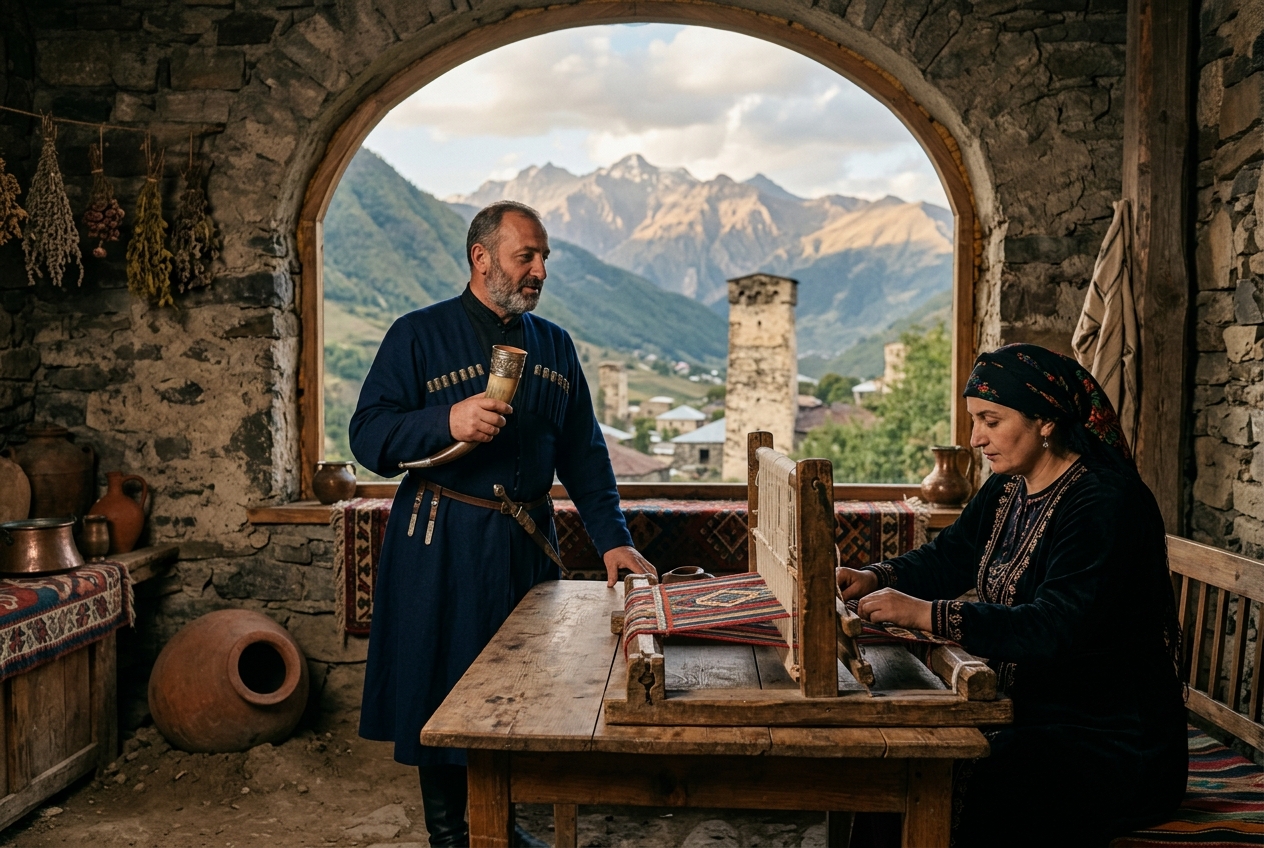
Every supra has a tamada, a toastmaster who guides the evening’s emotional arc. This isn’t a best-man-at-a-wedding kind of role. The tamada is part philosopher, part entertainer, part spiritual leader. A good tamada will lead toasts to God, to Georgia, to the deceased, to love, to children, to friendship, building in emotional intensity as the night progresses. Each toast is followed by everyone drinking, often from a kantsi (a traditional horn cup) that cannot be set down until emptied.
The tamada role is taken seriously. Being asked to serve as tamada is an honor that reflects the community’s respect for your wisdom and eloquence. In rural areas, particularly in Kakheti and Imereti, the tamada tradition remains virtually unchanged from centuries past. In urban Tbilisi, younger Georgians sometimes joke about the marathon nature of supras, but they still participate with genuine enthusiasm. The generational shift here is interesting: post-2003 “Rose Revolution” Georgians may speak English and work in tech, but they still know how to hold a horn and deliver a toast that makes the table go quiet.
Culinary Staples: From Khachapuri to Khinkali
Georgian food is one of the country’s most powerful cultural ambassadors. Khachapuri, the cheese-filled bread that comes in regional variations (Adjarian, Imeretian, Megrelian), is so central to daily life that economists created the “Khachapuri Index” to track inflation. That index rose 8.4% over the past year, reaching an average cost of 7.03 GEL in December 2024, making it a surprisingly useful economic indicator.
Khinkali, the twisted soup dumplings originating from the mountain regions, are another staple with strict eating etiquette: hold by the top knot, bite a small hole, sip the broth, then eat the rest. Throwing away the knot is acceptable. Using a fork is not. Beyond these two icons, Georgian cuisine includes dishes like lobio (spiced bean stew), pkhali (walnut-vegetable pâté), and churchkhela (the candle-shaped walnut-and-grape confection sometimes called “Georgian Snickers”). The flavor profile leans heavily on walnuts, fresh herbs like cilantro and tarragon, pomegranate, and adjika (a fiery chili paste from Abkhazia).
| Dish | Region of Origin | Key Ingredients |
|---|---|---|
| Khachapuri (Adjarian) | Adjara | Cheese, egg, butter, bread |
| Khinkali | Tusheti / Pshavi | Spiced meat, dough, broth |
| Lobio | Nationwide | Red beans, spices, cornbread |
| Churchkhela | Kakheti | Walnuts, grape must |
| Pkhali | Nationwide | Spinach/beet, walnut paste |
The Cradle of Wine: 8,000 Years of Viticulture
Georgia’s claim to being the birthplace of wine isn’t marketing. Archaeological evidence from 6000 BCE, including grape residue found on Neolithic pottery fragments in the village of Gadachrili Gora, supports it. The country is home to over 500 indigenous grape varieties, of which around 45 are used commercially. The most famous are Saperavi (a deep red) and Rkatsiteli (a versatile white), but exploring lesser-known varieties like Kisi, Mtsvane, and Aleksandrouli is one of the great pleasures of visiting.
The wine industry is booming. Georgian wine exports reached over 67,000 tons valued at $195.8 million during January-August 2024, a 16% increase compared to the same period the year before. The country had roughly 2,400 registered wineries as of 2023, ranging from massive Soviet-era factories to tiny family operations producing a few hundred bottles. Russia remains the dominant export market, absorbing 69.4% of exports in 2024, though Georgian winemakers are actively diversifying toward European and Asian markets.
The Qvevri Method: UNESCO-Recognized Winemaking
The qvevri is a large clay vessel, egg-shaped and lined with beeswax, buried underground for fermentation and storage. UNESCO recognized this winemaking method as Intangible Cultural Heritage in 2013, and it’s the technique that gives Georgian amber wines their distinctive character. Amber wine, made by fermenting white grapes with their skins and seeds for months in a qvevri, has a tannic, complex profile that surprises people expecting a conventional white.
Visiting a family marani (wine cellar) in Kakheti and watching a winemaker open a buried qvevri is one of those travel moments that stays with you. The process is essentially unchanged from what Neolithic Georgians did eight millennia ago. Small producers like Pheasant’s Tears in Sighnaghi and Iago’s Wine in Kartli have gained international cult followings by championing this traditional approach.
Polyphonic Singing and Traditional Folk Dance
If wine and food are Georgia’s body, music and dance are its soul. The country’s performing arts traditions are extraordinary, both in their technical complexity and their emotional power. These aren’t folk traditions preserved in amber for tourists. They’re living practices that Georgians engage with from childhood.
Harmonies of the Soul: Georgian Polyphony
Georgian polyphonic singing, where three or more independent vocal parts interweave without instrumental accompaniment, was one of the first traditions inscribed on UNESCO’s Intangible Heritage list in 2001. The style varies dramatically by region: Kakhetian songs tend toward long, sustained harmonies; Gurian songs feature rapid-fire yodeling called krimanchuli; Svan songs from the mountains carry an almost primordial, drone-based intensity.
What makes Georgian polyphony genuinely unusual in world music is its use of dissonant intervals that Western classical theory would consider “wrong” but that create a haunting, resonant beauty. A recording of the Georgian song “Chakrulo” was included on the Voyager Golden Record, launched into space in 1977 as a representation of human musical achievement. You can hear polyphonic singing at the Tbilisi State Conservatory, in village churches, and sometimes spontaneously at supras when the wine has been flowing long enough.
The Energy and Grace of National Choreography
Georgian folk dance is athletic, dramatic, and gender-differentiated in striking ways. Male dancers perform acrobatic feats: spinning on their knees, leaping, and dancing on their toes in soft leather boots. Female dancers glide with an almost floating quality, their movements restrained and elegant. The contrast is deliberate and deeply expressive.
The Sukhishvili National Ballet, founded in 1945, remains the country’s most famous dance ensemble and has performed in over 90 countries. Regional dances tell specific stories: the Kartuli is a courtship dance of extraordinary tenderness; the Khevsuruli depicts a sword fight interrupted by a woman throwing her headscarf between the combatants (a traditional peacemaking gesture). Watching a live performance at the Rustaveli Theatre in Tbilisi is essential if you visit.
Architectural Wonders from the Caucasus to the Black Sea
Georgia’s built environment reflects its geographic and cultural diversity. From cave cities to Art Nouveau districts, the architecture tells the story of a country that has been continuously inhabited and continuously reinventing itself. Tbilisi alone layers Persian bathhouses, Soviet Brutalism, and contemporary glass-and-steel structures within a few city blocks.
The Jvari Monastery (6th century), perched on a cliff above the confluence of the Mtkvari and Aragvi rivers, is one of the finest examples of early medieval Georgian architecture. Gelati Monastery near Kutaisi, built by King David the Builder in 1106, was a major medieval intellectual center sometimes called the “second Athens.” These sites aren’t isolated monuments. They exist within landscapes that Georgians consider sacred.
Svaneti’s Defensive Towers and Mountain Fortresses
Upper Svaneti, a UNESCO World Heritage Site, is home to clusters of medieval defensive towers (called koshki) that rise 20 to 25 meters high. Built between the 9th and 12th centuries, these towers served as family refuges during blood feuds and foreign invasions. The village of Ushguli, at roughly 2,200 meters elevation, is one of the highest continuously inhabited settlements in Europe.
Getting to Svaneti still requires commitment: a winding drive from Zugdidi or a short flight to Mestia. That relative isolation has preserved both the towers and the Svan culture, which maintains its own language, musical traditions, and religious practices distinct from lowland Georgia. The Svan dialect is not mutually intelligible with standard Georgian, and Svan ritual songs carry musical structures found nowhere else in the Caucasus.
Modern Resilience and the Future of Georgian Heritage
Georgia’s cultural story isn’t frozen in the past. The country is experiencing a creative renaissance that draws energy from its traditions while engaging with global contemporary currents. Tbilisi’s art scene, anchored by institutions like the Georgian National Museum and emerging galleries in the Fabrika complex, is attracting international attention. As one curator noted, Georgian art is gaining visibility at a European level, balancing regional narratives with universal contemporary concerns.
The tension between preservation and modernization is real. Younger Georgians, fluent in English and plugged into global culture, are reinterpreting traditions rather than abandoning them. Natural wine bars in Tbilisi serve qvevri wines alongside electronic music. Fashion designers incorporate Mkhedruli script into streetwear. DJs sample polyphonic singing in club tracks. This isn’t dilution. It’s a culture confident enough to evolve without losing its center.
Georgia’s distinct cultural heritage, from its alphabet and ancient Christianity to its feasting traditions and buried clay wine vessels, represents something increasingly rare: an unbroken thread connecting the deep past to a vibrant present. Whether you come for the khinkali or the polyphony, the mountain towers or the amber wine, you’ll leave understanding why Georgians guard their identity so fiercely. It’s not nostalgia. It’s a living inheritance they intend to keep passing forward.