
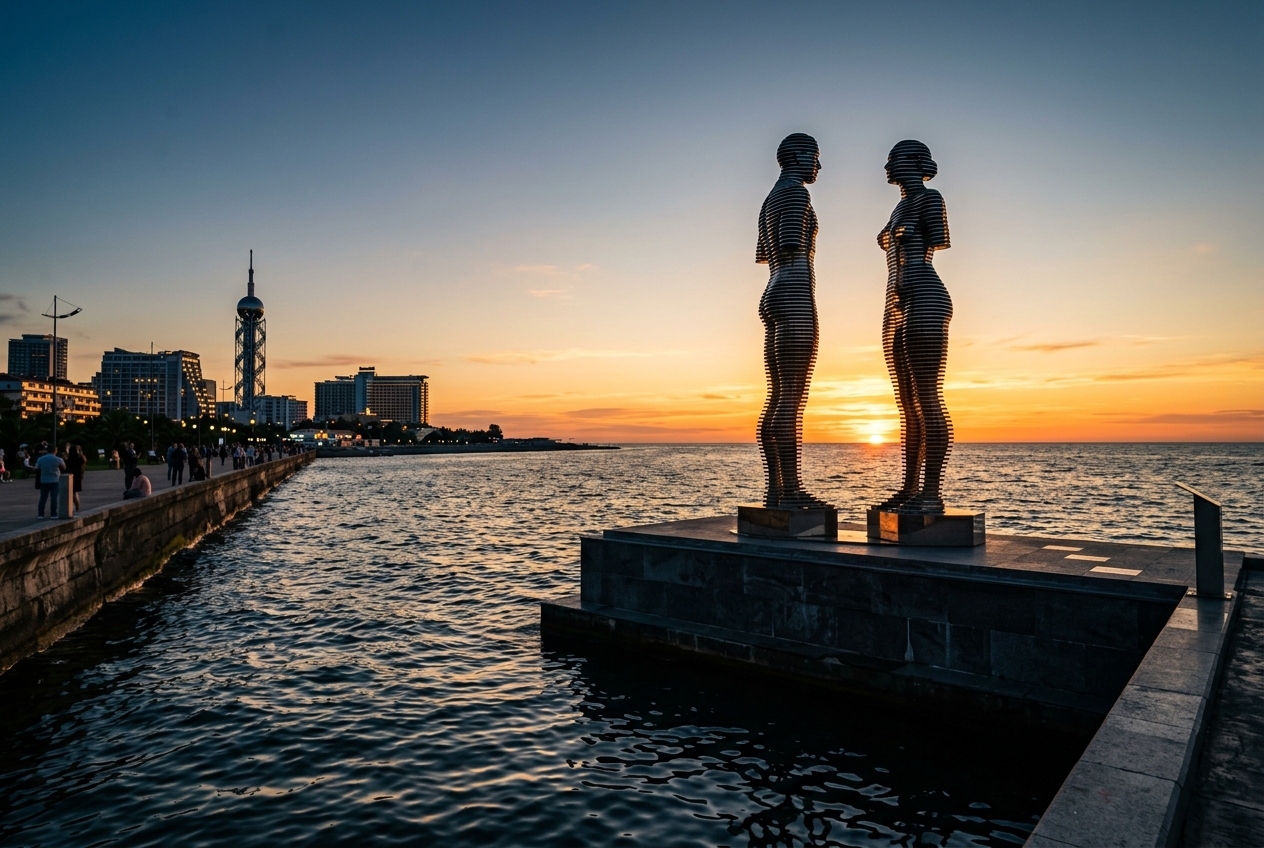
On the edge of the Black Sea, where the subtropical coast of Georgia meets the restless water, two towering steel figures reach for each other every evening as the sun drops behind the horizon. They merge, pass through one another, and drift apart again in a slow, mechanical ritual that has moved thousands of travelers to silence, tears, and frantic phone-camera fumbling. The Ali and Nino statue in Batumi is one of those rare public artworks that actually earns its emotional weight. It tells a story of love, cultural collision, and loss that predates the sculpture by nearly a century, rooted in a novel that itself remains wrapped in mystery and controversy. Whether you know the book or stumble on the figures by accident during a seaside stroll, the effect is the same: you stop, you watch, and something sticks with you. What follows is the full story behind this monument, from its literary origins to the engineering that makes it move, and why it matters far beyond Batumi’s boardwalk.
Origins and Inspiration: The Literary Roots of the Monument
Kurban Said’s 1937 Masterpiece
The statue draws its name and soul from the novel “Ali and Nino,” first published in Vienna in 1937 under the pen name Kurban Said. The book tells the story of Ali Khan Shirvanshir, a Muslim Azerbaijani nobleman, and Nino Kipiani, a Georgian Christian princess, set against the backdrop of Baku in the early twentieth century. Their love unfolds during the final years of the Russian Empire, through the chaos of World War I, and into the brief window of Azerbaijani independence before Soviet annexation.
The true identity of Kurban Said has been debated for decades. The two leading candidates are Lev Nussimbaum, a Jewish writer from Baku who converted to Islam and lived in Europe, and Yusif Vazir Chamanzaminli, an Azerbaijani diplomat and author. Nussimbaum, who also wrote under the name Essad Bey, is the more widely credited author in Western scholarship, and his own life story of fluid identity and cultural border-crossing mirrors the novel’s themes with almost eerie precision. The book itself was largely forgotten until its rediscovery and English translation in 2000, which sparked renewed global interest and scholarly debate.
Regardless of authorship, the novel struck a chord because it captured something real about the Caucasus: a region where empires, religions, and ethnic identities have overlapped and collided for centuries. The book is not just a love story. It is a meditation on what happens when personal devotion runs headlong into forces much larger than two people.
Cultural Conflict and the Star-Crossed Lovers
Ali and Nino’s relationship is defined by the tension between East and West, a tension that runs through every chapter like a fault line. Ali is educated in a Russian gymnasium in Baku but remains deeply tied to his Muslim Azerbaijani heritage. Nino comes from a Georgian aristocratic family with European cultural leanings. Their love is genuine, but the world around them makes that love almost impossible to sustain.
The novel does not romanticize this conflict. Ali’s family and community view Nino with suspicion, and Nino’s world sees Ali as exotic at best, threatening at worst. When war and revolution arrive, the personal becomes political in the most devastating way. Ali fights for Azerbaijani independence while Nino’s instincts pull her toward the relative safety of Georgia. Their story ends in separation and death, not because they stopped loving each other, but because the historical forces around them proved stronger.
This is what makes the novel so resonant in the Caucasus and beyond. It is not a fairy tale. It is an honest account of how identity, faith, and geopolitics can tear apart even the deepest human connections. The statue in Batumi takes this narrative and distills it into a single, repeating visual metaphor that anyone can understand, regardless of whether they have read a single page of the book.
The Vision of Tamara Kvesitadze
Conceptualizing the ‘Statue of Love’
Georgian sculptor Tamara Kvesitadze created the Ali and Nino statue, which she originally titled “Man and Woman,” in 2010. The work was commissioned as part of Batumi’s broader urban renewal under the leadership of Adjara’s regional government, which was investing heavily in transforming the city into a modern tourist destination. Kvesitadze, already known for her kinetic sculptures and installations, was given a prominent location on the Batumi Boulevard waterfront.
Her concept was deceptively simple: two abstract human figures, a man and a woman, that would slowly move toward each other, merge into a single form, and then pass through one another and separate. The cycle would repeat continuously. Kvesitadze has spoken about the work as a universal statement on love and loss, though the public immediately connected it to the Ali and Nino story, and that association has become inseparable from the piece.
What makes Kvesitadze’s vision remarkable is her refusal to make the figures realistic. They are not portraits of specific characters. Their bodies are composed of metal layers and open spaces, giving them a translucent, almost ghostly quality. This abstraction is deliberate. It allows viewers to project their own experiences of love, separation, and longing onto the figures, which is precisely why the statue resonates with people from wildly different cultural backgrounds. A couple from Seoul, a backpacker from Brazil, a Georgian grandmother: each sees something personal in the same ten-minute cycle.
The Engineering Behind the Movement
The mechanical reality of making two eight-meter-tall steel figures move smoothly through each other every ten minutes is a significant engineering challenge. The figures are constructed from multiple layers of painted steel, and each one is mounted on a motorized base that controls its rotation and forward movement along a track. The design required collaboration between Kvesitadze’s artistic team and mechanical engineers who specialized in kinetic public art.
Each figure rotates on its own axis while simultaneously moving along a curved path. The timing is calibrated so that the two forms align perfectly at the moment of “embrace,” creating the illusion that they have become one body. As they continue moving, they pass through each other thanks to the layered, open construction of the steel panels. The gaps between the metal sheets allow one figure’s layers to interlock with the other’s without physical collision.
| Feature | Detail |
|---|---|
| Height | Approximately 8 meters (26 feet) each |
| Material | Painted steel with layered panel construction |
| Movement cycle | Approximately 10 minutes per full sequence |
| Installation year | 2010 |
| Location | Batumi Boulevard, Adjara, Georgia |
| Designer | Tamara Kvesitadze |
The engineering had to account for Batumi’s coastal climate, which brings salt air, humidity, and strong winds off the Black Sea. The mechanical components require regular maintenance, and the steel surfaces need periodic repainting to prevent corrosion. It is a piece of public art that demands ongoing care, a fact that speaks to Batumi’s commitment to maintaining it as a centerpiece of the city’s identity.
Symbolism of the Kinetic Performance
The Ten-Minute Cycle of Union and Separation
The full performance of the Ali and Nino sculpture takes roughly ten minutes from start to finish, and then it begins again. The figures start apart, facing each other from a distance. They slowly approach, their outlines growing closer until they overlap and seem to merge into a single silhouette. For a brief moment, the two become one. Then they continue moving, passing through each other and emerging on the opposite side, now facing away, drifting apart.
This cycle is the heart of the statue’s emotional power. It is not a depiction of a happy ending. It is a depiction of impermanence: the idea that connection, no matter how profound, is always temporary. Every union contains within it the seed of separation. The figures will come together again, yes, but they will also always drift apart. There is no resolution, only repetition.
Visitors who watch the full cycle often describe it as unexpectedly moving. The slow pace forces you to pay attention in a way that a static sculpture does not. You find yourself waiting, almost holding your breath, as the figures approach. The moment of merging feels like relief. And then the separation begins, and it feels like grief. I have watched tourists stand through three or four complete cycles, unable to walk away, as if waiting for a different outcome that never comes.
Transparency and the Inevitability of Loss
The layered, open construction of the figures adds another dimension of meaning. Because the steel panels are spaced apart, you can see through the figures. Light passes through them. The sky and sea are visible behind and between their forms. This transparency suggests vulnerability and impermanence: these are not solid, invulnerable bodies but fragile, permeable ones.
When the figures merge, the overlapping layers create a denser, more opaque form. For that brief moment of union, they seem more solid, more real, more present. As they separate and the layers thin out again, they become almost ghostly. The visual metaphor is hard to miss: together, we are more substantial; apart, we become translucent, incomplete.
This transparency also connects to the novel’s themes of identity. Ali and Nino are both defined by their cultural backgrounds, yet those identities are not solid walls. They are porous, layered, full of gaps. The figures in the statue embody this idea physically. You can see the world through them, and they can pass through each other precisely because they are not impenetrable. The loss that the novel depicts is not a failure of love but a consequence of living in a world where borders, both political and cultural, shift constantly.
Batumi’s Iconic Landmark and Its Global Impact
The Coastal Setting of the Black Sea
The statue’s placement on Batumi Boulevard is no accident. The boardwalk stretches along the Black Sea coast, and the figures are positioned so that the sea serves as their backdrop. At sunset, the silhouettes of Ali and Nino are framed against a sky that shifts from gold to deep orange to violet. This is when most visitors come to watch, and it is when the emotional impact is strongest.
Batumi itself has undergone a dramatic transformation over the past two decades. Once a quiet Soviet-era port city, it has reinvented itself as Georgia’s premier coastal resort. The skyline now includes glass towers, a Ferris wheel, and a dancing fountain, but the Ali and Nino statue remains the most photographed and most emotionally resonant landmark. It is the image that appears on postcards, Instagram feeds, and travel blogs more than any other Batumi attraction.
The coastal setting also ties the statue to the broader geography of the Caucasus. The Black Sea has been a crossroads for millennia, connecting and separating cultures from Greece and Turkey to Russia and Georgia. Placing a monument about cultural collision and impossible love on this shore gives it a geographic resonance that reinforces its literary themes. The sea behind the figures is not just scenery. It is context.
A Beacon for Tourism and Modern Georgia
The statue has become one of the most recognizable symbols of modern Georgia, a country that has invested significantly in tourism infrastructure since its Rose Revolution in 2003. For a nation working to establish its identity on the global stage, independent of its Soviet past and distinct from its larger neighbors, public art like the Ali and Nino sculpture serves a strategic purpose. It says: we are a place where art, history, and emotion converge in ways you will not find anywhere else.
Tourism numbers in Batumi have climbed steadily, and the statue is frequently cited as a primary reason visitors choose the city over other Black Sea destinations. Tour guides in Batumi, many of them from the post-2003 English-speaking generation, tell the Ali and Nino story with genuine pride. It is not just a tourist attraction to them. It is a statement about the Caucasus itself: a region where love, conflict, and beauty have always been tangled together.
The global impact extends beyond tourism. Kvesitadze’s work has been exhibited and discussed in international art circles, and the Ali and Nino statue has appeared in lists of the world’s most striking public sculptures. It has brought attention not only to Batumi but to Georgian contemporary art more broadly, challenging the assumption that the country’s cultural contributions begin and end with polyphonic singing and ancient winemaking traditions.
The Enduring Legacy of the Ali and Nino Legend
The Ali and Nino statue endures because it does something that most public monuments fail to do: it makes you feel something real. It is not a celebration of victory or a memorial to tragedy in the conventional sense. It is a visual poem about the human condition, about the way love and loss are not opposites but partners in the same slow dance. The novel gave the story its words. Kvesitadze gave it a body, or rather two bodies, moving endlessly toward and away from each other on the edge of the sea.
If you visit Batumi, go to the boardwalk at sunset. Stand with the locals and the tourists and watch the full cycle at least twice. The first time, you will be impressed by the engineering. The second time, you will forget about the engineering entirely and just feel the story. That shift, from admiration to emotion, is the mark of great art.
The legend of Ali and Nino, whether encountered through the pages of a controversial novel or the steel silhouettes on the Batumi coast, asks a question that has no comfortable answer: can love survive when the world insists on drawing lines between people? The statue’s answer, repeated every ten minutes, is honest. Sometimes it can. And sometimes it passes right through you.