
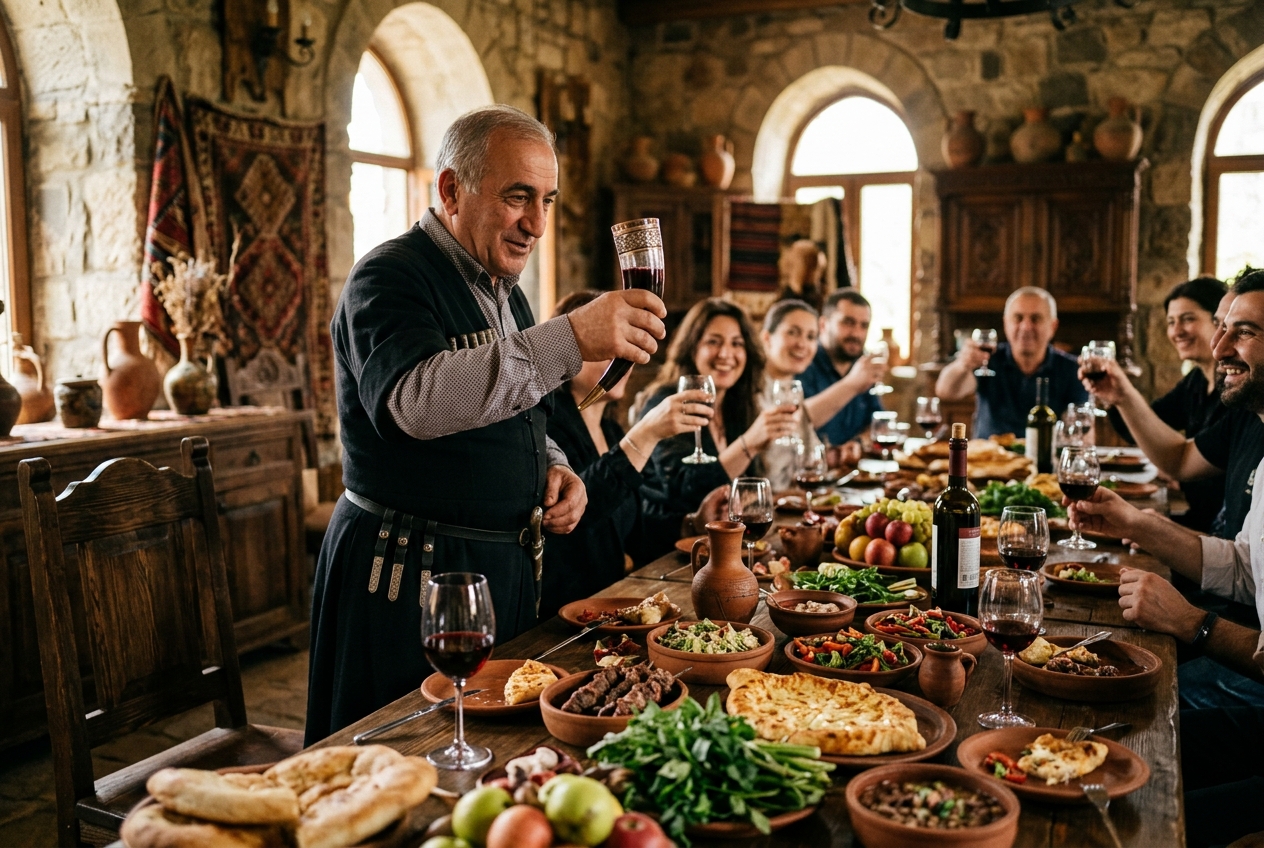
Few cultural traditions so completely merge food, philosophy, music, and social bonding into a single experience. The Georgian supra does exactly that: it transforms a meal into a ceremony where every toast carries weight, every dish tells a story, and every song reverberates with centuries of collective memory. I first encountered a supra in a village outside Kakheti, invited by a family I’d met barely an hour earlier. What followed over the next five hours rewired my understanding of what a “dinner” could be. This wasn’t entertainment. It wasn’t performance. It was something closer to a living, breathing cultural organism, guided by unwritten rules that every Georgian seems to absorb from childhood. The supra is a vibrant social event central to Georgian culture, embodying hospitality, togetherness, and strong bonds of family and friendship. To understand Georgia as a country – Sakartvelo, as Georgians call their homeland – you have to sit at one of these tables. No museum visit, no guidebook, no documentary can substitute for the experience of being present while a tamada raises his horn and the room falls silent. Understanding the Georgian supra as both art and ritual requires sitting with its history, its structure, and its living presence in modern life.
Origins and Cultural Significance of the Supra
The word “supra” itself offers a clue to the tradition’s layered past. The term was borrowed from the Persian word “sofre,” meaning tablecloth), a linguistic trace of the cultural exchanges that shaped Georgia over millennia. Sitting at the crossroads of empires – Persian, Ottoman, Roman, Mongol, Russian – Georgia absorbed influences while fiercely guarding its own identity. The supra became one of the primary vessels for that identity.
Archaeological evidence suggests communal feasting traditions in the South Caucasus dating back thousands of years, intertwined with Georgia’s ancient winemaking heritage. Clay vessels called qvevri, used for fermenting wine underground, have been found dating to roughly 6000 BCE. But the feast as we recognize it today is a more recent crystallization of older practices.
The Supra as a Pillar of National Identity
What makes the supra different from, say, a French banquet or a Japanese kaiseki meal is its explicit function as a carrier of national consciousness. The supra is not merely about eating well. It is a space where Georgians collectively rehearse their values: faith, patriotism, respect for ancestors, hospitality toward strangers. The concept of “stumari ghvtisaa” – the guest is a gift from God – finds its fullest expression here.
The supra exemplifies cultural nativism, reflecting local authenticity amidst imperial power dynamics. During periods of foreign domination, the feast table became a space of quiet resistance, a place where Georgian language, song, and values could be practiced freely even when political sovereignty was denied.
Historical Evolution from Ancient Feasts to Modern Ritual
The contemporary version of the supra finds its roots in the early 19th century, following the Russian annexation of Georgia). This period saw a formalization of the feast’s structure, as though Georgians were codifying their traditions in response to the threat of cultural erasure. Toast sequences became more standardized. The role of the tamada grew more defined. The table itself became a stage for performing Georgian-ness.
Earlier iterations were likely looser, more spontaneous. But the 19th-century version – born under imperial pressure – gave the supra the shape it largely retains today. That historical context matters: this is a tradition that was sharpened, not softened, by adversity.
The Tamada: Architect of the Ritual
No supra functions without a tamada. The toastmaster is not a host in the Western sense. He is closer to a conductor, a priest, and a storyteller rolled into one. I’ve watched tamadas in Tbilisi wine bars and in remote Svaneti villages, and while their styles differ wildly, the underlying authority of the role remains constant.
Roles and Responsibilities of the Toastmaster
The tamada controls the flow of the evening. He decides the order of toasts, sets the emotional temperature of the room, and ensures that every guest feels included. He does not simply propose toasts – he delivers them as small speeches, sometimes lasting several minutes, weaving personal anecdotes with philosophical reflections and historical references.
The tamada mediates between heaven and earth, guiding the table through various themes. This is not hyperbole. The first toast is always to God, and the sequence that follows moves through motherland, ancestors, family, and the departed before arriving at lighter themes like love and friendship. The tamada’s job is to manage this arc so that the table moves together emotionally, not just chronologically.
A bad tamada can kill a supra. I’ve seen it happen once: a man who treated the role as a platform for showing off rather than serving the table. The energy drained from the room within an hour. A great tamada, by contrast, makes everyone feel like the most important person at the table.
The Art of Eloquence and Emotional Pacing
Georgian eloquence at the supra table is not the polished rhetoric of a politician. It is warmer, more personal, often surprisingly vulnerable. A tamada might begin a toast to mothers with a memory of his own childhood, then widen the lens to speak about the universal experience of maternal love, then narrow it again to honor a specific mother present at the table.
The pacing matters enormously. Heavy, emotional toasts – to the deceased, to the motherland’s suffering – are followed by lighter moments, laughter, music. The tamada reads the room constantly. If the mood dips too low, he pivots. If things get too raucous, he brings the table back to gravity. This emotional architecture is what separates a supra from a party.
The Philosophy and Structure of Georgian Toasting
The toast sequence at a supra is not random. It follows a loose but widely understood order that reflects Georgian cosmology and values.
Standard Toast Sequences: God, Motherland, and Ancestors
Toasts are the rhythm of the feast, often covering topics like love, happiness, historical figures, and gratitude to God. The first toast is traditionally to God, understood as restoring unity between heaven and earth. The second typically honors Georgia itself. The third remembers ancestors and the deceased.
Here is a common toast progression at a traditional supra:
| Toast Number | Theme | Emotional Register |
|---|---|---|
| 1 | God / Divine gratitude | Reverent, solemn |
| 2 | Georgia / Motherland | Patriotic, passionate |
| 3 | Ancestors / The deceased | Somber, reflective |
| 4 | Parents and family | Warm, tender |
| 5 | Children and future | Hopeful, joyful |
| 6 | Friends and guests | Celebratory, inclusive |
| 7+ | Love, peace, specific honorees | Varied, often humorous |
This sequence can stretch to 20 or more toasts over the course of an evening. Each guest is expected to respond to the tamada’s toast with their own words before drinking, creating a layered, polyphonic conversation.
Wine as a Sacred Medium of Connection
Georgia is one of the oldest wine-producing regions on earth, and wine at the supra is not a beverage choice – it is a sacrament. Wine flows freely and accompanies every toast, honoring life, loss, and love. Drinking without a toast is considered poor form. The wine connects each participant to the words being spoken, making the act of drinking a physical affirmation of shared sentiment.
Qvevri-made amber wines – sometimes called “orange wines” in the West – are the traditional choice. These wines, fermented with their skins and seeds in buried clay vessels, have a tannic, earthy quality that feels ancient in your mouth. Drinking them from a kantsi (a traditional horn) during a toast to ancestors creates a sensory link across generations that is hard to describe but impossible to forget.
Culinary Artistry and Table Aesthetics
The food at a supra is not served in courses. Everything arrives at once, or nearly so, creating a table that groans under the weight of dishes. This abundance is intentional: it signals generosity and welcome.
The Visual Language of the ‘Blue Tablecloth’
The Lurji Supra, or “blue tablecloth” tradition, emerged between the 17th and 19th centuries and refers to a specific aesthetic of table arrangement. The blue cloth became associated with formal supras, and the arrangement of dishes on it followed visual principles: colors balanced, textures varied, the table itself becoming a kind of edible landscape.
Even at informal supras today, the visual presentation matters. Plates of green herbs (cilantro, tarragon, basil) sit alongside golden-brown khachapuri, ruby-red tkemali sauce, and deep purple pickled cabbage. The table is meant to look abundant and beautiful before anyone takes a bite.
Symbolic Dishes and Regional Variations
Certain dishes carry specific meanings. Satsivi, a walnut-based sauce served over turkey or chicken, appears at New Year’s supras. Churchkhela, the candle-shaped walnut-and-grape confection, represents harvest and sweetness. Khinkali from the mountain regions and Imeretian khachapuri from the west each carry regional pride.
In Kakheti, the wine country, expect more pork and amber wine. In Adjara on the Black Sea coast, the cuisine tilts toward dairy and bread, with the famous open-faced Adjarian khachapuri taking center stage. In Svaneti, kubdari – a meat-filled bread spiced with local herbs – dominates. Each region’s supra reflects its geography and agricultural traditions.
Polyphony and Performance in the Feast
Music at a supra is not background entertainment. It is woven into the fabric of the event, erupting spontaneously between toasts or sometimes during them.
The Integration of Traditional Georgian Folk Songs
Georgian polyphonic singing – recognized by UNESCO as a masterpiece of intangible heritage – is the natural soundtrack of the supra. These songs, performed in three-part harmony without instruments, carry an emotional power that recorded music simply cannot replicate. When three men at a table lock into a Kakhetian work song or a haunting Gurian lullaby, the room transforms.
I remember a supra in Sighnaghi where, after the toast to the deceased, three older men began singing “Mravalzhamier” – a traditional hymn meaning “many years.” The song lasted perhaps four minutes. Nobody spoke. Nobody moved. The silence afterward felt sacred. That moment, more than any toast or dish, captured what the supra really is: a space where time folds and the boundary between past and present dissolves.
The songs are not performed for an audience. Everyone at the table is a potential participant. Even those who don’t sing well are expected to join in, because the point is communion, not performance quality.
The Supra’s Role in Modern Social Fabric
The supra has not been frozen in amber. It continues to evolve, adapting to urban life, smaller apartments, busier schedules, and a younger generation that is more globally connected than any before it.
Conflict Resolution and Community Bonding
Traditionally, supras have served as spaces for resolving disputes. Families in conflict might be brought together at a supra, where the structured toasting format forces both sides to acknowledge shared values – God, country, ancestors – before addressing their differences. The presence of wine, food, and community witnesses creates accountability.
The supra also functions as a community-based event that has become a regional destination and sustainable development tool. In rural areas, hosting supras for visitors generates income while preserving traditions. This is not contrived “cultural tourism” – these are real families opening their real tables. The economic dimension has helped keep the tradition alive in villages that might otherwise lose their younger residents to Tbilisi or abroad.
Preserving the Intangible Heritage in a Globalized World
The Georgian supra is recognized as an element of intangible cultural heritage by UNESCO, a designation that carries both pride and responsibility. Younger Georgians – the post-2003 Rose Revolution generation, largely English-speaking and digitally fluent – relate to the supra differently than their grandparents did. Some see it as a beloved but sometimes exhausting obligation. Others are rediscovering it with fresh eyes, hosting smaller, more intimate supras that preserve the toasting structure while adapting the scale.
The tension between preservation and evolution is real. A supra in a Tbilisi craft-wine bar looks different from one in a Tushetian mountain village. But the core elements persist: the tamada, the toasts, the wine, the songs, the insistence that no guest leaves hungry or unacknowledged.
What strikes me most, after attending supras across Georgia over several years, is how resistant this tradition is to becoming a mere performance. Even when tourists are present, even when the setting is commercial, the emotional sincerity tends to break through. A tamada raising his horn to toast the departed is not acting. The tears are real. The songs carry real grief and real joy. The Georgian supra as art and ritual endures precisely because it refuses to separate the aesthetic from the authentic. If you ever find yourself in Georgia, accept every invitation to a supra you receive. Bring an empty stomach, a willingness to sing badly, and the understanding that you are about to participate in something genuinely rare: a tradition that has survived empires, and shows no signs of fading.