
Table of Contents
- Experience Orthodox Christmas in Georgia: Dates and Core Traditions
- The Alilo Procession: Tbilisi’s Grand Christmas Parade
- Logistics for Drivers: Navigating Tbilisi During Alilo
- Traditional Georgian Christmas Food and Where to Find It
- Beyond the Capital: Alilo Celebrations in Kakheti and Western Georgia
- Winter Driving Safety and Road Conditions in January
- What Stays Open: Managing Services and Sightseeing on January 7
- Frequently Asked Questions About Christmas in Georgia
Georgia celebrates Christmas on January 7, not December 25. If you’re planning a winter trip, this single date reshapes everything: what roads are closed, which restaurants serve holiday feasts, and where thousands of people march through the streets singing hymns and collecting donations for the poor. The Alilo procession in Tbilisi is the centerpiece of the holiday, and it’s one of the most visually striking public celebrations in the Caucasus. Winter travel to Georgia is surging: January 2026 alone brought in $325 million in tourism revenue, a 13.4% increase over the same period last year. That means more visitors are discovering what locals have always known: Georgian Christmas is worth the cold. This guide covers the traditions, the logistics of driving around Tbilisi and beyond during the holiday, and the practical details you need to actually enjoy the experience rather than just survive it.
Experience Orthodox Christmas in Georgia: Dates and Core Traditions
Christmas in Georgia follows the Julian calendar, which places the nativity on January 7. The evening before, January 6, is Christmas Eve, known locally as “Kvelaoba.” Most Georgian families attend a late-night or midnight liturgy at their local church. The Holy Trinity Cathedral (Tsminda Sameba) in Tbilisi holds the largest and most attended service, led by the Patriarch of Georgia, and it’s broadcast live on national television.
The holiday is a national public holiday, so banks, government offices, and most businesses close. Expect a quieter city on January 6 evening and January 7 morning before the Alilo procession kicks off.
Georgian Christmas traditions differ from Western ones in a few important ways. There’s no Santa Claus figure associated with January 7: that role belongs to “Tovlis Babua” (Grandfather Snow), who appears during the secular New Year celebrations on December 31. The religious holiday centers on church services, family meals, and the Alilo charity walk. Homes are decorated with the chichilaki, a traditional wooden ornament made from shaved walnut or hazelnut branches that curls into a small tree shape. It replaces the evergreen Christmas tree for this occasion, though plenty of Georgian households keep both.
Tip: If you want to attend the midnight liturgy at Sameba Cathedral, arrive by 10:00 PM on January 6 to get a spot. The cathedral holds several thousand people, but it fills up fast. Dress warmly and wear shoes you can stand in for two to three hours.
The Alilo Procession: Tbilisi’s Grand Christmas Parade
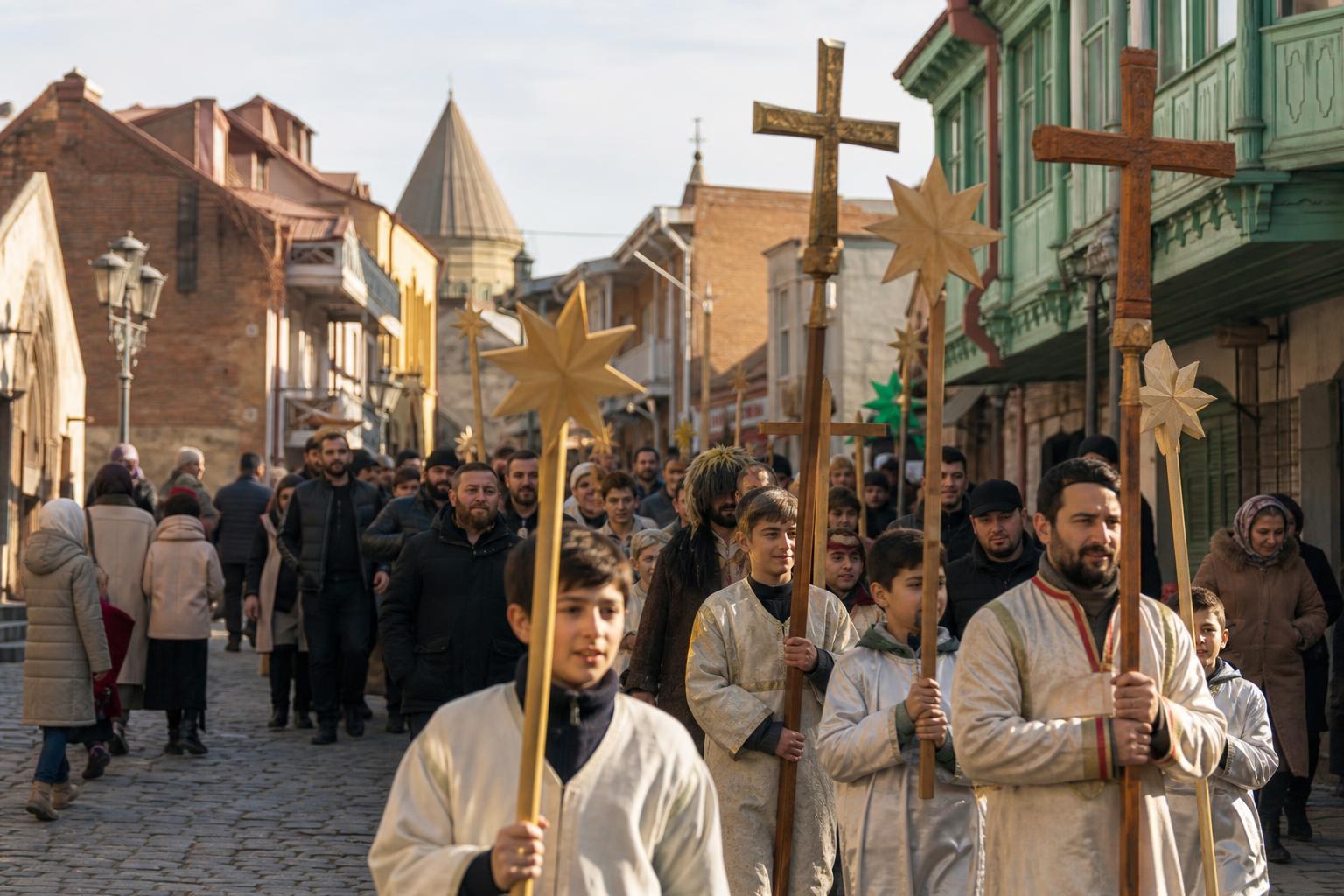
The Alilo is not a parade in the Western sense. It’s a walking procession with deep religious roots, where participants dressed in white robes carry icons, crosses, and banners through the streets of Tbilisi on January 7. Children, clergy, choirs, and ordinary citizens join in, singing traditional hymns as they move through the old city. The word “Alilo” itself comes from “Hallelujah.”
What makes the procession distinctive is its charitable purpose. Participants collect food, sweets, toys, and money along the route, all of which are distributed to orphanages, hospitals, elderly care homes, and families in need. If you’re watching from the sidewalk, it’s common to hand over a bag of tangerines, candy, or a small cash donation to the marchers. Nobody will pressure you, but joining in feels natural.
The procession typically starts late morning and can last several hours. Expect singing, incense, and a genuine sense of community rather than a commercialized spectacle.
Route Map and Best Vantage Points in Old Tbilisi
The main Alilo procession in Tbilisi generally follows a route from the Sameba (Holy Trinity) Cathedral area, crossing the Metekhi Bridge, and winding through the old town toward Sioni Cathedral and Freedom Square. The exact route can shift slightly year to year, so check local news or the Tbilisi City Hall website a few days before January 7.
The best spots to watch are along the Metekhi Bridge (where the procession is compressed and visually dramatic), near Sioni Cathedral on Sioni Street, and along Kote Abkhazi Street. Arrive at least 30 to 45 minutes before the procession reaches your chosen point.
Important: Streets along the Alilo route are closed to vehicle traffic. If you’re staying in Old Tbilisi, plan to walk everywhere on January 7. Don’t try to move your car once the closures begin.
Charity and Symbols: The Role of the Chichilaki
The chichilaki deserves a closer look because it’s genuinely unique to Georgia. These handmade ornaments are crafted by shaving thin curls from a branch of walnut or hazelnut wood, creating a shape that resembles a small, pale tree or beard. Artisans in rural areas, particularly in western Georgia’s Guria and Samegrelo regions, have been making them for centuries.
Chichilaki are traditionally burned after Epiphany (January 19) as a symbol of leaving the old year’s troubles behind. You’ll see them sold at markets around Tbilisi in late December and early January, often near the Dry Bridge Market or along Rustaveli Avenue. Prices vary, but small ones typically cost 10 to 25 GEL. They make excellent souvenirs and are far more culturally specific than a generic fridge magnet.
During the Alilo procession, many participants carry chichilaki alongside icons and crosses, connecting the folk tradition to the religious celebration.
Logistics for Drivers: Navigating Tbilisi During Alilo
Driving in central Tbilisi on January 7 is a bad idea, full stop. The Alilo route closures affect major streets in the old town, including sections near Metekhi Bridge, Baratashvili Street, and the area around Sioni Cathedral. Closures typically begin in the late morning and can last until mid-afternoon or later.
If you’re renting a car during this period, park it at your hotel or in a lot outside the historic center the night before. The Didube or Station Square areas have affordable parking garages, and you can reach Old Tbilisi by metro (Avlabari station is closest to Sameba Cathedral). The Tbilisi metro runs on a reduced holiday schedule on January 7, but service continues throughout the day.
For those planning to leave Tbilisi on January 7 for day trips, head out early in the morning before the procession begins, or wait until late afternoon when streets reopen. The main highways out of the city (toward Kakheti, Mtskheta, or the airport) are not affected by Alilo closures, but getting from the center to those highways can be slow.
| Parking Option | Distance to Old Tbilisi | Approximate Daily Rate (2026) |
|---|---|---|
| Didube area garages | 4 km (metro accessible) | 10-15 GEL |
| Station Square lots | 2.5 km (metro accessible) | 12-20 GEL |
| Hotel parking (center) | Walking distance | Often included or 15–30 GEL |
Note: Bolt and Yandex Go ride-hailing apps work on January 7, but expect surge pricing and longer wait times near the procession route. Budget extra time if you rely on these.
Traditional Georgian Christmas Food and Where to Find It
The Christmas Eve table in Georgia is traditionally meatless, built around dishes suitable for the fasting period that precedes the holiday. Lobiani (bean-filled bread), pkhali (vegetable spreads made from spinach, beet greens, or cabbage with walnut paste), and various mushroom dishes are staples. Gozinaki, a sweet made from caramelized honey and walnuts, is the signature Christmas dessert and appears on nearly every table.
On January 7 itself, after the fast is broken, meat returns with force. Satsivi, a cold turkey or chicken dish in a rich walnut sauce, is the star. Churchkhela (walnut strings dipped in grape juice and dried) and fresh tangerines round out the spread.
Finding these dishes at restaurants on January 7 requires some planning. Many family-run restaurants close for the holiday, while larger establishments in tourist areas stay open with special menus. In Tbilisi, check restaurants like Shavi Lomi, Barbarestan, or Cafe Littera for holiday menus, but book at least a few days ahead. Street vendors near the Alilo route often sell churchkhela, gozinaki, and hot drinks.
If you’re self-catering, the Goodwill and Carrefour supermarket chains stay open on reduced hours (typically 10:00 AM to 6:00 PM) on January 7. Stock up on January 5 or 6 to be safe.
Beyond the Capital: Alilo Celebrations in Kakheti and Western Georgia
Tbilisi gets the biggest Alilo procession, but smaller cities hold their own versions that feel more intimate and less crowded. The Kakheti wine region and western Georgia’s cities of Kutaisi and Batumi all host processions on January 7, and combining them with a road trip makes for a memorable winter itinerary.
In Sighnaghi, the “City of Love” perched on a ridge above the Alazani Valley, the Alilo procession winds through narrow cobblestone streets with views of the snow-capped Caucasus in the background. The town is small enough that you’ll feel like a participant rather than a spectator. Telavi, the regional capital of Kakheti, holds a larger procession with more participants and a market atmosphere.
Kutaisi’s Alilo centers on the Bagrati Cathedral area and draws from the surrounding villages, giving it a distinctly rural character.
Getting to Sighnaghi and Telavi by Car
Sighnaghi sits about 110 km east of Tbilisi, roughly a 1.5 to 2 hour drive via the main highway through Sagarejo. The road is paved and in decent condition year-round, though January can bring ice patches on the final winding ascent into town. A standard sedan handles this route fine in dry conditions, but carry chains just in case. Parking in Sighnaghi is free and usually easy, even during Alilo.
Telavi is about 150 km from Tbilisi, a 2 to 2.5 hour drive. You can reach it via the Gombori Pass (shorter but steep and potentially icy in January) or the longer but flatter route through Sagarejo and Gurjaani. In winter, the Gurjaani route is the safer choice.
Tip: If you’re visiting Kakheti’s wineries alongside the Alilo celebration, designate a driver or plan to stay overnight. Do not drink and drive: Georgian wine is generous, and police checkpoints are common on the Tbilisi-Kakheti highway in January.
Driving to Kutaisi for Regional Festivities
Kutaisi is 230 km west of Tbilisi, about a 3 to 3.5 hour drive on the well-maintained E60 highway. This is one of Georgia’s best roads, four lanes for most of the distance, and it’s rarely affected by winter weather at lower elevations. The Rikoti Pass section has been significantly improved with tunnel work, though check current conditions before departing.
Parking near Bagrati Cathedral in Kutaisi is limited on January 7. Arrive early or park in the city center and walk up.
Winter Driving Safety and Road Conditions in January
January is Georgia’s coldest month, and road conditions vary dramatically depending on elevation. The main east-west highway (E60) and the Tbilisi-Kakheti corridor are generally well-maintained and plowed, but mountain passes and rural roads can be treacherous.
Key winter driving considerations:
- Snow chains: Required by law when signs indicate chain zones. Rental car companies in Georgia sometimes provide them, but verify before picking up your vehicle. Buying a set at an auto parts store costs 40 to 80 GEL.
- Studded tires: Legal in Georgia during winter months. Most rental cars come with all-season tires, which are adequate for lowland routes but insufficient for mountain passes.
- The Georgian Military Highway (Tbilisi to Kazbegi) closes periodically in January due to avalanche risk and heavy snowfall at the Cross Pass. Check the Road Department of Georgia’s updates before attempting this route.
- Fuel: Gas stations are plentiful on main highways. Fill up before heading into rural areas, especially in Tusheti or Upper Svaneti (though Tusheti’s road is closed entirely in winter).
If you’re exploring Georgia by car during the Christmas period, Triproadwayplanner’s route guides include current road condition updates that can save you from unpleasant surprises.
What Stays Open: Managing Services and Sightseeing on January 7
January 7 is a public holiday, but Georgia doesn’t shut down completely. Here’s what to expect:
- Most museums in Tbilisi (National Museum, Museum of Fine Arts) close on January 7. The National Gallery sometimes opens with reduced hours: check their social media pages.
- Churches are open and actively holding services. This is actually the best day to experience Georgian Orthodox liturgy.
- Restaurants in tourist areas of Tbilisi (Aghmashenebeli Avenue, Old Town) mostly stay open. Reservations are strongly recommended.
- Pharmacies operate on a rotation system. At least one pharmacy per district stays open 24 hours.
- Public transport runs on a Sunday/holiday schedule. The Tbilisi metro operates but with longer intervals between trains (8 to 12 minutes instead of the usual 3 to 5).
- ATMs and currency exchange offices function normally.
- The Tbilisi International Airport operates on its regular schedule. Flights are not affected by the holiday.
If January 7 falls on a weekday, January 8 is sometimes declared a bridge holiday. Confirm the 2026 calendar with your hotel or a local source before planning business-related activities.
Frequently Asked Questions About Christmas in Georgia
Is Georgian Christmas the same as Russian Orthodox Christmas?
Both fall on January 7 because both churches use the Julian calendar for liturgical dates. However, Georgian and Russian Orthodox traditions differ in many ways: the Alilo procession, the chichilaki, and specific foods like satsivi are distinctly Georgian. The Georgian Orthodox Church is one of the oldest in the world, autocephalous since the 5th century, and its practices reflect that independent history.
Can tourists participate in the Alilo procession?
Yes. The Alilo is open to everyone. You don’t need to be Orthodox or Georgian to walk with the procession. Wearing white is traditional but not mandatory. Bringing donations of food, toys, or sweets to hand to the collectors is appreciated. Just be respectful during prayers and hymn-singing.
What should I wear to watch or join the Alilo?
Dress for cold weather: January temperatures in Tbilisi average 0 to 5°C, and you’ll be standing or walking outdoors for hours. Layers, a warm hat, waterproof boots, and gloves are essential. If you plan to enter a church during the procession, women should bring a headscarf, and both men and women should cover their shoulders and knees.
Do I need to book accommodation in advance for January 7?
Tbilisi has plenty of hotel and guesthouse capacity, but popular properties in Old Tbilisi book up during the Christmas and New Year period (roughly January 1 through 8). Booking two to three weeks ahead is usually sufficient. In smaller towns like Sighnaghi, options are more limited, so reserve earlier.
Is it worth visiting Georgia specifically for Christmas?
Absolutely. The combination of the Alilo procession, the midnight liturgy, the food, and the winter atmosphere creates an experience that’s hard to replicate elsewhere. Georgia welcomed a record 5.52 million international tourists in 2025, and an increasing share of those visitors are arriving in winter specifically for events like this. The country is set up for independent travel, car rental is affordable, and the distances between major sites are short enough for comfortable day trips even in cold weather.
Georgian Christmas on January 7 offers something rare: a major religious celebration that remains deeply authentic and community-driven, not packaged for tourists. Whether you watch the Alilo from a Tbilisi sidewalk, join the procession yourself, or drive out to a smaller town in Kakheti for a quieter version, you’ll see a side of Georgia that the summer crowds never encounter. Plan your driving logistics ahead of time, pack warm clothes, and bring something to donate to the Alilo collectors. That’s really all you need.