
Table of Contents
- The Art of the Georgian Dumpling: What to Look For
- Legendary Institutions for Authentic Khinkali
- Top-Rated Spots Comparison Table
- Budget-Friendly and Late-Night Favorites
- Etiquette: How to Eat Khinkali Like a Local
- Beyond Meat: Vegetarian and Specialty Options
- Finding Your Perfect Khinkali Spot
Tbilisi has a way of pulling you in through your stomach. The city smells like bread baking in tone ovens and meat sizzling on charcoal, and somewhere between the sulfur baths and the cobblestone alleys of the Old Town, you’ll encounter the dish that defines Georgian comfort food: khinkali. These twisted, soup-filled dumplings are more than a meal; they’re a ritual, a test of skill, and a point of fierce local pride. Every Tbilisi resident has an opinion about who makes the best ones, and those opinions are rarely polite. If you’re trying to figure out where to eat khinkali in Tbilisi, the sheer number of options can feel overwhelming. Some places have been serving the same recipe for decades. Others are reinventing the dumpling entirely. I’ve spent years eating my way through this city’s khinkali spots, and what follows is a distilled, honest guide to the places that actually deserve your time and your appetite. Whether you want a 1-lari dumpling at 2 a.m. or a truffle-stuffed version with a natural wine pairing, Tbilisi has you covered.
The Art of the Georgian Dumpling: What to Look For
Before you start hopping between restaurants, it helps to understand what separates a mediocre khinkali from one that makes you close your eyes and exhale. Georgia’s FMCG and food sector has grown significantly in recent years, and that growth has brought both higher standards and more competition to the restaurant scene. But mass production hasn’t replaced craft here. The best khinkali are still made by hand, often by women who learned the technique from their grandmothers.
A great khinkali isn’t just about taste. It’s about texture, structure, and the experience of eating it. You’re looking for a dumpling that holds together under the weight of its own broth, releases a burst of spiced juice when you bite into it, and has dough that’s thin enough to be tender but thick enough to maintain its shape. That balance is harder to achieve than most people realize.
The Anatomy of a Perfect Khinkali
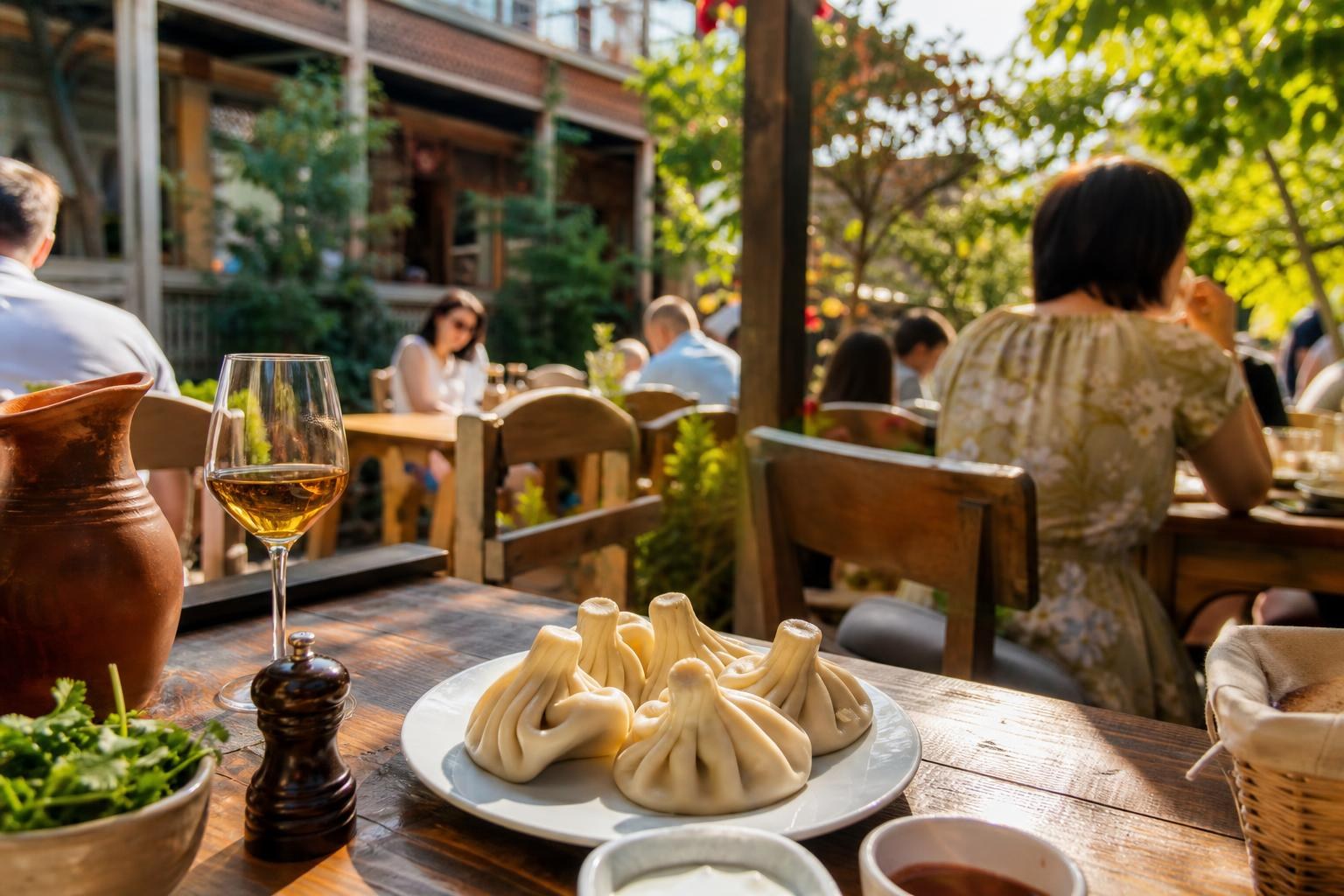
The top knot, called the kuchi, should have tight, even pleats. Traditional cooks aim for at least 18 to 20 folds, and some experienced makers hit 28 or more. The kuchi serves a practical purpose: it’s your handle. You grip it, flip the dumpling upside down, bite a small hole near the base, and sip the juice before eating the rest.
The dough should be elastic and slightly chewy, never gummy or thick. If the skin tears before you get it to your mouth, the kitchen rushed the resting time or rolled it too thin. The filling, whether meat or cheese or mushroom, should be juicy and well-seasoned with black pepper, cumin, and fresh herbs. A dry khinkali is a failed khinkali. There’s no debate on that point.
Traditional Varieties: Kalakuri vs. Pasanauruli
Two styles dominate the conversation. Kalakuri, or “city-style,” uses a mixture of beef and pork with onions, parsley, and a heavy hand of black pepper. The filling is raw when it goes into the dough, and it cooks inside the dumpling as it boils, creating that signature pocket of broth. This is the version most visitors encounter first.
Pasanauruli comes from the mountain village of Pasanauri on the Georgian Military Highway. It traditionally uses only beef or a beef-lamb blend, reflecting the highland regions where pork was less common. The spice profile leans heavier on cumin and coriander, and the dough is sometimes slightly thicker to withstand the altitude cooking conditions. Many Georgians consider pasanauruli the more “authentic” style, though that argument can get heated fast. Both versions are excellent when done right, and most serious khinkali restaurants in Tbilisi serve at least one of each.
Legendary Institutions for Authentic Khinkali
Tbilisi’s best khinkali spots range from no-frills canteens to stylish restaurants where the dumplings share menu space with European-influenced dishes. The places below have earned their reputations over years, sometimes decades, of consistent quality.
Pasanauri: The Gold Standard for Meat Fillings
If you ask ten Tbilisi locals for a recommendation, at least half will say Pasanauri. The chain has multiple locations across the city, with the branch on Chavchavadze Avenue being one of the most popular. Don’t let the word “chain” scare you: these dumplings are made fresh on-site, and the quality control is remarkably tight.
Their kalakuri khinkali is the benchmark by which many visitors judge all others. The pleats are consistent, the broth is peppery and rich, and a single order of five dumplings costs around 5 to 6 GEL (roughly $1.80 to $2.20 USD in 2026). The pasanauruli version uses a beef filling with a stronger cumin presence. Both are excellent. The restaurants are clean, service is fast, and you can watch the khinkali being assembled through glass kitchen windows. For a first-time visitor, this is the safest and most satisfying starting point.
Cafe Stamba and Shavi Lomi: Modern Gourmet Twists
Not every great khinkali experience in Tbilisi involves a plastic tablecloth and a stack of napkins. Cafe Stamba, located inside the Stamba Hotel in the Vera district, offers a refined take on the classic dumpling. Their kitchen experiments with fillings like cheese and herb blends, and the presentation is more polished than what you’ll find at traditional spots. Expect to pay more: a plate here runs 12 to 15 GEL, but the atmosphere and wine list justify the premium.
Shavi Lomi, tucked into a residential courtyard on Zubalashvili Street, bridges the gap between traditional and modern. Their menu rotates seasonally, and their khinkali variations have included wild mushroom and sulguni cheese fillings. The vibe is bohemian, the crowd is a mix of locals and expats, and the natural wine selection is one of the best in the city. If you want khinkali alongside dishes that push Georgian cuisine forward, these two spots deliver.
Sofia Melnikova’s Fantastic Douqan: Hidden Courtyard Gems
This place is an experience as much as a restaurant. Located in a crumbling courtyard in the Old Town, Sofia Melnikova’s Fantastic Douqan feels like stepping into someone’s eccentric living room. The walls are covered in art, the furniture is mismatched, and the menu is handwritten. Their khinkali isn’t always available, but when it is, it’s worth ordering alongside their other Georgian dishes.
The real draw here is the atmosphere and the sense of discovery. You’ll find it by walking through an unmarked doorway on Galaktion Tabidze Street and following a narrow passage into the courtyard. It’s the kind of place that captures the spirit of Tbilisi’s food culture perfectly: informal, generous, and slightly chaotic. Don’t expect efficiency. Do expect a memorable meal.
Top-Rated Spots Comparison Table
| Restaurant | Style | Price per 5 Khinkali (GEL) | Best For | Location |
|---|---|---|---|---|
| Pasanauri | Traditional | 5-6 | First-timers, consistent quality | Multiple locations |
| Cafe Stamba | Modern/Gourmet | 12-15 | Date night, wine pairing | Vera district |
| Shavi Lomi | Modern/Seasonal | 8-10 | Adventurous eaters, natural wine | Zubalashvili St. |
| Sofia Melnikova’s | Traditional/Eclectic | 6-8 | Atmosphere, hidden gem seekers | Old Town |
| Khasheria | Traditional | 4-5 | Late-night, budget dining | Kote Abkhazi St. |
| HB Tbilisi | Traditional | 5-7 | Beer hall vibe, groups | Sioni St. |
Prices reflect 2026 averages and may vary slightly by season or specific filling choice.
Budget-Friendly and Late-Night Favorites
One of the best things about Tbilisi’s khinkali scene is that you don’t need to spend much to eat well. Some of the city’s most satisfying dumplings come from places that barely have signage, let alone a social media presence. These spots cater to students, taxi drivers, and night owls who need something hot and filling after midnight.
Khasheria: The Best After-Hours Comfort Food
Khasheria, on Kote Abkhazi Street in the Old Town, is technically a khashi restaurant. Khashi is a tripe soup traditionally eaten at dawn as a hangover cure, which means the kitchen operates on a schedule that suits late-night diners perfectly. But their khinkali is the real reason to visit outside of khashi hours.
The dumplings here are straightforward kalakuri style, generously sized, and priced at around 4 to 5 GEL for five pieces. The interior is bare-bones: fluorescent lighting, simple tables, zero pretense. You’ll share the space with locals who treat this as their living room, and the staff won’t rush you. If you’re stumbling back from the bars on Shardeni Street at 1 a.m. and need something to anchor you, Khasheria is the answer.
HB Tbilisi: Traditional Beer Hall Atmosphere
HB Tbilisi, near Sioni Cathedral, operates as a Georgian-style beer hall with a menu built around hearty, shareable dishes. Their khinkali comes in both meat and cheese varieties, and the portions are generous. A cold Natakhtari or Argo beer alongside a plate of dumplings is one of Tbilisi’s simplest and most satisfying meals.
The atmosphere here is lively, especially on weekend evenings when groups of friends crowd around long tables. Prices stay reasonable: expect to spend 15 to 20 GEL total for khinkali, a beer, and maybe a side of pkhali (walnut and vegetable paste). It’s a good option for groups who want variety beyond just dumplings, as the menu also covers grilled meats, salads, and traditional stews.
Etiquette: How to Eat Khinkali Like a Local
Eating khinkali correctly matters in Georgia. This isn’t snobbery; it’s practical wisdom developed over centuries. The technique exists because the dumpling is designed to be eaten a specific way, and deviating from that method means losing the broth, burning your fingers, or both.
The Hands-Only Rule
Khinkali are eaten with your hands. No fork, no knife, no chopsticks. You pick the dumpling up by its top knot, flip it so the rounded belly faces upward, and bring it to your mouth. Using a fork is considered not just unnecessary but slightly embarrassing, like eating pizza with a knife in Naples. Georgian dining culture has deep roots in the concept of stumari ghvtisaa, meaning “a guest is from God,” and your hosts will gently correct your technique if they see you struggling. Accept the guidance. It’s offered with warmth.
The dumplings arrive hot, so give them a minute or two before picking one up. Impatience is the most common mistake tourists make. A khinkali fresh from the pot will scald your lips if you bite into it immediately.
Managing the Juice and the ‘Kuchi’
The juice inside the dumpling is the entire point. Once you’ve flipped the khinkali and brought it to your mouth, bite a small hole in the dough near the base and carefully sip the broth. This step is non-negotiable. Spilling the juice onto your plate is considered wasteful, and experienced eaters treat the broth as the most prized part of the dumpling.
After drinking the juice, eat the rest of the dumpling in one or two bites. The kuchi, the thick knot of dough at the top, is traditionally left on the plate uneaten. It serves as a counter: at the end of the meal, you can see how many khinkali each person consumed. Some people eat the kuchi, and nobody will arrest you for it, but leaving it is the traditional move. A plate piled high with discarded kuchi is a badge of honor at any Georgian table.
Beyond Meat: Vegetarian and Specialty Options
Georgia’s food traditions are deeply tied to the Georgian Orthodox fasting calendar, which means vegetarian cooking isn’t an afterthought here; it’s a centuries-old practice. During fasting periods, which can cover up to 200 days per year, meat and dairy are off the table, and Georgian cooks have developed an incredible repertoire of plant-based dishes to fill the gap.
Khinkali with potato and cheese fillings are available at nearly every restaurant mentioned above. The potato version uses a mashed filling seasoned with butter and herbs, while the cheese version typically features sulguni, a briny, stretchy cheese similar to mozzarella. Both are excellent, though the cheese version can be intensely salty if the kitchen uses an aged sulguni.
Mushroom khinkali have become increasingly popular in Tbilisi’s more modern restaurants. Shavi Lomi’s seasonal mushroom filling, when available, is one of the best vegetarian options in the city. Some newer spots are also experimenting with spinach and walnut fillings inspired by traditional pkhali recipes. Georgian cuisine has long been recognized for its diversity of flavors, and the vegetarian khinkali scene reflects that breadth.
For strict vegans, options are more limited but not impossible. A few restaurants now offer dough made without eggs, and potato fillings without butter. Ask before ordering, as recipes vary between kitchens. The Georgian word for fasting food is samarkhvo, and mentioning it to your server will signal that you’re looking for options free of animal products.
Finding Your Perfect Khinkali Spot
Tbilisi rewards the hungry and the curious. The best approach is to try multiple spots across different price points and styles rather than committing to a single restaurant. Start with Pasanauri for a reliable baseline, graduate to Shavi Lomi or Cafe Stamba for something more inventive, and end a late night at Khasheria with a plate of simple, honest dumplings and a glass of tarragon lemonade.
The best khinkali spots in Tbilisi aren’t hiding. They’re on busy streets, in crumbling courtyards, and inside beer halls where the tables are sticky and the laughter is loud. Order five to start, eat them with your hands, sip the broth carefully, and leave the kuchi on the plate. By your second or third meal, you’ll have your own strong opinion about who makes the best khinkali in this city, and you’ll defend it just as fiercely as any local would.