
Table of Contents
- The Spiritual Heart of Imereti: Historic Churches
- Subterranean Wonders: Exploring the Caves
- Planning Your Visit: Logistics and Comparison
- Beyond the Sights: Local Food and Culture
- Getting Around Kutaisi and Surrounding Regions
Kutaisi sits at the crossroads of ancient trade routes and modern budget airline hubs, making it one of the most accessible yet underrated cities in the Caucasus. Georgia’s second-largest city was once the capital of the Colchis and Imeretian kingdoms, and that royal pedigree still shows in the monasteries perched on its hilltops and the cave systems hidden beneath its forests. If you’re wondering what to do in Kutaisi, the answer starts underground and reaches skyward: the city’s caves and churches form a pair of experiences unlike anything else in Europe. With Georgia experiencing significant growth in international visitors over recent years, Kutaisi has emerged as a destination that rewards travelers who look beyond Tbilisi. I spent several weeks exploring the Imereti region, and what struck me most was how concentrated the highlights are: you can visit a UNESCO monastery, walk through a neon-lit cave, and eat a perfect khachapuri all before dinner. This guide covers the essential sites, practical logistics, and the food and culture that make a Kutaisi trip worth extending by a day or three.
The Spiritual Heart of Imereti: Historic Churches
The Imereti region holds some of Georgia’s most important religious architecture, and three sites near Kutaisi stand out as essential visits. These aren’t dusty museum pieces: they’re active places of worship where monks still chant, candles still burn, and the connection between stone and faith feels immediate. Each one occupies a dramatic natural setting, which says something about the medieval Georgian builders who chose beauty as a form of devotion.
Bagrati Cathedral: A Symbol of Unified Georgia
Bagrati Cathedral crowns Uk’imerioni Hill in the center of Kutaisi, visible from almost anywhere in the city. Built in the early 11th century during the reign of King Bagrat III, the cathedral was constructed to celebrate the unification of the Georgian kingdom, and its name honors the king who made that unification happen. The Ottoman Turks blew up much of the structure in 1691, and for centuries the cathedral stood as a roofless ruin, its broken walls somehow more powerful for what they’d survived.
A controversial reconstruction completed in 2012 restored the cathedral’s roof and interior, but the modern materials used led UNESCO to strip it of World Heritage status. The decision sparked fierce debate in Georgia, where many felt the restoration honored Bagrat III’s original vision. Whatever your opinion on the reconstruction, the cathedral remains one of the most significant architectural monuments in the country.
Walking up to Bagrati at sunset is one of the best free things you can do in Kutaisi. The panoramic view from the hilltop takes in the Rioni River, the city’s Soviet-era apartment blocks, and the green mountains beyond. There’s no entry fee, and the interior holds a calm that contrasts sharply with the busy streets below. Budget about 45 minutes for the visit, including the uphill walk from the city center.
Gelati Monastery: A UNESCO World Heritage Treasure
If Bagrati lost its UNESCO status, Gelati more than holds its own. Located about 11 kilometers northeast of Kutaisi, the Gelati Monastery complex was founded in 1106 by King David IV (David the Builder) and served as a major cultural and intellectual center for medieval Georgia. The monastery housed an academy that was sometimes called the “second Athens,” and its influence on Georgian scholarship, theology, and art lasted centuries.
The main cathedral’s interior mosaics and frescoes are the real draw. The mosaic of the Virgin Mary in the apse dates to the 12th century and remains one of the finest examples of Byzantine-influenced art in the Caucasus. The frescoes, though faded in places, cover nearly every surface and tell stories that span the Old and New Testaments. David the Builder himself is buried at the monastery entrance, beneath the south gate, so that every visitor literally walks over his grave: a final act of humility from a king who built an empire.
Getting to Gelati requires a marshrutka (minibus) from Kutaisi’s central market area or a taxi ride costing roughly 15-20 GEL (about $5-7 USD). The monastery is open daily, and there’s a small fee for photography. Pair it with Motsameta, which sits just a few kilometers away on the same road.
Motsameta Monastery: The Cliffside Sanctuary
Motsameta is smaller and less famous than Gelati, but its setting might be the most dramatic of any monastery in Georgia. The red-brick church sits on a narrow promontory above a deep, forested gorge carved by the Tskaltsitela River, whose name translates to “red water” after the blood of Georgian warriors who died fighting Arab invaders in the 8th century. The monastery’s name means “place of martyrs,” honoring the brothers David and Constantine Mkheidze who were tortured and killed for refusing to convert to Islam.
The approach to Motsameta is half the experience. You can walk a forested trail from Gelati (about 3 kilometers, mostly downhill), which takes you through oak and beech woods before the monastery appears suddenly above the canyon. Inside, the church is simple: whitewashed walls, a few icons, and the reliquary containing the brothers’ remains. Local tradition says you should crawl under the reliquary three times and make a wish.
Most visitors combine Motsameta and Gelati into a single half-day trip. A taxi driver will usually wait at one site while you explore, then drive you to the other, for a total round-trip fare of about 30-40 GEL ($10-14 USD). The trail between the two monasteries is well-marked and manageable for anyone with decent shoes.
Subterranean Wonders: Exploring the Caves
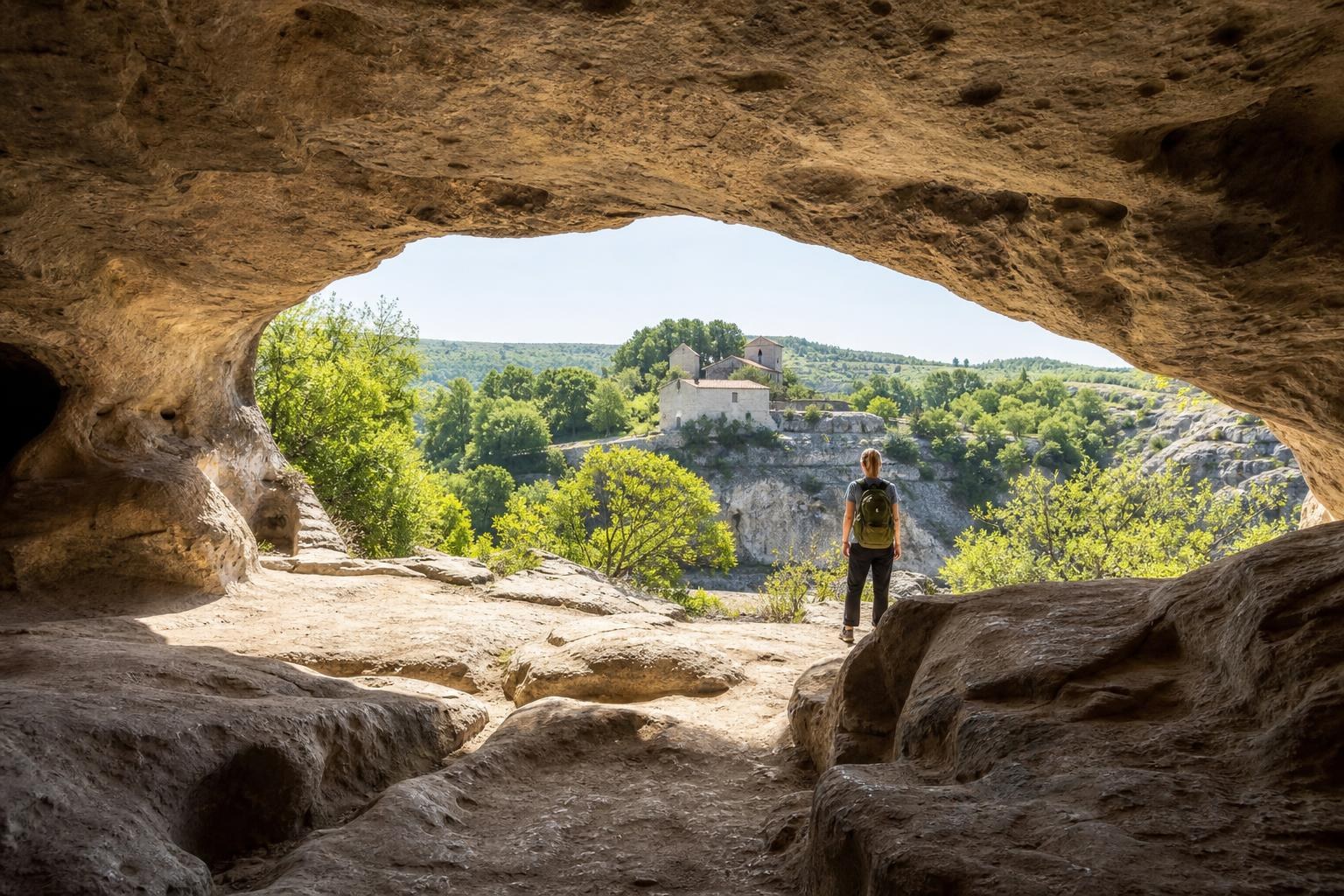
Kutaisi’s caves are the other half of the equation, and they offer something completely different from the spiritual weight of the churches. These are geological spectacles: millions of years of dripping water transformed into underground cathedrals of stone. Both major cave sites sit within easy day-trip distance of the city, and each one provides a distinct experience.
Prometheus Cave: A Multi-Colored Underground World
Prometheus Cave (also called Kumistavi Cave) is the largest cave open to tourists in Georgia, with about 1,800 meters of illuminated walkways winding through six connected chambers. The cave was discovered in 1984 and opened to visitors in 2011 after a major infrastructure investment that included colored LED lighting, paved paths, and even an underground river boat ride at the end of the tour.
The formations inside are genuinely impressive. Stalactites and stalagmites cluster in shapes that look like frozen waterfalls, pipe organs, and melted candle wax. The colored lighting is a matter of taste: some visitors find it magical, others wish they could see the formations under natural white light. Either way, the scale of the chambers is hard to overstate. Some ceilings rise 20 meters above the walkway, and the silence between tour groups is almost total.
Tours run approximately every 30-40 minutes and last about an hour. The temperature inside holds steady around 14°C (57°F) year-round, so bring a light jacket even in summer. The optional boat ride at the end adds about 15 minutes and costs an extra 17 GEL (roughly $6 USD). The cave sits about 20 kilometers from Kutaisi, and a taxi costs around 25-30 GEL one way.
Sataplia Nature Reserve: Dinosaurs and Glass Walkways
Sataplia offers a different kind of underground experience, combining a smaller cave with a nature reserve that holds genuine dinosaur footprints preserved in limestone. The footprints were discovered in 1933 by the local researcher Petre Chabukiani, and they date back roughly 120 million years to the Cretaceous period. A protective pavilion now covers the tracks, and the prints are clear enough to count individual toes.
The cave itself is shorter than Prometheus: about 300 meters of walkway through a single illuminated chamber. But Sataplia’s real highlight is the glass observation platform that juts out from the edge of a cliff above the Colchis forest. The transparent floor hangs about 280 meters above the valley, and on clear days the view stretches across the entire Imereti lowlands. It’s not for anyone with a serious fear of heights, but the panorama is worth the brief spike in heart rate.
Sataplia sits about 9 kilometers northwest of Kutaisi, making it the closer of the two cave sites. The nature reserve also includes short hiking trails through subtropical forest, where you might spot Colchic box trees and wild orchids. Budget about two hours for the full visit, including the cave, the dinosaur tracks, and the observation deck.
Planning Your Visit: Logistics and Comparison
Entry Fees and Opening Hours Table
Prices and hours shift occasionally, so confirm before you go, but these figures were accurate as of early 2026:
| Site | Entry Fee (GEL) | Entry Fee (USD approx.) | Hours | Closed |
|---|---|---|---|---|
| Bagrati Cathedral | Free | Free | 8:00 – 20:00 | None |
| Gelati Monastery | Free | Free | 8:00 – 19:00 | None |
| Motsameta Monastery | Free | Free | 8:00 – 19:00 | None |
| Prometheus Cave | 40 GEL | ~$14 | 10:00 – 18:00 | Mondays |
| Sataplia Nature Reserve | 25 GEL | ~$9 | 10:00 – 18:00 | Mondays |
A few notes: both caves are closed on Mondays, which catches some travelers off guard. The monasteries don’t charge entry fees, but donations are appreciated and small candles can be purchased inside for a few GEL. Prometheus Cave’s boat ride costs an additional 17 GEL on top of the regular ticket.
Best Time to Visit for Ideal Weather
Kutaisi sits in a humid subtropical zone, which means mild winters but plenty of rain. The best months for visiting are May through June and September through October. July and August bring heat (regularly above 35°C / 95°F) and the heaviest tourist crowds, especially since Kutaisi’s international airport brings direct flights from across Europe.
Spring is particularly beautiful for the monastery visits, when wildflowers cover the hillsides around Gelati and Motsameta. The caves maintain their constant 14°C temperature regardless of season, making them a perfect escape from summer heat or a rainy-day alternative in autumn. If you visit between November and March, expect shorter daylight hours and occasional snow at higher elevations, though the city itself rarely freezes.
Beyond the Sights: Local Food and Culture
Kutaisi is the capital of Imeretian cuisine, which differs from what you’ll find in Tbilisi or Kakheti. The region’s signature cheese, Imeretian cheese (imeruli kveli), is younger, softer, and less salty than its eastern Georgian counterparts. It’s the foundation of imeruli khachapuri, the round, flat cheese bread that most Georgians consider the definitive version of the dish. A good imeruli khachapuri from a bakery near the Green Market costs 3-5 GEL (about $1-2 USD), and it’s the best cheap meal in the city.
The Green Bazaar (Bazroba) itself is worth an hour of wandering. Vendors sell churchkhela (walnut strings dipped in grape juice), tkemali (sour plum sauce), fresh herbs by the armful, and seasonal fruit at prices that feel almost absurd. A kilo of ripe peaches in summer runs about 2-3 GEL. The market is also where you’ll find marshrutka departures for most regional destinations.
Kutaisi has a growing cafe culture, with several spots along Rustaveli Street serving excellent Georgian coffee and natural wines by the glass. Imeretian wines tend to be lighter and fruitier than the amber wines of Kakheti, partly because producers here more often use European-style winemaking methods rather than qvevri (clay vessel) fermentation. Ask for a glass of Tsolikouri or Tsitska for something distinctly local.
The city’s cultural calendar includes the Kutaisoba festival in autumn, celebrating the city’s founding with music, dance, and enough food to feed a small army. The Colchis Fountain in the central square, decorated with golden animal figures inspired by archaeological finds, makes a good meeting point and photo stop.
Getting Around Kutaisi and Surrounding Regions
Kutaisi’s city center is compact enough to walk, but reaching the caves, monasteries, and nature reserves requires transport. Taxis are the most convenient option, and the Bolt app works reliably here. A ride from the city center to Prometheus Cave runs about 25-30 GEL, while Gelati and Motsameta together cost roughly 30-40 GEL round-trip if the driver waits. Always confirm the price before departing, or use the app to avoid negotiation.
Marshrutkas leave from the area around the Green Bazaar and connect Kutaisi to most nearby towns and villages. A marshrutka to Tskaltubo (near Prometheus Cave) costs about 1.5 GEL, though you’ll still need a short taxi ride from Tskaltubo to the cave entrance. Service is frequent during daylight hours but essentially stops after 6 PM.
Kutaisi’s David the Builder International Airport sits about 14 kilometers west of the city and handles flights from Wizz Air, among other carriers. Budget airlines have made Kutaisi a popular entry point for travelers exploring Georgia, and a taxi from the airport to the city center costs around 20-25 GEL. There’s also a bus service timed to flight arrivals.
For travelers wanting to continue onward, daily trains and marshrutkas connect Kutaisi to Tbilisi (about 4 hours), Batumi (about 3.5 hours), and smaller towns across the Imereti and Samegrelo regions. The train station sits across the Rioni River from the old town, about a 10-minute taxi ride from most hotels.
Kutaisi rewards travelers who slow down. The caves and churches that define this part of Georgia aren’t just attractions to tick off a list: they’re places that connect you to geological time and medieval devotion in ways that feel immediate and physical. Spend at least two full days here. Use one for the monasteries and the hilltop walk to Bagrati, and another for the caves and a long lunch at the bazaar. You’ll leave understanding why Kutaisi, not Tbilisi, was the city that Georgian kings chose as their capital, and why this part of the country could reshape how travelers think about Georgia entirely.