
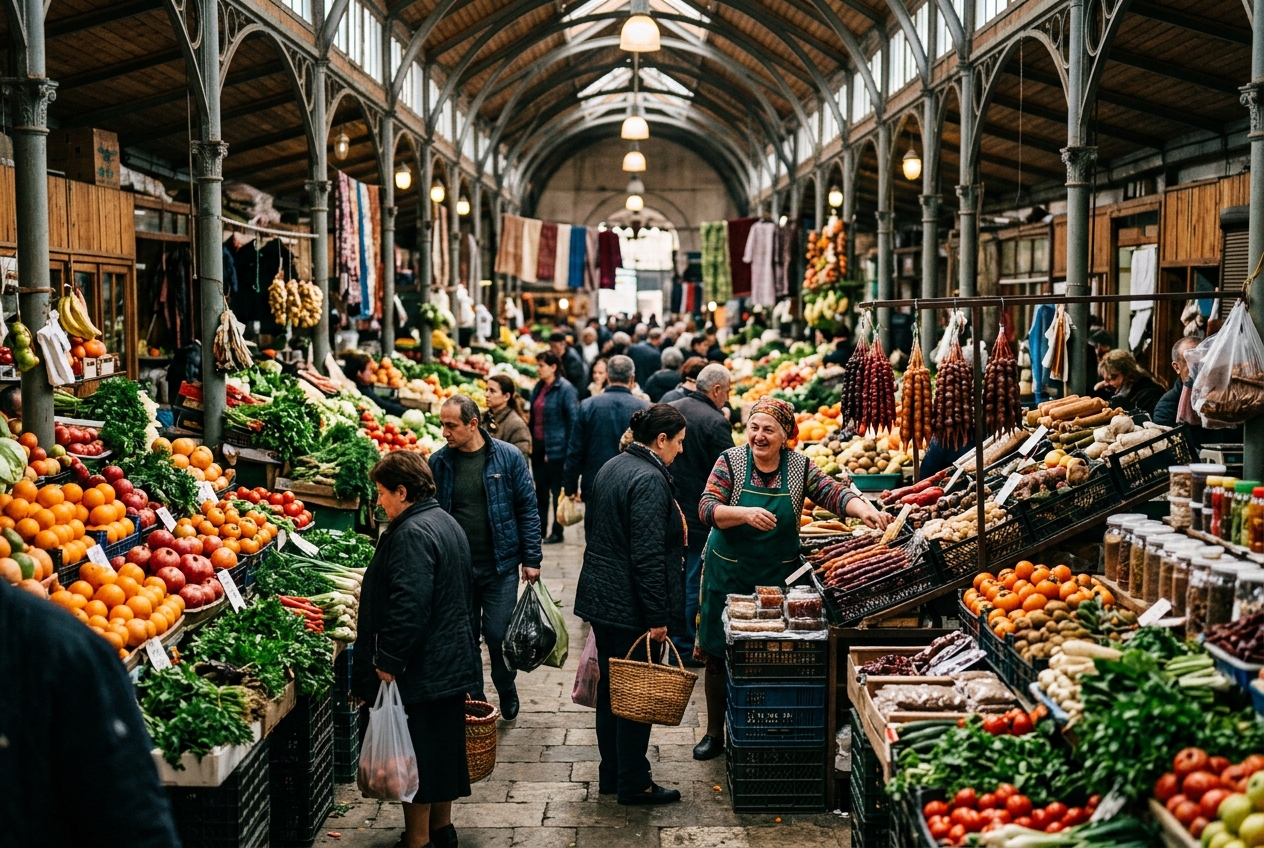
Few places in Georgia capture the rhythm of everyday life quite like the central market in Kutaisi. Known locally as the Green Bazaar, or “mtsvane bazari,” this sprawling marketplace on Paliashvili Street is where the city’s culinary soul lives and breathes. Forget the polished tourist experiences you might find in Tbilisi: this is Imereti at its most honest. Grandmothers sell churchkhela strung up that morning, farmers haul in crates of tomatoes still warm from the sun, and the scent of ground spices hangs in the air like a permanent resident. Whether you’re hunting for the perfect block of Imeretian cheese or just want to watch a city wake up and feed itself, the Green Bazaar delivers something no restaurant menu can replicate. I’ve wandered through markets across the Caucasus, and this one has a particular magic: it’s big enough to get lost in, small enough that vendors remember your face by your second visit. Here’s everything you need to know before you go.
The Heart of Kutaisi: History and Architecture
Kutaisi is Georgia’s second city, the ancient capital of the Colchis kingdom, and a place where history doesn’t sit behind velvet ropes. It spills into the streets, the churches, and especially the market. The Green Bazaar sits at the geographic and social center of Kutaisi, a short walk from both Kutaisi Park and the Colchis Fountain. The market has been a gathering point for trade, gossip, and community for generations, and the building itself tells that story in concrete and stone.
The structure housing the bazaar dates to the Soviet period, and it wears that heritage openly. You’ll spot the old weighing scales, the thick concrete countertops, and the utilitarian layout that characterizes Soviet-era market halls across the former USSR. But unlike many Soviet relics that feel cold or abandoned, this one pulses with life. The architecture is a shell; what fills it is distinctly Georgian.
The Iconic Soviet-Era Bas-Relief Entrance
The western entrance of the market complex features something you won’t find in any guidebook’s top ten list, but absolutely should. A vast, beautifully preserved Soviet-era bas-relief by artist Bernard Nebieridze stretches across a building near the entrance, depicting scenes tied to the region’s mythological and agricultural identity. The work is titled “Kolkheti,” a direct reference to the ancient kingdom of Colchis, and it was erected in 1995, making it one of the later Soviet-influenced public artworks in Georgia.
The bas-relief is worth several minutes of your time. It blends classical Georgian imagery with the monumental style typical of Soviet public art, and it’s in remarkably good condition. Most visitors walk past it on their way to buy tomatoes, which somehow makes it even better: art woven into the fabric of daily commerce, not cordoned off in a gallery.
Evolution from a Local Exchange to a Cultural Landmark
Markets like this one didn’t start as tourist attractions. For decades, the Green Bazaar was simply where Kutaisi fed itself. Farmers from surrounding Imeretian villages brought produce, cheese, and wine. Spice traders set up permanent stalls. Families came weekly to stock their kitchens. That function hasn’t changed, but the audience has expanded.
Over the past decade, as Georgia’s tourism sector has grown rapidly, the bazaar has become one of the most authentic places to visit in Kutaisi, offering a genuine glimpse into local life. What makes it work as a cultural landmark is precisely that it hasn’t been sanitized for visitors. There are no information boards in English, no curated “artisan corners.” You’re stepping into a working market where the primary customers are still local families. That authenticity is increasingly rare and increasingly valuable.
Navigating the Stalls: What to Buy
The bazaar is organized loosely by category, though “loosely” is doing heavy lifting in that sentence. Spice vendors cluster near one section, cheese sellers dominate another, and fruit and vegetable stalls sprawl across the open-air areas. Getting oriented takes a few minutes, but that’s part of the fun. Here’s what deserves your attention and your lari.
Authentic Georgian Spices and Svaneti Salt
If you buy one thing at the Kutaisi market, make it spices. Georgian cuisine relies on a specific palette of dried herbs and spice blends that are difficult to find outside the country, and the bazaar offers them at a fraction of what you’d pay in Tbilisi’s tourist shops.
The essential purchases include:
- Khmeli-suneli: Georgia’s signature spice blend, used in nearly everything from stews to bean dishes. Each vendor’s mix varies slightly.
- Svaneti salt (svanuri marili): A pungent, garlic-heavy salt blend from the Svaneti highlands. It transforms grilled meat and is the secret behind many Georgian dishes.
- Blue fenugreek (utskho suneli): Ground from the seeds and pods, this has a warm, nutty flavor distinct from standard fenugreek.
- Dried marigold petals (imeruli shaphrani): Often called “Georgian saffron,” this adds color and a subtle earthy flavor to walnut sauces.
Vendors will let you smell everything before buying, and most will happily fill small bags for just a few lari. Bring zip-lock bags from home if you want to pack them more securely for travel.
Churchkhela, Tklapi, and Local Confections
Churchkhela is Georgia’s answer to the energy bar, and it predates the concept by about a thousand years. These candle-shaped treats are made by dipping strings of walnuts (or hazelnuts) into thickened grape juice, then hanging them to dry. The Green Bazaar sells churchkhela in dozens of varieties: some made with white grape juice, others with dark, some studded with hazelnuts, others with walnuts or almonds.
Tklapi is the other traditional confection worth seeking out. It’s a thin, dried sheet of fruit puree, most commonly made from plums or apricots. Think of it as Georgian fruit leather, but tangier and less sweet than the commercial versions sold elsewhere. Vendors often let you taste before committing.
A word of practical advice: churchkhela keeps for weeks without refrigeration, making it an ideal travel snack or gift. Tklapi is even more durable. Both pack flat and survive checked luggage without issue.
Artisanal Imeretian Cheese and Fresh Produce
Imereti is cheese country, and the bazaar is ground zero for the region’s signature product: Imeretian cheese, or imeruli kveli. This is a fresh, brined cheese with a mild, slightly sour flavor, and it’s the base for khachapuri across western Georgia. At the market, you’ll find it sold in large wheels or cut to order, often still dripping with whey.
The cheese section is also where you’ll encounter some of the market’s most memorable vendors: older women from nearby villages who make cheese at home and bring it in daily. Don’t be surprised if someone insists you try a sample, then another, then a third from a different batch. This isn’t a sales tactic. It’s Imeretian hospitality, rooted in the Georgian principle of “stumari ghvtisaa,” the guest is from God.
The produce section peaks in summer and early autumn, when tomatoes, peppers, eggplants, herbs, and stone fruits overflow from wooden crates. Even if you’re not cooking, the visual display alone is worth the visit.
The Sensory Experience of the Green Bazaar
Atmosphere, Aromas, and Local Interactions
Walking through the Kutaisi Green Bazaar is a full sensory event. The first thing that hits you is the smell: layers of dried herbs, fresh bread from a nearby tone oven, ripe fruit, and the sharp tang of pickled vegetables. Then comes the sound, a constant hum of conversation in Georgian, the occasional shout between vendors, and the clatter of metal scales.
What strikes most visitors, especially those coming from Western Europe or North America, is how personal the interactions feel. This isn’t transactional commerce. Vendors will ask where you’re from, offer you tastes of everything within arm’s reach, and sometimes refuse to let you pay for small samples. I once spent twenty minutes at a walnut vendor’s stall learning how to crack them properly with a single hand motion, and walked away with a free bag “for practice.”
The generational divide is visible here too. Older vendors, educated during the Soviet era, often speak Russian but little English. Younger sellers, particularly those in their twenties and thirties, are more likely to know some English phrases. Having Google Translate’s offline Georgian pack downloaded on your phone bridges most gaps, but honestly, pointing, smiling, and holding up fingers for quantities works remarkably well.
Sampling Homemade Wine and Chacha
Georgia is the birthplace of wine, with an 8,000-year tradition of fermenting grapes in clay vessels called qvevri. At the bazaar, you’ll find vendors selling homemade wine by the liter in recycled plastic bottles. It won’t win any packaging awards, but the contents are often extraordinary: unfiltered, amber-hued wines made in the traditional method, with flavors you simply cannot find in commercial bottles.
Chacha, Georgia’s grape brandy, is the other liquid you’ll encounter. It ranges from smooth and aromatic to something that could strip paint, depending on who made it. Vendors will pour you a small taste without hesitation. If you’re visiting in the morning, be prepared: Georgians see nothing unusual about sampling chacha before noon.
A practical note on buying wine or chacha to bring home: check your airline’s liquid restrictions and customs regulations before purchasing large quantities. Most travelers find it easiest to buy a liter or two and pack it carefully in checked luggage wrapped in clothing.
Practical Tips for Visitors
Best Times to Visit and Opening Hours
The bazaar operates daily, though the best experience comes on weekday mornings between 8:00 and 11:00 AM. This is when the selection is freshest, the crowds are manageable, and the light filtering through the market’s open sections is at its best for photography.
| Day | Activity Level | Best For |
|---|---|---|
| Monday – Friday (morning) | Moderate | Freshest produce, fewer crowds |
| Saturday (morning) | High | Widest selection, most vendors |
| Sunday | Low to moderate | Quieter, some stalls closed |
| Afternoons (any day) | Declining | Less selection, some vendors pack up early |
The market doesn’t have a single official closing time. Most vendors are active by 7:00 AM and start packing up between 3:00 and 5:00 PM, depending on the season and how sales went that day. Saturday mornings draw the biggest crowds and the widest variety of goods, as village producers make the trip specifically for the weekend rush.
Currency, Pricing, and the Art of Haggling
Everything at the bazaar is priced in Georgian lari. Card payments are essentially nonexistent here, so bring cash. There are ATMs within walking distance, but having lari in your pocket before you arrive saves time.
Pricing is generally fair and consistent. A kilogram of tomatoes might run 2 to 4 lari depending on the season. A string of churchkhela costs between 3 and 7 lari. Spice bags typically go for 2 to 5 lari each.
Haggling exists but isn’t aggressive. This isn’t Istanbul’s Grand Bazaar. Prices are usually close to final, and pushing too hard on a grandmother selling her homemade cheese for 5 lari per kilo feels wrong because it is wrong. Where haggling makes sense is when you’re buying in quantity: ask for a small discount if you’re purchasing several kilograms of spices or multiple strings of churchkhela. Most vendors will round down or throw in an extra item.
Getting to the market is straightforward. From central Kutaisi, it’s walkable from most hotels. If you’re coming from further out, Bolt and Yandex Go both operate in Kutaisi, and a ride across the city rarely exceeds 5 lari.
Exploring the Neighborhood Around the Market
The Green Bazaar sits in one of Kutaisi’s most walkable neighborhoods, and combining a market visit with the surrounding attractions makes for a full morning or afternoon. The Colchis Fountain, a striking modern sculpture in the central square, is just a few minutes on foot. Kutaisi Park, shaded and pleasant, offers a place to sit and eat whatever you’ve just bought.
Walking south from the market takes you toward the White Bridge over the Rioni River, one of the city’s most photographed spots. Cross it and you’re near the old town area, where narrow streets hold small cafes, churches, and crumbling balconied houses that feel frozen in a previous century.
For a longer excursion, the Bagrati Cathedral sits on a hill overlooking the city and is reachable by a 20-minute uphill walk from the market area. The views from the cathedral grounds stretch across Kutaisi’s rooftops and the river valley beyond. Timing your market visit for the morning and the cathedral for the early afternoon, when the light is warm and angled, makes for an ideal day.
If you’re hungry after the bazaar, skip the restaurants immediately adjacent to the market (they tend to cater to quick lunches rather than quality) and walk ten minutes in any direction. Kutaisi has a growing number of small, family-run restaurants serving exceptional Imeretian cuisine: look for places where the menu is short and handwritten, a reliable sign that the food is made to order rather than pre-prepared.
The Kutaisi Central Market isn’t a place you visit to check a box on a sightseeing list. It’s where you go to understand how a Georgian city actually works: what people eat, how they trade, what they value. Spend a morning here, fill a bag with spices and churchkhela, accept every sample you’re offered, and let the experience be messy and unscripted. That’s the whole point. The Green Bazaar rewards curiosity far more than it rewards efficiency, and the best souvenirs you’ll carry home aren’t the ones you bought but the ones you tasted, smelled, and stumbled into by accident.