
Table of Contents
- The Maritime Legacy of the Ancient Phasis
- Architectural Landmarks and Cultural Heritage
- Natural Wonders of Kolkheti National Park
- Essential Visitor Information and Data
- Culinary Flavors of the Samegrelo Region
- Why This Port City Deserves a Spot on Your Itinerary
Few travelers planning a trip to the Caucasus have Poti on their radar, and that’s precisely what makes this city such a rewarding stop. Sitting where the Rioni River empties into the Black Sea, this port city on Georgia’s western coast has been a crossroads of civilizations for nearly three millennia. The ancient Greeks knew it as Phasis, the legendary destination of Jason and the Argonauts. Today, it’s a working port town with a population of roughly 42,000, a striking cathedral, one of the oldest lighthouses in the region, and a national park that ranks among Europe’s most important wetland ecosystems. I first visited on a detour from Batumi, expecting a quick overnight. I stayed for four days. The city has a quiet magnetism: the smell of salt air mixing with churchkhela vendors on the promenade, fishermen mending nets along the riverbank, and that unmistakable feeling of being somewhere genuinely untouched by mass tourism. If you’re the kind of traveler who prefers discovering places before the guidebooks catch on, this city deserves your attention.
The Maritime Legacy of the Ancient Phasis
The story of this city stretches back to a time when the eastern Black Sea coast was the edge of the known world for Mediterranean civilizations. Understanding that deep history is essential to appreciating what makes the place feel different from Georgia’s more popular destinations.
Traces of the Argonauts and Greek Colonization
The myth of Jason and the Golden Fleece places Colchis, the ancient kingdom of western Georgia, at the center of one of Greek literature’s most enduring stories. The river that flows through the modern city was called the Phasis by the Greeks, and it gave its name to the settlement that grew on its banks. By the 6th century BCE, Greek colonists from Miletus had established a trading post here, making it one of the oldest continuously inhabited sites in the Caucasus.
What’s fascinating is how the mythology intersects with real archaeology. The Colchian civilization was genuinely wealthy, and gold panning using sheepskins in the rivers of western Georgia likely inspired the Golden Fleece legend. Recent archaeological work in the broader region, including a unique ancient metallurgical complex discovered in Lechkhumi, continues to reveal the sophistication of these early Colchian societies. The area around the Rioni Delta has yielded Greek pottery, coins, and bronze artifacts that confirm centuries of active trade between the Colchian coast and the wider Mediterranean.
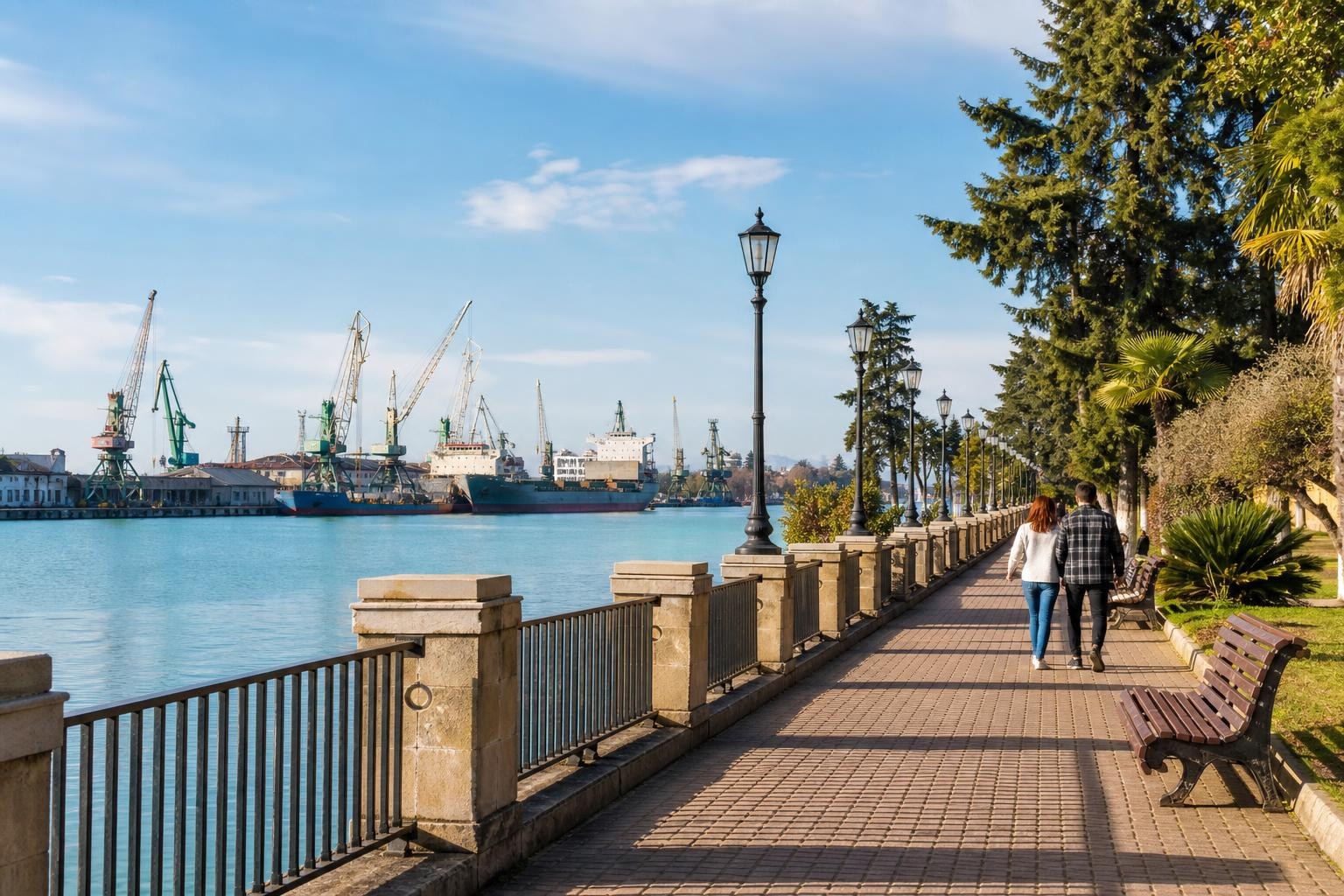
Walking along the riverfront today, it’s easy to imagine ancient galleys navigating the same waterway. The Rioni remains the longest river in western Georgia, and its mouth has shaped the geography and economy of this settlement for thousands of years.
Poti’s Evolution into a Modern Gateway
The city’s transformation from ancient trading post to modern port began in earnest during the 19th century under Russian Imperial rule. In 1858, it was officially granted city status, and the construction of a proper harbor turned it into Georgia’s primary commercial port. The railway connection to Tbilisi, completed in the 1870s, cemented its role as the country’s main conduit for international trade.
That role has only grown. In 2025, the sea port handled a record 636,466 TEU, representing a 17% increase that underscored its importance along the Middle Corridor trade route connecting China to Europe via Central Asia and the South Caucasus. Georgia’s position as an emerging investment hub along this corridor has drawn significant international attention, and a new port development project bringing together government, business, and U.S. financial institutions signals that the city’s commercial significance will keep expanding.
For visitors, this means the city carries a working-port authenticity that resort towns lack. You’ll see container ships being loaded at dawn, hear the clang of cranes, and share restaurants with merchant sailors from Turkey, Kazakhstan, and beyond. It’s not polished, but it’s real.
Architectural Landmarks and Cultural Heritage
Despite its modest size, the city holds some genuinely impressive architectural treasures. These aren’t the kind of attractions that require half-day visits, but they reward anyone who takes the time to look closely.
The Poti Cathedral: A Neo-Byzantine Masterpiece
The Cathedral of the Nativity of the Blessed Virgin Mary is the city’s most prominent landmark, and honestly, it caught me off guard. I wasn’t expecting a building of this scale or beauty in a small port town. Completed in 1907, the cathedral was modeled after the Hagia Sophia in Istanbul, and while it’s obviously smaller, the Neo-Byzantine proportions and the golden dome create a striking silhouette against the flat coastal terrain.
The interior features restored frescoes and an ornate iconostasis that reflects the Georgian Orthodox tradition. The cathedral has survived wars, Soviet-era neglect, and natural disasters, which makes its current state of careful restoration all the more impressive. Visitors who’ve seen photos of the cathedral’s distinctive exterior will recognize its pale stone walls and the distinctive cross-topped dome immediately.
The cathedral sits in the center of town and is free to enter. Women should bring a headscarf, and both men and women should cover their shoulders, as is standard in Georgian Orthodox churches. Early morning visits, around 8 or 9 AM, offer the best light and the fewest visitors.
The Lighthouse and Maritime Museum
The Poti Lighthouse, built in 1862, stands as one of the oldest surviving lighthouses on the eastern Black Sea coast. At roughly 28 meters tall, it’s been recognized by the International Association of Marine Aids to Navigation as a heritage structure of significance. The lighthouse is still operational, which gives it a different character than many preserved-but-decommissioned towers you’ll find in Western Europe.
Near the lighthouse, the small Maritime Museum houses a collection of nautical instruments, ship models, and photographs documenting the port’s history. The exhibits are modest but genuinely interesting if you’re curious about Black Sea shipping routes or the city’s role during the Soviet era. Admission is a few lari (roughly 1-2 USD), and a visit takes about 30-45 minutes.
The lighthouse and surrounding waterfront area make for an excellent late-afternoon walk, especially when the light turns golden and local families come out for their evening stroll along the breakwater.
Natural Wonders of Kolkheti National Park
The city’s greatest natural asset sits just south of town. Kolkheti National Park protects one of the most ecologically significant wetland systems in the entire Palearctic region, and it’s remarkably easy to access.
Biodiversity and Birdwatching at Lake Paliastomi
Lake Paliastomi, a shallow coastal lagoon connected to the Black Sea by a narrow channel, is the park’s centerpiece. The lake and surrounding marshes support over 190 bird species, including globally significant populations of white pelicans, pygmy cormorants, and several species of herons. During spring and autumn migration, the numbers are staggering: tens of thousands of waterbirds use the wetlands as a stopover on the East African-West Asian flyway.
For birdwatchers, this is one of the best sites in the entire Caucasus. Bring binoculars and a spotting scope if you have one. The park’s visitor center can arrange boat trips on the lake (around 40-60 GEL per boat, roughly 15-22 USD), which get you much closer to nesting colonies than shore-based observation allows. Early mornings between April and June offer the most spectacular sightings.
The wetlands also harbor a relic flora that dates back millions of years, including species of ferns and bog plants that have survived since the Tertiary period. Botanists consider these Colchic forests a kind of living time capsule, preserving plant communities that once covered much of Europe before the ice ages.
Navigating the Rioni River Delta
The Rioni Delta, where the river fragments into channels before meeting the sea, offers a different kind of experience. Guided boat tours through the delta’s maze of waterways take you through dense stands of alder forest and reed beds that feel almost tropical in their lushness during summer months.
These tours typically last 2-3 hours and cost between 50-80 GEL (18-30 USD) per person, depending on group size. The best operators are local fishermen who know the channels intimately and can point out otters, turtles, and the occasional jackal along the banks. Ask at the park visitor center or your guesthouse for recommendations rather than booking online, as the most experienced guides don’t have websites.
The delta is also where you’ll feel the city’s identity most clearly: a place shaped by water, where rivers, marshes, and sea all converge. It’s a landscape that has defined human settlement here for millennia, and spending a few hours on the water makes that connection tangible in a way that reading about it never quite manages.
Essential Visitor Information and Data
Getting to and around the city is straightforward, but a few practical details will save you time and frustration.
Travel Logistics: Seasonal Weather and Transport
The climate here is subtropical and humid, which means warm, muggy summers and mild, rainy winters. July and August temperatures regularly hit 30-33°C (86-91°F) with high humidity, while January averages around 5-7°C (41-45°F). The driest and most pleasant months for visiting are May, June, September, and October. Rain gear is essential year-round: annual rainfall exceeds 1,500mm, making this one of the wettest spots in Georgia.
Getting here from Tbilisi is easiest by train. Georgian Railways runs a daily service that takes approximately 5-5.5 hours and costs around 20-25 GEL (7-9 USD) for second class. Marshrutkas (minibuses) from Tbilisi’s Didube station are slightly faster but less comfortable. From Batumi, the journey is about 1.5 hours by marshrutka (8-10 GEL) or taxi (around 60-80 GEL). The city itself is walkable for most attractions, though a Bolt ride to Kolkheti National Park’s entrance costs only 5-8 GEL.
Accommodation is limited compared to Tbilisi or Batumi. Expect guesthouses and small hotels in the 60-150 GEL range (22-55 USD) per night. Booking.com has a handful of listings, but the best family-run guesthouses are often found through local contacts or Facebook groups dedicated to Georgia travel.
Data Table: Poti Travel Quick Facts
| Category | Details |
|---|---|
| Population | ~42,000 |
| Best Months to Visit | May, June, September, October |
| Average Summer Temperature | 30-33°C (86-91°F) |
| Average Winter Temperature | 5-7°C (41-45°F) |
| Annual Rainfall | 1,500+ mm |
| Train from Tbilisi | ~5.5 hours, 20-25 GEL |
| Marshrutka from Batumi | ~1.5 hours, 8-10 GEL |
| Budget Accommodation | 60-150 GEL/night |
| Port TEU Volume (2025) | 636,466 TEU (+17% YoY) |
| Kolkheti Boat Tour | 40-80 GEL per person |
| Key Attractions | Cathedral, Lighthouse, Kolkheti National Park |
Culinary Flavors of the Samegrelo Region
The food alone is worth the trip, and I don’t say that lightly. The city sits in the Samegrelo (Mingrelia) region, which has arguably the most distinctive and intensely flavored cuisine in all of Georgia. If you think Georgian food is just khachapuri and khinkali, Megrelian cooking will reset your expectations entirely.
The signature dish is elarji, a thick, stretchy porridge made from cornmeal and fresh sulguni cheese. It’s pulled and twisted until it reaches an almost mozzarella-like consistency, then served steaming hot. Pair it with bazhe, a walnut sauce with garlic and spices that Megrelians put on practically everything: chicken, fish, vegetables. The combination is rich, pungent, and completely addictive.
Megrelian khachapuri deserves special mention because it differs from the versions you’ll find elsewhere in Georgia. Here, the cheese bread is topped with an extra layer of melted sulguni on the outside, creating a double-cheese effect that makes the Imeretian version seem restrained by comparison. A good one costs 8-12 GEL (3-4 USD) at local bakeries.
Kupati, spiced pork sausages, are another regional specialty. They’re grilled over coals and served with tkemali (sour plum sauce) and fresh herbs. Street vendors near the central market sell them for 3-5 GEL, and they make an excellent quick lunch.
For fish, look for locally caught mullet or catfish from the Rioni, often pan-fried with adjika, the fiery chili-walnut paste that is the Megrelian answer to hot sauce. The waterfront restaurants near the port serve the freshest catches, and a full fish dinner with sides and a bottle of local wine rarely exceeds 40-50 GEL (15-18 USD) per person.
Don’t skip the local wine, either. While Samegrelo isn’t as famous as Kakheti for winemaking, the region produces distinctive varieties like Ojaleshi, a rare red grape that yields a semi-sweet wine with deep berry flavors. It pairs beautifully with the region’s spicier dishes. A bottle at a local shop runs 15-25 GEL.
Why This Port City Deserves a Spot on Your Itinerary
Poti won’t dazzle you with Instagram-ready old towns or boutique hotel scenes. What it offers instead is something harder to find: an unfiltered glimpse of a Georgian city that’s been trading with the world for nearly 3,000 years and still does so today. The cathedral is genuinely beautiful, the wetlands are world-class for birdwatching, and the Megrelian food will ruin you for lesser Georgian restaurants.
Give it at least two full days: one for the city’s landmarks and cuisine, another for Kolkheti National Park. If you’re traveling between Batumi and Kutaisi, the detour adds minimal time and maximum character to your trip. The city is well-positioned as a stop along western Georgia’s coast, and the infrastructure improvements happening around the port suggest it will only become easier to visit in the coming years.
Go before the rest of the travel world catches on. Some places are best discovered while they’re still themselves.