
Table of Contents
- Overview of the Sadakhlo-Bagratashen Border Crossing
- Transportation Options from Tbilisi to Yerevan
- Step-by-Step Immigration and Customs Process
- Driving Across the Border with a Personal or Rental Car
- Essential Amenities and Services at the Border
- Practical Tips for a Smooth Crossing
The overland route between Tbilisi and Yerevan is one of the most popular border crossings in the Caucasus, and for good reason: it’s cheap, relatively quick, and connects two capital cities that sit just 270 kilometers apart. But if you’ve never done it before, the Sadakhlo-Bagratashen crossing can feel intimidating. Border procedures, transport options, insurance requirements, currency quirks: there’s a lot to sort out, and most of it isn’t well documented online. I’ve been through this crossing multiple times in both directions, and I can tell you that the process is far simpler than it looks on paper. The anxiety usually comes from not knowing what to expect, not from the crossing itself. This guide covers everything you need: how to get there, what happens at each checkpoint, what paperwork you’ll need if you’re driving, and the small practical details that make the difference between a smooth trip and a frustrating one.
Overview of the Sadakhlo-Bagratashen Border Crossing
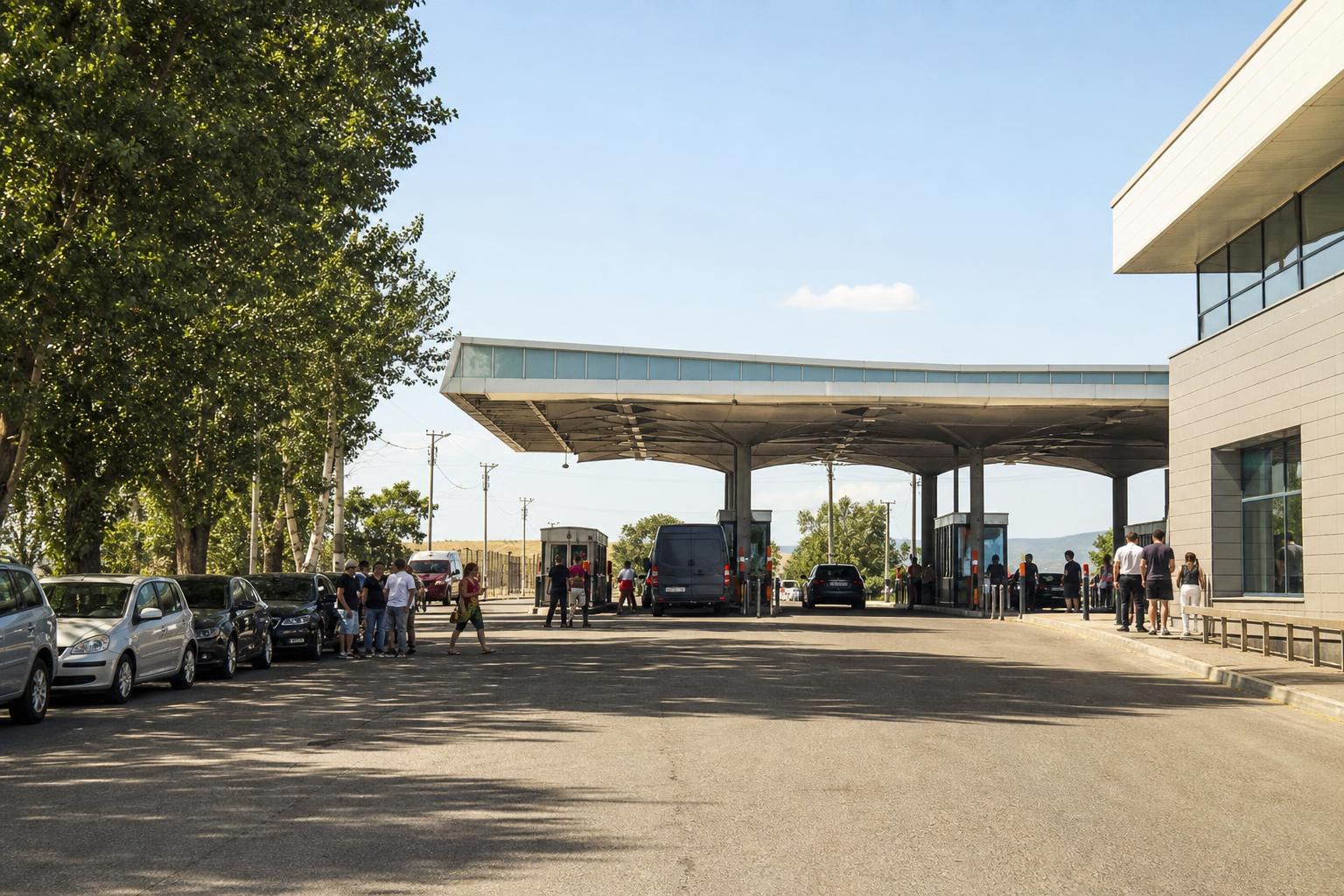
The Sadakhlo-Bagratashen crossing is the main land border between Georgia and Armenia, handling the vast majority of overland traffic between the two countries. It sits along the main highway connecting Tbilisi and Yerevan, which makes it the default crossing for buses, minibuses, private cars, and the overnight train. The border itself consists of two separate checkpoints: the Georgian side at Sadakhlo and the Armenian side at Bagratashen, connected by a short stretch of road (roughly 300 meters) that you walk or drive through.
There is a second Georgia-Armenia crossing at Bavra, further west, but it’s far less commonly used and mostly relevant for travelers heading to Gyumri or northwestern Armenia. For the Tbilisi-Yerevan corridor, Sadakhlo-Bagratashen is the only practical choice.
Location and Operating Hours
Sadakhlo sits about 90 kilometers south of Tbilisi, roughly a 90-minute drive depending on traffic. On the Armenian side, Bagratashen is located in the Tavush Province, about 170 kilometers from Yerevan. The border operates 24 hours a day, 7 days a week, including holidays. That said, crossing during off-peak hours (early morning or late evening) tends to be faster, with shorter queues and less congestion from commercial vehicles.
Peak times are typically mid-morning and late afternoon, when marshrutkas and shared taxis arrive in waves. If you’re driving yourself, aiming for an early departure from Tbilisi can save you 30 to 45 minutes of waiting.
Comparison Table: Transportation Methods and Costs
| Method | Approximate Cost | Travel Time | Frequency |
|---|---|---|---|
| Marshrutka (minibus) | 35-50 GEL ($13-18) | 5-6 hours | Multiple daily departures |
| Shared taxi | 60-80 GEL ($22-30) | 4-5 hours | On demand, when full |
| Private transfer | $80-150 total | 4-5 hours | Bookable in advance |
| Night train | From 103 GEL ($38) | ~10-11 hours | Every other day |
| Personal car | Fuel only (~$15-20) | 4-5 hours | Anytime |
Transportation Options from Tbilisi to Yerevan
Getting from Tbilisi to Yerevan is straightforward, but each transport option has its own personality. Your choice depends on whether you value speed, comfort, cost, or the experience itself.
Taking the Marshrutka (Minibus)
The marshrutka is the budget traveler’s workhorse. These minibuses depart from Tbilisi’s Ortachala Bus Station (also called the Southern Bus Station) throughout the day, with the first departures usually around 8:00 or 9:00 AM. You don’t need to book ahead: just show up, find the Yerevan-bound marshrutka, and grab a seat. They leave when full, which can mean a 20-minute wait or an hour-long one.
The ride takes about five to six hours including the border stop. The marshrutka driver handles the logistics at the crossing: you’ll get off with your passport, walk through both checkpoints, and reboard on the other side. Expect to pay between 35 and 50 GEL depending on the season and operator. The vehicles range from reasonably comfortable Mercedes Sprinters to older, more cramped options. Bring snacks and water; stops are infrequent.
Private Transfers and Shared Taxis
Shared taxis operate on a similar model to marshrutkas but with fewer passengers (typically four) and faster travel times. Drivers congregate at Ortachala and fill their cars before departing. The cost runs about 60 to 80 GEL per person, and you’ll shave roughly an hour off the marshrutka time because the car doesn’t make as many stops.
Private transfers are the premium option. Companies and individual drivers offer door-to-door service from your Tbilisi accommodation to your Yerevan hotel for $80 to $150 total (not per person). Apps like Bolt work within each city but won’t take you across the border, so you’ll need to arrange this through a transfer service or your hotel. For groups of three or four, a private transfer can actually work out cheaper per person than shared taxis.
The Night Train Experience
The Tbilisi-Yerevan night train is the most atmospheric way to make this journey, and it’s genuinely comfortable. Fares for the 2025-2026 service start at approximately 103 GEL ($38) for a berth in a four-person compartment, with higher-class options available. The train departs Tbilisi Station in the evening and arrives in Yerevan the following morning, taking about 10 to 11 hours.
You board, settle into your compartment, and fall asleep. Border formalities happen during the night: guards will wake you briefly to stamp your passport, but the process takes only a few minutes and you can go right back to sleep. The train runs every other day (check the current schedule before planning around it), and booking in advance through the Georgian Railway website or at the station is recommended during summer months. It’s one of those rare travel experiences where the journey itself is the highlight.
Step-by-Step Immigration and Customs Process
The actual border crossing is simpler than most people expect. The entire process typically takes 20 to 45 minutes for pedestrians and bus passengers, though it can stretch longer during peak periods or if you’re driving.
Exiting Georgia at Sadakhlo
When you arrive at the Georgian checkpoint, you’ll exit your vehicle and walk to the passport control window. Have your passport ready and any Georgian visa documentation if applicable (most nationalities enter Georgia visa-free for up to a year). The Georgian border officer will check your passport, stamp your exit, and wave you through. There’s no exit fee and no departure card to fill out.
If you entered Georgia with a vehicle, you’ll need to show the same documentation you used at entry. The process is quick and bureaucratic in the best sense: efficient, impersonal, and fast. After getting your exit stamp, you walk about 300 meters through a no-man’s-land corridor to the Armenian checkpoint.
Entering Armenia at Bagratashen
The Armenian side mirrors the Georgian process but with a few extra steps. You’ll approach the passport control booth, hand over your passport (and visa or e-visa printout if required), and receive your entry stamp. Armenian border guards may ask basic questions: purpose of visit, length of stay, where you’re staying. Keep answers simple and honest.
Customs screening is usually a formality for pedestrians with backpacks or suitcases. If you’re carrying anything unusual or large quantities of goods, expect a closer look. The standard customs allowances apply: up to 2 liters of alcohol, 50 cigars or 200 cigarettes, and personal items within reasonable limits.
Visa Requirements and E-Visa Information
Citizens of the EU, US, Canada, Australia, Russia, and most CIS countries can enter Armenia visa-free for stays of up to 180 days. If your nationality requires a visa, Armenia offers an e-visa system that’s straightforward and relatively fast: apply online at evisa.mfa.am, pay the fee (roughly $6 for a 21-day single-entry visa or $40 for a 120-day multiple-entry), and print the confirmation.
You can also obtain a visa on arrival at Bagratashen, but the e-visa saves time and eliminates any uncertainty. Processing at the border for visa-on-arrival can add 15 to 30 minutes. I’d strongly recommend sorting this out before you travel.
Driving Across the Border with a Personal or Rental Car
Driving yourself gives you the most flexibility, but it comes with paperwork that bus and train passengers don’t have to worry about. The crossing itself is the same: you drive through the Georgian checkpoint, cross the no-man’s-land, and enter the Armenian checkpoint. The difference is in what you need to present.
Required Documentation and Power of Attorney
If you’re driving your own car (registered in your name), you’ll need your passport, driver’s license (an international driving permit is recommended but not always required), vehicle registration, and proof of insurance valid in Armenia. Straightforward enough.
Rental cars are where things get complicated. Most Georgian rental companies do not allow their vehicles to cross into Armenia, and those that do require advance written permission. You’ll need a notarized power of attorney from the rental company explicitly authorizing you to take the car across the border. Without this document, Armenian border guards will turn you away. This isn’t a technicality they sometimes enforce: it’s checked consistently. Contact your rental company well before your trip to confirm cross-border travel is permitted and to obtain the necessary paperwork.
Mandatory Armenian Car Insurance (APPA)
Armenia requires all vehicles to carry local third-party liability insurance, known as APPA (Armenian Compulsory Motor Third Party Liability Insurance). Your existing insurance from Georgia or your home country will not be accepted as a substitute.
You can purchase APPA at the border itself: there’s a small insurance kiosk on the Armenian side at Bagratashen. The cost is modest, typically around 5,000 to 10,000 AMD ($12-25) depending on coverage duration and vehicle type. The process takes about 10 minutes. You can also buy APPA online before arriving, which is slightly faster but not necessary given how quick the border purchase is. Keep the insurance certificate in the car at all times during your stay in Armenia: police may ask to see it at random checkpoints.
Essential Amenities and Services at the Border
The Sadakhlo-Bagratashen crossing isn’t a major commercial hub, but it has the basics covered. Don’t expect an airport-style terminal with lounges and restaurants, but you won’t be stranded either.
Currency Exchange and ATMs
There are currency exchange booths on both sides of the border. Rates are predictably worse than what you’ll find in Tbilisi or Yerevan: expect a 3-5% markup compared to city rates. If you need Armenian dram (AMD) immediately, exchange a small amount at the border (enough for a meal and transport) and save the bulk of your currency exchange for a bank or ATM in Yerevan.
ATMs exist near the Armenian side but aren’t always reliable. I’ve encountered out-of-service machines more than once. Carry some cash in GEL or USD as a backup. Georgian lari are widely accepted at shops and exchange booths on the Armenian side of the border, and USD is universally exchangeable throughout Armenia. Download an offline currency converter app before you go: the GEL-to-AMD conversion isn’t one most people can do in their heads.
Purchasing Armenian SIM Cards
You can pick up an Armenian SIM card from small vendors on the Armenian side of the border, though the selection and pricing may not be ideal. The main carriers are Viva-MTS, Team Telecom Armenia, and Ucom. A basic tourist SIM with data typically costs 1,500 to 3,000 AMD ($3.50-7) and gives you enough data for maps and messaging for a week or two.
That said, if you’re not in a rush, you’ll find better deals and more helpful staff at official carrier stores in Yerevan. Many travelers simply rely on their Georgian SIM’s roaming or Wi-Fi at the border and buy an Armenian SIM once they reach the city. If you use an eSIM service like Airalo or Holafly, you can activate Armenian coverage before you even reach the border: no physical SIM swap needed.
Practical Tips for a Smooth Crossing
A few things I’ve learned from repeat crossings that don’t fit neatly into other sections:
- Bring a pen. You may need to fill out a customs declaration or immigration card, and the border doesn’t always have pens available. This sounds trivial until you’re holding up a line.
- Carry photocopies of your passport’s main page and any visa pages. If something goes wrong with digital records, a paper backup speeds things up enormously.
- Dress practically. You’ll be walking between checkpoints, sometimes in direct sun or cold wind depending on the season. Comfortable shoes and a layer you can add or remove make the wait more bearable.
- Keep your luggage accessible. If customs wants to inspect a bag, you don’t want to be unpacking an entire backpack on the sidewalk.
- Be patient and polite with border guards. The process is routine for them, and a friendly demeanor goes a long way. Don’t joke about smuggling, politics, or anything that could be misinterpreted.
- If you’re traveling with children, carry birth certificates or documentation proving your relationship to the child. Single parents or guardians traveling with minors may be asked for additional proof.
The Sadakhlo-Bagratashen crossing is well-trodden and generally hassle-free for travelers who arrive prepared. The whole process, from leaving your Tbilisi hotel to settling into a Yerevan taxi, rarely takes more than six hours by road. Whether you choose the marshrutka for its budget appeal, a shared taxi for speed, or the night train for its old-school charm, you’ll find that crossing from Georgia into Armenia is one of the easier border experiences in the region. Sort your documents, carry some cash, pack your patience, and you’ll be eating khorovats in Yerevan before you know it.