
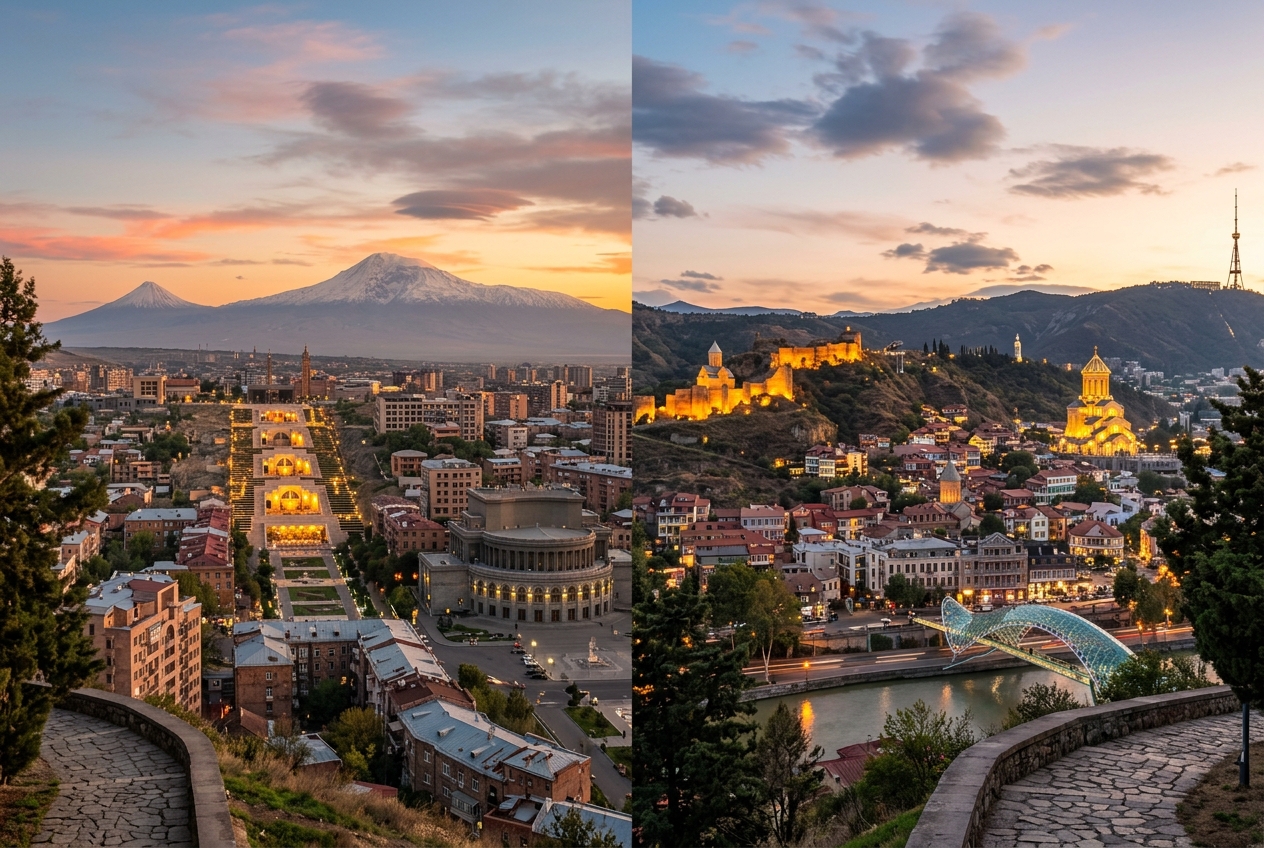
Two small capitals separated by a five-hour drive, sitting on opposite sides of a volcanic plateau, yet constantly compared by every backpacker, digital nomad, and culture junkie who passes through the South Caucasus. The question of whether Yerevan is better than Tbilisi has become one of the great travel debates of the region, and honestly, the answer depends entirely on what kind of traveler you are. I’ve spent extended time in both cities, and each one grabbed me in a completely different way. Yerevan felt like a long conversation with a philosopher over Armenian brandy. Tbilisi felt like stumbling into a party you didn’t know you were invited to but never wanted to leave. Both are affordable, both are safe, and both punch far above their weight in food, history, and atmosphere. But they deliver those things through very different personalities, and understanding those differences is what this comparison is really about. Georgia pulled in 7.8 million travelers in 2025, a 5.9% increase over the previous year, while Armenia saw 2.26 million foreign tourists, up 2.5%. The gap in raw numbers tells a story, but not the whole story.
The Rivalry of the Caucasus: Comparing Yerevan and Tbilisi
The comparison between these two cities isn’t new, but it’s intensified as both countries have leaned into tourism as economic engines. Georgia has been more aggressive in marketing itself, and the results show. Tbilisi has been ranked as the world’s second most trending travel destination for 2026, which is a staggering achievement for a city most Westerners couldn’t locate on a map fifteen years ago. Yerevan, by contrast, has grown more quietly, attracting a different kind of visitor: one drawn by the Armenian diaspora, ancient monasteries, and a culture that feels less touched by globalization.
The rivalry, if you can call it that, is mostly friendly. Armenians and Georgians share deep historical ties, overlapping cuisines, and a mutual understanding of what it means to be a small nation wedged between empires. But travelers inevitably compare them, and the two cities do compete for the same pool of Caucasus-curious visitors. Where Tbilisi has embraced a cosmopolitan, party-friendly identity, Yerevan has doubled down on its identity as a city of memory, art, and intellectual depth. Neither approach is wrong, but they attract different people.
One travel writer captured it well: Tbilisi is “Caucasus-lite,” easy and enjoyable for most visitors, while Yerevan offers a deeper cultural experience that creates a stronger emotional connection. That distinction has been consistent with what I’ve heard from dozens of travelers who’ve done both. Tbilisi is the city you recommend to everyone. Yerevan is the city you recommend to the right person.
Urban Atmosphere and Architectural Identity
The Pink Tufa and Soviet Grandeur of Yerevan
Yerevan’s visual identity hits you immediately. The city is built from pink and orange volcanic tufa stone, giving it a warm, almost rose-tinted glow in the afternoon sun. The central core was redesigned in the 1920s by architect Alexander Tamanyan, who envisioned a city radiating outward from Republic Square in concentric rings. The result is a capital that feels planned and monumental, with wide boulevards, Soviet-era institutional buildings, and an unmistakable sense of civic pride.
Walking through the Cascade, a massive limestone stairway decorated with contemporary sculptures and overlooking Mount Ararat on clear days, you feel the tension between old and new Armenia. The mountain itself sits across the border in Turkey, a constant, poignant reminder of the Armenian Genocide and the land that was lost. This undercurrent of historical weight gives Yerevan a seriousness that’s hard to find in other party-friendly capitals.
The Soviet architectural layer is impossible to ignore: brutalist apartment blocks, the circular Yerevan Opera Theatre, and wide ceremonial streets designed for parades. But unlike some post-Soviet cities where this feels oppressive, Yerevan has softened its Soviet bones with sidewalk cafes, public art, and a thriving gallery scene. The Vernissage open-air market, sprawling across the city center on weekends, sells everything from handmade duduk flutes to Soviet-era memorabilia.
The Bohemian Charm and Old World Alleys of Tbilisi
Tbilisi is architecturally chaotic in the best possible way. The Old Town is a tangle of narrow streets, crumbling wooden balconies, and courtyards where grapevines climb over doorways. Art Nouveau facades sit next to Persian-influenced bathhouses, which sit next to Soviet apartment blocks, which sit next to glass-and-steel modernist structures like the Bridge of Peace. The city looks like every empire that ever controlled it left a building behind and nobody bothered to tear any of them down.
This layered, organic quality gives Tbilisi a bohemian energy that Yerevan doesn’t quite match. The Fabrika hostel complex, a converted Soviet sewing factory in the Marjanishvili district, has become a symbol of the city’s creative scene: coworking spaces, craft beer bars, and design studios all crammed into one industrial courtyard. Street art covers entire building facades in neighborhoods like Vera and Sololaki.
The sulfur baths in the Abanotubani district are genuinely worth the hype. Soaking in a private domed bathhouse, getting scrubbed down by a burly attendant, and walking out into cobblestone streets feels like time travel. Tbilisi wears its history more casually than Yerevan, and that lightness is part of its appeal.
Culinary Landscapes and Nightlife Culture
Armenian Hospitality: Lavash, Khorovats, and Brandy
Armenian food is deeply traditional and doesn’t try to be trendy. Khorovats, the Armenian style of barbecue, is a weekend ritual: pork or lamb grilled over open flame, served with flatbread lavash, fresh herbs, and pickled vegetables. Meals are communal events, and refusing seconds is practically an insult. The phrase “hats u jur” (bread and water) is used to describe basic sustenance, but even basic meals in Armenia are prepared with a care that borders on devotion.
Armenian brandy, or konyak, deserves special mention. The Ararat Brandy Factory has been producing since 1887, and a bottle of their 10-year Akhtamar is one of the best souvenirs you can bring home. The brandy culture is so embedded that Winston Churchill reportedly demanded a case of Armenian brandy be delivered to him at Yalta.
Yerevan’s nightlife is more subdued than Tbilisi’s. There are good bars, especially along the Northern Avenue and in the Cascade area, but the city’s evening rhythm tends toward long dinners with friends rather than club-hopping. If you want a 4 AM techno scene, Yerevan isn’t your city.
Georgian Feasts: Khinkali, Khachapuri, and Natural Wine
Georgian cuisine has exploded in global popularity, and for good reason. Khachapuri, the cheese-filled bread that comes in regional variations (Adjarian style with an egg and butter melting in the center is the showstopper), is one of the world’s great comfort foods. Khinkali, the soup dumplings you eat by grabbing the twisted top knob and biting into the broth-filled pocket, are addictive. A proper Georgian supra (feast) is orchestrated by a tamada, or toastmaster, who leads a structured series of toasts that can last hours.
The natural wine movement owes a massive debt to Georgia, where wine has been made in clay vessels called qvevri for over 8,000 years. Orange wines, amber wines, and unfiltered reds are available everywhere in Tbilisi, often for just a few lari per glass. Wine bars like Vino Underground and g.Vino have become pilgrimage sites for oenophiles.
Tbilisi’s nightlife is genuinely world-class. Bassiani, a techno club built in a former Soviet swimming pool beneath a football stadium, has been featured in international music publications and draws DJs from Berlin and London. The city’s club scene is deeply tied to its post-Soviet identity and LGBTQ+ activism, giving it a political edge that makes it more than just a party.
Cost of Living and Travel Logistics
Budgeting for Accommodation and Transport
Both cities are remarkably affordable by European standards, but there are meaningful differences. Tbilisi is reportedly about 10% cheaper than Yerevan across most categories, though this fluctuates with exchange rates and seasonal demand. A mid-range daily budget in Tbilisi runs around $40 to $60 USD, covering accommodation, food, transport, and a few activities. Yerevan is slightly higher, particularly for accommodation, where a decent Airbnb in the center runs $30 to $50 per night compared to $25 to $40 in Tbilisi.
| Category | Yerevan (USD/day) | Tbilisi (USD/day) |
|---|---|---|
| Budget accommodation | $15-25 | $10-20 |
| Mid-range meal | $8-15 | $6-12 |
| Local transport | $3-5 | $2-4 |
| Coffee | $2-3 | $1.50-2.50 |
| Beer (local) | $2-3 | $1.50-2.50 |
Both cities have cheap and reliable public transport. Tbilisi’s metro is small but functional, and Bolt and Yandex Go are the go-to ride-hailing apps. Yerevan also uses Yandex Go extensively, and taxis are cheap enough that many visitors skip the bus system entirely. Download Google Translate offline packs for Armenian and Georgian before you arrive: neither alphabet is Latin-based, and while younger people in both cities speak English, older generations default to Russian or their native language.
Accessibility and Regional Day-Trip Potential
Tbilisi wins on accessibility. Its international airport has direct flights from most major European and Middle Eastern hubs, and budget carriers like Wizz Air have made it reachable for under $100 from several European cities. Yerevan’s Zvartnots Airport has fewer direct connections, though this is improving.
Day trips from Tbilisi are exceptional. Mtskheta, the ancient capital and a UNESCO World Heritage Site, is 20 minutes away. The wine region of Kakheti, with its family-run wineries and qvevri cellars, is a 90-minute drive. You can reach the mountain town of Kazbegi and its iconic Gergeti Trinity Church in about three hours.
Yerevan’s day-trip options are equally stunning but different in character. Garni Temple, the only standing Greco-Roman colonnaded building in the former Soviet Union, sits an hour outside the city. The monastery of Geghard, carved into a cliff face, is nearby. Lake Sevan, one of the largest high-altitude freshwater lakes in the world, is about an hour’s drive and feels like a completely different country: windswept, quiet, and hauntingly beautiful.
Lifestyle, Safety, and Digital Nomad Suitability
Both cities are exceptionally safe. Violent crime against tourists is nearly nonexistent in either capital, and I’ve spoken with numerous solo female travelers who felt comfortable walking alone at night in both Yerevan and Tbilisi. Police in both countries are generally helpful and non-corrupt, a dramatic improvement from the early 2000s, particularly in Georgia after the Rose Revolution reforms of 2003.
For digital nomads, Tbilisi has a clear edge in infrastructure. Coworking spaces are plentiful: Impact Hub Tbilisi, Terminal, and the aforementioned Fabrika all offer reliable Wi-Fi and community events. Georgia’s one-year visa-free policy for most nationalities makes it absurdly easy to set up a base. The English proficiency among the post-2003 generation is solid, ranking higher than Armenia on the EF English Proficiency Index.
Yerevan’s nomad scene is smaller but growing. The city has fewer coworking options, though spaces like Impact Hub Yerevan and The Loft are popular. Armenia offers a similar visa-friendly approach, with most nationalities getting 180 days visa-free. Internet speeds in central Yerevan are good, though they can be spotty in older buildings.
One important note for both cities: avoid bringing up the Nagorno-Karabakh conflict casually in Armenia, and be sensitive about the 2008 Russia-Georgia war in Tbilisi. These are not abstract political topics for locals; they are lived experiences that have shaped families and communities.
The generational divide in both cities is worth understanding. Older Armenians and Georgians, educated during the Soviet era, speak fluent Russian and may have limited English. Younger residents, especially those under 35, are far more likely to speak English and engage with Western cultural reference points. This split affects everything from restaurant interactions to taxi negotiations.
Verdict: Which Capital Should You Choose?
The question of whether Yerevan or Tbilisi is “better” misses the point, but if you’re forced to choose one, here’s my honest take. Pick Tbilisi if you want an easy, fun, visually stunning city with world-class food, a thriving nightlife, and a well-developed tourist infrastructure. It’s cheaper, better connected, and more immediately accessible for first-time visitors to the region.
Pick Yerevan if you want something quieter, more introspective, and culturally intense. If ancient history, genocide memorials, and conversations about national identity over homemade mulberry vodka sound more appealing than techno clubs and Instagram-friendly balconies, Yerevan will reward you in ways Tbilisi can’t.
The ideal trip, honestly, includes both. They’re five hours apart by car, and the journey between them passes through some of the most beautiful terrain in the Caucasus. Give yourself at least four days in each city, and you’ll leave understanding why this region has quietly become one of the most compelling travel destinations on earth.