
Table of Contents
- Understanding Tbilisi’s October Climate
- Essential Clothing Layers for Variable Weather
- Footwear for Cobblestones and City Walks
- Dress Codes for Specific Tbilisi Activities
- Autumn Accessories and Packing Essentials
- Final Tips for Staying Comfortable in the City
October in Tbilisi is one of those months that rewards travelers who pack thoughtfully and punishes those who don’t. The city sits in a valley surrounded by hills, which means weather patterns shift quickly, and a sunny morning on Rustaveli Avenue can turn into a chilly, drizzly afternoon by the time you reach the sulfur baths. Having spent multiple autumns walking these streets, I can tell you that figuring out what to wear in Tbilisi in October comes down to understanding the city’s specific quirks: its microclimates, its cultural expectations, and the reality that you’ll be walking far more than you planned. Georgian hospitality, or stumari ghvtisaa (“the guest is from God”), means you’ll be invited into homes, churches, and restaurants where your outfit choices genuinely matter. This guide covers the practical details: temperatures, layering strategies, footwear for those famously uneven cobblestones, and the dress codes nobody tells you about until you’re standing at a monastery entrance being handed a wrap skirt.
Understanding Tbilisi’s October Climate
Tbilisi’s autumn is genuinely pleasant, but “pleasant” doesn’t mean predictable. The city’s location in the South Caucasus, sheltered by the Greater Caucasus Mountains to the north, gives it a humid subtropical climate that behaves differently from other cities at similar latitudes. October marks the transition from the last warm days of late summer into a distinctly cooler period, and the shift can happen within a single week.
Daytime temperatures typically hover between 14°C and 22°C (57°F to 72°F) in early October, dropping to 8°C to 16°C (46°F to 61°F) by month’s end. Nights get noticeably cold, especially if you’re staying in the Old Town (Kala) where narrow streets channel wind off the Mtkvari River. Rain is moderate but real: expect around 40 to 55 mm of precipitation spread across 7 to 9 rainy days. The rain tends to come in short bursts rather than all-day downpours, which is good news for sightseeing but means you should always have rain protection within arm’s reach.
Average Temperatures and Precipitation Table
| Period | Avg High (°C/°F) | Avg Low (°C/°F) | Rainfall (mm) | Rainy Days |
|---|---|---|---|---|
| Oct 1-10 | 22 / 72 | 12 / 54 | 12-18 | 2-3 |
| Oct 11-20 | 18 / 64 | 10 / 50 | 14-20 | 2-3 |
| Oct 21-31 | 15 / 59 | 7 / 45 | 15-20 | 3-4 |
These numbers come from averaged meteorological data for Tbilisi, and 2026 forecasts align closely with recent years. One thing the table doesn’t capture is humidity: mornings can feel damp and raw even when temperatures seem moderate on paper.
The Transition from Early to Late October
Early October still carries residual summer warmth. You might find yourself comfortably eating khinkali on a restaurant terrace in a light shirt at 7 PM. The Dry Bridge Market is still buzzing, and locals are wearing everything from t-shirts to light sweaters, making it hard to gauge what’s appropriate.
By mid-October, the shift becomes unmistakable. Leaves on the plane trees along Chavchavadze Avenue turn golden, and the evening air develops a bite that catches tourists off guard. I’ve watched visitors shivering outside Fabrika in thin jackets, clearly not expecting temperatures to drop 10 degrees between afternoon and evening.
Late October is firmly autumn. Morning fog sometimes settles in the valley, burning off by mid-morning but keeping early risers cold. If you’re planning day trips to Mtskheta or Jvari Monastery during this period, add another layer: those hilltop sites are exposed and windy. The temperature difference between central Tbilisi and an elevated monastery 20 kilometers away can be 4 to 6 degrees.
Essential Clothing Layers for Variable Weather
The layering principle isn’t just a travel cliché for Tbilisi in October: it’s genuinely the only strategy that works. You’ll start mornings cool, warm up during midday walks through Abanotubani, and then need warmth again as the sun dips behind Mtatsminda. A rigid outfit won’t cut it.
Think in three tiers: a breathable base, a flexible mid-layer, and a protective outer shell. The goal is to add or remove pieces without carrying a massive bag. Tbilisi is a walking city, and you’ll resent every unnecessary item stuffed in your daypack by the time you’ve climbed up to Narikala Fortress.
Lightweight Base Layers and Mid-Layers
For base layers, merino wool or synthetic moisture-wicking fabrics outperform cotton in every scenario. Cotton absorbs sweat and rain, leaving you clammy during those uphill walks through Sololaki. A long-sleeve merino top works as a standalone piece on warmer early-October days and as a base layer when temperatures drop later in the month.
Mid-layers are where you have the most flexibility. A lightweight fleece, a wool sweater, or a thin down vest all work well. I personally favor a merino crew-neck sweater because it looks presentable enough for a nice dinner in the Vera neighborhood while still functioning as insulation under a jacket. Georgian restaurants, even upscale ones, tend toward a smart-casual vibe rather than formal dress codes, so a clean sweater reads perfectly.
Avoid bulky hoodies as your primary mid-layer. They’re fine for casual wandering, but they don’t compress well in a bag, and they look out of place if you’re invited to a supra (traditional Georgian feast). A structured cardigan or zip-up knit gives you the same warmth with more versatility.
Outerwear: Trench Coats and Leather Jackets
Your outer layer is the single most important packing decision for October in Tbilisi. Two options dominate among both locals and well-prepared visitors: trench coats and leather jackets.
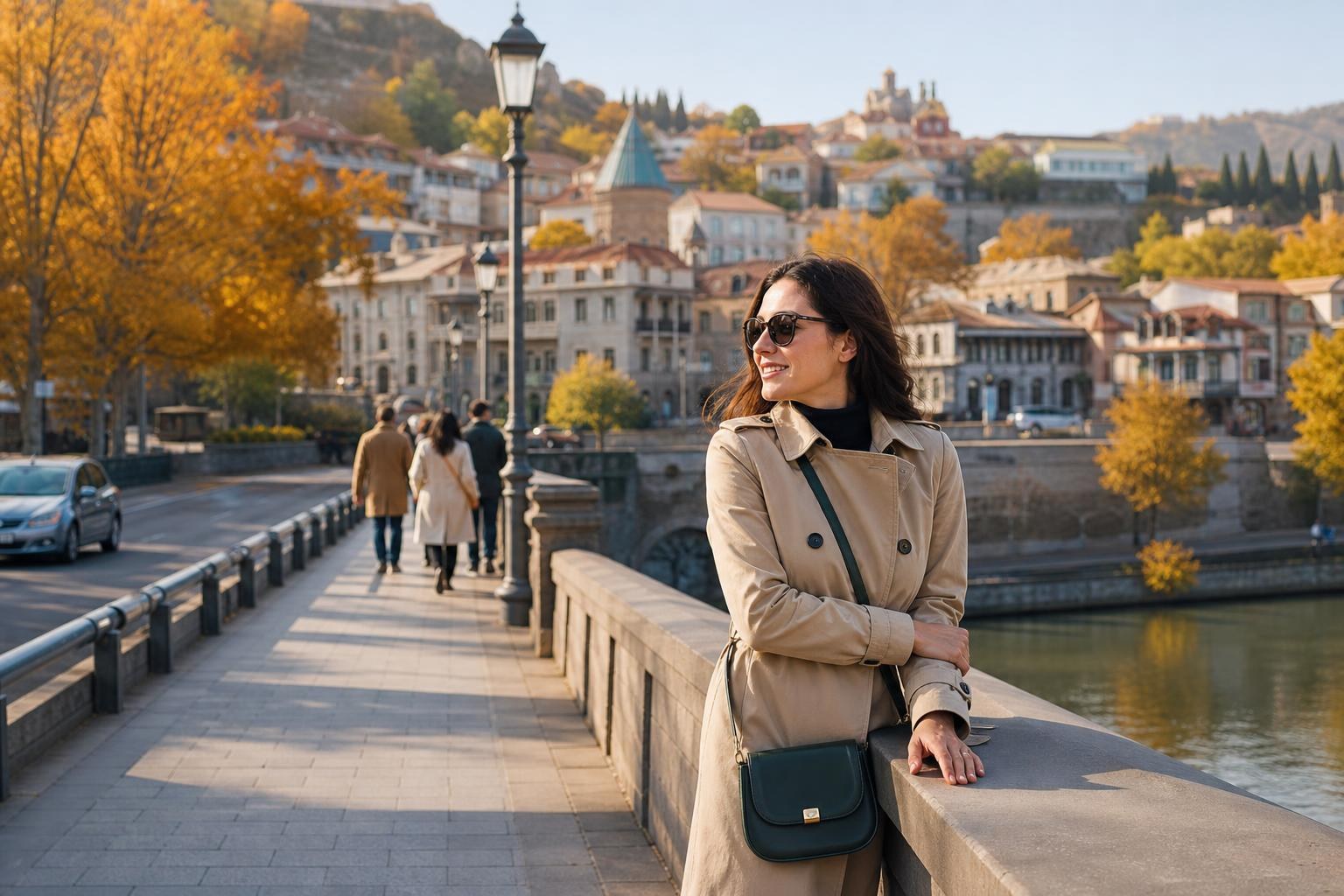
A classic trench coat handles light rain, blocks wind, and looks sharp on Tbilisi’s streets. Georgian fashion leans European, and a trench fits right in whether you’re browsing the galleries on Atoneli Street or having natural wine at a bar in Mtatsminda. Look for one with a removable liner if you want maximum flexibility.
Leather jackets are everywhere in Tbilisi. The city has a strong leather-goods tradition, and you’ll find excellent options at local shops along Leselidze Street for 150 to 400 GEL (roughly $55 to $150 USD). A well-fitted leather jacket handles wind and light drizzle, and it packs a visual punch that aligns with Tbilisi’s aesthetic. If you’re considering buying one locally, the quality of Georgian leather goods is genuinely impressive, particularly from smaller workshops in the Old Town.
Whatever you choose, make sure it has a hood or pair it with a compact umbrella. The short rain bursts I mentioned earlier don’t justify a full rain shell, but getting caught without any coverage on the Metekhi Bridge is miserable.
Footwear for Cobblestones and City Walks
This is where most visitors get it wrong, and I say this from experience after watching a friend destroy a pair of ballet flats on day one. Tbilisi’s Old Town is built on uneven cobblestones, cracked sidewalks, and steep hills. The path up to Narikala Fortress involves loose gravel. The steps near the Abanotubani sulfur baths are slippery when wet. Thin-soled shoes and heels are a genuine hazard.
Your primary shoes should be comfortable ankle boots or sturdy walking shoes with good grip. Leather ankle boots are ideal because they handle the cobblestones, look appropriate for restaurants and churches, and protect your feet from puddles during rain. Women and men alike can find excellent options at Ecco or local shoe shops near the Dezerter Bazaar, where quality leather boots run 200 to 350 GEL ($75 to $130).
If you want a second pair, pack lightweight sneakers for casual days or longer walks along the Mtkvari River embankment. White sneakers are popular among Tbilisi’s younger crowd and work fine for flat terrain. Just don’t rely on them as your only footwear.
Sandals are a mistake in October. Even during warmer early-October days, evenings get cold enough that exposed feet become uncomfortable. And if you’re visiting any churches, sandals can feel disrespectful, especially in more rural monasteries outside the city.
One practical tip: break in your shoes before the trip. Tbilisi rewards 15,000 to 20,000 step days, and blisters from new boots will ruin your plans faster than any weather surprise.
Dress Codes for Specific Tbilisi Activities
Tbilisi is more relaxed than many travelers expect, but it’s not uniformly casual. The city exists at an interesting intersection: a young, creative population that dresses in contemporary European styles alongside deeply traditional cultural institutions with clear expectations. Knowing where you’re going determines what you should put on.
Visiting Orthodox Churches and Monasteries
This is non-negotiable and catches tourists off guard constantly. Georgian Orthodox churches, including the stunning Holy Trinity Cathedral (Sameba) and the ancient Anchiskhati Basilica, require modest dress for both men and women.
Women must cover their heads and shoulders, and skirts or dresses should fall below the knee. Many churches provide wrap skirts and headscarves at the entrance, but the quality varies and they’re shared among hundreds of visitors daily. Carrying your own lightweight scarf solves both problems: wrap it around your head inside churches and drape it over your shoulders when entering. A long, flowy skirt that rolls up small is worth packing if you plan to visit multiple religious sites.
Men need long pants (no shorts) and should remove hats before entering. Sleeveless shirts are frowned upon. A simple long-sleeve button-up or crew-neck sweater meets the standard easily.
If you’re planning a day trip to Jvari Monastery or David Gareja, these rules apply even more strictly. Rural monasteries are active religious communities, not tourist attractions, and dressing appropriately shows respect for the monks and pilgrims you’ll encounter.
Dining Out in the Vera and Vake Neighborhoods
Vera and Vake are Tbilisi’s most fashionable dining districts, and the restaurant scene here has matured significantly. Places like Shavi Lomi, Cafe Littera, and the wine bars along Ietim Gurji Street attract a well-dressed local crowd, especially on weekend evenings.
The dress code is smart-casual rather than formal. Dark jeans or tailored trousers paired with a nice sweater or blouse work perfectly. You don’t need a blazer or cocktail dress, but showing up in hiking gear or athletic wear will feel conspicuous. Georgians dress up for dinner as a form of social respect, and matching that energy, even modestly, goes a long way.
For men, a clean pair of chinos, leather shoes, and a collared shirt or quality knit is the sweet spot. For women, a midi dress with ankle boots or tailored pants with a silk top fits the atmosphere. The key is looking intentional without being overdressed.
Casual neighborhood spots and the street food stalls around Machakhela or near the Dezerter Bazaar have zero dress expectations. Eat your lobiani in whatever you’re wearing.
Autumn Accessories and Packing Essentials
The right accessories separate a comfortable October trip from a frustrating one. Here’s what actually earns its place in your bag:
- A medium-weight scarf: doubles as church head covering, warmth layer, and style piece. Wool-blend or cashmere works best. You can find beautiful Georgian wool scarves at the Dry Bridge Market for 30 to 80 GEL ($11 to $30).
- A compact umbrella: those afternoon rain bursts are real. Skip the full-size version and get a travel umbrella that fits in a day bag.
- Sunglasses: October sun in Tbilisi is lower on the horizon and hits your eyes differently than summer. You’ll want them, especially on the Metekhi Bridge or the cable car to Mtatsminda Park.
- A crossbody bag or small backpack: Tbilisi is safe by regional standards, but petty pickpocketing exists in tourist-heavy areas. Keep your belongings close and accessible.
- Thin gloves for late October: if you’re visiting during the last week, early mornings and evenings can dip below 8°C. A pair of lightweight knit gloves takes up zero space and saves your hands.
- A reusable water bottle: tap water in Tbilisi is safe to drink and tastes good. Staying hydrated while walking hilly streets matters more than people realize.
Skip the heavy winter gear. You won’t need a puffy down jacket, thick scarves, or thermal underwear unless you’re heading into the mountains beyond the city. For Tbilisi proper, the items above cover your needs.
One digital essential worth mentioning: download the Bolt app before arrival. Taxis in Tbilisi are cheap (most rides within the center cost 5 to 10 GEL, roughly $2 to $4), and having Bolt means you won’t need to negotiate with drivers on rainy evenings when you’d rather not walk.
Final Tips for Staying Comfortable in the City
Packing for Tbilisi’s October weather is really about accepting variability and planning for it rather than hoping for the best. The city rewards flexibility: the traveler in a layered outfit with good boots and a scarf will enjoy the day regardless of whether it’s 20°C and sunny or 10°C and drizzling.
A few closing thoughts from someone who’s made every mistake on this list. First, check the forecast for your specific dates before finalizing your bag. Early October and late October are practically different seasons. Second, leave room in your luggage. Tbilisi has incredible shopping, from vintage finds at the Dry Bridge Market to handmade leather goods and Georgian wool products. You will buy things.
Third, prioritize comfort over fashion for daytime and save your nicer pieces for evening. Nobody on the steep path to Narikala cares what you’re wearing, but a well-chosen outfit at a Vera wine bar makes the evening feel special. This autumn guide for dressing in Tbilisi boils down to one principle: dress in pieces you can add, remove, and mix throughout the day, and you’ll handle anything October throws at you. The city itself does the rest.