
Table of Contents
- Strolling the Iconic Batumi Boulevard
- Exploring Old Batumi and European Squares
- Natural Wonders and Botanical Beauty
- Culinary Experiences and Adjarian Flavors
- Day Trips and Coastal Adventures
- Practical Travel Information for Visitors
- Your Best Days in Batumi
Batumi sits on the eastern shore of the Black Sea, tucked into a subtropical corner of Georgia that most Western travelers still haven’t discovered. That’s changing fast. The city’s international airport handled 1.23 million passengers in 2025, a 29% jump from the year before, and 2026 numbers are tracking even higher. What draws people here is a strange and wonderful collision: Ottoman-era mosques next to glass skyscrapers, Soviet-era parks beside Italian-style piazzas, and a coastline where you can swim in the morning and hike through a cloud forest by lunch. Whether you’ve got three days or three weeks, Batumi city rewards the curious. This guide covers the places, food, and practical details that actually matter, based on what I’ve seen work for travelers who come here and immediately start extending their stays.
Strolling the Iconic Batumi Boulevard
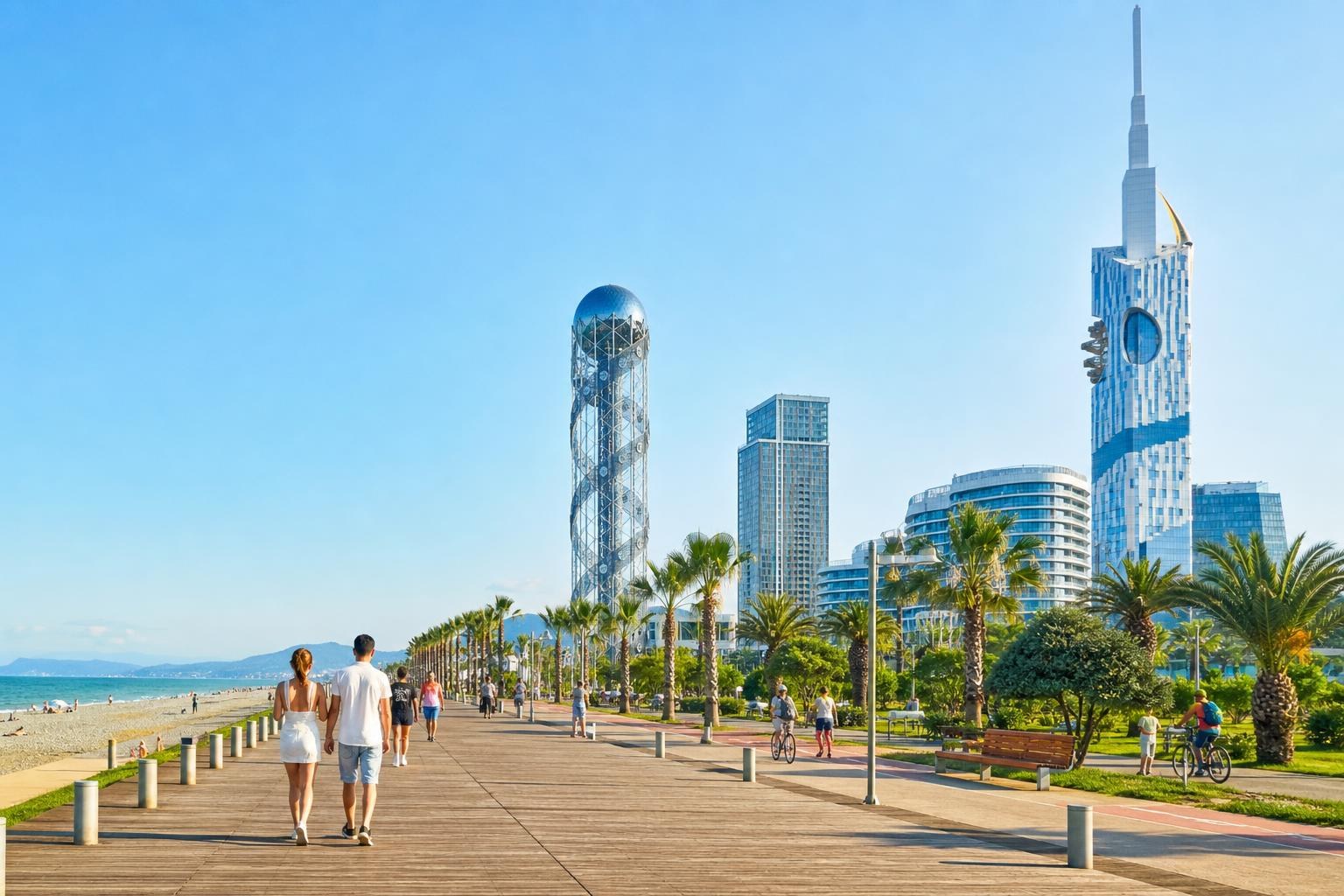
The Batumi Boulevard is the city’s spine, a seven-kilometer promenade that stretches along the coast and connects nearly every major attraction. It was originally laid out in 1884 during the city’s first oil boom, and it’s been expanded multiple times since. The most recent additions pushed it south toward the newer resort district, where gleaming towers and casino hotels have sprung up over the past decade.
Walking the full length takes about 90 minutes at a relaxed pace, but most people spend half a day here because there’s so much to stop for. Rent a bicycle from one of the stations along the path (around 5 GEL per hour, roughly $1.80) or grab an electric scooter through the Bolt app. The boulevard is wide enough that cyclists, joggers, and strolling families coexist without chaos. Palm trees line both sides, and in summer the subtropical humidity makes the sea breeze feel like a reward you’ve earned.
The Dancing Fountains and Ali & Nino Statue
The musical fountain show near the center of the boulevard runs nightly from May through October, usually starting around 9 PM. It’s free, it’s genuinely impressive, and locals treat it like a social event. Grab a bench early or watch from one of the nearby cafés.
A few hundred meters south, the Ali and Nino statue has become Batumi’s most photographed landmark. Two metal figures, each about eight meters tall, rotate toward and through each other every ten minutes, representing the doomed lovers from Kurban Said’s 1937 novel. The symbolism of two cultures meeting and passing through one another hits differently here, in a city that has been Ottoman, Russian, and Georgian across a single century.
Alphabetic Tower and Panoramic Views
The Alphabetic Tower rises 130 meters and is impossible to miss from anywhere on the boulevard. Its design celebrates the Georgian alphabet, one of only 14 unique writing systems still in use worldwide. The exterior features 33 enormous letters spiraling up the structure.
There’s a rotating observation deck and restaurant at the top. Tickets cost about 15 GEL (around $5.50). Go at sunset if you can manage the timing: the view stretches across the entire bay, with the Caucasus foothills visible to the east on clear days. I’d skip the restaurant food (it’s overpriced and mediocre) but the coffee is fine, and you’re really paying for the panorama.
Exploring Old Batumi and European Squares
Step a few blocks inland from the boulevard and the mood shifts entirely. Old Batumi is a grid of narrow streets lined with wooden balconied houses, many of them restored, some still crumbling in that photogenic way that makes you reach for your camera. This neighborhood predates the modern city’s glass-and-steel ambitions by over a century, and it’s where you’ll find the best street food, the most interesting shops, and the kind of lived-in character that resort districts can’t manufacture.
The area between the two main squares covers roughly six blocks and is entirely walkable. Street vendors sell churchkhela (walnut strings dipped in grape juice and dried) for 2-3 GEL apiece. You’ll hear Turkish, Russian, Georgian, and increasingly English as you wander. The contrast with the flashy waterfront is part of what makes Batumi so interesting: it doesn’t try to be just one thing.
Piazza Square: An Italian Escape
Piazza Square was built in 2009 and modeled after Italian Renaissance plazas. That sounds like it could be tacky, and honestly, the concept raised eyebrows when it was announced. But the execution works. The mosaic tilework, the clock tower, and the arched colonnades create a genuinely pleasant space where people linger over espresso and wine.
Live music plays most evenings in summer. The restaurants ringing the square are tourist-priced but not outrageously so: expect to pay 25-40 GEL ($9-15) for a main course. For cheaper eats, duck into the side streets just behind the square where local restaurants serve khachapuri Acharuli (the boat-shaped cheese bread that originated in this region) for 8-12 GEL.
Europe Square and the Medea Statue
Europe Square sits a short walk north and has a completely different energy. It’s larger, more open, and anchored by the Medea statue, a golden figure holding the Golden Fleece atop a tall column. The reference is to the ancient Greek myth of Jason and the Argonauts, which is set in Colchis, the ancient name for this part of Georgia. The statue is a deliberate statement: Batumi is European, and its roots go back to the very origins of European mythology.
The square hosts concerts and public events throughout summer. The surrounding buildings are an eclectic mix of neoclassical and Art Nouveau facades, many of them restored government buildings. At night, the illuminated fountain and the Medea statue give the whole space a theatrical quality that photographs beautifully.
Natural Wonders and Botanical Beauty
Batumi’s subtropical climate produces vegetation you won’t find anywhere else in Georgia, or in most of Europe for that matter. The city receives over 2,500 millimeters of rainfall annually, making it one of the wettest places on the continent. That moisture feeds everything from bamboo groves to citrus orchards, and the city has turned its natural abundance into genuine attractions worth your time.
Batumi Botanical Garden
Located nine kilometers north of the city center, the Batumi Botanical Garden covers 111 hectares across a hillside overlooking the sea. Founded in 1912, it houses over 5,000 plant species organized into geographic zones: Japanese, Himalayan, Australian, Mexican, and more. The garden isn’t a manicured European affair; it feels closer to a managed jungle, with winding paths that dip through ravines and climb to viewpoints.
Admission is 15 GEL. Budget at least three hours, more if you’re a plant person. The garden has its own beach at the bottom of the hill, accessible by a long staircase, where you can swim after your walk. Marshrutka (minibus) number 31 runs from the city center and drops you at the main entrance. A taxi costs about 15-20 GEL each way.
Dolphinarium and 6 May Park
Six May Park sits in the heart of the city and functions as Batumi’s green lung. It’s home to a small lake, a zoo (modest but free), and the Batumi Dolphinarium. The dolphin shows run several times daily in summer and cost about 20 GEL for adults. Opinions on dolphinariums vary, but the facility is well-maintained and the animals appear healthy.
The park itself is a pleasant place to spend an hour, especially if you’re traveling with kids. There are pedal boats on the lake, a small Ferris wheel, and plenty of shaded benches. It’s also where you’ll see local life most clearly: grandparents playing backgammon, teenagers sharing sunflower seeds, families picnicking on the grass. This is where Batumi feels least like a tourist destination and most like a city where people actually live.
Culinary Experiences and Adjarian Flavors
Adjara, the region Batumi belongs to, has its own distinct culinary identity within Georgian cuisine. The star is khachapuri Acharuli, that boat-shaped bread filled with cheese, butter, and a raw egg that you stir together at the table. Every restaurant serves it, but the best versions come from places where the dough has been hand-stretched and baked in a tone (traditional clay oven). I’ve had memorable ones at Retro on Gorgiladze Street and at Old Boulevard near the port.
Beyond khachapuri, look for borano (a rich cheese-and-butter dish served bubbling hot), sinori (rolled cottage cheese crepes in walnut sauce), and iakhni (beef stew with walnut and herb paste). The Adjarian palate leans heavier on dairy and walnuts than the rest of Georgia, and portions are enormous.
Fish is fresher here than in Tbilisi, obviously. Grilled barabulka (red mullet) and trout are common on menus along the boulevard. A full meal with wine at a mid-range restaurant runs 30-50 GEL per person ($11-18). At a local canteen-style spot, you can eat well for under 15 GEL.
The city’s wine scene deserves a mention too. While Adjara isn’t Georgia’s primary wine region, several bars along Parnavaz Mepe Street pour excellent natural wines from Kakheti and Imereti. A glass of good qvevri wine costs 8-15 GEL, which is still absurdly cheap by European standards. The bar Vinyl, near Piazza Square, has one of the better selections and stays open late.
Day Trips and Coastal Adventures
Batumi works brilliantly as a base for exploring the wider Adjara region. The coastline stretches in both directions, and the mountains begin just 20 kilometers inland. Most day trips can be done by marshrutka, taxi, or organized tour, though renting a car (from about 80 GEL per day) gives you the most flexibility.
The Machakhela National Park, about an hour’s drive east, offers hiking through old-growth forest and visits to medieval arched bridges. Sarpi, on the Turkish border 15 kilometers south, has a dramatic cliff-side beach and a border crossing that’s surprisingly casual if you want to pop into Turkey for lunch. The mountain village of Khulo, reachable by a spectacular road through the Lesser Caucasus, has a functioning cable car that locals use as actual transportation across a gorge.
Gonio-Apsaros Fortress
Twelve kilometers south of Batumi, the Gonio Fortress is one of the oldest fortifications in Georgia, dating to the 1st century AD when it served as a Roman castrum. The massive stone walls are remarkably intact, and a small museum inside displays artifacts from Roman, Byzantine, and Ottoman periods.
Admission is 3 GEL. The site takes about an hour to explore. What makes it special isn’t just the age but the layers: you can literally see where Roman construction ends and Ottoman additions begin. Local legend claims the Apostle Matthias is buried within the fortress walls, though archaeological evidence is inconclusive. A marshrutka from Batumi’s bus station takes about 20 minutes.
Argo Cable Car Ride
The Argo Cable Car departs from near the port and climbs to the top of Anuria Mountain, 250 meters above sea level. The ride takes about 15 minutes each way and costs 25 GEL round trip. At the top, there’s a viewing platform, a small café, and a hilltop fortress ruin.
The real draw is the view. On a clear day, you can see the entire Batumi skyline, the port, the botanical garden to the north, and Turkey’s coastline to the south. Go in the late afternoon for the best light. The cable car runs year-round but closes during high winds, so check conditions if you’re visiting in winter.
Practical Travel Information for Visitors
Getting to Batumi is straightforward. The international airport receives direct flights from Istanbul, Dubai, Tel Aviv, Warsaw, and several other cities, with connections expanding each season. From Tbilisi, the train takes about five hours and costs 25-35 GEL depending on class, while the bus takes six hours for about 30 GEL. The train is more comfortable and scenic, following the river valleys through western Georgia.
Accommodation ranges from $15-20 per night for a private Airbnb apartment in the old town to $80-150 for beachfront hotels. The hotel sector continues to grow, with bookings rising even during the off-season, a sign that Batumi is becoming a year-round destination rather than a purely summer one. For the best value, book apartments on Gorgiladze or Chavchavadze streets: you’ll be central, close to the boulevard, and surrounded by restaurants.
The city is compact enough that you rarely need transportation beyond your feet. When you do, Bolt works well and rides within the city rarely exceed 5-7 GEL. The local marshrutka system covers the wider area for 0.50 GEL per ride.
Georgian lari (GEL) is the currency, and ATMs are everywhere. Credit cards are accepted at most restaurants and shops, though market vendors and marshrutka drivers deal in cash only. English is spoken at hotels and tourist-facing businesses, but basic Georgian phrases (gamarjoba for hello, madloba for thank you) go a long way. The city is attracting increasing international investment in real estate and infrastructure, which means the tourist infrastructure improves noticeably from year to year.
Table: Best Time to Visit and Weather Data
| Month | Avg. High (°C) | Avg. Rainfall (mm) | Sea Temp (°C) | Crowd Level |
|---|---|---|---|---|
| January | 9 | 230 | 10 | Very Low |
| March | 13 | 160 | 11 | Low |
| May | 21 | 120 | 18 | Moderate |
| July | 28 | 180 | 25 | High |
| September | 25 | 250 | 24 | Moderate-High |
| November | 15 | 260 | 17 | Low |
Peak season runs from June through September, with July and August being the busiest (and most expensive). I’d argue May and September are the sweet spot: warm enough to swim, fewer crowds, and hotel prices drop by 30-40%. Winter visits suit those interested in the city’s cultural side, casino scene, and day trips to the mountains without the beach-holiday crowds.
Your Best Days in Batumi
Batumi is one of those places that consistently outperforms expectations. People arrive thinking they’ll spend two days and end up staying a week, drawn in by the food, the affordability, the strange beauty of a city that’s simultaneously ancient and brand new. The mix of old Adjarian culture with modern ambition creates something you won’t find elsewhere on the Black Sea coast.
Start with the boulevard and old town, eat your weight in khachapuri, take the cable car for the view, and leave at least one day for the botanical garden or Gonio Fortress. If you’re the type who travels to eat and wander rather than check boxes, this city will reward you. Flights from major hubs are frequent and increasingly affordable, so there’s never been a better time to book a trip and see what all the buzz is about.