
Table of Contents
- The Georgian Lari (GEL): An Overview
- Quick Reference: Currency Exchange and Value
- How and Where to Exchange Money in Tbilisi
- Using ATMs and Credit Cards in Georgia
- Practical Tips for Handling Cash in Georgia
- Your Lari, Your Trip
Georgia’s national currency catches many first-time visitors off guard. They land in Tbilisi expecting euros, dollars, or even Turkish lira, only to discover that this small Caucasus nation has its own distinct money with a surprisingly stable track record. The Georgian lari (currency code: GEL) has been the country’s sole legal tender since 1995, and understanding how it works before you arrive will save you real headaches at the airport exchange booth, in Tbilisi’s labyrinthine Old Town shops, and especially when you venture into the countryside where card readers are rare. I’ve watched travelers fumble through their first taxi ride from Tbilisi International Airport, unsure whether to hand over dollars or the colorful bills they just received from an ATM. That confusion is entirely avoidable. This guide covers everything from banknote denominations and exchange strategies to ATM fees and tipping etiquette, all grounded in 2026 prices and current realities on the ground. Whether you’re planning a weekend in Tbilisi or a month-long road trip through Svaneti, knowing how to handle the lari will make your trip smoother and cheaper.
The Georgian Lari (GEL): An Overview
The word “lari” translates roughly to “hoard” or “property” in old Georgian, and the currency symbol is ₾. Georgia introduced the lari in 1995 to replace the interim kupon currency, which had been ravaged by hyperinflation during the chaotic early post-Soviet years. Since then, the lari has matured into a reasonably stable currency, though it does fluctuate against the dollar and euro depending on tourism flows, remittances, and regional geopolitics.
As of mid-2026, one US dollar buys approximately 2.70 to 2.75 GEL, while one euro fetches around 3.00 to 3.10 GEL. These rates shift, so always check a live converter before your trip. The National Bank of Georgia sets monetary policy and has maintained inflation targets that keep the lari from wild swings, though the currency did weaken notably in 2020 and again briefly in late 2024.
Georgia’s economy has been growing steadily, driven by tourism, agriculture, and tech, which supports the lari’s relative strength in the region. The country processes over 7 million international visitors annually now, and that tourism revenue feeds directly into currency stability.
One thing that surprises people: you cannot easily spend US dollars or euros in Georgia. Unlike Turkey or Egypt, where shops might accept foreign currency informally, Georgian businesses almost universally deal in lari only. A few high-end hotels quote room rates in dollars or euros, but payment still converts to lari. Plan accordingly.
Banknotes and Coins in Circulation
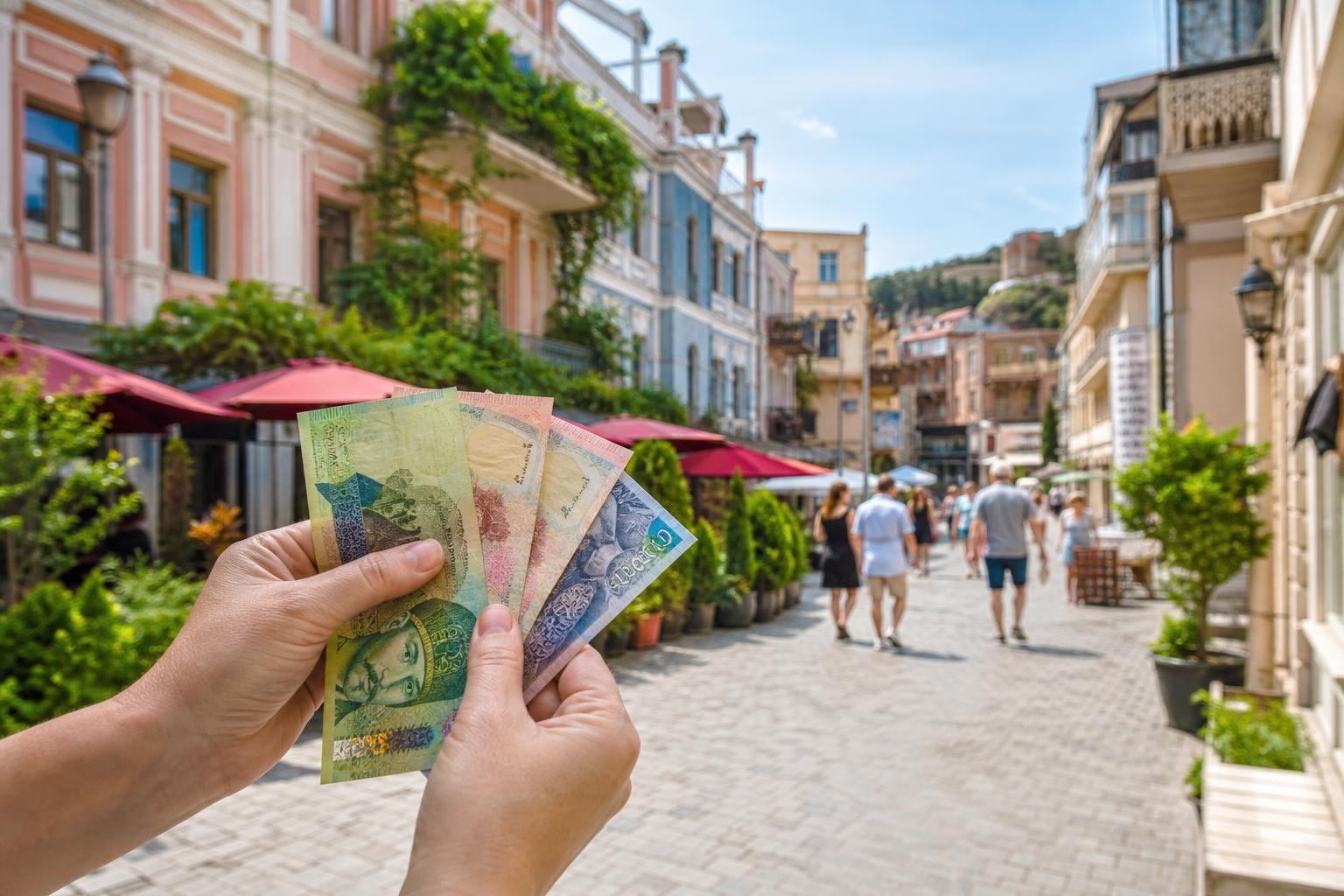
Georgian banknotes come in denominations of 5, 10, 20, 50, 100, and 200 lari. The 200 lari note is the largest and was introduced relatively recently. Each bill features a prominent Georgian historical or cultural figure: the 50 lari note, for instance, depicts Queen Tamar, the medieval ruler who presided over Georgia’s Golden Age.
The notes are colorful and distinct from one another, which makes them easy to sort even if you can’t read Georgian script. The 5 lari note is brown, the 10 is green, the 20 is blue, the 50 is purple-brown, the 100 is green-gray, and the 200 is a deep green. All notes include security features like watermarks, holographic strips, and microprinting. The newer series issued from 2016 onward have enhanced anti-counterfeit measures.
For daily spending in Tbilisi, you’ll handle 5, 10, and 20 lari notes most frequently. A 100 lari note (roughly $36-37 USD) can be awkward to break at small shops or marshrutka stops, so try to keep smaller bills on hand. The 200 lari note is even harder to use for everyday purchases.
The Tetri: Smaller Units of Currency
Like cents to the dollar, the lari divides into 100 tetri. Coins circulate in 1, 2, 5, 10, 20, and 50 tetri denominations, plus 1 and 2 lari coins. The word “tetri” means “white” in Georgian, a reference to silver coinage from centuries past.
You’ll encounter tetri constantly. A Tbilisi metro ride costs 1 lari (100 tetri), bread from a tone oven runs about 80 tetri to 1.50 lari, and street-side churchkhela (the candle-shaped walnut-and-grape candy) typically costs 2-3 lari. Tetri coins feel small and lightweight, and the 1 and 2 tetri pieces are almost comically tiny. Many locals round prices to the nearest 5 or 10 tetri in casual transactions, so don’t stress about having exact change down to the single tetri.
Quick Reference: Currency Exchange and Value
Getting a feel for what the lari actually buys is more useful than memorizing exchange rates. Georgia remains one of Europe’s most affordable destinations, though Tbilisi prices have crept upward since the post-2022 influx of Russian and Belarusian relocators pushed up rents and restaurant costs. Still, your money stretches far compared to Western Europe.
A practical mental shortcut for Americans in 2026: divide lari prices by roughly 2.7 to get the dollar equivalent. For Europeans, divide by about 3. A 27 lari restaurant meal? That’s $10. A 150 lari guesthouse room? About $55. Once this math becomes automatic, you’ll stop second-guessing every purchase.
Budget travelers can expect to spend around 80-120 GEL per day covering accommodation, food, transport, and basic sightseeing. Mid-range travelers typically land between 200-350 GEL daily. These numbers assume you’re eating at local restaurants rather than international chains and using marshrutkas or the metro instead of private transfers.
Table: Common Conversions and Typical Costs
| Item | Price in GEL | Approx. USD |
|---|---|---|
| Metro ride (Tbilisi) | 1 GEL | $0.37 |
| Khachapuri (cheese bread) at a café | 8-14 GEL | $3-5 |
| Local beer (0.5L, restaurant) | 5-8 GEL | $1.85-3 |
| Bottle of Georgian wine (shop) | 12-35 GEL | $4.50-13 |
| Taxi across Tbilisi (Bolt app) | 5-12 GEL | $1.85-4.50 |
| Budget hostel dorm bed | 25-45 GEL | $9-17 |
| Mid-range hotel room | 150-300 GEL | $55-110 |
| SIM card with data (30 days) | 15-25 GEL | $5.50-9 |
| Sulfur bath (private room, Abanotubani) | 40-100 GEL | $15-37 |
| 1 kg of peaches (summer market) | 2-4 GEL | $0.75-1.50 |
These prices reflect Tbilisi in 2026. Outside the capital, expect costs to drop 20-40% for accommodation and dining.
How and Where to Exchange Money in Tbilisi
Tbilisi makes currency exchange remarkably easy. Small exchange booths dot virtually every major street, and competition between them keeps rates honest. You won’t need to hunt for a place to swap dollars or euros for lari: the challenge is more about choosing the right spot.
The best exchange rates in Tbilisi cluster around Marjanishvili, Rustaveli Avenue, and the area near Liberty Square. These high-traffic zones have dozens of booths competing for business, and the rate differences between the best and worst can mean 5-10 tetri per dollar. On a $500 exchange, that gap translates to roughly 25-50 GEL, enough for a solid dinner.
Always bring crisp, undamaged bills. Georgian exchange booths are notoriously picky about the condition of foreign banknotes. A small tear, ink stain, or excessive creasing can get your bill rejected or exchanged at a penalty rate. Newer series US bills ($100 notes from 2013 onward) are preferred.
Currency Booths vs. Banks
Exchange booths (often labeled “Exchange” or “ვალუტა” in Georgian) are faster and usually offer better rates than banks. They charge no commission in most cases, and the posted rate is what you get. Transactions take under a minute: hand over your dollars or euros, receive lari, count it, done.
Banks like TBC Bank and Bank of Georgia also exchange currency but tend to offer slightly worse rates and require more paperwork. If you’re exchanging a large sum (over 3,000 GEL equivalent), banks might actually be preferable because they provide receipts and a paper trail. For amounts under that, street booths are the practical choice.
One important tip I always share: the exchange rate posted outside a booth should match what you receive inside. If a booth tries to apply a different rate once you’re at the counter, walk away. This bait-and-switch is rare in Tbilisi but not unheard of in tourist-heavy zones like the Old Town.
Exchange Rates at Tbilisi International Airport
The airport exchange counters at Shota Rustaveli Tbilisi International Airport offer noticeably worse rates than city-center booths: typically 3-7% less favorable. If you arrive with no lari at all, exchange only a small amount at the airport, enough for a taxi or Bolt ride into the city (around 20-30 GEL), then swap the rest downtown.
ATMs inside the airport terminal offer a better alternative to the exchange counter. They dispense lari directly from your bank account at the interbank rate, minus whatever fee your home bank charges. TBC Bank and Bank of Georgia ATMs are both available in the arrivals hall.
If you’re arriving late at night and worried about finding an exchange booth open, don’t be. Many Tbilisi booths operate until 10 or 11 PM, and some near major intersections run 24 hours. The city is accommodating in this regard.
Using ATMs and Credit Cards in Georgia
Georgia’s banking infrastructure has modernized significantly. The country’s two dominant banks, TBC Bank and Bank of Georgia, operate extensive ATM networks throughout Tbilisi and in most regional towns. Visa and Mastercard are widely accepted at restaurants, supermarkets, hotels, and shops in the capital.
Georgia has also been rolling out an instant payment system (IPS) that is reshaping how businesses and consumers handle transactions. While this primarily affects local bank-to-bank transfers, it signals a broader shift toward digital payments that benefits tourists indirectly through better point-of-sale infrastructure.
Contactless payments work at most Tbilisi establishments. Apple Pay and Google Pay function with Georgian payment terminals, though I’d recommend keeping a physical card as backup. Some older terminals only accept chip-and-PIN.
Card Acceptance in Tbilisi vs. Rural Areas
In Tbilisi, you can go days without touching cash if you stick to restaurants, cafés, supermarkets, and ride-hailing apps. The city’s tech-forward culture means even small coffee shops often accept cards.
Step outside Tbilisi, and the picture changes fast. In towns like Mestia, Stepantsminda (Kazbegi), or Sighnaghi, card acceptance is hit-or-miss. Family-run guesthouses, village shops, marshrutka drivers, and market vendors almost always deal in cash only. If you’re heading to Tusheti or Upper Svaneti, bring enough lari to cover your entire stay because ATMs may not exist or may be out of service.
A good rule: carry at least 100-150 GEL in cash per day when traveling outside major cities. This covers meals, accommodation deposits, and transport without leaving you stranded.
Withdrawal Fees and DCC Risks
Most Georgian ATMs charge a flat fee of 2-5 GEL per withdrawal (roughly $0.75-1.85). Your home bank will likely add its own foreign transaction fee on top, typically 1-3% of the withdrawal amount. To minimize fees, withdraw larger amounts less frequently rather than pulling out 50 GEL every day.
The bigger trap is Dynamic Currency Conversion (DCC). When an ATM asks whether you’d like to be charged in your home currency or in Georgian lari, always choose lari. Selecting your home currency lets the ATM operator set the exchange rate, and they invariably add a 3-7% markup. This applies to card payments at restaurants and shops too. If the terminal asks you to pay in dollars or euros instead of lari, decline and insist on lari.
I’ve seen travelers lose $20-30 on a single ATM withdrawal by accidentally accepting DCC. It’s the most common and most avoidable money mistake in Georgia.
Practical Tips for Handling Cash in Georgia
Cash remains king for a significant portion of Georgian daily life. Even in Tbilisi, you’ll encounter situations where only lari bills and coins work: paying for a shared taxi to Mtskheta, buying fruit at the Dezerter Bazaar, tipping your guide at a winery, or settling up at a family-run sakhli (house restaurant) in the countryside.
Keep your bills organized. Georgian lari notes are similar in size across denominations, and in dim restaurant lighting, it’s easy to hand over a 50 instead of a 5. I fold different denominations differently or keep large bills in a separate section of my wallet.
Carrying a mix of small and medium bills (5s, 10s, and 20s) makes life easier. Street vendors and marshrutka drivers often can’t break a 100 lari note, and asking them to do so holds up the line and creates awkwardness.
Tipping Culture and Small Change
Georgia doesn’t have the aggressive tipping culture you find in the US, but tips are appreciated and increasingly expected in tourist-facing businesses. Most Tbilisi restaurants do not add a service charge to the bill, so leaving 10-15% is a kind gesture that staff genuinely notice. In rural guesthouses, where the family often cooks and serves your meal personally, a tip of 10-20 GEL feels appropriate and is received warmly.
For taxi drivers using Bolt or Yandex Go, tipping isn’t expected but rounding up is common. If your ride costs 8.50 GEL, handing over 10 and saying “didi madloba” (thank you very much) is a nice touch. Tour guides and drivers on multi-day trips typically receive 20-50 GEL per day from each participant, depending on group size and service quality.
Keep small coins handy for church donation boxes. Georgian Orthodox churches are free to enter, but dropping a lari or two into the offering box is customary, especially if you light a candle.
Identifying Counterfeit or Damaged Notes
Counterfeit lari notes are uncommon but not nonexistent. The newer banknote series includes several security features that make fakes relatively easy to spot. Hold any note up to the light: you should see a clear watermark portrait and a continuous security thread. The holographic strip on 20, 50, 100, and 200 lari notes shifts color when tilted. If a note feels unusually smooth, thin, or waxy, that’s a red flag.
Damaged notes are a more practical concern. Georgian businesses will sometimes refuse bills with tears, heavy stains, or missing corners. If you receive a damaged note as change, try to spend it quickly at a larger establishment like a supermarket chain (Carrefour, Goodwill, or Nikora), which tends to be more lenient. Banks will also exchange damaged lari notes for fresh ones at no charge, though you may need to fill out a short form.
When receiving change from exchange booths, count your money before walking away. Mistakes happen, and they’re much easier to resolve on the spot than after you’ve left.
Your Lari, Your Trip
Getting comfortable with Georgia’s currency takes about a day. Once you’ve memorized the basic denominations, pulled cash from a TBC or Bank of Georgia ATM, and learned to decline DCC at every terminal, you’re set. The lari is straightforward, the exchange infrastructure in Tbilisi is excellent, and prices remain remarkably low compared to most of Europe.
My strongest recommendation: arrive with $100-200 in clean US bills or euros, exchange a small amount at the airport, withdraw lari from an ATM downtown, and keep a cash reserve for rural travel. Download the Bolt app for taxis, carry small bills for markets and marshrutkas, and always choose to pay in lari when a card terminal gives you the option.
Georgia rewards travelers who engage with its local systems rather than fighting them. The lari is part of that experience: a small, proud currency for a small, proud country. Handle it well, and your trip will be smoother for it.