
Table of Contents
- Planning Your Independent Rtveli 2026 Experience in Kakheti
- Understanding the Tradition: Picking, Pressing, and the Supra
- Best Regions and Timing for the Kakheti Wine Harvest
- Driving to the Georgia Grape Harvest: A Practical Guide
- How to Find Family Wineries That Welcome Harvest Guests
- Essential Safety: Alcohol and Road Rules in Wine Country
- A One-Day Self-Drive Rtveli Itinerary from Tbilisi
- What to Pack and How to Prepare for Vineyard Work
- Beyond the Grapes: Cultural Highlights During Rtveli
- Budgeting for Your Independent Kakheti Wine Tour
- Frequently Asked Questions About Rtveli Georgia
Every autumn, Georgia’s Kakheti region transforms into a hive of activity as families, neighbors, and strangers gather to pick grapes, stomp them in stone troughs, and celebrate with marathon feasts that can last until dawn. This is rtveli: the annual grape harvest that has shaped Georgian identity for over 8,000 years. If you’re an independent traveler with a rental car and a taste for hands-on cultural experiences, you can join in without booking an organized tour. The 2026 harvest season is shaping up to be historic: Georgia’s national harvest is forecast to exceed 320,000 tonnes, the largest since independence. Kakheti, where roughly 70% of the country’s grapes grow, is the epicenter. This guide covers the practical side of getting there by car, finding welcoming families, staying safe on wine-country roads, and making the most of a single day or an entire week in the vineyards.
Planning Your Independent Rtveli 2026 Experience in Kakheti
The harvest window in Kakheti typically runs from mid-September through mid-October, though the exact dates shift each year depending on weather and grape variety. White grapes like Rkatsiteli are usually picked first, followed by the red Saperavi a week or two later. For 2026, picking was already well underway by late September, with over 100,000 tonnes processed in Kakheti alone.
Planning independently means you control your schedule, but it also means doing your homework. You’ll want to identify a few family wineries or guesthouses in advance, confirm they’re harvesting during your visit dates, and sort out your transportation. A rental car gives you the most flexibility since villages with the best harvest experiences sit 10-30 km off the main highway, often on unpaved roads where marshrutkas don’t go.
Start reaching out to potential hosts at least two to three weeks before your trip. Many small producers announce their harvest dates on Facebook or Instagram, and a polite message in English (or better yet, Georgian with Google Translate’s help) usually gets a warm reply.
Understanding the Tradition: Picking, Pressing, and the Supra
Rtveli is not just agricultural labor. It is a social ritual with deep roots in Georgian Orthodox Christianity and pre-Christian wine culture. The word itself comes from the Georgian verb “rtvela,” meaning to harvest or gather.
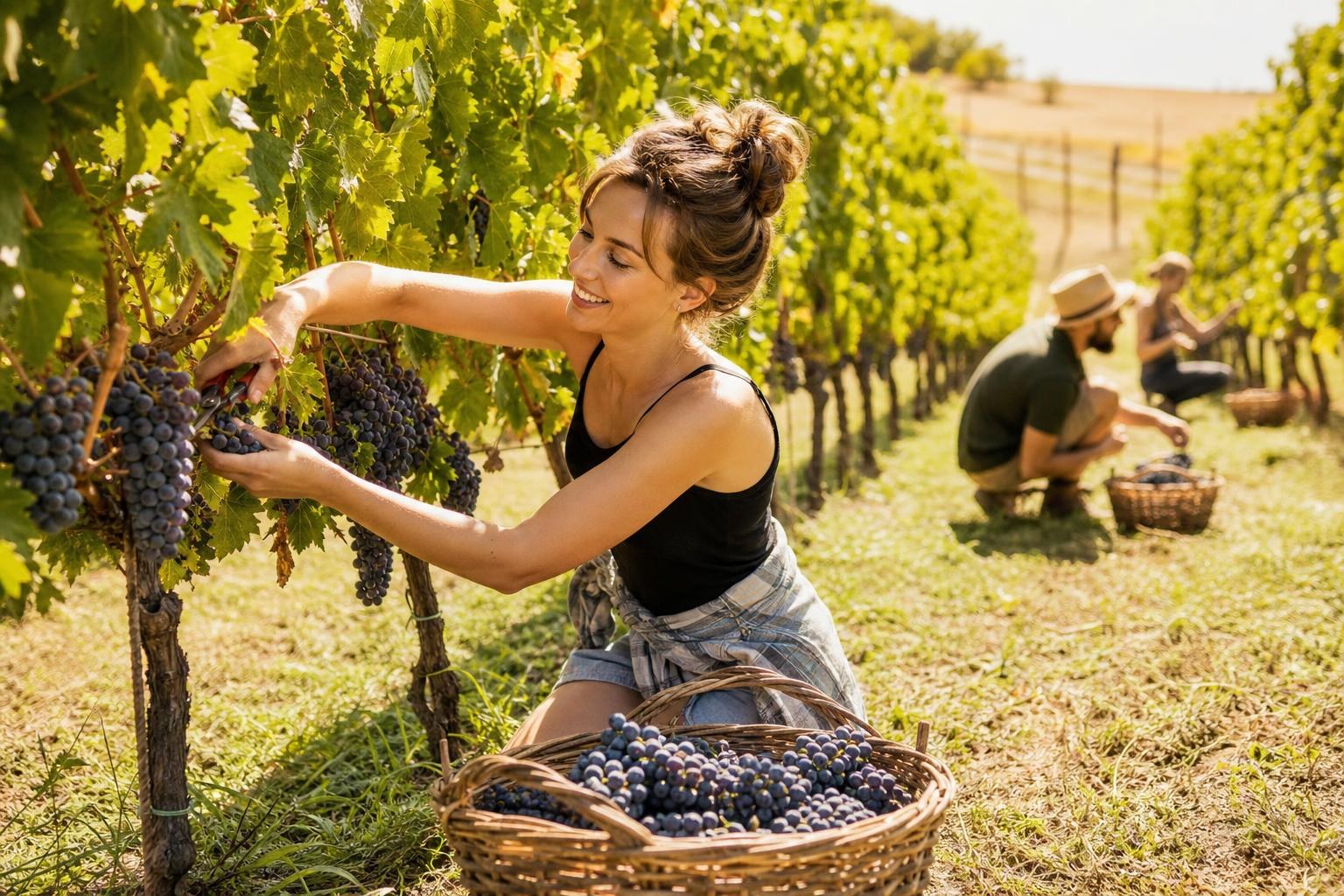
The process follows a rhythm that has barely changed in centuries. Families and friends gather in the vineyard at dawn, cutting grape clusters by hand with small curved knives called “natsvali.” The harvested grapes are carried in baskets to the marani, the wine cellar, where they’re dumped into a satsnakheli: a long, shallow stone or wooden trough. Someone, often a guest of honor, climbs in barefoot and begins pressing the grapes by stomping.
The pressed juice, skins, and stems flow into qvevri, the large clay vessels buried underground that UNESCO recognized as part of Georgia’s Intangible Cultural Heritage. After the work, the supra begins. This is the traditional Georgian feast, led by a tamada (toastmaster), with dish after dish of food, polyphonic singing, and an alarming quantity of homemade wine. Refusing a toast is considered poor form; pacing yourself is considered wisdom.
Best Regions and Timing for the Kakheti Wine Harvest
Kakheti is a large region, and the harvest experience varies significantly depending on where you go. Here’s a quick comparison of the main areas:
| Area | Distance from Tbilisi | Best For | Typical Harvest Dates |
|---|---|---|---|
| Telavi area | ~95 km (1.5 hrs) | Family wineries, Tsinandali estate | Late Sept – mid Oct |
| Sighnaghi area | ~110 km (1.5 hrs) | Scenic hilltop town, boutique stays | Late Sept – mid Oct |
| Kvareli / Napareuli | ~140 km (2 hrs) | Larger wineries, Kindzmarauli zone | Early – mid Oct |
| Gurjaani | ~105 km (1.5 hrs) | Wine festival (Oct 10, 2026) | Late Sept – early Oct |
The Gurjaani Wine Festival on October 10, 2026 is the single largest public harvest event for independent travelers, with free tastings, grape pressing, and live music. If you can only pick one date, that’s the one.
Timing matters more than location. Arrive too early (before mid-September) and the grapes aren’t ready. Arrive after mid-October and most families have already finished pressing.
Driving to the Georgia Grape Harvest: A Practical Guide
Getting There by Car: Tbilisi to Telavi and Sighnaghi
Two main routes connect Tbilisi to Kakheti’s wine country. Both are paved and manageable in a standard sedan, though a few side roads to smaller villages benefit from higher clearance.
The Gombori Pass route to Telavi (about 95 km, 1.5-2 hours) winds through forested mountains with sharp switchbacks. The road was resurfaced in recent years and is in decent condition, but fog and livestock on the road are common hazards, especially in early morning. No 4×4 needed on the main road, but drive cautiously.
The highway route via Sagarejo to Sighnaghi (about 110 km, 1.5 hours) is flatter and faster, following the Alazani Valley floor. This is the easier drive, especially if you’re arriving after dark.
Tip: Download offline maps on Google Maps or Maps.me before leaving Tbilisi. Cell coverage gets spotty between villages, and you’ll need navigation for the last few kilometers to most family wineries.
Parking is informal throughout Kakheti. You’ll typically pull up alongside a family’s fence or park in a dirt yard. There are no paid parking lots in the villages.
If you’re renting a car in Tbilisi, pick it up the morning of your trip to avoid overnight parking fees in the city. Most rental agencies are near the airport or along Rustaveli Avenue.
How to Find Family Wineries That Welcome Harvest Guests
This is the part most guides skip, and it’s the most important. Large commercial wineries (Kindzmarauli Corporation, Teliani Valley) offer polished tours but rarely let visitors actually pick or press grapes. The real rtveli experience happens at small family operations with a few hundred vines and a marani in the backyard.
Here’s how to find them:
- Search Facebook groups like “Expats in Georgia” or “Travel Georgia” and post that you’re looking for a harvest experience. Locals and expats regularly share contacts.
- Book a guesthouse in Kakheti through Booking.com or directly via Facebook, and ask your host if they or their neighbors are harvesting. Many guesthouse owners have their own vineyards.
- Check Airbnb Experiences for Kakheti. A few families list harvest-day activities there, though availability is limited and fills up fast.
- Simply drive through villages like Tsinandali, Napareuli, or Velistsikhe during harvest season. If you see people picking grapes, stop and ask if you can help. Georgian hospitality, or “stumari ghvtisaa” (the guest is from God), means you’ll rarely be turned away.
Expect to work for two to four hours in the vineyard, then be rewarded with a supra that dwarfs any restaurant meal you’ve had in Georgia. Bringing a small gift for your hosts, a box of sweets, good coffee, or a bottle of something from your home country, is appreciated but not required.
Essential Safety: Alcohol and Road Rules in Wine Country
This section might save your trip, or your life. Georgian roads are statistically among the more dangerous in Europe, and harvest season adds two risk factors: heavy agricultural traffic and a lot of wine consumption.
Important: Do not drink and drive. Georgia enforces strict drunk-driving laws with significant fines and potential jail time. If you plan to taste wine or attend a supra, arrange a designated driver, book a taxi back to your accommodation via Bolt or Yandex Go, or simply stay overnight in the village. Guesthouses in Kakheti cost as little as 60-120 GEL per night (roughly $22-44 USD in 2026), and your hosts will likely insist you stay anyway.
Other road safety notes for Kakheti:
- Tractors hauling grape-filled trailers are everywhere on narrow village roads during September and October. Give them wide berth.
- Cows, dogs, and the occasional horse wander onto the road without warning, especially at dusk.
- Speed cameras exist on the main highways. The typical speed limit is 60 km/h in towns and 80-90 km/h on open roads.
- Fuel up in Telavi, Sighnaghi, or Gurjaani. Gas stations are scarce between smaller villages.
A One-Day Self-Drive Rtveli Itinerary from Tbilisi
If you only have one day, this itinerary gets you into the vineyards and back to Tbilisi by evening, though staying overnight is strongly recommended so you can actually enjoy the wine.
Morning: Harvesting and Pressing in the Satsnakheli
Leave Tbilisi by 7:00 AM and drive to Telavi via the Gombori Pass (arrive around 8:30-9:00 AM). Head to your pre-arranged family winery. Most harvest work starts early to avoid the midday heat.
You’ll spend two to three hours cutting grape clusters with hand shears, filling plastic crates, and carrying them to the marani. The work is physical but not grueling. Once enough grapes are collected, the pressing begins in the satsnakheli. If you’re lucky (and willing), you’ll be invited to climb in barefoot and stomp. The sensation of cool grape juice between your toes while a grandfather sings a Kakhetian harvest song is something no organized Kakheti wine tour can replicate.
Afternoon: Churchkhela Making and Wine Tasting
After pressing, the host family will likely begin making churchkhela: the candle-shaped walnut-and-grape-juice candy that’s sometimes called “Georgian Snickers.” Strings of walnuts are dipped repeatedly into thickened grape must (tatara) until they build up a thick, chewy coating. You can help dip and hang them to dry.
By early afternoon, the supra will be underway. Expect khinkali, mtsvadi (grilled pork), fresh herbs, cheese, bread from the tone oven, and endless toasts with homemade wine poured from clay pitchers.
Note: If you’re driving back to Tbilisi, stick to water or a single symbolic sip during toasts. Your hosts will understand. Alternatively, call a Bolt taxi from Telavi to Tbilisi (roughly 80-120 GEL one way) and retrieve your car the next morning.
What to Pack and How to Prepare for Vineyard Work
Vineyard work during the Georgian wine harvest is messy, sunny, and physical. Pack accordingly:
- Old clothes you don’t mind staining permanently. Grape juice, especially from Saperavi, does not wash out.
- Closed-toe shoes with grip for vineyard rows (muddy after rain). Bring flip-flops or bare feet for the satsnakheli.
- A wide-brimmed hat and sunscreen. Kakheti in September is still warm, often 28-32°C.
- A reusable water bottle. Dehydration sneaks up on you fast when you’re working in the sun.
- A small daypack with your phone, cash (many villages have no ATMs), and a portable charger.
- Hand sanitizer and wet wipes. There may not be a sink near the vineyard.
You don’t need any prior experience. Families will show you exactly how to cut clusters without damaging the vine, and the atmosphere is festive, not demanding. Children, grandparents, and first-time visitors all work side by side.
Beyond the Grapes: Cultural Highlights During Rtveli
Harvest season overlaps with some of Kakheti’s best non-wine attractions. If you’re spending more than a day, consider these:
- The Alaverdi Monastery near Akhmeta hosts its own harvest blessing, and the monks produce wine in qvevri on-site. The cathedral itself dates to the 11th century.
- Sighnaghi’s city walls offer panoramic views of the Alazani Valley. The town is compact enough to walk in an hour and has several small galleries and a surprisingly good local history museum.
- The Tsinandali Estate, Alexander Chavchavadze’s 19th-century manor, has a wine-tasting room with over 16,000 bottles in its cellar. Entry is affordable and the gardens are worth a slow stroll.
- Pottery workshops in Shrosha (between Tbilisi and Kakheti) let you watch qvevri being made by hand, a tradition as old as winemaking itself.
These stops fit naturally into a multi-day driving loop. Triproadwayplanner’s route guides can help you sequence them efficiently if you’re building a longer Kakheti itinerary.
Budgeting for Your Independent Kakheti Wine Tour
One of the best things about an independent harvest trip is how affordable it can be. Here’s a realistic daily budget for 2026:
| Expense | Budget Range (GEL) | Approx. USD |
|---|---|---|
| Car rental (economy, per day) | 80-150 GEL | $30-55 |
| Fuel (Tbilisi round trip) | 40-60 GEL | $15-22 |
| Guesthouse (per night) | 60-120 GEL | $22-44 |
| Meals (if not hosted) | 30-50 GEL | $11-18 |
| Wine tasting fees | 15-40 GEL | $6-15 |
| Bolt taxi (Telavi to Tbilisi) | 80-120 GEL | $30-44 |
Most family wineries don’t charge for the harvest experience itself. You show up, you work, you eat, you drink. The exchange is your labor and your company. Some guesthouses that package the experience may charge 220-410 GEL for a “harvest day” that includes meals.
Boutique vineyard hotels during peak harvest weekends run $180-$250 per night, but a simple village guesthouse is a fraction of that and puts you closer to the real action.
Tip: Carry cash in small denominations (5, 10, 20 GEL notes). Village shops and family wineries don’t accept cards. The nearest ATMs are in Telavi, Sighnaghi, and Gurjaani.
Frequently Asked Questions About Rtveli Georgia
Do I need to speak Georgian to participate in the harvest?
No, but it helps enormously to know a few phrases. “Gamarjoba” (hello), “gmadlobt” (thank you), and “gaumarjos” (cheers, used during toasts) will earn you goodwill. Many younger Georgians in Kakheti speak some English, and Google Translate’s Georgian offline pack works well for basic communication.
Can I buy wine directly from families during rtveli?
Yes, and it’s one of the best reasons to visit. Homemade wine from family cellars typically costs 5-15 GEL per liter. Bring empty plastic bottles or ask your host for containers. Note that taking homemade wine through airport security requires proper sealed bottles in checked luggage.
Is it safe to visit Kakheti as a solo traveler?
Kakheti is one of the safest regions in Georgia. Solo travelers, including women, regularly visit family wineries without issues. Georgian hospitality culture means strangers are treated as honored guests. Police are generally reliable and responsive throughout the region.
What if I arrive and the harvest is already finished?
If you arrive after mid-October, most families will have completed picking, but wine is still fermenting in qvevri and churchkhela is still drying. You can visit maranis, taste new wine, and experience the post-harvest calm. The atmosphere is quieter but still welcoming.
How does the state-set grape price affect small producers?
The government’s Harvest Management Company sets fixed purchase prices for grapes: Saperavi with 20%+ sugar content is priced at 1.50 GEL per kilogram in 2026. This mainly affects farmers selling to large wineries. Small family producers who make their own wine are less impacted, but the fixed price acts as a floor that keeps the harvest economically viable for everyone.
The 2026 rtveli season is a remarkable year to experience Kakheti’s harvest firsthand. With a record crop, a well-timed festival calendar, and family wineries that genuinely welcome strangers into their homes and vineyards, there’s no better way to understand Georgia than by getting grape juice on your shoes. Rent a car, pack old clothes, line up a place to sleep, and commit to staying sober behind the wheel. Everything else will take care of itself the moment you pull up to a family’s gate and say “gamarjoba.”