
Table of Contents
- The Ultimate Dark Tourism Loop: Tskaltubo and Chiatura
- Planning Your Drive: Route Logistics and Road Conditions
- Tskaltubo: The Rise and Fall of Stalin’s Favorite Spa Town
- Safety and Legality While Exploring Abandoned Places in Georgia
- Chiatura: Riding the ‘Stalinist Death Defying’ Cable Cars
- A Spiritual Detour: The Katskhi Pillar Monolith
- Soviet Georgia’s Brutalist Architecture and Industrial Heritage
- Essential Road Trip Gear and Photography Tips for Urban Explorers
- Frequently Asked Questions About Tskaltubo and Chiatura
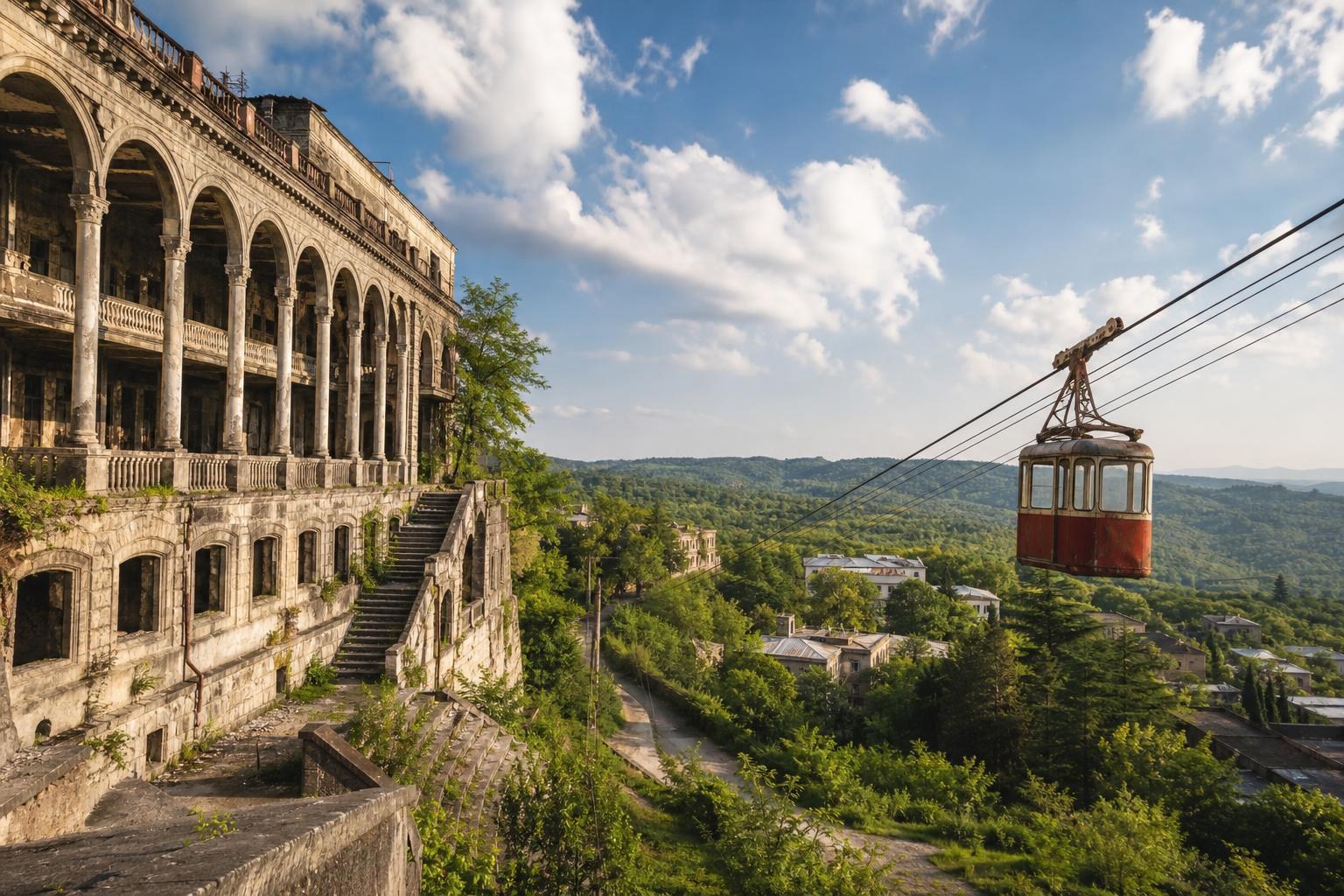
Two of the most hauntingly photogenic stops in all of Georgia sit just 70 kilometers apart in the Imereti region: Tskaltubo, a crumbling Soviet spa town where Stalin once soaked in radon baths, and Chiatura, a manganese mining city connected by cable cars that look like they belong in a Cold War thriller. Together, they form a compact road trip loop from Kutaisi that you can knock out in a single long day or stretch into a rewarding overnight. Dark tourism is booming globally, with the sector reaching a market value of $33.5 billion in 2026, and this corner of Georgia ranks among the most accessible and atmospheric dark tourism destinations in Europe. If you’re renting a car and want something genuinely different from the standard monastery-and-wine circuit, this is it. Here’s exactly how to plan the drive, what you’ll actually find when you get there, and how to explore responsibly.
The Ultimate Dark Tourism Loop: Tskaltubo and Chiatura
This loop works best as a day trip or overnight from Kutaisi, Georgia’s second city and the main gateway to the Imereti region. The basic route is simple: Kutaisi to Tskaltubo (about 20 minutes), then Tskaltubo to Chiatura (roughly 1.5 hours via the E60 and local roads), with the Katskhi Pillar as a natural detour between the two.
October is the sweet spot for this trip. The autumn light is golden and moody, temperatures hover around 15-20°C, and if you time it near Halloween, the atmosphere in the abandoned sanatoriums is genuinely eerie. Summer works too, but the buildings are sweltering inside and the overgrown vegetation blocks some of the best angles.
| Segment | Distance | Drive Time | Road Quality |
|---|---|---|---|
| Kutaisi to Tskaltubo | 9 km | 15-20 min | Paved, good condition |
| Tskaltubo to Katskhi Pillar | 55 km | ~1 hr | Paved, some rough patches |
| Katskhi Pillar to Chiatura | 15 km | 20 min | Paved, narrow sections |
| Chiatura to Kutaisi (return) | 65 km | ~1.5 hrs | Paved, mountain curves |
No 4×4 is needed for any of this. A standard rental sedan handles every road on this route comfortably.
Planning Your Drive: Route Logistics and Road Conditions
Start early from Kutaisi, ideally by 8:30 AM. The drive to Tskaltubo is short enough that you can grab coffee in Kutaisi’s old town and still arrive before the morning light gets too harsh for photography. Parking in Tskaltubo is informal: you’ll find space along the main boulevard near the central park without trouble.
The stretch from Tskaltubo to Chiatura follows the Kvirila River valley through increasingly dramatic terrain. The road is fully paved but narrow in places, with occasional livestock crossings that demand patience. Georgian drivers tend to pass aggressively on two-lane roads, so stay alert and use pulloffs when faster traffic builds behind you.
Tip: Fill your tank in Kutaisi or Tskaltubo. There’s a Wissol station in Zestafoni (on the E60) if you need fuel mid-route, but options thin out near Chiatura. Keep your headlights on during the mountain sections: tunnels are poorly lit and some have no lighting at all.
For those planning routes across Georgia by car, Triproadwayplanner’s guides cover road conditions and seasonal closures across the country, which is useful if you’re combining this loop with a longer Imereti itinerary.
Tskaltubo: The Rise and Fall of Stalin’s Favorite Spa Town
Between the 1930s and 1991, Tskaltubo was one of the Soviet Union’s premier health resorts. The town’s naturally warm radon springs (around 33-35°C year-round) made it a destination for workers sent on state-sponsored rest cures. At its peak, 22 grand sanatoriums operated here, each designed in a different architectural style ranging from neoclassical to Stalinist baroque. Trains arrived directly from Moscow, and Joseph Stalin himself visited multiple times, with a private bathhouse built for his exclusive use.
The collapse of the Soviet Union gutted the town’s purpose overnight. Without centralized funding or a stream of state-directed visitors, the sanatoriums emptied. During the 1990s wars in Abkhazia, thousands of internally displaced persons (IDPs) were resettled into the abandoned buildings, where many still live today. The result is a surreal landscape: ornate ballrooms with chandeliers dangling over makeshift kitchens, marble staircases leading to apartments with satellite dishes, and grand facades slowly being consumed by vegetation.
The town represents a cross-section of Soviet history and a race against time for photographers who want to capture the decay before ongoing redevelopment transforms the remaining structures.
Must-See Ruins: Sanatorium Medea and Iveria
Sanatorium Medea remains one of the most photogenic structures in town. Its circular central hall, with concentric balconies rising several stories, looks like something from a dystopian film set. As of 2026, access is informal: you can walk in, but be aware that some sections are structurally compromised. Test floors before committing your weight, especially on upper levels.
Sanatorium Iveria has undergone a dramatic transformation. The building was fully restored and reopened in 2024 as a 156-room Radisson Collection property, making it the first major international luxury hotel in the area. You can no longer explore it as a ruin, but the contrast between the restored Iveria and the decaying buildings around it tells its own story.
The iconic Sanatorium Tbilisi is being converted into a 122-room Marriott-branded hotel with completion expected by late 2026, meaning the site is fenced off and inaccessible. Other major sites like Shakhtiori have become private property and are strictly guarded. The window for exploring these buildings is closing fast.
Important: The list of accessible sanatoriums changes year to year as redevelopment progresses. Ask locally at guesthouses or the tourism information center near the central park for current access information before wandering in.
Ethics and Etiquette: Exploring Among Internally Displaced Persons
This is the part most travel blogs gloss over, and it matters more than getting the perfect shot. Several of the sanatoriums still house IDP families who were displaced from Abkhazia over 30 years ago. These are people’s homes. Children play in the courtyards. Laundry hangs from balconies that once overlooked ballrooms.
Practical rules for respectful visits:
- Do not enter occupied rooms or apartments. If a door is closed, it’s someone’s home.
- Ask permission before photographing people. A smile and a gesture go a long way, even without shared language.
- Don’t treat residents as attractions. They’re not part of the scenery.
- Bring small gifts if you plan to interact: coffee, chocolate, or fruit are always appreciated.
- Keep noise levels reasonable, especially early in the morning or late at night.
Some residents are friendly and will invite you in for tea. Accept graciously if you have time. Others are understandably tired of tourists treating their living situation as a spectacle. Read the room.
Safety and Legality While Exploring Abandoned Places in Georgia
Georgia doesn’t have the same trespassing laws as Western Europe or North America. There’s no blanket prohibition on entering abandoned buildings, but “abandoned” is doing a lot of heavy lifting in that sentence. Many structures in Tskaltubo are now privately owned, even if they look derelict. Entering guarded or fenced properties without permission is illegal and can result in confrontation with security guards.
For buildings that remain genuinely open:
- Never explore alone. Bring at least one partner.
- Wear closed-toe shoes with good grip. Broken glass, exposed rebar, and wet concrete are everywhere.
- Carry a headlamp or strong flashlight. Interior corridors are pitch black.
- Watch for unstable floors, especially on upper stories. Water damage has weakened many structures over decades.
- Don’t remove anything. Soviet-era tiles, fixtures, and mosaics belong where they are.
- Let someone know your plans and expected return time.
Note: There is no formal rescue infrastructure for urban explorers in this area. If you fall through a floor or get injured inside a building, emergency response will be slow. Your travel insurance should cover adventure activities: check your policy before you go.
Chiatura: Riding the ‘Stalinist Death Defying’ Cable Cars
About 70 kilometers east of Tskaltubo, Chiatura sits in a steep river gorge that made conventional transport impractical when the Soviets developed its manganese mines in the 1950s. Their solution was a network of aerial cable cars, originally 17 lines connecting residential areas on the canyon rim to the mines and city center below. For decades, these rattling metal boxes, some with no doors and rusted-through floors, were the only way for miners and residents to commute.
The old Soviet cabins became internationally famous as terrifying relics. Videos of tourists white-knuckling their way across the gorge in shaking, groaning gondolas went viral repeatedly through the 2010s.
The Chiatura cable car system has been almost entirely replaced. Four modern French-built Poma lines now operate from a new Central Station, serving the Mukhadze, Lezhubani, Sanatorium, and Naguti routes. A ride costs just 0.50 GEL (roughly $0.19 USD in 2026). The experience is smooth, safe, and offers spectacular views of the gorge.
The New System vs. The Rusting Relics
The modern lines are genuinely pleasant. Enclosed cabins, proper safety mechanisms, and regular schedules make them a practical way to see the canyon geography. But they lack the visceral thrill that made the old system famous.
A few of the original Soviet stations and cables remain visible around town, rusting in place as informal monuments. You can photograph them from the ground, though climbing on decommissioned infrastructure is both illegal and dangerous. The Sashevardno line, featuring the steepest incline in the post-Soviet space at 48 degrees, officially reopened in October 2024 after restoration, offering a middle ground between the old terror and new comfort.
Parking in Chiatura is straightforward. Leave your car near the Central Station and explore the cable car network on foot and by gondola. The town itself is compact enough to walk, though the hills are steep.
A Spiritual Detour: The Katskhi Pillar Monolith
Roughly halfway between the two towns, a 40-meter natural limestone column rises from the valley floor with a small church perched impossibly on top. The Katskhi Pillar has been a site of Christian hermitage since at least the 6th century, and a single monk lived on the summit for over 20 years until recently.
You cannot climb the pillar (access is restricted to monks), but the view from the base is remarkable. A small monastery complex at ground level is open to visitors. Dress modestly: covered shoulders and long pants for men, head coverings and skirts for women.
The turnoff from the main road is signed but easy to miss. Look for it about 10 kilometers before Chiatura when approaching from the west. A short gravel road leads to a small parking area. The walk from the car to the base takes about 10 minutes.
Soviet Georgia’s Brutalist Architecture and Industrial Heritage
The Imereti region preserves one of the densest concentrations of Soviet-era industrial and civic architecture in the Caucasus. Beyond the sanatoriums and cable cars, you’ll encounter bus stops designed as sculptural concrete forms, workers’ clubs with theatrical facades, and industrial infrastructure that looks like it was designed by someone who read too much science fiction.
Chiatura’s mining infrastructure is particularly striking. The ore processing facilities, conveyor systems, and workers’ housing blocks form a complete industrial landscape that tells the story of Soviet Georgia’s role as a resource extraction zone for Moscow. Manganese from these mines supplied the Soviet steel industry for decades.
This kind of heritage is disappearing fast. Some structures are being demolished, others are simply collapsing. If industrial architecture and brutalist design interest you, this trip is worth prioritizing sooner rather than later. Bring a wide-angle lens.
Essential Road Trip Gear and Photography Tips for Urban Explorers
Packing right makes the difference between a productive day and a frustrating one. Here’s what actually matters for this specific trip:
- A wide-angle lens (14-24mm equivalent) for capturing interiors where you can’t step back far enough
- A tripod or gorilla pod for low-light interiors: many sanatorium hallways are too dark for handheld shots
- Dust mask or N95: decades of decay means airborne particles in enclosed spaces
- Work gloves for steadying yourself on rough surfaces
- At least 2 liters of water per person: there are few shops near the ruins
- Portable phone charger: GPS navigation drains batteries fast on mountain roads
- Google Translate offline Georgian language pack, downloaded before you leave Kutaisi
For photography, the golden hours (first hour after sunrise, last hour before sunset) create dramatic light through broken windows and collapsed roofs. Midday works for interiors where shafts of light penetrate from above. Overcast days actually produce the most even, atmospheric results inside the sanatoriums.
Tip: Download offline maps for the entire Imereti region before leaving Kutaisi. Cell coverage is patchy between Tskaltubo and Chiatura, and you don’t want to lose navigation mid-route on an unfamiliar mountain road.
Frequently Asked Questions About Tskaltubo and Chiatura
Is it safe to visit the abandoned sanatoriums in Tskaltubo in 2026?
The accessible buildings carry real structural risks: weakened floors, falling debris, and exposed hazards. Visit with a partner, wear proper footwear, and stick to ground floors unless you have urban exploration experience. The bigger concern is access: many formerly open sanatoriums are now fenced, guarded, or under active renovation. Check locally for current conditions.
Can you still ride the old Soviet cable cars in Chiatura?
The original Soviet gondolas have been decommissioned and replaced by four modern Poma lines. The restored Sashevardno line offers the closest experience to the old system, with its steep 48-degree incline. Rides cost 0.50 GEL.
How long does this road trip take?
Plan for a full day if you want to explore both towns and visit the Katskhi Pillar. The total driving time is about 3 hours, but you’ll want at least 2-3 hours in Tskaltubo and 1-2 hours in Chiatura. An overnight in either town lets you shoot at golden hour in both locations.
Do I need a 4×4 for this route?
No. The entire loop from Kutaisi is on paved roads. A standard rental car handles everything comfortably. Just watch for livestock on the Chiatura road and take mountain curves at sensible speeds.
Are the sanatoriums free to enter?
The remaining accessible buildings have no formal entry fee. However, this is changing rapidly as properties are privatized and redeveloped. The Radisson Collection (former Iveria) and the upcoming Marriott (former Sanatorium Tbilisi) are obviously no longer explorable ruins. Budget nothing for entry fees but everything for respect toward the communities still living in these structures.
This loop through Imereti’s Soviet past is one of the most concentrated and accessible dark tourism experiences in Europe. The window is narrowing, though. Between hotel conversions, privatization, and natural decay, the Tskaltubo you can visit in 2026 will look different from what’s there in 2028. If this trip is on your list, don’t wait. Drive it this autumn, bring your camera, and treat the people and places you encounter with the care they deserve.