
Table of Contents
Few dishes capture the soul of a cuisine quite like a fire-roasted vegetable mash served alongside bread. If you’ve ever sat at a Georgian or South Asian table and watched someone char eggplants directly over an open flame, peel away the blackened skin, and fold the smoky flesh into a rough, aromatic mixture, you’ve witnessed something ancient and deeply satisfying. This preparation, known broadly as chokha, bridges cultures and geographies in ways that surprise most people encountering it for the first time. The word itself carries different meanings depending on where you are: in Georgia (the country nestled between Europe and Asia), it refers to a beloved roasted vegetable side dish, while in the Indian states of Bihar and Jharkhand, it describes a strikingly similar concept of fire-roasted vegetables mashed with spices. Both traditions share a reverence for smoke, simplicity, and the transformative power of direct flame on humble ingredients. What makes this dish so compelling isn’t complexity. It’s the opposite: a handful of vegetables, fire, salt, and a few aromatics combine into something far greater than their parts suggest. Whether you’re eating it scooped onto Georgian cornbread or paired with litti in Patna, the experience hits the same primal note. This guide covers everything you need to know about this remarkable preparation, from its exact definition to the best ways to make it at home.
What is Chokha?
Definition
Chokha is a roasted vegetable preparation where whole vegetables, most commonly eggplant, tomatoes, peppers, and sometimes potatoes, are charred over an open flame or baked until their skins blister and their flesh turns soft and smoky. The charred vegetables are then peeled, mashed or roughly chopped, and mixed with aromatics like garlic, fresh herbs, oil, and salt. The result is a textured, intensely flavored side dish meant to accompany bread or other staples.
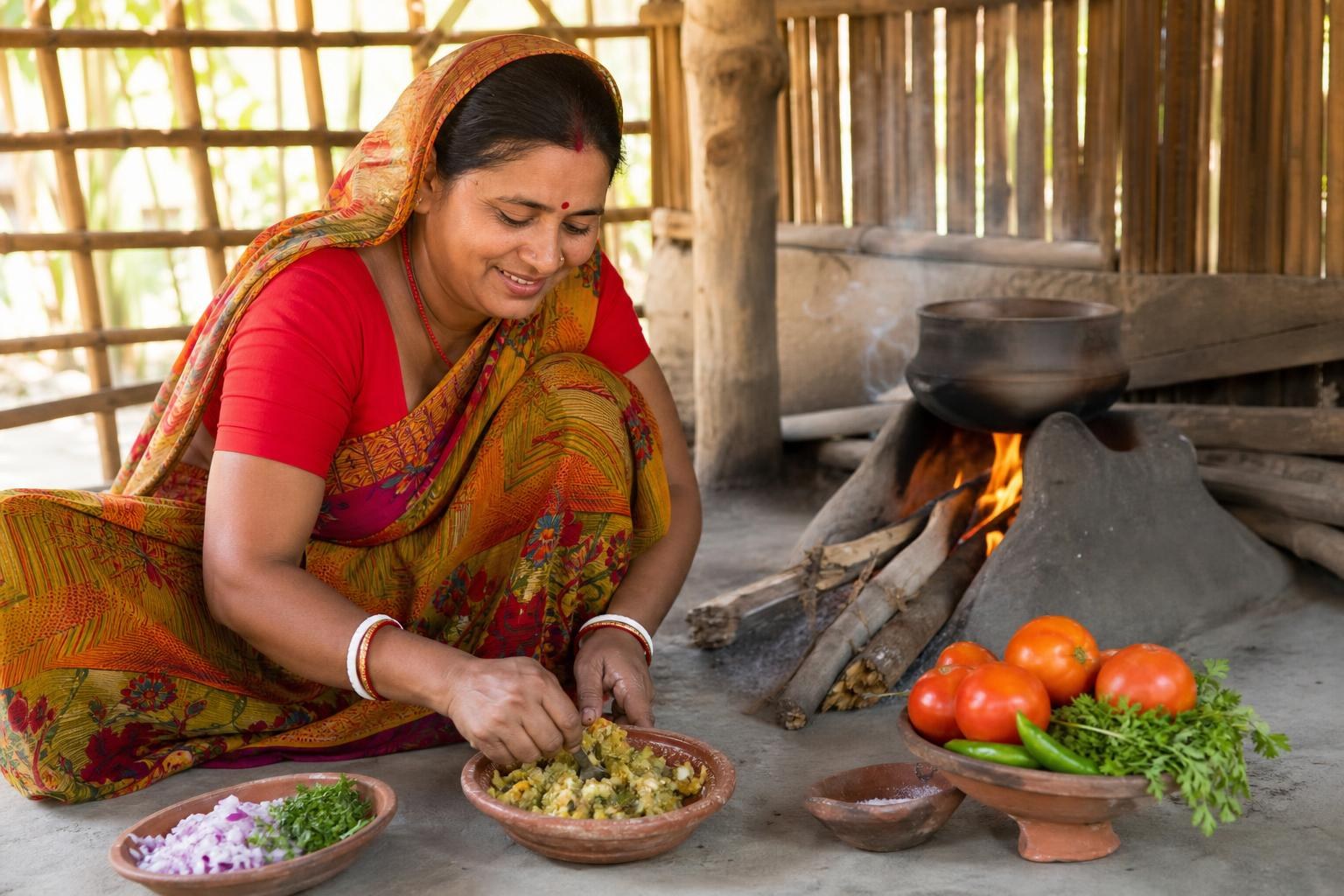
The Georgian version, often spelled “k’hokha” in transliteration, typically features roasted eggplant as its star ingredient, combined with walnuts, garlic, herbs like cilantro, and sometimes pomegranate seeds. The Indian version from Bihar centers on roasted eggplant (baingan ka chokha), roasted tomato (tamatar ka chokha), or roasted potato (aloo ka chokha), finished with mustard oil, green chilies, raw onion, and fresh coriander.
Despite the geographic distance between Georgia and Bihar, the core technique is identical: direct fire contact with whole vegetables, followed by peeling and rough mashing. This isn’t a coincidence of naming. It reflects a universal human discovery that fire transforms bland vegetables into something extraordinary.
Key Concepts
Several principles define this dish across its variations:
- Smoke as seasoning: The charring process isn’t just about cooking. The Maillard reaction and actual combustion of the vegetable skin create complex smoky compounds that penetrate the flesh. This is the dish’s signature flavor, and it can’t be replicated by simply baking vegetables in an oven.
- Rough texture: This is not a smooth puree. The mash retains chunks and irregular pieces, giving each bite a slightly different texture. The contrast between silky roasted eggplant and crunchy raw onion or walnut is intentional.
- Minimal ingredients: A proper version rarely contains more than six or seven ingredients. The restraint is the point: you’re tasting the vegetable and the fire, not a complicated spice blend.
- Freshness: Both Georgian and Indian versions are meant to be eaten fresh, ideally within an hour or two of preparation. The flavors dull as the dish sits, and the smoky brightness fades.
The dish belongs to a broader family of fire-roasted preparations found across the Middle East, Balkans, and South Asia, including baba ganoush, ajvar, and bhartha. But it maintains a distinct identity through its particular combinations and cultural context.
How Chokha Works
Core Mechanism
The magic of this dish comes down to pyrolysis: the chemical decomposition of organic material through heat. When you place a whole eggplant directly on a gas burner, charcoal grill, or wood fire, the skin chars at temperatures exceeding 300°C (572°F). This extreme surface heat does two things simultaneously. It breaks down the cell walls of the vegetable flesh, turning it soft and almost creamy, while the burning skin generates hundreds of volatile aromatic compounds, including guaiacol and syringol, that give the dish its characteristic smokiness.
The key difference between roasting vegetables in an oven and charring them over open flame is contact. In an oven, hot air surrounds the vegetable evenly, producing a gentle roast. Over flame, the direct contact creates zones of intense carbonization right next to areas of gentle steaming (the interior cooks in its own moisture). This contrast produces a more complex flavor profile than any single cooking method alone.
Timing matters enormously. An under-charred eggplant will taste bland and watery. An over-charred one becomes bitter from excessive carbon. The sweet spot is when the skin is completely blackened and papery, the flesh collapses when pressed, and steam escapes from small cracks. For a medium eggplant on a gas burner, this takes roughly 15 to 20 minutes with regular turning.
Components
A standard Georgian version and a Bihari version share structural DNA but differ in their finishing ingredients. Here’s a side-by-side comparison:
| Component | Georgian Chokha | Bihari Chokha |
|---|---|---|
| Primary vegetable | Eggplant, tomato, pepper | Eggplant, tomato, or potato |
| Fat | Sunflower or walnut oil | Mustard oil (raw, uncooked) |
| Allium | Garlic (raw, crushed) | Raw onion, garlic |
| Heat | Mild green pepper | Green chili (bird’s eye or similar) |
| Herbs | Cilantro, sometimes basil | Fresh coriander leaves |
| Acid | Pomegranate seeds, vinegar | Lemon juice |
| Nuts | Crushed walnuts | None |
| Served with | Shotis puri, mchadi (cornbread) | Litti, roti, or rice |
The Georgian preparation tends toward a nuttier, more herbaceous profile, while the Bihari version hits harder with the pungent bite of raw mustard oil and the sharp heat of green chilies. Both are assertive flavors designed to complement starchy, mild-flavored breads.
One detail worth understanding: in the Georgian version, the walnut paste often does double duty as both a textural element and a binding agent, holding the mash together in a way that makes it easier to scoop with bread. In the Bihari version, mustard oil serves a similar cohesive function while adding its own distinctive sharpness.
Benefits and Use Cases
Key Benefits
This dish punches well above its weight for several reasons that go beyond just tasting good.
From a nutritional standpoint, roasted eggplant is remarkably low in calories (roughly 25 calories per 100 grams) while being rich in fiber, potassium, and antioxidants like nasunin, a compound found in eggplant skin that has shown promise in protecting cell membranes. When you add raw garlic, fresh herbs, and walnuts (in the Georgian version), you’re building a dish that delivers genuine micronutrient density without any processed ingredients.
The preparation is naturally vegan and gluten-free, which makes it one of those rare traditional dishes that fits modern dietary restrictions without any modification. I’ve seen this become a go-to recommendation for people hosting mixed dietary groups: it satisfies vegans, gluten-free eaters, and committed carnivores at the same table.
Cost is another genuine advantage. In Tbilisi’s Dezerter Bazaar, a kilo of eggplant runs about 2-3 GEL (roughly $0.75 to $1.10 USD in 2026), and a bunch of fresh cilantro costs less than 1 GEL. You can prepare enough to feed four people for under $3 total. In Bihar, the economics are even more favorable: a kilo of baingan at a local sabzi mandi rarely exceeds 30-40 INR.
The dish also requires no specialized equipment. A gas burner, a fork for turning, and a bowl are all you need. No blender, no food processor, no special pan.
Common Applications
The most traditional use is as a side dish alongside bread. In Georgia, you’ll find it served as part of a supra (feast) spread, sitting alongside other cold preparations like pkhali, badrijani nigvzit, and various salads. It’s typically one of several dishes placed on the table before the main courses arrive.
In Bihar and Jharkhand, baingan ka chokha is practically inseparable from litti: baked wheat balls stuffed with sattu (roasted gram flour). This pairing is so iconic that “litti-chokha” functions as a single compound noun in the region. Street vendors in Patna serve it on sal leaf plates, the mustard oil glistening under bare bulbs, and it remains one of the most affordable and satisfying street meals in India.
Beyond these traditional contexts, the dish adapts well to modern cooking situations:
- As a dip or spread for crusty bread at dinner parties (it works beautifully on sourdough)
- As a filling for wraps or sandwiches, especially when paired with grilled halloumi
- As a base layer under grilled meat or fish, where the smokiness of the mash complements charred protein
- Mixed into pasta as a sauce component, thinned with a little pasta water and olive oil
- As a topping for flatbread pizzas, spread in place of tomato sauce
I’ve personally found that the Georgian walnut-heavy version works better as a standalone dip, while the Bihari mustard oil version shines brightest as a side paired with something starchy and mild.
Best Practices
Making a good version of this dish is simple. Making a great one requires attention to a few details that most recipes skip.
Start with the right eggplant. You want medium-sized specimens that feel heavy for their size, with taut, glossy skin and no soft spots. The large globe eggplants common in Western supermarkets work fine, but the longer Asian or Japanese varieties char more evenly due to their thinner profile. If you can find the small, round Indian brinjals, those produce the most intensely flavored results.
Fire selection matters more than most people realize. The hierarchy, from best to acceptable, looks like this: wood or charcoal fire, then gas burner, then broiler, then oven. Each step down the list loses smoky complexity. If you’re stuck with an electric stove, your best option is to use a broiler set to high, placing the eggplant on a foil-lined sheet about 3 inches from the element. Turn every 4 to 5 minutes.
On a gas burner, place the whole eggplant directly on the grate over a medium-high flame. Don’t prick the skin first: you want the interior to steam in its own moisture. Turn it with tongs every 3 to 4 minutes until every surface is charred and the eggplant collapses when you lift it. The total time runs 15 to 25 minutes depending on size.
After charring, place the eggplant in a bowl and cover it for 10 minutes. The residual steam loosens the skin and makes peeling effortless. Peel under running water if you must, but know that you’re washing away some smoky flavor when you do.
Here’s a mistake I see constantly: people squeeze out the liquid from the roasted eggplant. Don’t do this. That liquid carries dissolved smoky compounds and natural sugars. Squeezing it out leaves you with a dry, bland mash. Instead, let the excess liquid drain briefly in a colander, no more than 2 to 3 minutes, then chop and mix.
For the Georgian version, crush your walnuts by hand or with a mortar and pestle, never in a food processor. You want irregular pieces, some powdery and some chunky. Add the garlic raw and finely minced. Fold in torn cilantro leaves at the very end so they stay bright green.
For the Bihari version, the mustard oil should be raw (kachchi ghani), not refined. Add it last, drizzled over the finished mash. The pungent, almost wasabi-like bite of raw mustard oil is non-negotiable for authenticity. If you can’t find good mustard oil, a small amount of extra virgin olive oil with a pinch of mustard powder is a distant but workable substitute.
Season assertively. This dish needs more salt than you think, because the eggplant flesh is naturally very mild. Taste and adjust twice before serving.
Related Concepts
Chokha belongs to a broader tradition of fire-roasted vegetable preparations that spans from the Balkans to South Asia. Understanding its relatives helps clarify what makes each version distinct.
Baba ganoush, the Lebanese and Levantine staple, shares the same charred eggplant base but diverges with the addition of tahini (sesame paste), which gives it a creamier, richer texture. Baba ganoush is blended smoother and served primarily as a dip, whereas chokha maintains a rougher, chunkier character.
Ajvar, the red pepper relish from Serbia and North Macedonia, applies the same charring technique to red bell peppers and sometimes eggplant. It’s typically cooked down further with oil into a preserve-like consistency, designed to be jarred and stored for winter. The Georgian version of chokha made with roasted red peppers is essentially a fresh, uncooked cousin of ajvar.
Bhartha (or bharta) from North Indian cuisine, particularly baingan bharta from Punjab, is the closest relative to Bihari chokha but differs in one critical way: bharta is cooked again after mashing, sautéed with onions, tomatoes, and spices in oil. This second cooking step mellows the smokiness and creates a more integrated, curry-like dish. Chokha skips this step entirely, preserving the raw, immediate impact of the fire.
In Georgian cuisine specifically, chokha sits within a family of cold vegetable preparations that includes pkhali (finely chopped vegetables bound with walnut paste), badrijani nigvzit (fried eggplant rolls with walnut filling), and various marinated vegetable salads. What distinguishes it from these relatives is the emphasis on direct fire contact rather than boiling or frying.
The Turkish dish patlıcan salatası and the Greek melitzanosalata follow nearly identical methods to Georgian chokha, reinforcing the idea that this technique emerged independently across fire-cooking cultures throughout the region. The variations are in the finishing: Greeks add lemon and olive oil, Turks might include yogurt, Georgians reach for walnuts and pomegranate.
One concept worth understanding is the difference between “smoking” and “charring.” Smoking involves exposing food to wood smoke at lower temperatures over longer periods. Charring, which is what happens in chokha preparation, involves direct flame contact at high temperatures for shorter durations. The flavor compounds produced are related but distinct: charring creates more caramelized, bitter-sweet notes, while smoking produces mellower, more penetrating flavors.
For anyone interested in exploring these connections firsthand, a trip through Tbilisi’s old town restaurants or the street food stalls near Patna Junction will reveal how deeply these simple preparations are woven into daily eating. They’re not restaurant showpieces. They’re the kind of food people eat every day, made fresh each time, and somehow never boring.
Whether you first encounter this dish at a Georgian supra with a tamada raising toasts or at a roadside stall in Bihar where the smoke curls up from charcoal braziers, the experience is remarkably consistent: honest food, made with fire and a few good ingredients, tasting like something humans have been eating for thousands of years. Chokha doesn’t need fancy technique or rare ingredients. It needs a flame, a vegetable, and someone willing to pay attention for twenty minutes. That simplicity is exactly what makes it worth learning, cooking, and sharing. If you’ve never made it at home, start with a single eggplant on your gas burner tonight. You’ll understand immediately why this dish has survived across centuries and continents.