
Table of Contents
- Overview of Safety and Cultural Hospitality in Georgia
- Navigating Georgian Cities and Public Spaces
- Comparative Safety Data for Solo Female Travelers
- Social Norms and Avoiding Unwanted Attention
- Safety Considerations for Rural Exploration and Hiking
- Essential Resources and Emergency Contacts
- Final Thoughts for Women Heading to Georgia Solo
Georgia has a way of surprising first-time visitors. You arrive expecting a small post-Soviet country tucked between Europe and Asia, and what you find instead is a place where strangers invite you to dinner, taxi drivers refuse to let you pay, and grandmothers in mountain villages press homemade churchkhela into your hands like you’re a long-lost relative. For women considering a solo trip, the question of safety naturally comes up, and it deserves an honest answer grounded in real data and lived experience rather than vague reassurances. The short version: Georgia is one of the safest countries in the broader European region for solo female travelers, but like anywhere, it helps to understand the cultural context and know what to expect. I’ve spent considerable time in Tbilisi, Batumi, Kazbegi, and Svaneti, and this guide reflects both the statistics and the ground-level reality of traveling alone as a woman in this country.
Overview of Safety and Cultural Hospitality in Georgia
Georgia, or Sakartvelo as Georgians call their homeland, sits at a crossroads where empires have collided for millennia. That geography has shaped a culture that is fiercely proud, deeply religious, and almost aggressively hospitable. Understanding this cultural backdrop matters because it directly affects how you’ll experience the country as a solo female traveler. Safety isn’t just about crime statistics: it’s about how a society treats strangers, what social norms govern public behavior, and whether institutions like police and emergency services function reliably. On all these fronts, Georgia performs well.
The country has invested heavily in tourism infrastructure since the Rose Revolution of 2003, and the results show. Tourist police units operate in major cities, signage is increasingly bilingual, and the general attitude toward foreign visitors is one of genuine warmth rather than transactional hospitality. This isn’t the polished, corporate friendliness of a resort destination. It’s something more personal and sometimes more intense.
Crime Rates and Global Safety Rankings
Georgia consistently ranks among the safest countries in Europe by multiple measures. The country maintains a safe country status with a Level 1 advisory from the U.S. Department of State, the lowest risk category available. Violent crime against tourists is exceptionally rare. Petty theft exists, as it does in any tourist destination, but even pickpocketing rates in Tbilisi are lower than in most Western European capitals.
The homicide rate in Georgia hovers around 1.2 per 100,000 people, which places it well below the European average and far below the rates in many countries that travelers visit without a second thought. Corruption in the police force, once a significant problem during the Shevardnadze era, was dramatically reduced after the 2004 police reforms. Today, Georgian police are generally professional, responsive, and accustomed to dealing with tourists. Many officers in Tbilisi and Batumi speak basic English.
A useful way to think about personal safety in Georgia is to compare it with countries like Portugal, Japan, or New Zealand, all of which share similarly low crime rates and a general culture of respect toward visitors.
The Concept of ‘Guest from God’ in Georgian Culture
The phrase “stumari ghvtisaa,” meaning “a guest is from God,” isn’t just a saying printed on souvenir magnets. It reflects a hospitality tradition that predates Christianity in the region and remains a living, breathing part of daily life. When a Georgian family invites you into their home, they mean it. Refusing can actually cause offense.
This tradition manifests in practical ways for solo travelers. Guesthouse owners in rural areas often treat guests like family members, cooking elaborate multi-course meals and insisting you stay longer than planned. Taxi drivers in smaller towns may refuse payment from a foreign guest or go well out of their way to help you find your destination. I once had a man in Mestia walk twenty minutes to personally escort me to a trailhead because he was worried I’d take a wrong turn.
The flip side is that this intensity of hospitality can occasionally feel overwhelming, especially for women traveling alone. A Georgian host’s insistence that you eat more, drink more wine, or stay another night comes from genuine generosity, but it can be hard to set boundaries if you’re not prepared for it. Learning to say “gmadlobt, magram sakmaris” (thank you, but it’s enough) with a smile goes a long way.
Navigating Georgian Cities and Public Spaces
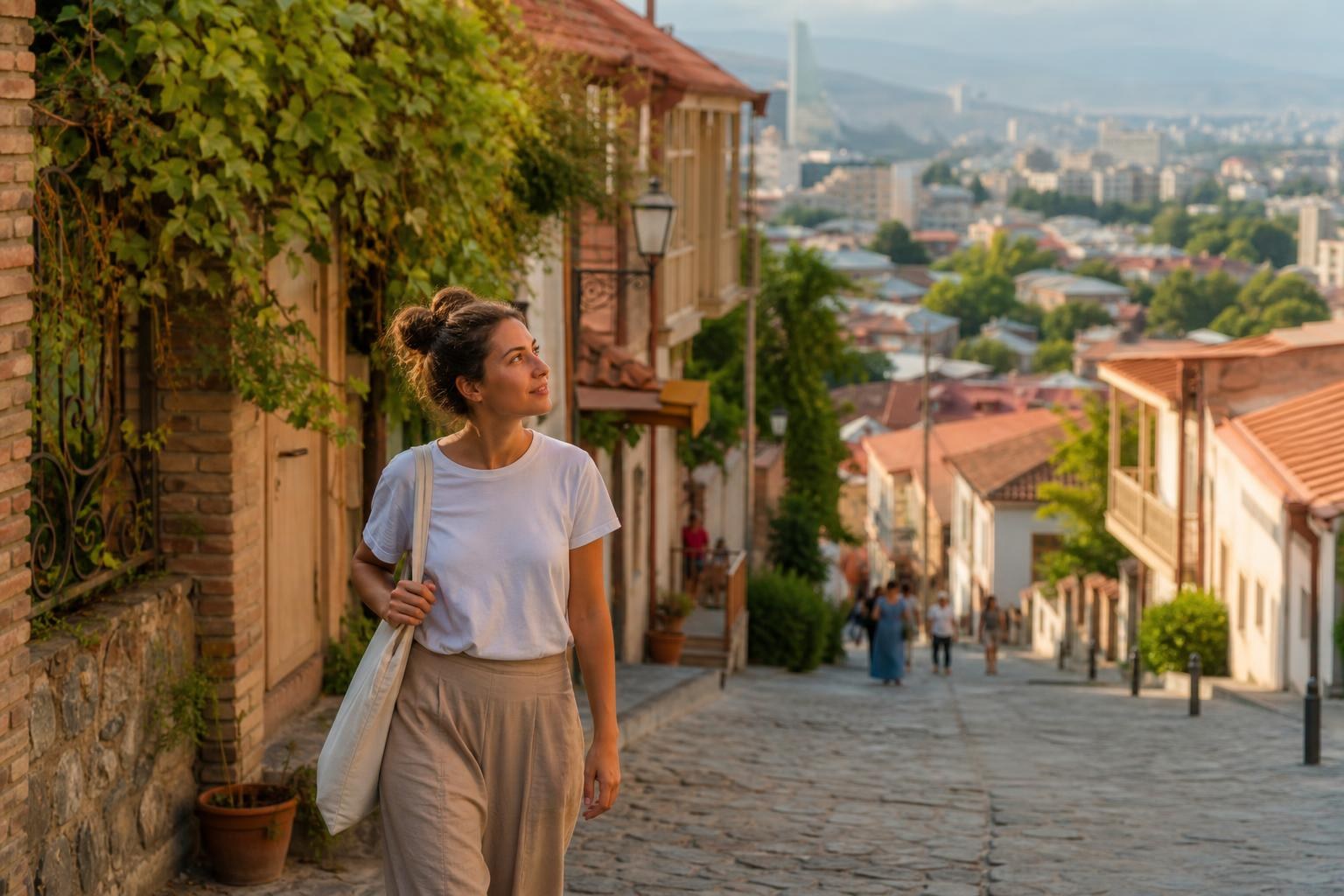
Tbilisi and Batumi are the two cities where most solo female travelers spend the majority of their time, and both are remarkably walkable and well-lit compared to many cities of similar size. Tbilisi’s Old Town, the Marjanishvili district, and Vake are all areas where you’ll see women of all ages walking alone at various hours. Batumi’s seaside boulevard is busy with families and couples well past midnight during summer months.
Georgian cities have a Mediterranean quality to their street life. Cafes stay open late, people linger outdoors, and there’s a constant flow of pedestrians that creates natural safety through sheer presence. The post-2003 generation, raised on English-language media and increasingly connected to European cultural norms, is particularly easy to interact with. Younger Georgians in urban areas tend to be curious about foreign visitors without being intrusive.
Walking Alone at Night in Tbilisi and Batumi
I’ll be direct: walking alone at night in central Tbilisi feels safer than walking alone at night in most American or Western European cities of comparable size. The areas around Rustaveli Avenue, Freedom Square, Abanotubani, and the Dry Bridge are well-lit and populated until late. Tbilisi’s nightlife district around Bassiani and the club scene near the river can get rowdy, but the rowdiness tends to be contained and directed inward rather than at passersby.
Batumi is similarly comfortable after dark, particularly along the boulevard and in the tourist center. The city has a resort-town energy during summer, with families and groups out late enjoying the warm evenings. Street harassment of the aggressive, following-you-home variety that women sometimes encounter in other parts of the Caucasus or Mediterranean is genuinely uncommon in Georgian cities.
That said, common sense still applies. Poorly lit residential areas on the outskirts of any city carry more risk than well-traveled tourist zones. The neighborhoods around Tbilisi’s Didube bus station and the area near the train station are functional rather than charming, and while not dangerous per se, they’re not where you want to wander aimlessly at 2 AM. Stick to areas where other people are present, keep your phone charged, and trust your instincts.
Public Transport and Ride-Sharing Safety
Tbilisi’s metro system is clean, cheap (1 GEL per ride in 2026), and perfectly safe for solo women. It runs until midnight and is well-monitored by security cameras. The yellow minibuses called marshrutkas are a different experience: crowded, confusing if you don’t speak Georgian, and driven with a casual relationship to traffic laws. They’re safe in terms of personal security, but the driving itself can be hair-raising.
For getting around cities, the Bolt app works throughout Georgia and is the preferred option for most travelers. Rides are affordable, the driver’s details are logged in the app, and you can share your trip with a contact back home. Yandex Go also operates in Georgia and functions similarly. Both apps eliminate the need to negotiate fares or worry about unlicensed taxis, which is a genuine concern: unmarked taxis at the airport and bus stations sometimes overcharge tourists significantly.
For intercity travel, Georgian Railways operates a comfortable and inexpensive service between Tbilisi and Batumi, with a scenic route through the mountains that’s worth the trip on its own. The overnight train is popular with solo travelers and has separate sleeping compartments that can be booked for privacy.
Comparative Safety Data for Solo Female Travelers
Putting Georgia’s safety profile in context helps frame realistic expectations. The table below compares Georgia with several popular solo travel destinations across key safety indicators relevant to women traveling alone.
| Safety Indicator | Georgia | Portugal | Thailand | Turkey | Morocco |
|---|---|---|---|---|---|
| U.S. State Dept. Advisory Level | Level 1 | Level 1 | Level 1 | Level 2 | Level 2 |
| Violent Crime Rate (per 100k) | ~1.2 | ~0.8 | ~2.5 | ~2.6 | ~1.5 |
| Street Harassment Frequency | Low | Low | Moderate | Moderate-High | High |
| Police Responsiveness to Tourists | High | High | Moderate | Moderate | Variable |
| Solo Female Traveler Popularity | Growing rapidly | Very high | Very high | High | Moderate |
| English Proficiency (Urban) | Moderate | High | Moderate | Moderate | Low-Moderate |
Georgia compares favorably to many established tourism destinations and outperforms several of them on metrics that matter most to women traveling alone. The street harassment frequency is notably lower than in Turkey or Morocco, two countries that attract far more solo female visitors despite presenting more daily friction in this regard.
One factor that doesn’t show up in crime statistics is the general social attitude toward women in public spaces. Georgia occupies an interesting middle ground: it’s a patriarchal society in many respects, particularly in rural areas and within family structures, but this patriarchy tends to manifest as protectiveness toward women rather than aggression. A Georgian man is far more likely to insist on carrying your bag or walking you to your hotel than to harass you on the street. Whether this protectiveness is welcome depends on your perspective, but it does contribute to a sense of physical safety.
Social Norms and Avoiding Unwanted Attention
Georgian social norms around gender are more traditional than what you’d find in Scandinavia or Western Europe, but less restrictive than in much of the Middle East or Central Asia. Women in Tbilisi dress in the full spectrum from miniskirts to hijabs, and nobody bats an eye. The generational divide matters here: Georgians under 35 in cities have social attitudes broadly aligned with Southern Europe, while older generations and rural communities hold more conservative views.
Unwanted attention from men does happen, but it typically takes the form of persistent friendliness rather than threatening behavior. A man at a cafe might try to buy you a coffee, a group of guys might call out a compliment as you walk by, or a guesthouse owner’s son might offer to show you around town with a bit too much enthusiasm. These interactions are almost always harmless and can be deflected with a firm but friendly “ara, gmadlobt” (no, thank you).
Dress Code and Etiquette for Religious Sites
Georgia is one of the oldest Christian nations on earth, and its churches and monasteries are active places of worship, not museums. Every major church requires women to cover their heads and shoulders, and most expect skirts or long pants rather than shorts. Many churches provide wraps and scarves at the entrance, but carrying a lightweight scarf in your daypack saves hassle.
The major monasteries like Jvari, Gelati, and the cave monastery of David Gareja are particularly strict about dress codes. Shorts, tank tops, and uncovered hair will get you turned away. This isn’t unique to Georgia: similar rules apply at churches in Greece, Russia, and Ethiopia. Treating these spaces with respect earns you goodwill from locals and often leads to richer interactions with monks and churchgoers who appreciate that you’ve made the effort.
Outside religious sites, there’s no enforced dress code anywhere in Georgia. Tbilisi’s fashion scene is actually quite progressive, and the city hosts fashion weeks and design events that push boundaries. Batumi’s beach culture is relaxed, with bikinis and beachwear standard along the waterfront. In rural mountain villages, dressing modestly isn’t required but is appreciated: it signals respect for local customs and tends to result in warmer reception from older residents.
Managing Interactions in Traditional Settings
The supra, Georgia’s legendary feast, is where traditional gender dynamics become most visible. A tamada (toastmaster) leads the table through a series of elaborate toasts, and the role is almost always filled by a man. As a female guest, you’ll be treated with great respect and generosity, but you may also encounter assumptions about your drinking capacity or marital status that feel dated.
The best approach is to participate with good humor. You don’t have to match anyone glass for glass: sipping rather than draining your wine during toasts is acceptable, and saying you don’t drink alcohol is respected, though it may prompt concerned questions about your health. If someone asks why you’re traveling alone or whether your husband “allowed” you to come, it’s usually genuine curiosity rather than judgment. A simple, confident answer tends to satisfy.
In more traditional rural settings, you might notice that women and men socialize separately during gatherings. As a foreign guest, you’ll often be exempt from these norms and welcomed into the main gathering regardless of gender. This is the “guest from God” principle overriding local gender conventions, and it’s one of the more charming aspects of Georgian hospitality.
Safety Considerations for Rural Exploration and Hiking
Georgia’s mountains are the country’s greatest natural asset and a major draw for solo travelers. The Caucasus range offers everything from gentle day hikes in Kazbegi to multi-day treks through Svaneti and Tusheti that rival anything in Nepal or Patagonia. The safety considerations here shift from urban concerns about street crime to practical wilderness issues: weather, terrain, and connectivity.
Hiking alone in the Georgian mountains is generally safe from a human threat perspective. The trails in popular areas like the Kazbegi region, the Truso Valley, and the routes around Mestia see enough foot traffic during summer months (June through September) that you’re rarely truly isolated. Shepherd dogs, however, are a real concern. Georgian livestock guardian dogs are large, territorial, and not always friendly to hikers passing through their domain. Carrying a walking stick and giving flocks a wide berth is standard practice.
Staying Connected in Remote Mountain Regions
Cell coverage in Georgia’s mountains is patchy at best. Magti and Geocell, the two main carriers, provide decent coverage in valleys and near villages but drop off quickly once you’re on ridgelines or in deep gorges. The Tusheti region, accessible only by a terrifying mountain road from June to October, has almost no reliable cell service outside the village of Omalo.
Download offline maps before heading into remote areas. Maps.me and the offline function in Google Maps both work well for Georgian trails. A power bank is essential since charging opportunities in mountain guesthouses can be limited to a few hours of generator power per day. If you’re planning multi-day treks, consider renting a satellite communicator: several outfitters in Tbilisi and Mestia now offer them for around 15-20 GEL per day.
Registering your trek with local police or guesthouse owners is a smart habit. In Svaneti and Tusheti, guesthouse owners typically know the trails intimately and will raise an alarm if you don’t return when expected. This informal safety network is remarkably effective and has been credited with quick rescues when hikers get injured or lost.
Guesthouse Safety and Booking Reliable Tours
Rural guesthouses in Georgia are overwhelmingly family-run operations where you sleep in a spare bedroom and eat meals with the family. This setup is inherently safe for solo women: you’re essentially a guest in someone’s home, and the social dynamics of Georgian family life provide a natural layer of security. The grandmother of the house will likely fuss over you more than any hotel concierge ever would.
Booking through platforms like Booking.com or directly through local tourism boards helps ensure you’re staying at established, reviewed properties. The solo travel experience in Georgia has been extensively documented by bloggers and travel writers, and their guesthouse recommendations are generally reliable. In Svaneti, the Mestia tourism information center can arrange guesthouse stays and connect you with certified mountain guides.
For organized tours, stick with licensed operators. The Georgian National Tourism Administration maintains a registry of certified guides and tour companies. Multi-day hiking tours through Svaneti or Tusheti typically cost between 80-150 GEL per day including meals, accommodation, and guide services. Solo female travelers often find that joining a small group tour for remote treks offers the best balance of independence and security.
Essential Resources and Emergency Contacts
Having the right numbers and apps on your phone before you arrive makes a real difference. Georgia’s emergency number is 112, which connects to police, ambulance, and fire services and has English-speaking operators available. The tourist police hotline is 0800-800-909 (toll-free within Georgia) and operates around the clock with multilingual staff trained specifically to assist foreign visitors.
Your embassy or consulate should be your first call in any serious emergency. Most major embassies are located in Tbilisi, and their contact information should be saved in your phone before you arrive. The U.S. Embassy, British Embassy, and EU delegation all maintain updated travel advisory pages for Georgia with current security information.
Key apps to download before your trip:
- Bolt and Yandex Go for ride-hailing
- Google Translate with the Georgian offline language pack (the Georgian alphabet is unique, and you won’t be able to sound out signs without help)
- Maps.me for offline navigation, especially in rural areas
- WhatsApp, which is the dominant messaging platform in Georgia and how most guesthouses and tour operators communicate
Travel insurance that covers mountain rescue is worth the investment if you plan to hike. Standard policies often exclude activities above certain altitudes or in regions without road access, which describes much of the Georgian Caucasus. Companies like World Nomads and SafetyWing offer plans that specifically cover trekking activities.
Keep photocopies of your passport, visa (if applicable: many nationalities get visa-free entry for one year), and insurance documents both digitally and in paper form. Georgian border control and police occasionally ask for identification, and having a copy available while your original stays locked in your accommodation is a sensible precaution.
Final Thoughts for Women Heading to Georgia Solo
Georgia is one of those rare destinations where the reality exceeds the promise. The safety concerns that might give you pause before booking are, by and large, smaller in practice than they appear from a distance. The country’s combination of low crime, cultural hospitality, affordable prices, and extraordinary natural beauty makes it one of the best solo travel destinations available to women right now, and the fact that it remains relatively under-touristed compared to Western Europe only adds to its appeal.
Pack a scarf for churches, download offline maps for the mountains, learn five phrases in Georgian, and go. The worst thing that’s likely to happen to you is eating too much khinkali and being guilted into a third glass of wine by a grandmother who thinks you look too thin. There are worse fates.