
Table of Contents
- The Essence of the Georgian Sweet Table
- Iconic Confections: Churchkhela and Pelamushi
- Festive Pastries and Holiday Specialties
- Regional Varieties and Nut-Based Delights
- Nutritional Profile and Seasonal Availability Table
- Modern Takes on Ancient Flavors
- A Tradition Worth Tasting
Few culinary traditions carry as much history in every bite as the sweets of Georgia. Tucked between the Caucasus Mountains and the Black Sea, this small country has spent millennia perfecting a repertoire of confections built on walnuts, honey, grape must, and spices that most Western palates have never encountered. Georgian sweets are not afterthoughts to a meal: they are cultural artifacts, tied to harvests, religious holidays, and the legendary feasting tradition known as the supra. I have spent years tasting my way through Tbilisi’s confectionery shops and village kitchens in Kakheti, and I can tell you that even a single piece of churchkhela bought from a roadside grandmother will rewrite your understanding of what candy can be. This guide covers the essential desserts, their regional variations, their nutritional realities, and the modern wave of artisanal reinvention that is putting these ancient flavors on international radar.
The Essence of the Georgian Sweet Table
The Georgian dessert table, or tkbili magida, is less about sugar and more about concentrated natural flavor. Walk through the Dezerter Bazaar in Tbilisi and you will notice something immediately: most traditional confections contain no refined sugar at all. The sweetness comes from fruit, honey, and the natural fructose in grape juice reduced to a thick syrup called badagi. This philosophy predates modern health trends by centuries.
What makes these desserts distinctive is their texture range. You get the chewy density of churchkhela, the silky smoothness of pelamushi pudding, the shatteringly crisp layers of kada pastry, and the sticky crunch of gozinaki. Each one occupies a different sensory space, and together they form a dessert tradition that feels complete in a way few national cuisines achieve.
Key Ingredients: Walnuts, Honey, and Grape Must
Three ingredients form the backbone of nearly every traditional Georgian confection. Walnuts grow abundantly across the country, particularly in the western regions of Imereti and Samegrelo, and they appear in everything from stuffed pastries to the nut-studded core of churchkhela. Georgian honey, especially the dark, intensely floral varieties from mountain apiaries in Tusheti and Svaneti, provides sweetness with depth that processed sugar simply cannot replicate.
Then there is grape must: the unfermented juice pressed during the autumn rtveli harvest. Georgians reduce this juice into badagi, a thick syrup, or tatara, a flour-thickened version used to coat churchkhela strings. Given that Georgia is home to over 500 indigenous grape varieties, the flavor profiles of these grape-based sweets shift dramatically depending on the region. A churchkhela made with Rkatsiteli grape must in Kakheti tastes entirely different from one made with Kolkhuri grapes in western Georgia.
The Role of Desserts in Supra Celebrations
The supra is Georgia’s iconic communal feast, presided over by a tamada (toastmaster) who guides the evening through a series of elaborate toasts. Desserts do not simply appear at the end of a supra: they are woven throughout the meal and carry symbolic weight. Gozinaki signals the New Year. Churchkhela, hung in long strings from kitchen ceilings, represents abundance and patience (it takes weeks to dry properly). Offering sweets to a guest is an extension of the Georgian proverb stumari ghvtisaa: “a guest is a gift from God.”
The Georgian government has recognized this culinary heritage as a tourism asset. A new agency was established to promote gastronomic heritage and tourism, underscoring how seriously the country takes its food traditions as part of national identity. At a supra, refusing a sweet offered by your host is not just rude: it is a rejection of centuries of cultural meaning.
Iconic Confections: Churchkhela and Pelamushi
If Georgia’s dessert tradition had a mascot, it would be churchkhela, followed closely by its liquid cousin, pelamushi. These two confections are made from the same base ingredient: grape must thickened with flour. But they diverge into completely different eating experiences, one a portable, shelf-stable snack and the other a warm, spoonable pudding.
Churchkhela: The ‘Georgian Snickers’
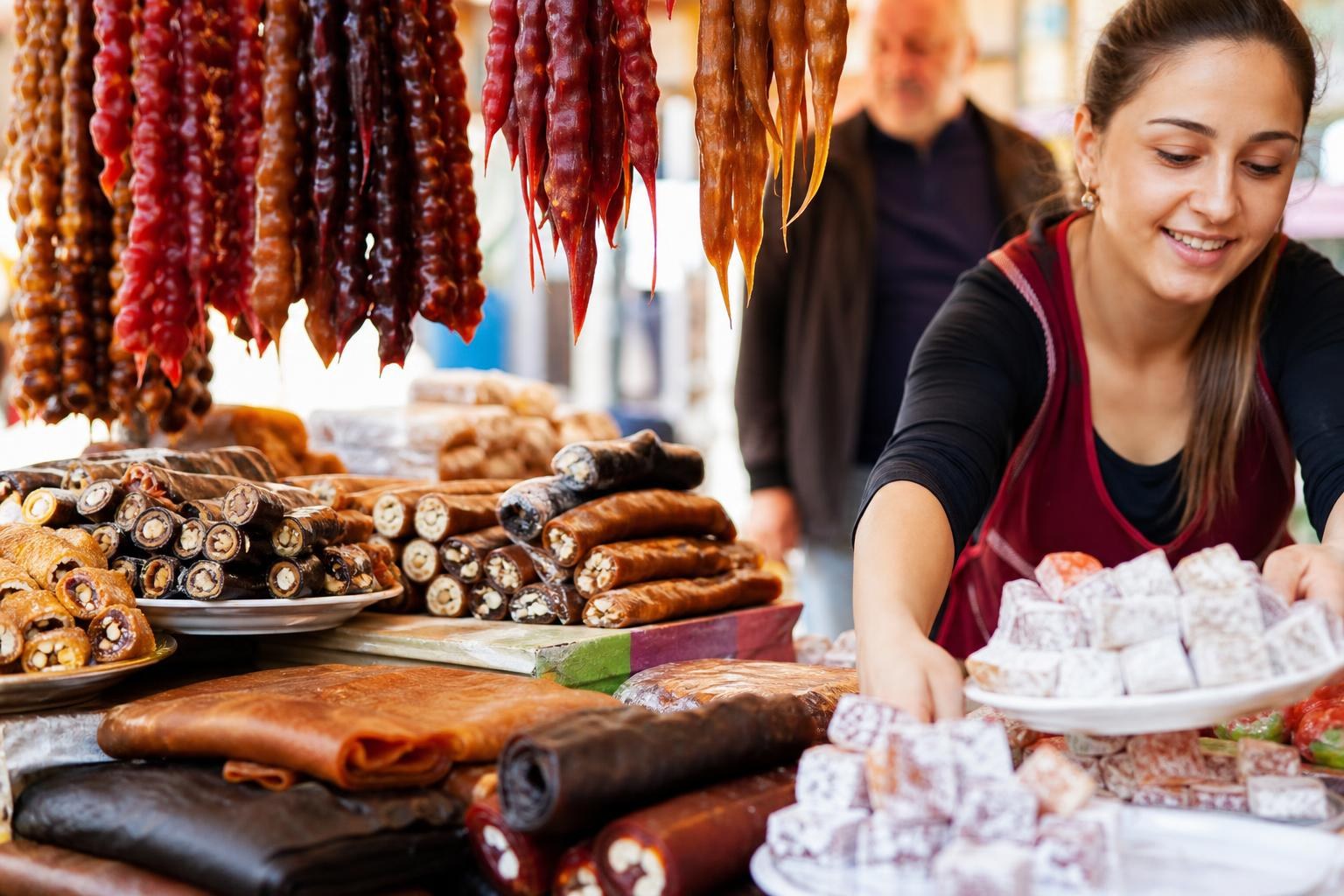
Churchkhela is often called the “Georgian Snickers,” and while the comparison is reductive, it captures something true: this is a dense, satisfying, nut-filled confection designed to deliver energy. Strings of walnuts (or sometimes hazelnuts or almonds) are threaded onto a cord, dipped repeatedly into hot tatara (grape must thickened with wheat flour), and hung to dry for one to two weeks. The result is a candle-shaped treat with a chewy grape exterior and a crunchy nut interior.
The process is labor-intensive. Each string gets dipped five to ten times, with drying time between coats. Traditional churchkhela production follows methods that have remained largely unchanged for centuries, though EU-supported programs have helped small producers meet food safety standards for export. A single piece costs roughly 3 to 5 GEL (about $1 to $1.80 USD) at local markets, making it one of the most affordable and portable snacks in the country.
Pelamushi: The Traditional Grape Juice Pudding
Pelamushi is what happens when you take the same tatara used for churchkhela but serve it warm as a pudding rather than drying it into a shell. Fresh grape must is heated with flour (traditionally corn flour in western Georgia, wheat flour in the east), stirred constantly until it thickens into a smooth, glossy mass, then poured into molds and topped with walnuts.
The texture sits somewhere between a French blancmange and a Turkish muhallebi, but the flavor is entirely its own: deeply fruity, lightly tannic, and not cloyingly sweet. Pelamushi is seasonal by nature, appearing primarily during the September and October grape harvest. Some Tbilisi restaurants now serve it year-round using preserved grape must, but purists insist it tastes best made fresh during rtveli, when the grape juice still carries the warmth of the sun.
Festive Pastries and Holiday Specialties
Georgian holidays are inseparable from specific desserts. Each celebration has its own signature sweet, and preparing these treats is a communal activity that binds families and neighborhoods together.
Gozinaki: The Essential New Year’s Honey Treat
Gozinaki is the taste of Georgian New Year. Made from toasted walnuts folded into hot honey, spread flat, and cut into diamond or rectangle shapes, it is the simplest of Georgian confections and arguably the most beloved. The preparation is straightforward, but the technique matters: the honey must be heated to exactly the right temperature (around 150°C) so it caramelizes slightly without burning, creating a brittle that snaps cleanly.
Every family has its own version. Some add a squeeze of lemon juice for brightness. Others incorporate toasted sesame seeds or sunflower seeds alongside the walnuts. In Svaneti, you might find gozinaki made with local mountain honey that has a distinctly herbal, almost medicinal quality. The tradition of preparing gozinaki for New Year’s celebrations dates back centuries, and skipping it would be like an American family skipping pumpkin pie at Thanksgiving: technically possible, but culturally unthinkable.
Kada: The Flaky Sweet Bread of the Mountains
Kada (sometimes spelled k’ada) is a layered pastry filled with a sweet mixture of butter, flour, and sugar. It originates in the mountainous regions of Georgia, particularly Adjara and parts of Guria, where the cold climate demands calorie-dense foods. The dough is rolled thin, spread with the sweet filling, folded, and baked until golden.
The result resembles a cross between a Danish pastry and an Indian paratha: flaky, buttery, and moderately sweet. Unlike many Georgian desserts, kada does use refined sugar in its filling, reflecting a slightly more modern evolution. It is commonly served at Easter, weddings, and other celebrations, often alongside strong Georgian tea. A good kada should shatter when you break it, revealing dozens of paper-thin layers inside.
Regional Varieties and Nut-Based Delights
Georgia’s dessert traditions vary significantly from region to region. The country is small (roughly the size of West Virginia), but its dramatic topography creates isolated valleys and microclimates that have fostered distinct culinary identities.
Nazuki: The Spiced Aromatic Bread of Surami
Nazuki is a sweet bread specific to the town of Surami, located on the highway between Tbilisi and Kutaisi. It is baked in a tone (the same cylindrical clay oven used for regular Georgian bread), and its dough is enriched with butter, sugar, cinnamon, cloves, and sometimes raisins. The exterior develops a dark, slightly charred crust from the oven’s intense heat, while the interior stays soft and fragrant.
Driving through Surami, you will see roadside vendors selling nazuki from wooden stalls, each loaf still warm. A loaf typically costs 3 to 4 GEL. The bread is best eaten within a few hours of baking, as it dries out quickly. Some travelers describe it as Georgia’s answer to cinnamon bread, but the clove and the tone-oven smokiness give it a character that is distinctly its own.
Paska: The Symbol of Georgian Easter
Paska is Georgia’s Easter bread, a rich, tall, cylindrical loaf decorated with a cross on top. The dough contains eggs, butter, and sugar, and it is often flavored with vanilla or citrus zest. While paska exists in various forms across Eastern Orthodox cultures (Ukraine’s version is perhaps the most internationally known), the Georgian iteration tends to be less sweet and more bread-like.
Preparing paska is a serious ritual. The dough requires multiple rises, and many Georgian grandmothers insist on absolute silence during the final rise, believing that loud noises will cause the bread to collapse. The bread is blessed at church on Easter Saturday and then broken and shared among family members on Easter Sunday morning. It is one of the few Georgian desserts that relies on wheat flour and dairy rather than nuts and grape must, reflecting the influence of broader Orthodox Christian baking traditions.
Nutritional Profile and Seasonal Availability Table
Georgian desserts tend to be more nutritionally interesting than their Western counterparts because they rely on whole nuts, honey, and fruit rather than refined sugar and artificial ingredients. That said, they are still calorie-dense: a single piece of churchkhela can pack 250 to 350 calories, mostly from walnuts.
| Dessert | Primary Ingredients | Calories (approx. per serving) | Peak Season | Shelf Life |
|---|---|---|---|---|
| Churchkhela | Walnuts, grape must, flour | 250-350 | Oct-Nov (harvest) | 2-3 months |
| Pelamushi | Grape must, corn/wheat flour | 150-200 | Sep-Oct | 2-3 days |
| Gozinaki | Walnuts, honey | 200-280 | Dec-Jan (New Year) | 2-4 weeks |
| Kada | Flour, butter, sugar | 300-400 | Year-round | 1-2 days |
| Nazuki | Flour, butter, cinnamon, cloves | 250-300 | Year-round | Same day |
| Paska | Flour, eggs, butter, sugar | 200-280 | Easter (spring) | 2-3 days |
The seasonal pattern is important for travelers. If you visit Georgia in October during the grape harvest, you will find fresh pelamushi and newly made churchkhela everywhere. Visit in late December, and gozinaki dominates. Summer visitors may find fewer traditional sweets available, though Tbilisi’s bakeries and confectioneries stock churchkhela and kada year-round.
Modern Takes on Ancient Flavors
The Georgian confectionery market is experiencing a genuine boom. The chocolate and confectionery sector is projected to grow at a CAGR of 27.32% from 2025 to 2031, driven by both domestic demand and growing export interest. This growth is fueling a wave of innovation that respects tradition while pushing boundaries.
Artisanal Reinterpretations in Tbilisi
Tbilisi’s food scene has exploded over the past five years, and desserts are no exception. Artisanal producers like Nugbari have built businesses around premium churchkhela and nut-based confections, using high-quality ingredients and modern packaging that makes these traditional treats viable as gifts and exports. You can now find churchkhela dipped in dark chocolate, gozinaki infused with saffron, and pelamushi served as a fine-dining dessert with walnut praline and grape reduction.
The Fabrika complex in Tbilisi’s Marjanishvili district hosts pop-up confectioners who experiment with flavors like matcha-walnut churchkhela or honey-lavender gozinaki. These innovations sometimes draw purist criticism, but they are introducing Georgian desserts to audiences who might never try the traditional versions. A box of artisanal churchkhela from a Tbilisi boutique runs about 25 to 40 GEL ($9 to $14 USD), significantly more than market prices but packaged for gifting.
Pairing Georgian Sweets with Qvevri Wines
One of the most exciting developments is the pairing of traditional Georgian confections with qvevri wines: wines fermented in large clay vessels buried underground, a method UNESCO recognized as Intangible Cultural Heritage. The logic is intuitive, since churchkhela and pelamushi are already made from grape must, they share a natural affinity with wine.
Amber wines (white grapes fermented with their skins in qvevri) pair beautifully with walnut-heavy churchkhela. The wine’s tannins complement the nut’s bitterness, while its dried-fruit notes echo the grape must coating. Sweet Kindzmarauli, a naturally semi-sweet red from Kakheti, works surprisingly well with gozinaki: the honey’s caramel notes play against the wine’s dark berry character. Several wine bars in Tbilisi, including Vino Underground and g.Vino, now offer dedicated dessert-and-wine pairing flights that showcase these combinations.
A Tradition Worth Tasting
Georgia’s dessert traditions carry something rare: they are genuinely ancient, made from ingredients that grow abundantly in the local landscape, and still prepared by hand in homes and small workshops across the country. Unlike many “traditional” foods that have been industrialized beyond recognition, a churchkhela bought from a village grandmother in Kakheti in 2026 tastes essentially the same as one made 500 years ago.
Whether you are planning a trip to Georgia or hunting for Georgian sweets at a specialty shop abroad, the key is to start with the classics: churchkhela for texture, gozinaki for sweetness, pelamushi for something you have genuinely never tasted before. These are not just desserts. They are edible history, and they deserve a place on your table.