
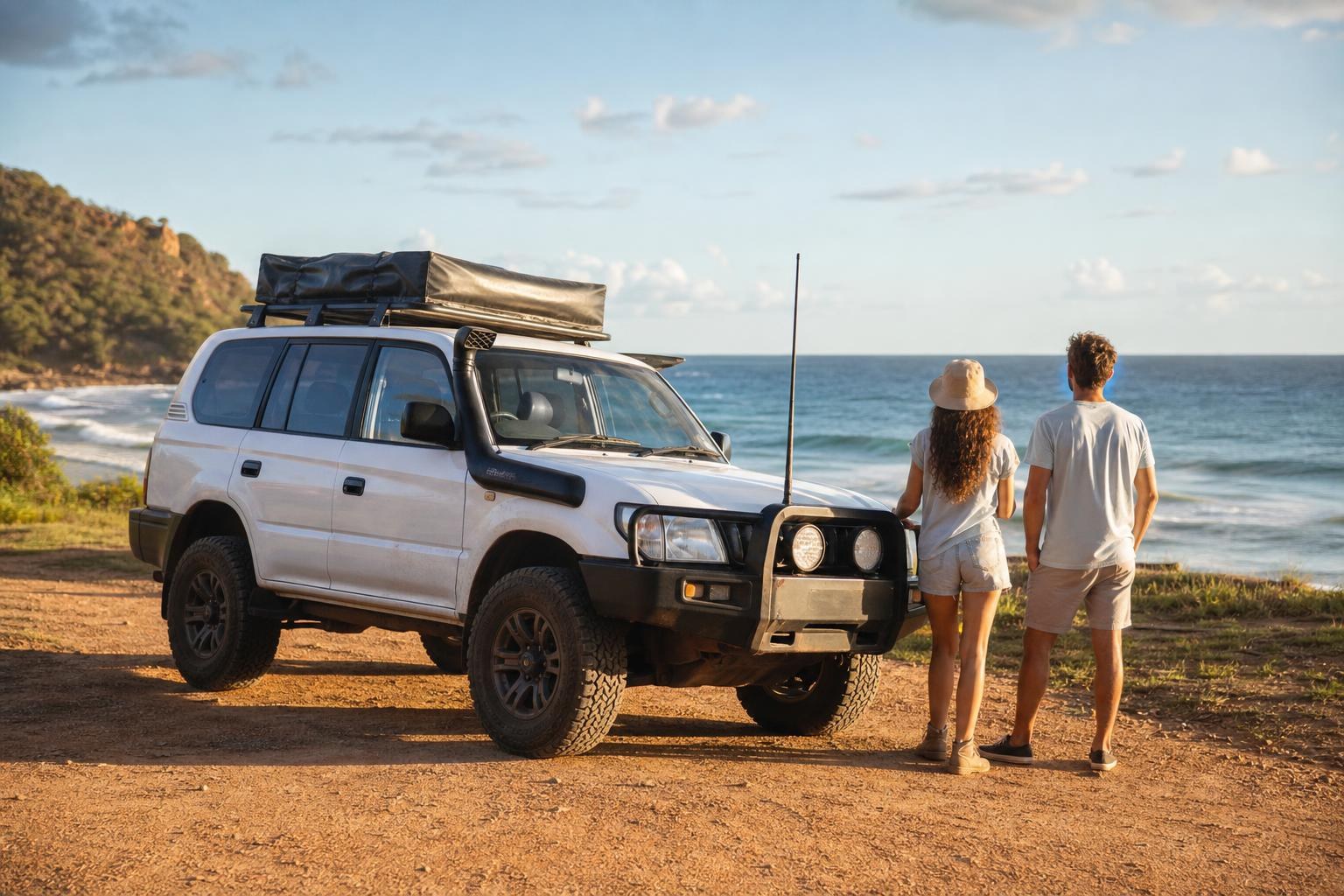
Table of Contents
If you’ve ever stared at a gravel road winding into the mountains and thought, “my sedan isn’t going to cut it,” you already understand the appeal of renting a four-wheel-drive vehicle. Whether it’s a week-long overland trip through Namibia, a ski weekend in the Alps, or a self-drive safari in East Africa, having the right vehicle changes everything. A 4×4 rental gives you access to terrain, experiences, and freedom that a standard car simply can’t deliver. But the category is broader than most people realize, and the pricing, insurance, and vehicle options can trip you up if you don’t know what you’re looking at. This guide breaks down exactly what renting a 4×4 means, how the process works, why people do it, and how to avoid the mistakes that cost real money.
What is 4×4 Rental?
Definition
A 4×4 rental is the short-term hire of a vehicle equipped with a four-wheel-drive system, meaning engine power is distributed to all four wheels rather than just two. These vehicles are specifically designed to handle rough terrain, unpaved roads, steep inclines, river crossings, and conditions where a two-wheel-drive car would get stuck or become dangerous to drive.
The “4×4” designation refers to the drivetrain configuration: four wheels total, four wheels powered. Some rental vehicles are full-time 4WD (power goes to all wheels constantly), while others are part-time or selectable, meaning the driver can switch between two-wheel and four-wheel drive depending on conditions. This distinction matters more than most renters realize, because a part-time system on a paved highway can actually damage the drivetrain if left engaged.
Rental companies offering these vehicles range from global chains like Hertz and Europcar to specialized outfitters that focus exclusively on off-road and overlanding vehicles. The specialized operators tend to provide better-equipped trucks with recovery gear, rooftop tents, and satellite communication devices, while the big chains typically offer standard SUVs with 4WD capability but minimal off-road preparation.
Key Concepts
A few terms come up repeatedly in this space, and understanding them saves confusion at the rental counter.
- AWD vs. 4WD: All-wheel drive (AWD) is a lighter system found in crossover SUVs. It improves traction on wet roads but isn’t designed for serious off-roading. True 4WD systems include low-range gearing for crawling over rocks and through mud. If you need to go off-road, make sure the vehicle has 4WD with low range, not just AWD.
- Ground clearance: Measured in millimeters or inches from the lowest point of the vehicle to the ground. A Toyota Land Cruiser typically offers around 225mm; a standard sedan sits at about 130mm. That difference determines whether you clear a rock or rip off your oil pan.
- Transfer case: The mechanical component that splits power between front and rear axles. Vehicles with a proper transfer case and locking differentials are the ones you want for serious terrain.
- Self-drive vs. chauffeur-driven: Most rentals are self-drive, but in some regions (parts of West Africa, for example) you’ll find operators who include a driver-guide. This can be worth the extra cost if you’re unfamiliar with local road conditions.
The type of vehicle you actually need depends entirely on where you’re going. A Suzuki Jimny handles mountain trails in Georgia or Iceland perfectly well and costs a fraction of a Land Cruiser. But if you’re crossing the Makgadikgadi Pans in Botswana, you need something heavier with long-range fuel tanks and proper recovery points.
How 4×4 Rental Works
Core Mechanism
The rental process for a four-wheel-drive vehicle follows a similar pattern to any car hire, but with a few critical differences that catch first-timers off guard.
You start by selecting a vehicle category. Most operators group their fleet into tiers: light 4×4 (think Suzuki Jimny, Dacia Duster), mid-range (Toyota Hilux, Ford Ranger), and heavy/expedition (Land Cruiser 300, Land Rover Defender). Pricing scales accordingly, and the gap between tiers can be significant. A Jimny in Iceland might run $80-120 per day in 2026, while a fully equipped Land Cruiser in Namibia can hit $250-400 per day depending on the season and included gear.
The booking itself typically requires a valid driver’s license (international driving permit recommended in most countries outside your home region), a credit card for the security deposit, and a minimum age of 21-25 depending on the operator. Security deposits for 4×4 vehicles are substantially higher than for regular cars: expect $1,500 to $5,000 held on your card, sometimes more for expedition-grade vehicles.
One thing that surprises many renters is the mileage policy. Some operators offer unlimited kilometers, but many off-road rental companies cap daily mileage at 200-300km, with per-kilometer charges beyond that. On a two-week trip through southern Africa, those overages can add up to hundreds of dollars if you don’t plan your route carefully.
Components
A typical 4×4 rental package includes several components beyond just the vehicle itself.
| Component | Standard Rental | Expedition/Overlanding Rental |
|---|---|---|
| Vehicle | Base 4×4, highway tires | Modified 4×4, all-terrain tires |
| Insurance | Basic CDW, high excess | Comprehensive, lower excess |
| Equipment | Spare tire, jack | Recovery boards, hi-lift jack, compressor |
| Navigation | GPS unit or phone mount | Satellite communicator, paper maps |
| Camping gear | Not included | Rooftop tent, kitchen kit, fridge |
| Support | Roadside assistance (paved roads) | Satellite-based recovery, backup vehicle |
Insurance deserves its own mention because it’s where most of the confusion and unexpected cost lives. Standard collision damage waiver (CDW) policies from big chains often exclude damage from unpaved roads, water crossings, or driving on the vehicle’s roof. Read that again: the insurance on your off-road vehicle may not cover off-road damage. Specialized operators usually offer more appropriate coverage, but you need to read the fine print and ask specifically about gravel road damage, tire punctures, and windshield chips, which are the three most common claims.
Benefits and Use Cases
Key Benefits
The most obvious benefit of renting a 4×4 is access. Roads that are impassable in a regular car become routine. But the advantages go deeper than that.
Freedom of schedule is a big one. When you’re not dependent on tour operators or transfer services, you set your own pace. Want to spend an extra night at a remote campsite because the sunset was extraordinary? You just do it. This kind of flexibility is impossible with organized tours, and it fundamentally changes the quality of a trip.
Safety is another factor people underestimate. In countries with poorly maintained roads, a vehicle with proper ground clearance, four-wheel drive, and decent tires is genuinely safer than a sedan. Potholes that would destroy a low-slung car are minor bumps in a Hilux. Flooded sections of road that strand two-wheel-drive vehicles are manageable with proper traction. In mountainous regions like the Caucasus or the Scottish Highlands, a 4×4 handles icy switchbacks with far more confidence than a front-wheel-drive hatchback.
Cost efficiency also plays a role, particularly for groups. A single 4×4 rental carrying four people with camping gear can be dramatically cheaper than four individual spots on a guided safari or adventure tour. A two-week self-drive safari in Namibia might cost $3,000-4,000 total for the vehicle, while a comparable guided tour runs $5,000-8,000 per person.
Common Applications
People rent four-wheel-drive vehicles for a wide variety of purposes, and the use case shapes everything from vehicle choice to insurance needs.
- Overland travel and self-drive safaris: Southern and East Africa are the biggest markets here. Namibia, Botswana, Tanzania, and South Africa all have well-established 4×4 rental infrastructure with vehicles equipped for multi-week bush travel.
- Winter driving: Ski trips in the Rockies, Scandinavia, or the Caucasus. Snow and ice demand the traction that only AWD or 4WD provides. In Georgia, for instance, reaching ski resorts like Gudauri or Bakuriani in January without a 4×4 is risky at best.
- Island and remote exploration: Iceland’s F-roads legally require 4WD vehicles, and rental companies will fine you for taking a standard car onto them. Similar situations exist in the Faroe Islands, Crete’s mountain roads, and parts of New Zealand’s South Island.
- Construction and work sites: Less glamorous but common. Contractors working in rural areas often rent 4×4 pickups for weeks or months rather than buying a fleet vehicle.
- Emergency and disaster response: NGOs and aid organizations frequently rent local 4×4 fleets when deploying to areas with damaged infrastructure.
The rental market has grown significantly since 2020, driven partly by the post-pandemic shift toward independent travel and partly by the expansion of overlanding as a mainstream travel style rather than a niche hobby.
Best Practices
Renting a 4×4 well is about avoiding the mistakes that cost money, time, or safety. Here’s what actually matters based on patterns I’ve seen repeatedly.
Check the vehicle thoroughly before you leave the lot. I mean thoroughly. Photograph every scratch, dent, and chip. Open the hood and check fluid levels. Verify the spare tire is inflated and the jack works. Test the 4WD system in the parking lot. Rental companies in popular off-road destinations deal with constant damage claims, and some operators will try to pin pre-existing damage on you if you haven’t documented the vehicle’s condition at pickup.
Understand your insurance before you need it. Call your credit card company and ask specifically whether their rental coverage applies to 4×4 vehicles on unpaved roads. Most premium travel credit cards exclude “off-road use” from their coverage, which effectively means any gravel road. If your card doesn’t cover it, buy the operator’s comprehensive policy. The $20-40 per day feels expensive until you’re looking at a $2,500 tire and rim replacement bill.
Learn the vehicle before you hit difficult terrain. Spend 30 minutes in a safe area practicing engaging and disengaging 4WD, using low range, and understanding the vehicle’s turning radius. A Land Cruiser handles nothing like a Jimny, and neither handles like your car at home. If the rental company offers a briefing, take it seriously.
Carry the right supplies. Even on a day trip, you should have at least 5 liters of extra water, a basic first aid kit, a charged phone with offline maps downloaded, and a tire repair kit. For multi-day trips in remote areas, add recovery boards (or confirm the rental includes them), a satellite communicator like a Garmin inReach, and extra fuel if your route includes long stretches between stations.
Book early for peak seasons. The global fleet of well-maintained expedition 4x4s is smaller than demand suggests. In Namibia, vehicles for July-October (dry season) often book out six to nine months in advance. Iceland’s summer season is similarly competitive. If you’re planning a trip during peak periods, reserve your vehicle as early as possible, and get the confirmation in writing.
Fuel costs will be higher than you expect. A Land Cruiser or Hilux burns 12-16 liters per 100km on pavement and significantly more off-road. Budget for fuel as a major expense category, not an afterthought. In remote regions, fuel prices can be 30-50% higher than in cities.
Related Concepts
The world of 4×4 rental overlaps with several adjacent categories that are worth understanding, especially if you’re comparing options.
Overlanding is the closest cousin. While a rental 4×4 is simply a vehicle, overlanding is a travel philosophy: self-sufficient, vehicle-based travel through remote areas, typically with camping equipment built into or onto the vehicle. Many specialized rental operators cater specifically to overlanders, providing vehicles with rooftop tents, portable fridges, cooking equipment, and water storage. The line between “renting a 4×4” and “renting an overland rig” is mostly about equipment and intent.
Campervan and motorhome rentals serve a similar self-drive audience but with different priorities. A campervan offers more living comfort but far less off-road capability. You won’t take a Sprinter van down a rocky riverbed. For travelers who want to stay on paved or well-maintained gravel roads and prioritize sleeping comfort over terrain access, a campervan makes more sense. For those heading into genuinely rough country, a 4×4 with a rooftop tent is the better tool.
Vehicle subscription services have emerged as an alternative to traditional rentals for longer-term needs. Companies in Europe and North America now offer monthly subscriptions that include insurance, maintenance, and roadside assistance for a flat fee. These can be more economical than daily rental rates for trips lasting a month or longer, though the vehicle selection tends to favor urban SUVs over proper off-road trucks.
Guided 4×4 tours represent the other end of the spectrum from self-drive rental. You get the vehicle and the terrain, but someone else drives and plans the route. This makes sense for travelers who want the experience without the responsibility, or for destinations where local knowledge is essential for safety. Parts of Mongolia, the Sahara, and remote Patagonia fall into this category.
Finally, the concept of “hire purchase” or rent-to-own schemes has gained traction in markets like South Africa and Australia, where people rent a 4×4 for an extended period with the option to buy it at the end. This suits expats or long-term travelers who need a vehicle for six months to a year but don’t want to deal with buying and selling.
Understanding where a standard 4×4 rental fits among these options helps you choose the right approach for your specific trip. The rental model works best for trips lasting a few days to a few weeks, in destinations with established rental infrastructure, where you have enough driving confidence to handle the vehicle independently.
The core advice is simple: match the vehicle to the terrain, read every word of the insurance policy, and document the vehicle’s condition like your wallet depends on it, because it does. A well-planned rental of a four-wheel-drive vehicle opens up some of the most spectacular places on earth. A poorly planned one opens up your bank account. Take the time to get it right, and the freedom you gain is absolutely worth the effort.