
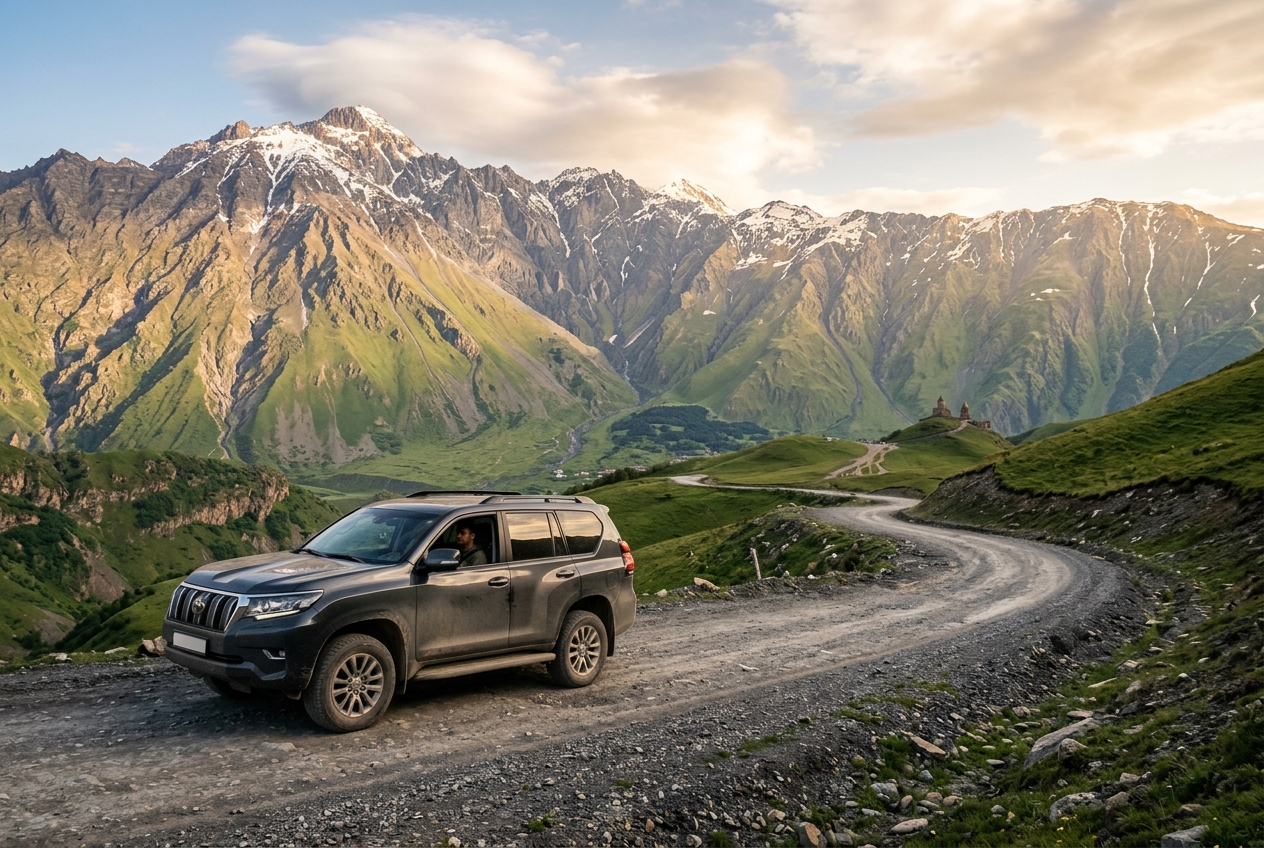
Georgia, the small Caucasus nation known locally as Sakartvelo, packs an absurd amount of geographic diversity into a country roughly the size of West Virginia. Within a single day’s drive, you can move from subtropical Black Sea coastline to semi-arid desert, then climb into alpine valleys where 5,000-meter peaks loom overhead. That range is exactly what makes the vehicle question so important. Travelers who show up expecting smooth European highways are in for a surprise: some of Georgia’s most spectacular destinations sit at the end of unpaved, rutted mountain tracks that would destroy a standard sedan. So is renting an SUV in Georgia actually worth the extra cost, or is it overkill for most itineraries? The answer depends entirely on where you plan to go, and this piece breaks it down destination by destination, season by season, and dollar by dollar.
Evaluating Georgia’s Diverse Terrain and Road Conditions
Georgia’s main highways have improved dramatically over the past decade. The road from Tbilisi to Batumi is a proper motorway now, and the Georgian Military Highway running north to Kazbegi is paved and well-maintained. But step off these primary corridors and conditions change fast. The country has roughly 20,000 kilometers of roads, and a significant portion of those outside major routes are gravel, dirt, or something in between. Understanding this split is the key to making a smart rental decision.
The Challenge of High-Altitude Mountain Passes
Several of Georgia’s most iconic routes cross passes above 2,500 meters. The Abastumani Pass, the Zagar Pass into Tusheti, and various tracks through Upper Svaneti sit at elevations where weather shifts without warning. These roads are narrow, often single-lane, and feature sheer drops with no guardrails. A sedan can technically handle some of these in perfect summer conditions, but you’ll be white-knuckling it the entire way, and one unexpected rain shower turns hard-packed dirt into a slippery mess. An SUV with decent tires and four-wheel drive gives you a genuine safety margin on these routes, not just comfort.
Navigating Unpaved Roads in Remote Regions
Beyond the mountain passes, many of Georgia’s remote villages are connected by unpaved roads riddled with potholes, river crossings, and loose rock. I’ve seen rental sedans bottomed out on the road to Dartlo, their oil pans cracked on rocks that a vehicle with proper ground clearance would have cleared easily. In regions like Tusheti, Khevsureti, and parts of Samtskhe-Javakheti, unpaved roads aren’t the exception: they’re the rule. If your itinerary includes any of these areas, a standard car isn’t just inconvenient; it’s genuinely risky.
Urban Driving vs. Off-Road Exploration
If you’re sticking to Tbilisi, Kutaisi, and Batumi with maybe a day trip to Kazbegi, a smaller car is perfectly fine and actually preferable. Tbilisi’s old town streets are narrow and parking is chaotic. A compact hatchback is easier to maneuver and park. Economy car rental options in Tbilisi start around $16 to $20 per day, which is hard to argue with for city-focused trips. The SUV question only becomes relevant when your plans extend beyond paved roads.
Must-Visit Destinations Requiring a 4×4 Vehicle
Some places in Georgia simply cannot be reached without a capable vehicle. These aren’t obscure spots: they’re on every serious traveler’s wish list, and they’re the reason most people consider upgrading their rental in the first place.
The Rugged Journey to Ushguli and Upper Svaneti
Ushguli, one of Europe’s highest continuously inhabited settlements, sits at 2,200 meters in Upper Svaneti. The road from Mestia to Ushguli is about 45 kilometers of rough gravel, river fords, and rocky stretches that take three to four hours to cover. During my first visit, I watched a Mitsubishi Delica ford a knee-deep river crossing that would have flooded any sedan’s exhaust. The medieval Svan towers and the view of Mount Shkhara make this journey one of Georgia’s absolute highlights, but you need a vehicle that can handle the punishment. Local marshrutkas (minibuses) do make the trip, but having your own 4×4 means you can stop at villages along the way and explore at your own pace.
Reaching the Remote Villages of Tusheti
Tusheti might be the strongest argument for renting an SUV in Georgia. The only road in crosses the Abano Pass at 2,926 meters, making it one of the most dangerous roads in Europe. It’s unpaved, single-lane in places, and open only from late May or June through October, depending on snowfall. There is no alternative route. You either drive it in a capable 4×4 or you don’t go at all. The reward is extraordinary: stone villages like Dartlo and Omalo perched on green ridgelines, with hiking trails that see a fraction of the traffic you’d find in more accessible mountain regions. A sedan simply cannot make this journey.
Exploring Vashlovani National Park’s Desert Landscapes
On the opposite end of Georgia’s geographic spectrum, Vashlovani National Park in the southeast offers semi-arid badlands, dramatic canyons, and a feeling of being on another planet entirely. The park requires a 4×4 for entry: rangers won’t let you in without one. The tracks inside the park cross dry riverbeds and loose sand, and there’s no cell service if something goes wrong. It’s one of the least-visited national parks in the Caucasus, which is part of its appeal, but preparation matters here.
Practical Benefits of an SUV for Georgian Road Trips
Beyond reaching specific destinations, an SUV offers day-to-day advantages that add up over a week or two of driving in Georgia.
Ground Clearance and Pothole Resilience
Even on Georgia’s paved secondary roads, potholes are a constant companion. The road from Kutaisi to Mestia, for example, is technically paved but has stretches where the asphalt has deteriorated badly. A sedan with 130mm of ground clearance will scrape and bounce through sections that an SUV with 200mm or more will handle without issue. This isn’t about comfort alone: hitting a deep pothole at speed can crack a wheel rim, blow a tire, or damage suspension components, any of which will ruin your day and potentially your trip.
Storage Capacity for Outdoor Gear and Luggage
Georgia is an outdoor destination. Most travelers who rent an SUV are planning to hike, camp, or at least spend significant time away from cities. A compact sedan’s trunk fills up fast with two backpacks, hiking boots, and a few bags of groceries from a Tbilisi supermarket. An SUV gives you room for camping gear, extra water (essential in Vashlovani), and the kind of supplies you need when your nearest shop might be three hours away. If you’re traveling as a group of three or four, the space difference becomes even more significant.
Cost Analysis: Rental Fees vs. Long-Term Value
The price gap between a sedan and an SUV in Georgia is real but not as dramatic as you might expect, especially when you factor in what you gain.
| Vehicle Type | Daily Rate (Low Season) | Daily Rate (High Season) | Best For |
|---|---|---|---|
| Economy sedan | $16-20 | $25-35 | City trips, paved highways |
| Compact SUV/crossover | $30-45 | $45-60 | Mixed terrain, light gravel |
| Full-size SUV/4×4 | $45-60 | $60-75+ | Mountain passes, Tusheti, Vashlovani |
Budget car rentals in Georgia start from around 24 to 49 euros per day, with costs increasing when you add extras like Collision Damage Waiver and airport pickup fees. Full SUVs run higher, but the premium of $25 to $40 per day often pays for itself when you consider the alternative: paying for guided 4×4 tours to places like Ushguli or Tusheti, which can cost $80 to $150 per person per trip.
Fuel Efficiency and Local Petrol Prices
SUVs burn more fuel, obviously. A typical economy car might get 6 to 7 liters per 100 kilometers on Georgian roads, while a Mitsubishi Pajero or Toyota Land Cruiser will drink 10 to 14 liters per 100 kilometers, especially on mountain roads. Petrol in Georgia costs roughly 3.20 to 3.50 GEL per liter (about $1.20 to $1.30 USD). For a two-week trip covering 2,500 kilometers, the fuel difference between a sedan and an SUV works out to roughly $80 to $120 extra. That’s noticeable but not trip-breaking, especially split between two or more travelers.
Insurance Considerations for Off-Road Use
This is where things get tricky and where many travelers get caught off guard. Most standard rental insurance policies in Georgia exclude damage caused on unpaved roads. If you take a basic sedan to Tusheti and crack the oil pan, you’re paying out of pocket. Even with an SUV, check whether your policy covers off-road use specifically. Local rental companies may offer better prices, more flexible terms, and vehicles better suited to Georgian roads than international chains, and they’re often more willing to include off-road coverage. Ask explicitly before signing. Some travelers use credit card travel insurance as a backup, but verify that your card covers off-road driving in Georgia before relying on it.
Seasonal Factors and Weather Variability
Georgia’s weather varies enormously by region and season, and this directly affects which vehicle you need.
Winter Driving and Snow Safety in the Caucasus
From November through March, mountain roads in Svaneti, Tusheti, and Khevsureti close entirely. The Tusheti road shuts down as early as October. Even the Georgian Military Highway to Kazbegi can close temporarily during heavy snowfall. If you’re visiting in winter, your driving will mostly be limited to lowland routes between Tbilisi, Kutaisi, Batumi, and the wine region of Kakheti. A sedan with winter tires handles these routes fine, though an SUV with all-wheel drive gives you extra confidence on icy stretches. November is actually the cheapest month to rent a car in Georgia, averaging $36 per day, so the cost argument for a sedan weakens during the off-season.
Muddy Conditions During the Spring Thaw
Spring in Georgia, roughly March through May, brings snowmelt and rain that turns unpaved roads into mud. Even roads that are manageable in summer become impassable for two-wheel-drive vehicles. The road to Ushguli typically doesn’t become reliably passable until mid-June. If you’re visiting in late spring and hoping to reach mountain destinations, a 4×4 isn’t optional: it’s mandatory. I’ve talked to travelers who rented sedans in May planning to visit Svaneti and had to turn back at river crossings that were bone-dry in August. Timing matters as much as vehicle choice.
Final Verdict: When to Choose an SUV over a Sedan
The honest answer to whether renting an SUV in Georgia is worth it comes down to your specific itinerary. If you’re spending a week exploring Tbilisi, tasting wine in Kakheti, visiting cave monasteries, and relaxing in Batumi, save your money and rent a compact car. Those routes are paved, well-maintained, and an SUV would be wasted.
But if Tusheti, Ushguli, Vashlovani, or Khevsureti are on your list, and they should be because these are Georgia’s most extraordinary destinations, an SUV isn’t a luxury. It’s a requirement. The $25 to $40 daily premium buys you access to places that are genuinely inaccessible otherwise, plus peace of mind on the unpredictable secondary roads that connect Georgia’s highlights.
My recommendation for most travelers spending ten days or more: rent a sedan for your first few days in Tbilisi and Kakheti, then swap to a 4×4 for the mountain portion of your trip. Several local agencies in Tbilisi will arrange this kind of split rental. It’s the most cost-effective approach and means you’re not wrestling a Land Cruiser through Tbilisi’s chaotic traffic when you don’t need to.
Georgia rewards travelers who get off the beaten path. The country’s soul lives in those remote mountain villages where a tamada will invite you to a supra you’ll never forget, where grandmothers press churchkhela in your hands and refuse payment, where the phrase stumari ghvtisaa, “a guest is from God,” isn’t a slogan but a lived belief. Getting there often requires a capable vehicle. Choose accordingly.