
Table of Contents
If you’ve ever traveled through the former Soviet Union, the Caucasus, or Central Asia, you’ve probably encountered a particular type of minibus that seems to operate by its own mysterious logic. It stops wherever passengers wave it down, the driver collects cash with one hand while steering with the other, and the vehicle itself is packed well beyond what any Western safety inspector would approve. This is the marshrutka: a shared minibus that serves as the backbone of public transportation across a vast stretch of the world. For millions of people, these vehicles aren’t a novelty or a curiosity. They’re the daily commute, the grocery run, the trip to visit relatives in another city. And for travelers, understanding how they work can mean the difference between getting hopelessly lost and unlocking the cheapest, most authentic way to move through a country. I’ve spent years riding these minibuses across Georgia, Armenia, Russia, and Ukraine, and I can tell you that the experience is equal parts chaotic, efficient, and oddly charming. Whether you’re planning a trip to Tbilisi or just trying to understand post-Soviet transit culture, here’s everything you need to know.
What is Marshrutka?
Definition
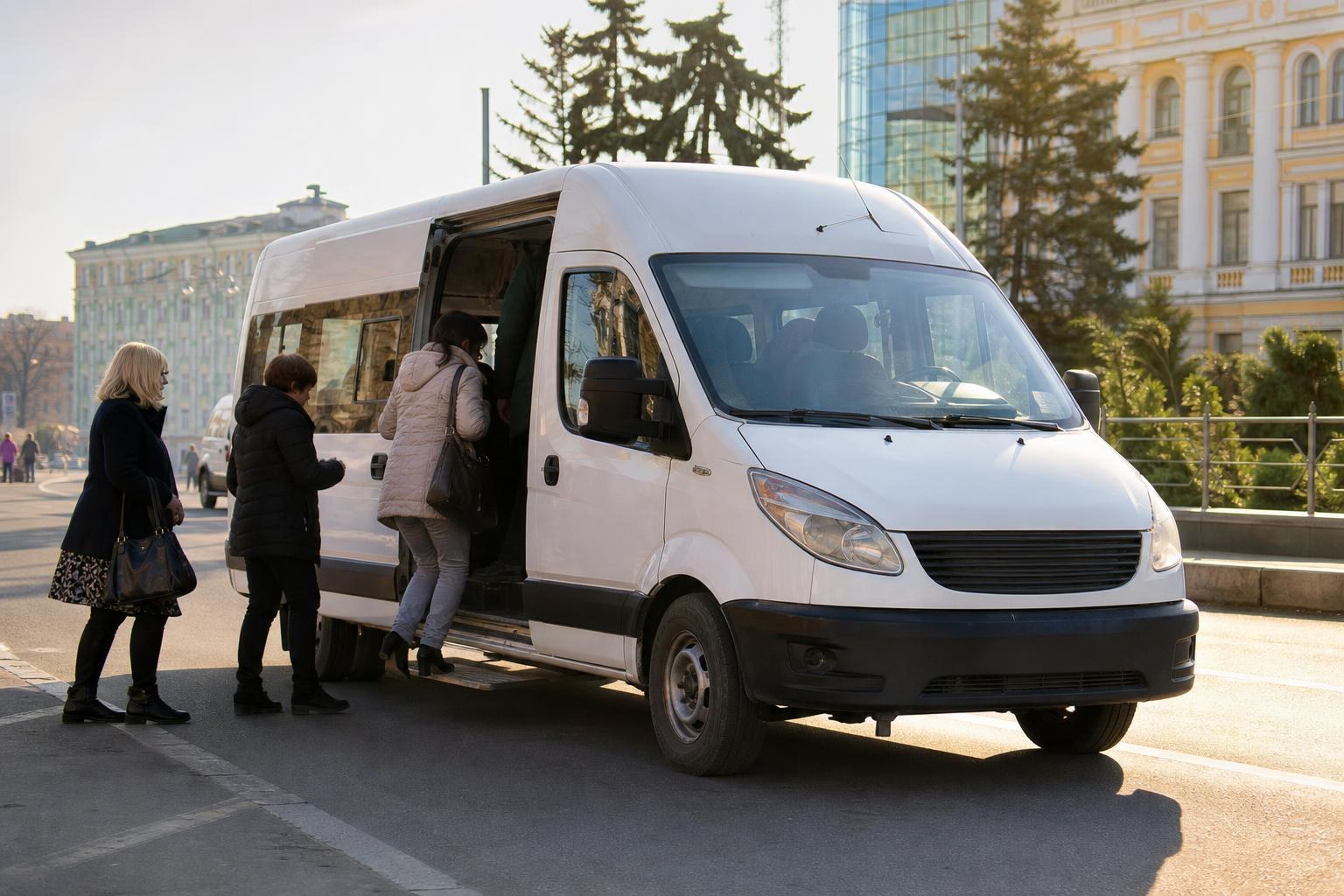
A marshrutka (Russian: маршрутка, derived from “marshrutnoye taksi,” meaning “routed taxi”) is a shared minibus that operates along a fixed route but with a degree of flexibility that distinguishes it from conventional city buses. Think of it as a hybrid between a city bus and a shared taxi. The vehicle follows a predetermined path through a city or between towns, but it can stop almost anywhere along that route when a passenger signals the driver.
These vehicles typically seat between 10 and 20 passengers, though in practice you’ll often find 25 or more people crammed inside during peak hours. The most common models are Mercedes-Benz Sprinters, Ford Transits, and older Soviet-era PAZ and GAZelle minibuses, though the fleet varies enormously by country and city. In Tbilisi, Georgia, for instance, you’ll see relatively modern yellow minibuses, while smaller towns in rural Armenia might still run aging Soviet-era vans that feel like time capsules.
The word itself has become so embedded in local vocabulary that it’s used across dozens of countries and languages. In Georgian, it’s “samarshruto” (სამარშრუტო). In Uzbek, “marshrutka” is borrowed directly from Russian. Regardless of the local name, the concept remains the same: cheap, frequent, semi-informal shared transit.
Key Concepts
Several characteristics set marshrutkas apart from other forms of public transit:
- Fixed routes, flexible stops: Unlike a city bus with designated stops, a marshrutka driver will typically pull over anywhere a passenger asks, as long as it’s safe (and sometimes when it isn’t)
- Cash-based payment: Passengers usually pay the driver directly in cash, either when boarding or when exiting, though some cities have introduced electronic payment cards in recent years
- No fixed schedule: Marshrutkas generally depart when full rather than at set times, especially on intercity routes
- Driver as operator: The driver simultaneously navigates traffic, collects fares, makes change, and manages the passenger load, often while talking on the phone
- Route numbers: Each marshrutka displays a route number and sometimes the major stops along its path, usually in the local language
The informality is the point. These vehicles fill gaps that formal transit systems can’t or won’t cover, connecting neighborhoods, villages, and cities with a frequency and reach that fixed-schedule buses rarely match.
How Marshrutka Works
Core Mechanism
The operational model is deceptively simple. A marshrutka follows a numbered route through a city or between two destinations. Passengers flag it down from the roadside, much like hailing a taxi, or board at a designated starting point such as a bus station. When you want to get off, you call out to the driver: the traditional phrase in Russian is “ostanovite pozhaluysta” (stop, please), though in Georgia you might hear “gacheret” or simply a loud knock on the window or wall of the vehicle.
Fares are typically fixed for the entire route, regardless of where you board or exit. In Tbilisi, a city marshrutka ride costs about 1 GEL (roughly $0.35 USD as of 2026), making it one of the cheapest transit options anywhere. Intercity routes cost more but remain remarkably affordable: a three-hour ride from Tbilisi to Kutaisi runs about 15-20 GEL ($5-7 USD).
On intercity routes, marshrutkas often depart from central bus stations (called “avtovagzali” in Georgian). There’s usually no advance ticketing. You show up, find the marshrutka heading to your destination, and wait until enough passengers have boarded for the driver to consider the trip worthwhile. During busy periods, departures can happen every 15-20 minutes. On quieter routes, you might wait an hour or more.
Components
The marshrutka ecosystem involves several distinct elements working together:
| Component | Description | Example |
|---|---|---|
| Vehicle | Minibus, typically 10-20 seats | Mercedes Sprinter, GAZelle |
| Driver/Operator | Often an independent contractor or small fleet employee | Pays a daily fee to the fleet owner, keeps the fares |
| Route | Numbered path through a city or between towns | Route #37 in Tbilisi (Didube to Gldani) |
| Fare | Fixed price, usually paid in cash | 1 GEL within Tbilisi, 15-20 GEL for intercity |
| Stops | Semi-formal: major intersections plus anywhere on request | Wave your hand, the driver pulls over |
| Schedule | Departs when full, no fixed timetable on most routes | Every 10-30 minutes during peak hours |
The economic model is worth understanding. Many marshrutka drivers don’t earn a salary. Instead, they rent the vehicle from a fleet owner for a daily fee (often around 50-100 GEL in Georgia) and keep whatever fares they collect above that amount. This creates a strong incentive to pack as many passengers as possible and to drive fast between stops, which partially explains the, let’s say, spirited driving style that most riders experience.
Benefits and Use Cases
Key Benefits
The marshrutka system persists across so many countries for good reason. It solves real transportation problems that formal systems struggle with.
Cost is the most obvious advantage. A marshrutka ride costs a fraction of what a taxi charges and is often cheaper than formal bus services where they exist. For residents of countries where average monthly salaries hover around $400-800 USD, the difference between a 1 GEL marshrutka ride and a 10 GEL taxi ride adds up fast over a month of daily commuting.
Frequency matters just as much. Because marshrutkas depart when full rather than on a fixed schedule, they naturally adjust to demand. During rush hour, you might see one every five minutes on popular routes. This organic responsiveness means less waiting time than many scheduled bus services can offer, especially in cities where formal transit infrastructure is underfunded.
Coverage is perhaps the most critical benefit. Marshrutkas reach places that no formal transit system bothers with. Small villages, suburban neighborhoods, industrial zones on city outskirts: if enough people need to get there, a marshrutka route will eventually emerge to serve them. In rural Georgia, a marshrutka might be the only public transit option connecting a mountain village to the nearest town.
For travelers specifically, marshrutkas offer an unfiltered window into local life. You’ll hear conversations, observe daily routines, and sometimes get drawn into impromptu interactions with curious locals. I once had an entire marshrutka of passengers in Kakheti collectively help me figure out where to get off for a specific winery, complete with a phone call to someone’s cousin who lived nearby.
Common Applications
The marshrutka serves different purposes depending on context:
- Daily urban commuting: The most common use, connecting residential neighborhoods to city centers, markets, and transit hubs
- Intercity travel: Connecting major cities and regional towns, often the cheapest option for distances under 300 km
- Airport transfers: In cities like Tbilisi, specific marshrutka routes connect the airport to the city center for a fraction of taxi prices
- Market and bazaar access: Routes often terminate at or near major markets, reflecting the commercial needs of regular riders
- Rural connectivity: In mountainous regions like Svaneti or Tusheti in Georgia, marshrutkas (sometimes upgraded to 4×4 vehicles) provide the only public transit link to remote communities
- Cross-border travel: Some marshrutka routes cross international borders, particularly between Georgia and Armenia or between Central Asian countries
Travelers heading to Georgia can use the Google Maps app or the Tbilisi-specific transit app to identify marshrutka routes, though real-time accuracy varies. The Bolt ride-hailing app works well in Georgian cities for when you’d rather skip the marshrutka experience entirely, but at 5-10x the cost.
Best Practices
Riding a marshrutka for the first time can be intimidating, especially if you don’t speak the local language. Here’s practical advice drawn from years of personal experience and countless conversations with fellow travelers.
Learn your route number before you leave. Ask your hotel or hostel staff which marshrutka number goes where you need, and write it down. Route numbers are usually displayed on a placard in the windshield, sometimes only in the local script (Georgian mkhedruli, Cyrillic, etc.). Having the number written down means you can match it visually even if you can’t read the destination text.
Carry small bills and coins. Drivers make change, but they’re not thrilled about breaking large notes during a busy route. In Georgia, keep 1 GEL coins handy. In Russia, have small ruble notes ready. Paying with exact change earns you quiet respect and speeds up the boarding process.
Sit near the front if you want to see where you’re going and communicate with the driver. Sit near the back if you want to observe local life and don’t mind a bumpier ride. Avoid the fold-down seats near the door if you can: they’re uncomfortable and you’ll need to stand up every time someone exits.
Tell the driver your destination when you board, especially on intercity routes. A simple “Kutaisi?” with a questioning tone works fine. On city routes, having your stop name written in the local language on your phone screen is incredibly helpful. Google Translate’s offline pack for Georgian or Russian is worth downloading before your trip.
Watch how locals pay and exit. In some cities, you pay when boarding. In others, you pass your money forward through other passengers to the driver (yes, really) and your change comes back the same way. When you want to get off, call out clearly or knock on the interior wall. Don’t be shy about it: drivers are used to loud signals and may not notice a polite murmur.
A word about safety: marshrutka driving standards vary wildly. Georgian marshrutka drivers have a well-earned reputation for aggressive driving, and accident rates on intercity routes are a genuine concern. Wearing a seatbelt when one is available is wise, even if no one else does. Avoid standing if possible, and consider skipping marshrutkas on mountain roads in bad weather, where the risk calculus shifts significantly.
Related Concepts
The marshrutka doesn’t exist in isolation. It belongs to a broader family of informal and semi-formal transit systems found worldwide, each adapted to local conditions.
The closest equivalent in other regions is the “dolmuş” in Turkey: a shared minibus that operates along fixed routes with flexible stops, using a nearly identical economic model. The word “dolmuş” literally means “stuffed” or “filled,” which tells you everything about the boarding philosophy. If you’ve ridden one, you already know how a marshrutka works.
In Southeast Asia, the “songthaew” (Thailand) and “jeepney” (Philippines) serve similar functions. Latin America has its “colectivos” and “peseros.” Africa has “matatus” (Kenya), “tro-tros” (Ghana), and “danfos” (Nigeria). Each of these evolved independently to solve the same problem: how do you provide affordable, frequent transit in cities and regions where formal public transportation is inadequate or nonexistent?
What makes the post-Soviet marshrutka system distinctive is its scale and the degree to which it was formalized after the collapse of the USSR. When state-run bus systems deteriorated in the 1990s, private operators filled the vacuum almost overnight. Governments eventually imposed route licensing, fare regulations, and vehicle inspections, creating a system that sits somewhere between fully informal (like many African minibus networks) and fully formal (like Western European bus systems).
Some cities are actively phasing out marshrutkas in favor of modern bus fleets. Tbilisi has been gradually replacing marshrutka routes with larger, air-conditioned city buses over the past several years, and Moscow completed a similar transition in 2020. But in smaller cities and on intercity routes, the marshrutka remains irreplaceable: no formal system can match its flexibility, frequency, and cost-effectiveness in areas with lower population density.
The cultural significance runs deeper than transportation. The marshrutka is a social space where strangers interact, help each other with directions, share food on long rides, and collectively negotiate the chaos of post-Soviet urban life. It’s a microcosm of the societies it serves: informal, occasionally frustrating, surprisingly functional, and deeply human.
For anyone planning travel in Georgia, Armenia, or the broader region, the marshrutka isn’t just a way to get from point A to point B. It’s an experience that reveals how these societies actually work, one crowded, rattling, improbably efficient minibus ride at a time. Download your offline maps, pocket some small change, and don’t be afraid to knock loudly on the wall when your stop approaches. The driver’s heard worse.