
Table of Contents
- Morning: Old Tbilisi and Narikala Fortress
- One-Day Tbilisi Logistics and Costs
- Midday: Cultural Landmarks and Modern Architecture
- Afternoon: Rustaveli Avenue and Mtatsminda Park
- Evening: Wine Tasting and Georgian Supra
- Essential Tips for a Perfect 24 Hours in Tbilisi
Tbilisi is one of those cities that rewards the rushed visitor almost as generously as the slow traveler. I’ve spent weeks in this city across multiple trips, and every time I return, I’m struck by how much you can absorb in a single day if you plan your route well. The capital of Georgia packs centuries of history, jaw-dropping architecture, and some of the best food on the continent into a walkable core that rarely requires a taxi. Whether you’re on a long layover, squeezing in a day trip from a Caucasus road trip, or just testing the waters before a longer stay, this 24-hour Tbilisi itinerary covers the highlights without feeling like a sprint. Georgia’s tourism numbers have been climbing steadily, with over 1.6 million international visitors arriving in the second quarter of 2025 alone, and Tbilisi absorbs the bulk of that traffic. The city handles it well. Most major sights cluster within a 2-kilometer radius in the Old Town, which means your biggest enemy isn’t distance: it’s lingering too long over a second plate of khachapuri. Here’s how to spend one day in Tbilisi and actually see the things that matter.
Morning: Old Tbilisi and Narikala Fortress
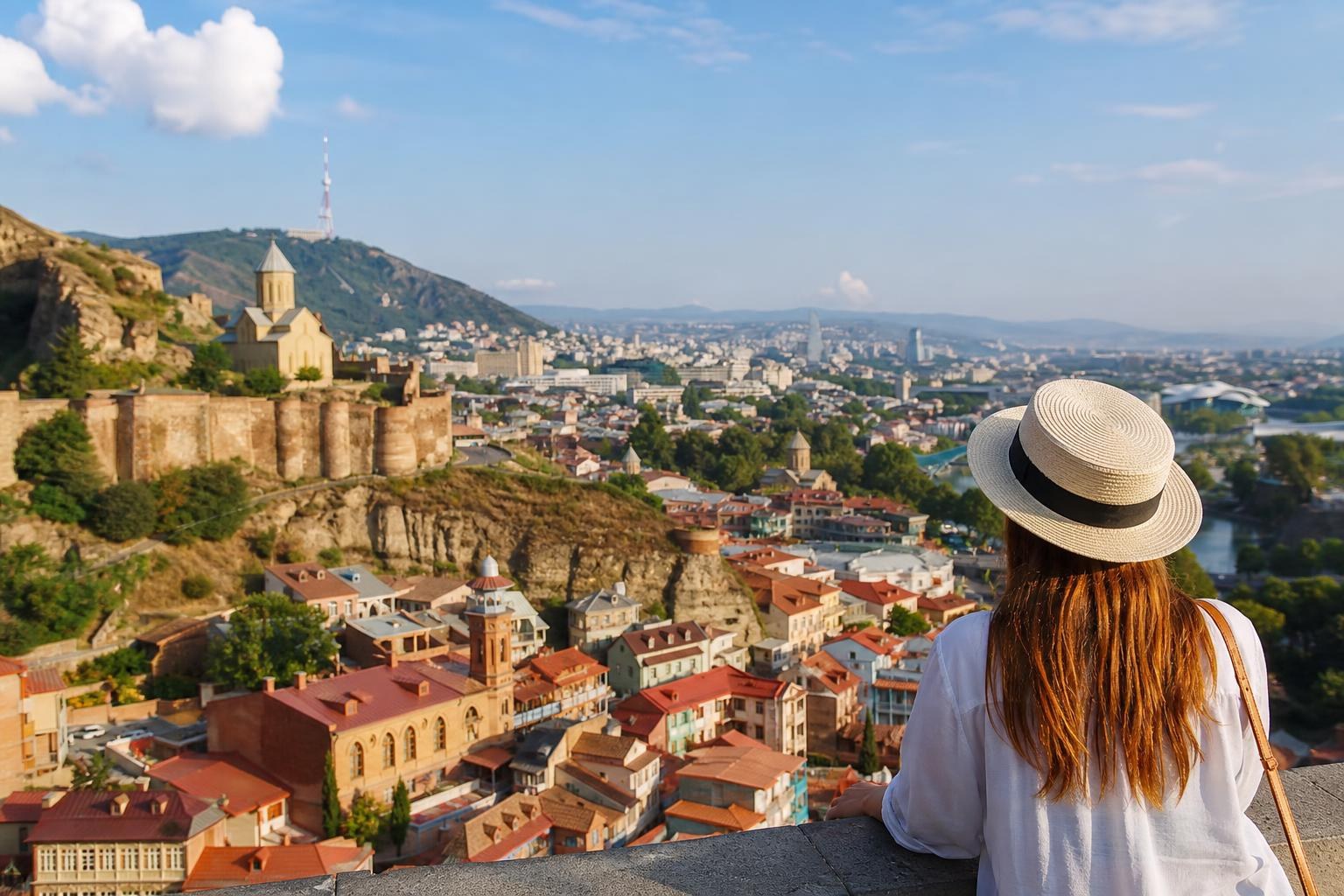
Start early. By 8:30 AM, the Old Town streets are still relatively quiet, the light is golden against the carved wooden balconies, and the sulfur baths haven’t yet filled with tour groups. Your morning loop covers three connected areas that you can walk between in minutes, and together they form the emotional core of the city.
The goal here is to move south to north through the oldest neighborhoods, climbing up to the fortress before the midday heat makes the ascent uncomfortable. Wear shoes with grip: the cobblestones are uneven and the fortress path is steep in places.
The Sulfur Bath District (Abanotubani)
Abanotubani sits at the southern edge of Old Tbilisi, right where the Tsavkisis-Tskali River meets the Mtkvari. The district’s brick-domed bathhouses have been operating since the 13th century, and legend holds that King Vakhtang Gorgasali founded Tbilisi itself after discovering these hot springs while hunting. The name “Tbilisi” comes from “tbili,” meaning warm in Georgian.
You don’t need to take a full bath this early (though if you want to, the Orbeliani Bathhouse opens at 7 AM and a private room runs about 80-120 GEL). Walking through the district takes only 15-20 minutes, but the photo opportunities are constant: the blue-tiled facade of the Orbeliani baths, steam rising from vents in the brick domes, and the narrow streets lined with grapevines overhead. The sulfur smell is noticeable but not overwhelming.
Narikala Fortress and Mother of Georgia
From Abanotubani, you have two options for reaching Narikala Fortress. The cable car from Rike Park costs 2.50 GEL each way using a Metromoney card, but I’d recommend walking up the trail from the botanical garden side for the morning route and saving the cable car for later. The hike takes about 20 minutes at a moderate pace.
Narikala dates to the 4th century and has been expanded by every empire that passed through: Persians, Arabs, Mongols, Ottomans, and Russians all left their mark. The fortress walls are partially ruined, which honestly makes them more photogenic. From the top, you get a 360-degree panorama of the city: the Mtkvari River cutting through the valley, the modern skyline to the north, and the sprawling Soviet-era neighborhoods climbing the surrounding hills. The 20-meter aluminum statue of Kartlis Deda (Mother of Georgia) stands just east of the fortress, holding a wine bowl in one hand and a sword in the other. It’s a perfect summary of the Georgian character: hospitality for friends, steel for enemies.
Leghvtakhevi Waterfall and Meidan Square
Descend from Narikala back through the Old Town toward Leghvtakhevi Waterfall, a surprisingly lush cascade hidden in a gorge right in the middle of the city. The waterfall itself is modest, maybe 15 meters, but the walk through the narrow canyon with its overhanging cliffs feels like stepping out of an urban environment entirely. The path is paved and takes about 10 minutes each way.
From the waterfall, loop back to Meidan Square, which served as Tbilisi’s main trading hub for centuries. The square sits at the intersection of several Old Town streets and makes a natural meeting point. This is a good spot to grab your first Georgian coffee (strong, dark, often served with a piece of churchkhela from a nearby vendor for 3-5 GEL). By now it should be around 10:30 or 11 AM, and you’ve covered the most historically dense part of the city.
One-Day Tbilisi Logistics and Costs
One of the best things about Tbilisi for day-trippers is how affordable it remains compared to European capitals. A realistic daily budget for a mid-range traveler runs about $50-70 USD, covering meals, transport, entrance fees, and a couple of drinks in the evening.
Here’s a quick cost breakdown for this itinerary:
| Expense | Cost (GEL) | Cost (USD approx.) |
|---|---|---|
| Metro/bus rides (4 trips) | 10 | $3.50 |
| Cable car (round trip) | 5 | $1.80 |
| Funicular to Mtatsminda | 17 | $6.00 |
| Lunch (restaurant) | 25-40 | $9-14 |
| Dinner with wine | 50-80 | $18-28 |
| Museum entry | 15-20 | $5-7 |
| Coffee and snacks | 10-15 | $3.50-5 |
| Total | 132-187 | $47-65 |
Transport is almost negligible. The Tbilisi metro costs 1 GEL per ride (about $0.35), and you can buy a rechargeable Metromoney card at any station for 2 GEL. Bolt works well here and most rides within the center cost 5-8 GEL. For this itinerary, though, you’ll walk most of it. Download offline Google Maps before you go: cell data works fine in Tbilisi, but having offline maps as backup saves hassle.
Midday: Cultural Landmarks and Modern Architecture
By late morning, shift your focus northward from the Old Town toward Tbilisi’s more contemporary landmarks. This stretch bridges the medieval city and the 21st-century additions that have reshaped the skyline since 2010.
Gabriadze Clock Tower and Rezo Gabriadze Theater
The Gabriadze Clock Tower on Shavteli Street is one of those spots that looks whimsical in photos but hits differently in person. Built by the legendary Georgian puppeteer and filmmaker Rezo Gabriadze, the tower is covered in ceramic tiles and features a small angel that emerges every hour to strike a bell. The attached Gabriadze Theater hosts puppet shows that are genuinely moving, though getting tickets on short notice can be difficult during peak season.
Even if you can’t catch a show, spend 10 minutes watching the clock mechanism and browsing the attached cafe, which serves excellent coffee and has walls covered in Gabriadze’s original artwork. The theater sits on a street lined with galleries and small shops, and the whole block has a creative energy that feels distinctly Tbilisi.
The Bridge of Peace and Rike Park
Walk five minutes east to the Bridge of Peace, a glass-and-steel pedestrian bridge designed by Italian architect Michele De Lucchi and completed in 2010. It’s the most polarizing piece of architecture in the city: some Tbilisians love it, others think it clashes with the Old Town skyline. I think it works, especially at night when the LED canopy creates light patterns visible from across the river.
Cross the bridge into Rike Park, a green space on the east bank that offers great views back toward the Old Town and Narikala. The park has a small amphitheater, children’s play areas, and the lower station of the Narikala cable car if you want to ride it now. The tubular concert hall buildings in the park, also designed by an Italian firm, were never completed and stand as curious monuments to ambitious plans that stalled.
Holy Trinity Cathedral (Sameba)
From Rike Park, take a 15-minute walk (or a short taxi) uphill to Sameba, the Holy Trinity Cathedral. Completed in 2004, it’s the largest religious building in Georgia and the main cathedral of the Georgian Orthodox Church. The golden dome is visible from almost everywhere in the city.
The interior is vast and still being decorated with frescoes, a process that’s been ongoing for over two decades. Entry is free, but dress modestly: women need head coverings (scarves are available at the entrance) and men should avoid shorts. Whether or not you’re religious, the sheer scale of the space and the quality of the iconography make this worth 20-30 minutes. The cathedral grounds also offer excellent panoramic views of the city.
Afternoon: Rustaveli Avenue and Mtatsminda Park
After lunch (grab a table at any of the restaurants near Meidan or along the river), head to Rustaveli Avenue, the main artery of Tbilisi’s cultural and political life. This is where the city shifts from medieval charm to 19th-century grandeur.
Parliament Building and National Museum
Rustaveli Avenue stretches about 1.5 kilometers from Freedom Square to the former Parliament building. The boulevard is lined with plane trees, theaters, and imposing stone buildings from the Russian Imperial period. The old Parliament building, with its distinctive rounded facade, was the site of the April 9, 1989 tragedy and the 2023-2024 protests, making it one of the most politically charged locations in the country.
The Georgian National Museum sits partway down the avenue and houses an extraordinary collection. The Treasury room alone, with its pre-Christian gold artifacts from Colchis and Iberia, justifies the 15 GEL entry fee. You could spend hours here, but for a one-day visit, focus on the Treasury and the Soviet Occupation exhibit on the top floor. Budget about 45 minutes to an hour.
Funicular Ride to Mtatsminda
At the western end of Rustaveli, follow Chonkadze Street uphill to the funicular station. The Tbilisi Funicular, originally built in 1905 and fully renovated in 2012, climbs Mtatsminda (Holy Mountain) in about five minutes. A round-trip ticket costs 17 GEL.
At the top, Mtatsminda Park is a mix of amusement rides, restaurants, and observation decks. Skip the rides unless you’re traveling with kids, and head straight for the viewing platform. On a clear day, you can see the snow-capped Caucasus Mountains to the north. The park also has the Pantheon of Writers and Public Figures, where Georgia’s most celebrated artists are buried, including the poet Nikoloz Baratashvili and the writer Ilia Chavchavadze. The funicular runs until 11 PM in summer, so you can also save this for sunset if you’d rather spend your afternoon exploring more of the Old Town.
Evening: Wine Tasting and Georgian Supra
Georgia claims to be the birthplace of wine, and with 8,000 years of documented winemaking, the claim holds up. Your evening in Tbilisi should center on two things: eating well and drinking the local qvevri wine. The traditional Georgian feast, called a supra, is led by a tamada (toastmaster) who guides the table through a series of elaborate toasts. You won’t find a formal supra at most restaurants, but the spirit of communal eating and generous portions carries through everywhere.
Traditional Cuisine: Khinkali and Khachapuri
If you eat only two things in Georgia, make them khinkali and khachapuri. Khinkali are twisted soup dumplings filled with spiced meat (or mushrooms, cheese, or potato). The technique matters: hold the dumpling by its twisted top knob, bite a small hole, sip the broth, then eat the rest. Discard the doughy knob. A plate of five costs 8-12 GEL at most restaurants.
Khachapuri comes in regional varieties, but the Adjarian style is the showstopper: a boat-shaped bread filled with molten cheese, topped with a raw egg and butter that you stir together at the table. It’s rich enough to split between two people. For a sit-down dinner with khinkali, khachapuri, a salad, and a bottle of Saperavi wine, expect to pay around 50-80 GEL per person at a mid-range restaurant, which is remarkably reasonable for a meal this good.
Exploring Shardeni Street Nightlife
After dinner, walk to Shardeni Street and the surrounding blocks for Tbilisi’s most concentrated nightlife area. The narrow pedestrian street is lined with wine bars, cocktail spots, and live music venues. Prices here are slightly higher than elsewhere in the city, but a glass of Georgian wine still runs 10-18 GEL, and cocktails rarely exceed 25 GEL.
For wine specifically, look for bars that specialize in natural Georgian wines made in qvevri (clay vessels buried underground). Vino Underground on Tabidze Street is a local institution with rotating selections from small Georgian producers. If you prefer something more structured, several wine bars offer guided tastings of 4-5 wines for 30-50 GEL. The neighborhood stays lively until well past midnight, and the walk back through the illuminated Old Town, with the Bridge of Peace glowing and Narikala lit up on the hillside, is one of those moments that makes you want to book a return trip immediately.
Essential Tips for a Perfect 24 Hours in Tbilisi
A day in Tbilisi is enough to fall in love with the city, but a few practical details will make the experience smoother. Spring (April-June) and fall (September-October) offer the best weather for walking, with temperatures in the 18-25°C range. Summer can push past 35°C, which makes midday fortress climbs genuinely unpleasant.
Georgian is written in its own unique alphabet, and English proficiency varies. Younger Tbilisians in the service industry generally speak English well, but older residents and taxi drivers may not. Download a Georgian language pack for Google Translate before your trip. The Bolt app eliminates language barriers for transport entirely.
Safety is rarely a concern. Tbilisi consistently ranks as one of the safest capitals in Europe, and solo travelers, including women, report feeling comfortable walking alone at night in the central neighborhoods. Petty theft exists but is uncommon. The tourist police are helpful and usually speak English.
One day gives you the highlights, but it also gives you a reason to come back. Georgia has a saying: “stumari ghvtisaa,” meaning a guest is a gift from God. You’ll feel that generosity in every interaction, from the restaurant owner who insists on a free dessert to the stranger who walks you to your destination when you look lost. That hospitality isn’t a tourism strategy. It’s just how things work here. Plan your 24-hour Tbilisi itinerary with the stops above, leave room for spontaneous detours, and trust that this city will give you more than you expected.