
Table of Contents
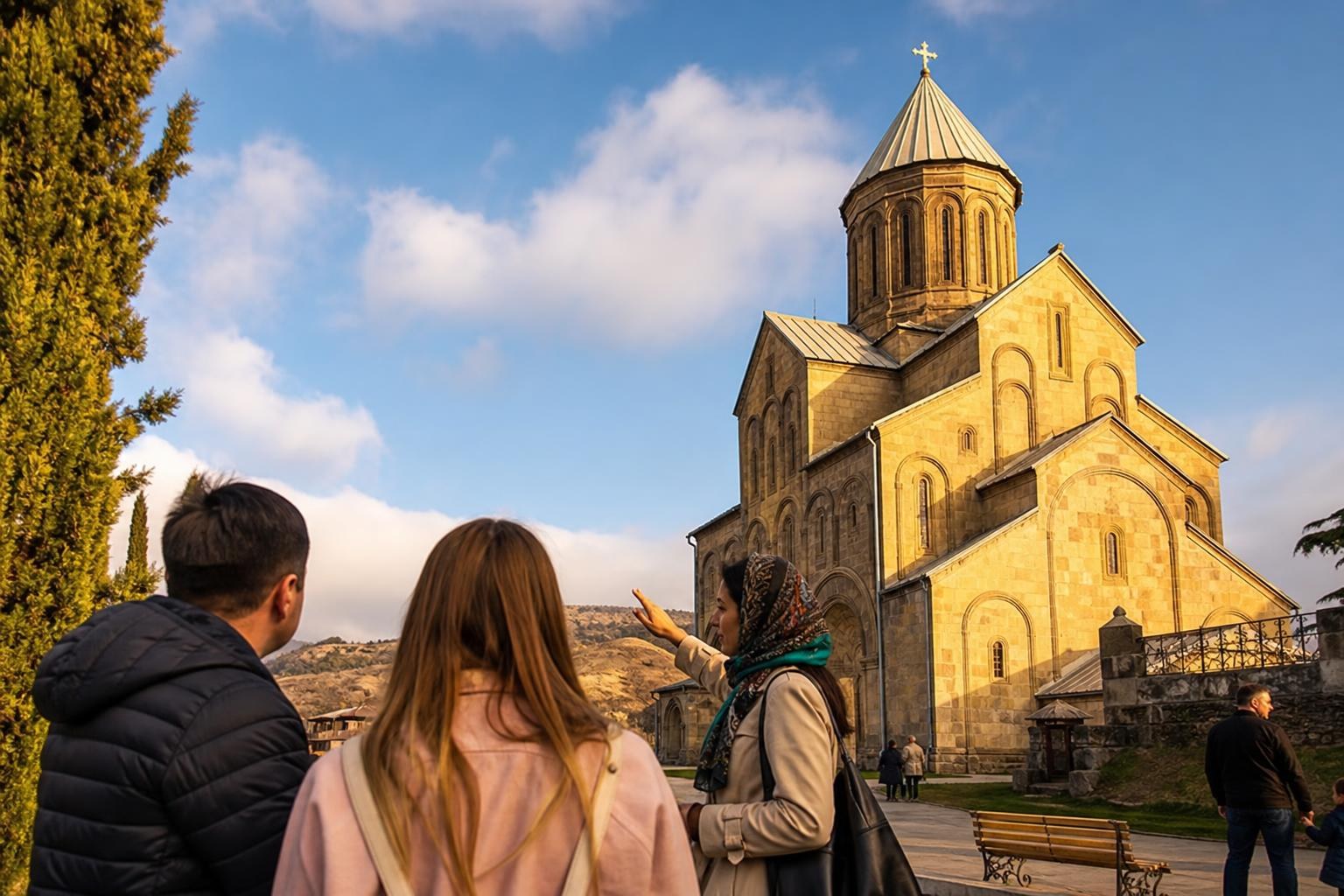
Georgia is one of the oldest Christian nations on Earth, with a spiritual tradition stretching back to 337 AD. For travelers arriving from Central Asia, the Middle East, or Europe, the country’s churches and monasteries aren’t just architectural marvels: they’re living institutions where incense still drifts through naves built sixteen centuries ago and polyphonic hymns echo off stone walls every Sunday morning. I’ve stood inside these spaces many times, and the experience is genuinely different from visiting a museum. These are active places of worship first and tourist attractions second, which is exactly what makes them so powerful. This guide to the Georgian Orthodox Church for tourists covers everything from historical context and etiquette to specific sites and practical tips for respectful visits.
Historical Foundations of Georgian Christianity
Georgia’s relationship with Christianity runs deeper than most visitors realize. The country didn’t simply adopt the faith: it wove Christianity into its national identity so thoroughly that the two became inseparable. Understanding this history transforms a church visit from casual sightseeing into something genuinely meaningful.
The Georgian word for their country is Sakartvelo, and the people call themselves Kartvelebi. But the name “Georgia” itself has deep Christian resonance, derived from Saint George, the dragon-slaying patron saint whose cross appears on the national flag. Walk through any Georgian town and you’ll see his image on churches, street signs, and even wine labels. This isn’t casual symbolism. It reflects a civilization that has defined itself through its faith for nearly 1,700 years, surviving invasions by Persians, Arabs, Mongols, Ottomans, and Soviets while holding onto its religious identity.
Georgia is preparing to celebrate 1,700 years of Christianity with state-funded events totaling 53 million GEL (roughly $19 million USD). That kind of national investment tells you everything about how central the Church remains to Georgian identity in 2026.
The Legacy of Saint Nino and King Mirian III
The conversion story begins with a woman named Nino, a Cappadocian slave who arrived in the Kingdom of Iberia (eastern Georgia) around 320 AD. Georgian tradition holds that Nino healed Queen Nana of a serious illness through prayer, which caught the attention of King Mirian III. The king himself experienced a divine revelation during a hunting trip when sudden darkness fell and lifted only after he prayed to Nino’s God.
Mirian declared Christianity the state religion around 337 AD, making Georgia one of the first kingdoms in the world to do so, just a few years after Armenia. Nino is venerated as “Equal to the Apostles” (Motziquli) in the Georgian Church, and her grapevine cross, bent into a distinctive curved shape and bound with her own hair, remains the most recognizable symbol of Georgian Christianity. You’ll see replicas of this cross in virtually every church you enter.
What makes this story remarkable is its staying power. Nino isn’t a dusty historical figure: Georgians talk about her the way Americans might reference the Founding Fathers, with genuine reverence and familiarity. Her feast days (January 14 and June 1) draw large crowds, and her supposed burial site at Bodbe Monastery in Kakheti is one of the most visited pilgrimage destinations in the country. When you visit Bodbe, you’ll find locals praying at her tomb alongside tourists snapping photos of the Alazani Valley views.
Autocephaly and the Role of the Patriarchate
The Georgian Orthodox Church has been autocephalous, meaning self-governing, since the 5th century. This is a critical distinction that separates it from churches that fall under the authority of Constantinople or Moscow. The head of the Church carries the title Catholicos-Patriarch of All Georgia, and the current patriarch, Ilia II, has held the position since 1977.
Ilia II is one of the most trusted public figures in the country. Opinion polls consistently place him above any politician, and his influence extends well beyond religious matters. He has spoken on issues ranging from education to demographics. His practice of personally baptizing every third child born to a Georgian family has been credited with contributing to a measurable increase in the birth rate. Whether you agree with the Church’s political influence or not, understanding the Patriarch’s role helps explain why Georgians react strongly when they feel their religious traditions are being disrespected.
The autocephalous status also means the Georgian Church has its own liturgical calendar, its own saints, and its own theological traditions that differ in subtle ways from Greek or Russian Orthodoxy. The liturgy is conducted in Old Georgian (Khutsuri script), and the musical tradition of polyphonic chanting is unique in the Christian world. This independence has been a source of immense national pride, especially during periods of foreign occupation when the Church served as the primary guardian of Georgian language and culture.
Essential Etiquette and Dress Code for Visitors
Here’s where many tourists get it wrong, and it matters. Georgian churches aren’t tourist attractions with velvet ropes and gift shops. They’re active places of worship where locals come to pray, light candles, and participate in sacraments. Showing up in shorts and a tank top isn’t just frowned upon: it can genuinely offend people who consider these spaces sacred. I’ve seen visitors turned away at the door of Svetitskhoveli for inappropriate clothing, which is an uncomfortable experience for everyone involved.
The good news is that the expectations are clear and easy to meet. Most major churches keep a basket of headscarves and wrap-around skirts near the entrance for unprepared visitors. But relying on these loaners feels a bit like borrowing someone’s jacket at a restaurant because you didn’t read the dress code. A little preparation goes a long way.
Georgia has been tightening its tourism infrastructure in recent years. The country introduced new entry requirements for foreign visitors in 2025, and there’s been ongoing discussion about tour guide registration requirements to ensure quality visitor experiences. The point is that Georgia takes its tourism seriously, and visitors who reciprocate that seriousness by respecting church etiquette are universally appreciated.
Required Attire for Men and Women
Women should cover their heads with a scarf when entering any Georgian Orthodox church. Shoulders and knees must also be covered. Long skirts or pants that reach below the knee are acceptable, though traditional Georgian women typically wear skirts rather than pants in church. If you’re visiting multiple churches in a day, which is common on routes through Mtskheta or Kakheti, just keep a lightweight scarf in your bag.
Men have it slightly easier but still face rules. Hats must be removed before entering. Shorts are not acceptable, and sleeveless shirts are discouraged. Long pants and a shirt with sleeves will get you through any church door without issue.
A few practical tips that save headaches:
-
Pack a dedicated “church scarf” in your daypack: a lightweight cotton or silk scarf works perfectly and takes up almost no space
-
Women wearing pants can tie a sarong around their waist as a makeshift skirt
-
Avoid clothing with large logos, slogans, or images that might be considered disrespectful
-
Sandals are fine, but you’ll be standing on stone floors that can be cold even in summer
Photography and Silence: Behavioral Guidelines
Photography rules vary by church, and there’s no single national policy. Some churches allow photography without flash. Others prohibit it entirely, especially during services. A few charge a small fee (typically 2-5 GEL) for camera use. When in doubt, look for posted signs near the entrance or ask a church attendant. If you see a service in progress, put the camera away entirely.
Silence is expected inside all churches. Keep your voice to a whisper if you need to speak. Phone ringtones should be silenced before entering. I once watched a tourist’s phone blast a pop song during a baptism at Sioni Cathedral, and the collective stare from the congregation was withering enough to make anyone want to disappear.
Other behavioral guidelines worth knowing:
-
Don’t turn your back to the altar: when leaving, back away or turn to the side
-
Don’t cross your legs while sitting (benches are rare, but some churches have them along the walls)
-
Avoid pointing at icons or frescoes: use an open hand gesture instead
-
Candles can be purchased inside the church (usually 0.50-1 GEL each) and lit as a form of prayer: tourists are welcome to participate
-
Don’t touch icons unless you see locals doing so (kissing icons is a common practice for believers)
-
During active liturgy, stand quietly along the sides rather than walking through the nave
Architectural Features and Sacred Art
Georgian church architecture developed along a distinctive path that sets it apart from Byzantine, Romanesque, or Russian Orthodox traditions. The buildings tend to be compact, vertically oriented, and built from local stone that weathers into beautiful earth tones over centuries. Walking into a Georgian church feels different from entering a Greek or Russian one: the spaces are more intimate, the decoration more restrained, and the relationship between interior and exterior more integrated with the surrounding landscape.
The earliest surviving churches date to the 5th and 6th centuries, and they show a progression from simple basilica forms to the cross-cupola design that became the Georgian standard. What’s remarkable is how consistent this architectural language remained over more than a thousand years. A church built in the 7th century and one built in the 11th share recognizable DNA, even as the details evolved.
Cross-Cupola Design and Iconic Stonework
The classic Georgian church form is the cross-in-square plan, where a central dome sits atop a drum supported by four arms extending in a cross shape. This creates a compact, unified interior space that draws the eye upward toward the dome, which symbolically represents heaven. The Jvari Monastery (586-605 AD), perched on a cliff above the confluence of the Mtkvari and Aragvi rivers near Mtskheta, is one of the purest examples of this form.
Georgian stone carving reached extraordinary levels of sophistication. The facades of churches like Samtavisi (1030 AD) and the Bagrati Cathedral in Kutaisi feature intricate geometric patterns, grape vine motifs, and zoomorphic figures carved in high relief. These aren’t just decorative: they carry symbolic meaning. Grape vines reference both the Eucharist and Georgia’s ancient winemaking tradition. Interlaced crosses represent the interconnection of the divine and earthly realms.
The stone itself tells a story. Churches in eastern Georgia tend to use yellow-gold sandstone, while those in the west use grey volcanic stone. The Gelati Monastery near Kutaisi combines both, creating a visual dialogue between building phases. Pay attention to the masonry joints: the precision of Georgian stone cutting, achieved without modern tools, rivals anything produced in medieval Europe.
Understanding Frescoes and the Iconostasis
Georgian frescoes follow Orthodox iconographic conventions but with local characteristics that trained eyes can spot. Figures tend to be slightly more elongated than their Byzantine counterparts, and the color palette often includes distinctive earth tones derived from local mineral pigments. The finest surviving frescoes are at Gelati Monastery (12th century), the Ubisi church (14th century), and the cave churches of David Gareja.
The iconostasis is the screen of icons that separates the nave (where worshippers stand) from the sanctuary (where the priest performs the Eucharist). In Georgian churches, the iconostasis tends to be less elaborate than in Russian Orthodox churches: often a simple stone or wooden screen with a few rows of icons rather than the towering, gilded structures found in Moscow or St. Petersburg. This restraint is characteristic of Georgian aesthetic sensibility.
When reading a Georgian iconostasis, look for these standard elements:
-
The Royal Doors in the center, through which only the priest passes
-
Icons of Christ and the Virgin Mary flanking the Royal Doors
-
The Deesis row showing Christ enthroned with the Virgin and John the Baptist
-
Local saints, particularly Saint Nino and Saint George, in prominent positions
The frescoes on the walls and ceilings follow a spatial theology. Christ Pantocrator (ruler of all) appears in the dome, looking down. The Virgin Mary occupies the apse behind the altar. Scenes from Christ’s life progress along the walls, and the Last Judgment typically covers the western wall near the entrance, so it’s the last thing worshippers see as they leave.
Must-Visit Cathedrals and Monastic Complexes
Georgia has over 300 churches and monasteries that are historically significant, but a handful stand above the rest. These aren’t just the most famous: they’re the sites where the architecture, the history, the setting, and the spiritual atmosphere combine to create truly unforgettable experiences. Georgia has become a top global travel destination precisely because of sites like these.
Planning your route matters. The sites below are spread across different regions, and some require significant travel time or physical effort to reach. I’d recommend at least five days to visit all of them comfortably, though you could hit the highlights in three days with early starts and long drives.
Svetitskhoveli: The Spiritual Heart of Mtskheta
Svetitskhoveli Cathedral in Mtskheta, about 20 kilometers northwest of Tbilisi, is the single most important church in Georgia. The current structure dates to the 11th century, built over the site where tradition says Christ’s robe was buried after being brought to Georgia by a Jewish man named Elioz who had witnessed the Crucifixion.
The name means “Life-Giving Pillar,” referring to a cedar pillar that supposedly grew over the robe’s burial site and began producing a healing oil. The pillar’s base is still visible inside the cathedral, enclosed in a small stone chapel. Whether you believe the legend or not, the weight of history in this building is palpable. Georgian kings were crowned and buried here. The Patriarch still conducts major services within its walls.
Architecturally, Svetitskhoveli is a masterclass in Georgian ecclesiastical design. The cross-cupola plan is executed at a grand scale, with a soaring central dome that floods the interior with light. Fragments of medieval frescoes survive on the walls, including a striking zodiac cycle and a Last Judgment scene. The exterior features elaborate stone carvings, including a famous relief of a hand holding a chisel, believed to be a portrait of the architect Arsukidze.
Practical tips for visiting: arrive early (before 9 AM) to avoid tour groups. The cathedral is free to enter. Mtskheta itself is a small town easily reached by marshrutka (minibus) from Tbilisi’s Didube station for about 1 GEL, or by taxi for 15-20 GEL. Combine your visit with Jvari Monastery, visible on the cliff above town, though you’ll need a car or taxi to reach Jvari since there’s no public transport up the hill.
Gergeti Trinity and High-Altitude Monasticism
Gergeti Trinity Church (Tsminda Sameba) sits at 2,170 meters above sea level, with the 5,047-meter peak of Mount Kazbek looming behind it. This is probably the most photographed church in Georgia, and for good reason: the combination of medieval stone architecture and raw alpine scenery is staggering.
The church dates to the 14th century and served as a hiding place for sacred relics during times of invasion. Its isolation was the point: enemies had to climb a steep mountain path to reach it, making it a natural fortress for Georgia’s most precious religious objects. The Khevi cross of Saint Nino was reportedly stored here during Persian invasions.
Getting there requires either a steep 1.5-hour hike from the town of Stepantsminda (formerly Kazbegi) or a 20-minute ride in a 4×4 vehicle. The hike is worth it if you’re reasonably fit: the trail winds through alpine meadows with wildflowers in summer, and the sense of arrival at the top is deeply satisfying. 4×4 rides cost about 60-80 GEL round trip and can be arranged from Stepantsminda’s main square.
The church interior is simple: bare stone walls, a few icons, and candles. There’s no electricity. Services are held occasionally, and if you happen to catch one, the sound of chanting inside this small stone chamber at 2,170 meters is something you won’t forget. The best times to visit are early morning for photography (the light on Kazbek is extraordinary) or late afternoon when most tour groups have left.
Vardzia and David Gareja Cave Monasteries
Vardzia and David Gareja represent a completely different tradition of Georgian monasticism: cave-based communities carved directly into cliff faces. These aren’t churches built on mountains but rather mountains transformed into churches.
Vardzia, in southern Georgia near the Turkish border, was originally a cave city built by Queen Tamar in the 12th century. At its peak, it contained over 6,000 rooms spread across 13 levels, including a church, a throne room, bakeries, pharmacies, and an irrigation system. An earthquake in 1283 exposed much of the interior by shearing away the cliff face, which is why you can see the honeycomb of rooms from the valley below. The Church of the Assumption, deep inside the complex, contains remarkable frescoes including a portrait of Queen Tamar herself, one of the few contemporary depictions of this legendary ruler.
David Gareja, in eastern Georgia near the Azerbaijani border, is a monastery complex founded in the 6th century by David, one of the thirteen Assyrian Fathers who established monastic life in Georgia. The complex includes the Lavra monastery at the base of the ridge and the Udabno monastery on the other side, reached by a 20-minute hike over the ridge. Udabno’s cave chapels contain some of the finest medieval frescoes in the Caucasus, including vivid depictions of the Last Supper and the Crucifixion painted directly onto cave walls.
Both sites require significant travel from Tbilisi. Vardzia is about a 4-hour drive south, best combined with a visit to the Akhaltsikhe fortress. David Gareja is about 2 hours southeast, and the road quality deteriorates significantly for the last stretch. Neither site has much tourist infrastructure, so bring water and snacks. Entrance fees are minimal: around 7 GEL for Vardzia and free for David Gareja.
Religious Calendar and Significant Feast Days
The Georgian Orthodox Church follows the Julian calendar for most feast days, which means dates fall 13 days later than their Gregorian equivalents. Christmas, for example, is celebrated on January 7 (Gregorian), not December 25. This catches some visitors off guard, but it also means you might stumble into a major celebration when you weren’t expecting one.
Visiting during a feast day can be extraordinary. Churches that might feel quiet on an ordinary Tuesday transform into packed, incense-filled spaces with hours-long liturgies, processions, and communal meals. The energy is completely different, and you’ll see a cross-section of Georgian society that you’d never encounter otherwise: grandmothers in black, young families with squirming children, soldiers in uniform, and teenagers who showed up because their parents insisted.
|
Feast Day |
Gregorian Date |
Significance |
Best Place to Experience |
|---|---|---|---|
|
Christmas (Shoba) |
January 7 |
Birth of Christ; Alilo procession through streets |
Tbilisi, Mtskheta |
|
Epiphany (Natlisgheba) |
January 19 |
Baptism of Christ; blessing of waters |
Tbilisi (Mtkvari River) |
|
Easter (Aghsdgoma) |
Varies (April/May) |
Most important feast; midnight liturgy |
Any major cathedral |
|
Svetitskhovloba |
October 14 |
Feast of Svetitskhoveli Cathedral |
Mtskheta |
|
Giorgoba (St. George’s Day) |
November 23 |
Patron saint feast; national holiday |
Nationwide |
|
Ninooba |
June 1 |
Feast of Saint Nino |
Bodbe Monastery, Sighnaghi |
|
Mariamoba (Assumption) |
August 28 |
Dormition of the Virgin Mary |
Nationwide, especially rural churches |
Easter is the big one. The Georgian Easter celebration begins with a midnight liturgy on Saturday night that can last until 3 or 4 AM. Churches overflow with worshippers holding red-dyed eggs and candles. The Patriarch leads the main service at Sameba (Holy Trinity) Cathedral in Tbilisi, and the atmosphere is electric. If you’re in Georgia during Easter, attending even part of the midnight service is an experience worth rearranging your schedule for.
The Christmas Alilo procession is another highlight. On January 7, groups of people dressed in traditional costumes walk through city streets singing hymns and collecting donations for charity. The Tbilisi Alilo is the largest, stretching from Sameba Cathedral through the old town, but smaller towns have their own versions that feel more intimate and authentic.
Quick Reference: Top Georgian Churches to Visit
This table consolidates the most significant churches and monasteries for visitors planning their itinerary. I’ve included practical details that guide books often skip.
|
Site |
Region |
Century Built |
Distance from Tbilisi |
Difficulty of Access |
Time Needed |
|---|---|---|---|---|---|
|
Svetitskhoveli Cathedral |
Mtskheta |
11th c. |
20 km |
Easy (marshrutka) |
1-2 hours |
|
Jvari Monastery |
Mtskheta |
6th c. |
25 km |
Moderate (taxi needed) |
30-45 min |
|
Sameba (Holy Trinity) Cathedral |
Tbilisi |
21st c. (2004) |
City center |
Easy (walk/metro) |
1 hour |
|
Sioni Cathedral |
Tbilisi |
6th-7th c. |
City center |
Easy (walk) |
30-45 min |
|
Gelati Monastery |
Kutaisi |
12th c. |
230 km |
Easy (taxi from Kutaisi) |
1-2 hours |
|
Bagrati Cathedral |
Kutaisi |
11th c. |
225 km |
Easy (walk from center) |
45 min |
|
Gergeti Trinity Church |
Stepantsminda |
14th c. |
150 km |
Moderate (hike or 4×4) |
2-4 hours |
|
Alaverdi Cathedral |
Kakheti |
11th c. |
120 km |
Easy (car) |
1 hour |
|
Bodbe Monastery |
Sighnaghi |
4th c. (rebuilt) |
110 km |
Easy (taxi from Sighnaghi) |
1-2 hours |
|
Vardzia Cave Monastery |
Samtskhe-Javakheti |
12th c. |
270 km |
Moderate (long drive) |
2-3 hours |
|
David Gareja |
Kakheti |
6th c. |
70 km |
Challenging (rough road, hike) |
3-4 hours |
|
Nikortsminda |
Racha |
11th c. |
280 km |
Moderate (remote) |
1 hour |
A few routing suggestions based on common travel patterns: if you have only one day for churches, do the Mtskheta loop (Svetitskhoveli plus Jvari) in the morning and Sameba Cathedral in the afternoon. With three days, add a Kakheti wine region trip that includes Alaverdi Cathedral and Bodbe Monastery. A full week allows you to reach the western sites (Gelati, Bagrati) and the remote cave monasteries.
Georgia’s tourism infrastructure has expanded significantly in recent years, with improved roads and signage to major religious sites. That said, some of the most rewarding churches are the ones you stumble upon in small villages, unmarked on any tourist map, where a caretaker might unlock the door and show you 800-year-old frescoes by flashlight.
Experiencing Liturgy and Polyphonic Chanting
If you visit Georgian churches only as architectural monuments, you’re missing the heartbeat of the tradition. The liturgy, the chanting, the ritual: these are what the buildings were designed for. Attending a Georgian Orthodox service, even briefly, transforms your understanding of these spaces from “old building” to “living tradition.”
Georgian liturgical music is built on polyphonic chanting, a tradition so distinctive that UNESCO inscribed it on the Intangible Cultural Heritage list. Unlike Western choral music, Georgian polyphony uses three independent vocal lines that interweave in complex harmonies. The bass voice (bani) holds a drone, the middle voice (mtkmeli) carries the melody, and the top voice (mdzakhili) improvises ornamental phrases. The result is a sound that seems to emerge from the stone walls themselves: dense, resonant, and deeply emotional.
You don’t need to be Orthodox or even religious to attend a service. Georgian churches are open to all visitors during liturgy, with a few caveats. Stand along the sides or near the back. Don’t sit down (there are few seats, and they’re for the elderly or infirm). Don’t walk around during the service. And don’t leave during the Eucharist prayer, the most sacred part of the liturgy, unless you can exit quietly through a side door.
The main Sunday liturgy (Tsminda Liturgia) typically begins around 9 or 10 AM and lasts 2-3 hours. You’re not expected to stay the entire time: arriving for the first 30-45 minutes gives you a full experience of the chanting and ritual. Evening vespers (around 5-6 PM on Saturdays) are shorter and often less crowded, making them a good alternative for visitors who want a more intimate experience.
Several churches in Tbilisi are known for particularly strong choirs. The Anchiskhati Basilica, the oldest surviving church in Tbilisi (6th century), hosts a small choir that performs in the intimate acoustic space with extraordinary effect. Sameba Cathedral has a larger, more formal choir. Outside Tbilisi, the monks at Gelati Monastery maintain a chanting tradition that dates back to the academy founded there by King David the Builder in the 12th century.
For those who want to experience Georgian sacred music outside of a church service, the Tbilisi State Conservatory and the Rustavi Ensemble occasionally perform concert versions of liturgical chants. These performances lack the spiritual context of a church service but allow you to hear the music in detail and appreciate its technical complexity. Check local listings during your visit, as schedules vary.
The physical experience of attending liturgy engages all the senses. The smell of frankincense fills the air as the priest swings the censer. Candlelight flickers across gold-leafed icons. The stone floor is cool beneath your feet. The chanting rises and falls in waves. And around you, Georgians of all ages cross themselves, bow, and kiss icons with practiced ease. Even as a non-believer, I’ve found these services profoundly moving: not because of any theological conviction, but because you’re witnessing a continuous cultural practice that has survived 17 centuries of war, occupation, and upheaval.
A practical note: many tour operators now offer packages that include church visits as part of broader Georgia itineraries. These can be convenient, but I’d encourage independent visits for the liturgy experience specifically. Tour groups tend to visit churches during off-hours for photography, which means you miss the living tradition entirely.
One last tip for the liturgy experience: learn the Georgian word “gmertma daglotsot” (God bless you). If an elderly Georgian woman sees you standing respectfully in church and presses a piece of blessed bread into your hand (this happens more often than you’d expect), this phrase is the perfect response. It will earn you a smile that makes the whole trip worthwhile.
A Final Word for the Thoughtful Visitor
Georgia’s Orthodox churches are not relics of a distant past. They are active, breathing spaces where a 1,700-year-old tradition continues to shape daily life, national identity, and community bonds. The tourist who approaches these sites with curiosity and respect will receive something far richer than Instagram photos: genuine connection with one of the world’s oldest continuous Christian cultures.
Pack a headscarf, silence your phone, arrive early, and stay long enough to hear the chanting. Talk to the caretakers. Light a candle, even if prayer isn’t your habit. The gesture costs 50 tetri and connects you, however briefly, to a tradition that has outlasted empires. Georgia’s churches have survived the Mongols, the Ottomans, and Soviet atheism. They’ll survive your visit too, but they’ll leave a mark on you that lasts far longer than you might expect. That quiet, incense-scented impression of standing in a space where people have prayed for a millennium and a half: that’s the real souvenir.