
Table of Contents
Georgia is one of the oldest Christian nations on earth, with a faith tradition stretching back to the fourth century. Walk into any of its 5,000-plus churches or monasteries, from the cave complex at Vardzia to the hilltop cathedral of Jvari, and you’re stepping into a space where worship has been continuous for over a millennium. That history shapes how Georgians view their sacred spaces, and it shapes what they expect visitors to wear inside them. Whether you’re a devout pilgrim or a curious traveler snapping photos of medieval frescoes, understanding the dress code at Georgian churches will save you from awkward moments at the door and show genuine respect for the culture you came to experience. I’ve watched plenty of tourists get turned away at monastery gates in Kakheti and Svaneti, not because anyone was trying to be unwelcoming, but because the standards here are specific and taken seriously. This guide covers exactly what to wear, what to avoid, and how to handle the practical challenges of staying covered in 38°C heat or on cobblestone monastery paths.
Understanding the Significance of Orthodox Church Etiquette
Georgian Orthodoxy isn’t a museum exhibit. It’s a living, breathing practice for roughly 83% of the country’s population. The Georgian Orthodox Church, autocephalous since the fifth century, considers its churches to be the literal house of God, not a historical attraction. When a priest is chanting liturgy inside Svetitskhoveli Cathedral and a tour group walks in wearing tank tops and shorts, it’s not just a fashion faux pas: it’s experienced as a disruption to active worship.
The concept of modesty in Georgian churches draws from the same theological roots as other Eastern Orthodox traditions, but Georgia applies them with particular consistency. Even small village churches in remote Tusheti or Racha will expect visitors to dress appropriately. There’s no “too rural to matter” exception.
Understanding this context matters because it reframes the dress requirements from arbitrary rules into something that makes cultural sense. Georgians use the phrase “stumari ghvtisaa,” meaning “a guest is a gift from God.” That hospitality extends to churches, but it comes with an expectation that guests will honor the space. In practice, this means the etiquette standards apply equally to tourists and locals, and nobody gets a pass for being foreign.
One thing that surprises many Western visitors is how strictly these norms are enforced even at the most popular tourist sites. Tbilisi’s Holy Trinity Cathedral (Sameba), the largest cathedral in the South Caucasus, sees thousands of tourists weekly. Every single one is expected to comply. The church attendants near the entrance will politely but firmly redirect anyone who doesn’t meet the standard, and they’ve been doing it long enough that they’re not shy about it.
Core Dress Code Requirements for Men and Women
The basic principle is straightforward: cover up. But the specifics differ for men and women, and the details matter more than you might expect.
Both sexes should avoid clothing that’s excessively tight, transparent, or bearing provocative images or text. Ripped jeans, even if they’re fashionable, won’t fly. Bright neon colors aren’t technically banned, but they’ll draw looks. Think of it as dressing for a formal occasion in a conservative household: you want to blend in, not stand out.
Shoulders must be covered for everyone. No sleeveless tops, no spaghetti straps, no muscle tees. Knees should be covered too. This isn’t a “below the knee is fine” situation for women: skirts or dresses should fall well past the knee, ideally to mid-calf or lower.
Guidelines for Women: Headcoverings and Skirts
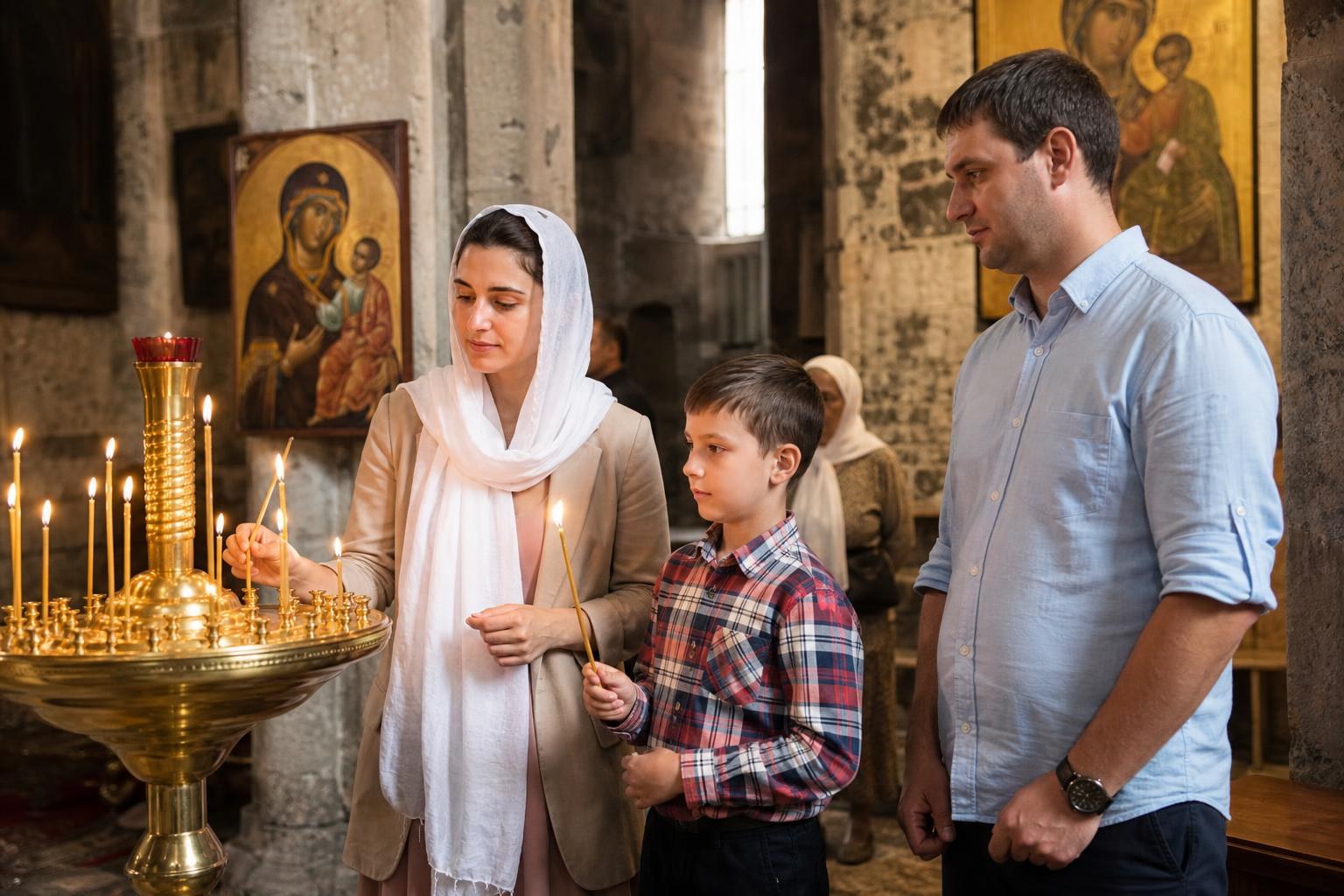
Women face the most specific requirements. A head covering is mandatory inside virtually every Georgian Orthodox church. This means a scarf, shawl, or any fabric that covers the hair. It doesn’t need to be a formal religious garment: a simple cotton scarf works perfectly. I keep a lightweight one in my daypack at all times when traveling in Georgia.
Pants on women remain a point of contention. Technically, many churches prefer women to wear skirts or dresses. In practice, at major tourist churches in Tbilisi, women in long, loose trousers are rarely turned away. But at monasteries, especially active ones like Alaverdi or David Gareja, women are expected to wear skirts that cover the knees, and pants may genuinely get you stopped at the entrance. The safest approach is to carry a wrap skirt.
Makeup and strong perfume are traditionally discouraged, though this is enforced less consistently than clothing rules. Lipstick, specifically, can be an issue because kissing icons is part of Orthodox worship, and lipstick marks on icons are considered disrespectful.
Guidelines for Men: Modest Attire and Uncovered Heads
Men have it somewhat simpler, but there are still clear expectations. The key rule that catches many male visitors off guard is the opposite of what you’d do in a Western church: men must remove hats, caps, and any head covering before entering. This includes beanies in winter and baseball caps in summer.
Long pants are required. Shorts of any length are not acceptable, and this rule is enforced consistently everywhere from Tbilisi to the most remote highland churches. A pair of lightweight chinos or linen trousers will get you through any church visit comfortably.
Shirts should have sleeves. A short-sleeved collared shirt or a t-shirt with sleeves that reach mid-bicep is generally fine. Sleeveless shirts, open shirts showing the chest, and shirts with offensive graphics will get you turned away. Sandals without socks are technically acceptable for men, though closed shoes are preferred at monasteries where you might be walking through active religious communities.
Summary Table: Quick Reference for Visitors
|
Requirement |
Women |
Men |
|---|---|---|
|
Head |
Must be covered with scarf or shawl |
Must be uncovered (remove hats/caps) |
|
Shoulders |
Fully covered |
Fully covered |
|
Tops |
No low-cut or transparent fabrics |
No sleeveless or open-chest shirts |
|
Legs |
Skirt/dress below knees preferred; long loose pants sometimes accepted at tourist churches |
Long pants required; no shorts |
|
Footwear |
Closed or modest sandals; heels impractical |
Closed shoes preferred; sandals accepted |
|
Accessories |
Avoid heavy makeup, especially lipstick |
Remove sunglasses indoors |
|
General |
No tight, sheer, or provocative clothing |
No tight, sheer, or provocative clothing |
Keep this reference handy on your phone. It covers 90% of what you need to know for any church or monastery visit in Georgia.
Using Provided Wraps and Aprons at Church Entrances
Here’s the good news: Georgians know that tourists don’t always arrive prepared. Most major churches and nearly all monasteries that receive regular visitors keep a supply of wraps, aprons, and headscarves near the entrance. These are typically simple fabric pieces, often in dark colors, that you can borrow for the duration of your visit.
At Svetitskhoveli, Jvari, and Sameba, you’ll usually find a basket or rack of scarves and wrap-around skirts right by the door. They’re free to use: just return them when you leave. The quality varies. Some are clean cotton wraps; others have seen better days. If you’re particular about hygiene, bringing your own is the better move.
At smaller or more rural churches, wraps and coverings may be available but aren’t guaranteed. I’ve visited churches in Svaneti where there was nothing at the entrance, and the only option was to improvise with a jacket or buy a scarf from a vendor outside. Don’t count on every church having supplies, especially during peak tourist season when they run out quickly.
The etiquette around these loaner garments is simple: use them respectfully, fold them when you’re done, and place them back where you found them. Don’t stuff them into a pile or leave them on a bench. These are provided as a courtesy, and treating them carelessly reflects poorly on all visitors.
Seasonal Considerations and Practical Packing Tips
Georgia’s climate swings dramatically between seasons and altitudes. Tbilisi hits 40°C in July, while Ushguli in Svaneti can be chilly even in August. Your church wardrobe needs to account for both extremes.
Pack at least one lightweight scarf that can double as a head covering and a shoulder wrap. A cotton or linen wrap skirt that rolls up small is worth its weight in gold for women. Men should pack at least one pair of long, breathable trousers specifically for church visits, even if they plan to live in shorts the rest of the trip.
Managing Summer Heat While Staying Covered
Summer is when the dress code feels most burdensome. You’ve been hiking in Kazbegi or wandering Tbilisi’s Old Town in 37°C heat, and now you need to cover your arms, legs, and head to step inside a church. It’s uncomfortable, but manageable with the right fabrics.
Linen and lightweight cotton are your best friends. Avoid polyester or synthetic blends: they trap heat and make you miserable within minutes. A loose linen shirt with sleeves works for both men and women. For women, a thin cotton maxi skirt breathes far better than wrapping a heavy borrowed apron over shorts.
Color matters too. Dark fabrics absorb more heat, and many of the loaner wraps at churches are dark navy or black. Bringing your own light-colored scarf and skirt means you’ll stay cooler. A small, packable fan or a water bottle with a mist function can help during longer monastery visits where you might be inside for 20-30 minutes.
Hydrate before you enter. Most churches don’t allow food or drinks inside, so take a long drink of water before you go in. Georgian summers are dry, and the combination of heat and heavy clothing can cause lightheadedness faster than you’d expect.
Footwear for Uneven Stone Floors and Monasteries
This is the detail most packing guides skip, and it’s the one that causes the most physical discomfort. Georgian churches and monasteries are old: many date to the sixth through thirteenth centuries. Their floors are uneven stone, worn smooth by centuries of foot traffic. Monastery complexes often involve steep paths, gravel courtyards, and sometimes actual hiking to reach the entrance.
Flip-flops are a bad idea. They offer no grip on polished stone, and they’ll slow you down on monastery paths. High heels are practically dangerous at sites like David Gareja, where you’re walking along cliff edges. The best option is a comfortable, closed-toe walking shoe with good grip. Trail shoes or sturdy sandals with ankle straps and rubber soles work well.
If you’re visiting Georgian Orthodox monasteries in mountainous regions, plan for actual walking. Gelati Monastery near Kutaisi, for example, sits on a hillside with cobblestone paths. Jvari requires a short but steep approach. Wearing the wrong shoes turns a beautiful visit into a painful ordeal.
Additional Rules of Conduct Inside the Sanctuary
Clothing is only part of the equation. Georgian churches have behavioral expectations that go beyond what you wear, and ignoring them can cause more offense than a bare shoulder.
Photography rules vary by church. Some allow photos without flash; others prohibit cameras entirely, especially during services. Look for signs near the entrance, or ask. When in doubt, don’t shoot. I’ve seen tourists get scolded by priests for photographing during active liturgy, and it’s uncomfortable for everyone involved.
Silence is expected. Georgian Orthodox services involve chanting, incense, and long periods of standing (there are typically no pews). If you enter during a service, stand quietly near the back or sides. Don’t walk through the middle of the congregation or between worshippers and the altar. The altar area, behind the iconostasis, is off-limits to laypeople and absolutely off-limits to tourists.
Candle lighting is a common practice. You can buy thin beeswax candles at most churches for about 0.50-1 GEL (roughly $0.20-0.40 USD in 2026). Lighting a candle and placing it in the sand-filled tray is a respectful gesture, even if you’re not Orthodox. Just watch how locals do it first and follow their lead.
Physical contact with icons follows specific customs. Georgians kiss icons as part of their worship. If you choose to do the same, approach the icon, make the sign of the cross (or simply bow your head if you’re not Orthodox), and touch your lips to the glass or frame. Don’t touch the painted surface with your hands. And again, skip the lipstick.
Couples should avoid public displays of affection inside churches. Holding hands is fine; kissing or embracing is not appropriate in this context. Keep children close and reasonably quiet. Georgians are extraordinarily welcoming to families, but a child running around the sanctuary during prayers will draw disapproval.
Respecting the Space, Enjoying the Experience
Getting the dress code right at Georgian churches isn’t about following arbitrary rules: it’s about entering one of the world’s oldest Christian traditions on its own terms. Georgia’s churches are extraordinary. The frescoes at Gelati, the atmosphere at Alaverdi during a midnight Easter service, the sheer drama of Gergeti Trinity Church against the Caucasus peaks: these are experiences worth a little preparation.
Pack a scarf, bring long pants or a wrap skirt, wear sensible shoes, and leave the attitude at the door. You’ll be rewarded with access to spaces that have been sacred for over 1,500 years, and with the quiet appreciation of the Georgians who worship there. The small effort of dressing appropriately opens doors, literally and figuratively, that stay closed to those who can’t be bothered. That’s a trade worth making every time.