
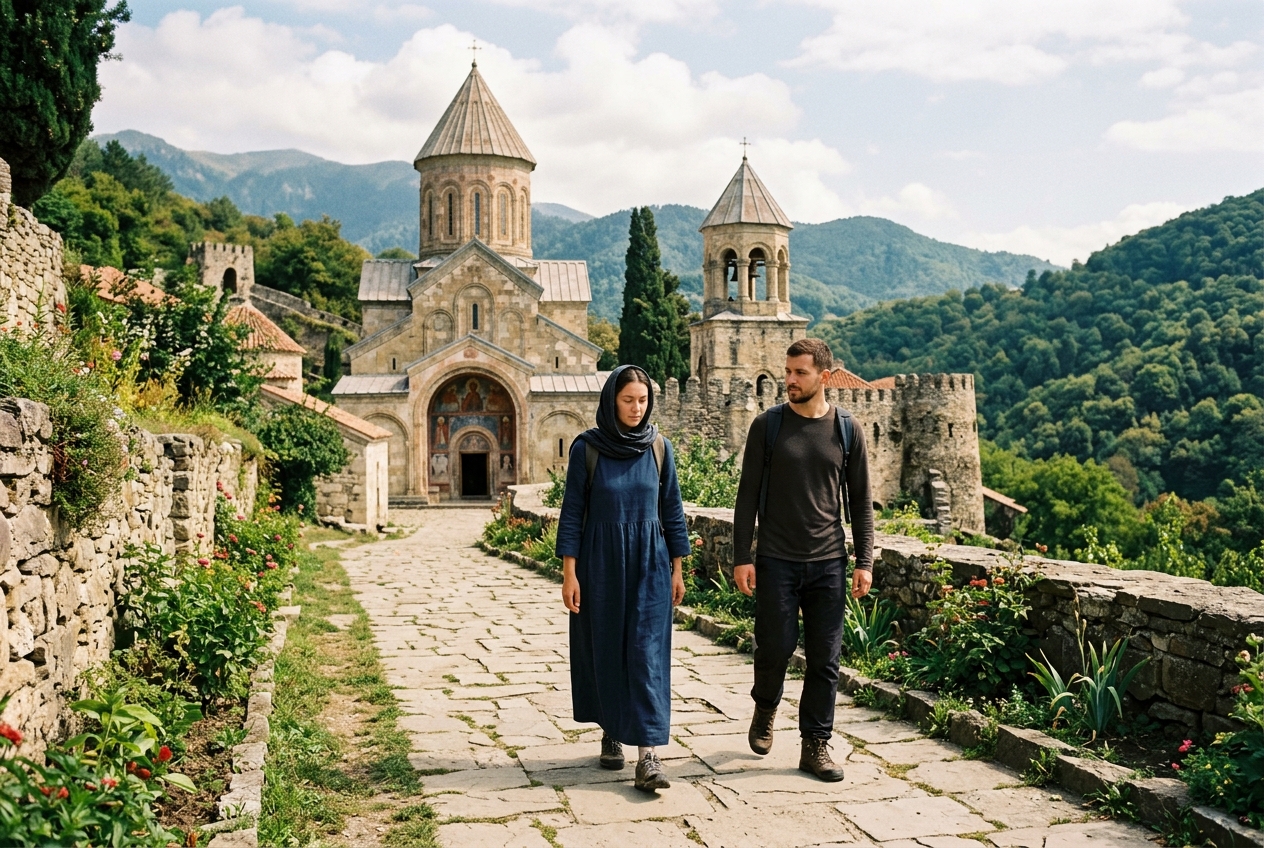
Georgia’s monasteries are some of the most visually stunning religious sites in the world. Perched on clifftops, tucked into mountain valleys, and scattered across the countryside, places like Jvari, Gelati, and David Gareja draw hundreds of thousands of visitors each year. But here’s the thing most travel blogs gloss over: what you wear to these sites genuinely matters, and not just in a “be polite” kind of way. I’ve watched tourists get turned away at monastery gates for wearing tank tops or shorts, and it’s an awkward, avoidable situation. Knowing what to wear at Georgian Orthodox monasteries before you arrive saves you from scrambling at the entrance or missing out entirely. Georgian religious dress codes aren’t arbitrary rules designed to frustrate visitors. They’re rooted in centuries of Orthodox Christian tradition, and Georgians take them seriously. This country adopted Christianity in 337 AD, making it one of the oldest Christian nations on earth, and that history is woven into daily life. Whether you’re a believer or simply a curious traveler, respecting the dress code is the easiest way to show that you value the culture you’ve come to experience. This guide covers everything you need to know: specific clothing requirements for women and men, footwear advice for rugged terrain, what to do if you show up unprepared, and seasonal tips for a country where monastery elevations can shift from sea level to 2,000 meters.

Understanding the Traditional Dress Code for Orthodox Sites
The Role of Modesty in Georgian Religious Life
Modesty in Georgia isn’t a performance or a set of arbitrary restrictions. It’s a deeply held cultural value shaped by over 1,700 years of Orthodox Christianity. The Georgian word for church, “eklesia,” carries a weight that goes beyond architecture: it refers to a sacred gathering, a space where the physical and spiritual worlds are understood to meet. Dressing modestly for these spaces is considered an act of reverence, not unlike removing your shoes before entering a Japanese home.
The overarching principle is to dress modestly and respectfully to honor the sanctity of the church, and that idea extends beyond fabric. Modesty in Georgian religious life encompasses behavior, volume, and posture. You’ll notice locals crossing themselves at the entrance, speaking in hushed tones, and moving through the space with a kind of intentional quietness. Clothing is the most visible expression of this respect, but it’s part of a larger cultural framework.
For travelers coming from Western countries where casual dress is the norm even in churches, this can feel like a shift. But once you understand that Georgians view their monasteries as living, active places of worship rather than museums, the dress code makes intuitive sense. Even monasteries that appear “touristy” on the surface, like Svetitskhoveli in Mtskheta, are active religious sites with daily services.
Why Specific Attire is Required for Entry
The dress requirements at Georgian monasteries aren’t suggestions. Some sites will genuinely deny entry if you are wearing shorts or other clothing deemed inappropriate. This applies to both men and women, and it’s enforced more strictly at active monasteries than at purely historical ruins.
The reasoning is theological. Orthodox tradition holds that the church building itself is sanctified space, and entering it requires a degree of physical preparation. Just as a priest vests before conducting a service, laypeople are expected to present themselves with care. Exposed shoulders, bare legs above the knee, and uncovered heads (for women) are all considered inappropriate because they shift attention away from worship and toward the individual.
This isn’t unique to Georgia: you’ll find similar codes at Orthodox sites in Greece, Russia, and Ethiopia. But Georgia enforces them with particular consistency, especially at rural and mountain monasteries where tourism hasn’t softened traditional expectations. The monks and nuns who live at these sites aren’t running visitor attractions. They’re maintaining a way of life, and the dress code is part of that.
Essential Clothing Guidelines for Women
Headcoverings: Scarves and Shawls
Women are expected to wear a headscarf or something similar to partially cover the hair when entering any Georgian Orthodox church or monastery. This is the single most important piece of clothing to remember, and it’s the one most frequently forgotten by tourists.
You don’t need anything elaborate. A lightweight cotton or linen scarf works perfectly, and it doesn’t need to cover every strand of hair. Think of it as draping loosely over the top and sides of your head, not wrapping tightly like a hijab. Many Georgian women simply fold a scarf in a triangle and tie it loosely under the chin or behind the neck. A large pashmina or shawl that you’re already carrying for warmth doubles nicely for this purpose.
I always recommend keeping a scarf in your daypack regardless of your plans. Georgian road trips have a way of leading to unexpected monastery stops, and having a scarf on hand means you’re always prepared. Solid, muted colors tend to be the safest choice: think navy, black, burgundy, or forest green rather than neon patterns.
Appropriate Skirt Lengths and Styles
Skirts and dresses should be at least knee-length, and longer is always better. Mid-calf or ankle-length skirts are ideal and will never draw a second glance. Anything above the knee risks refusal at stricter monasteries.
The style matters less than the coverage. A-line skirts, wrap skirts, maxi dresses, and even loose palazzo pants that read as a skirt are all acceptable. What you want to avoid is anything tight, sheer, or with high slits. The goal is for the garment to hang loosely and not draw attention to the body’s shape.
If you’re a traveler who lives in hiking pants and leggings (which is completely reasonable given Georgia’s terrain), consider packing a lightweight wrap skirt that you can pull on over your pants at monastery entrances. Several outdoor brands make travel skirts that weigh almost nothing and roll up to the size of a fist. This is the hack that experienced Georgia travelers swear by.
Shoulder and Neckline Requirements
Shoulders should be fully covered. This means no tank tops, spaghetti straps, or off-the-shoulder tops. A basic t-shirt with sleeves that reach at least mid-upper arm is the minimum. Many women opt for lightweight long-sleeve shirts, which also protect against sun at high-altitude sites.
Necklines should be modest: nothing plunging or deeply scooped. A crew neck, boat neck, or standard V-neck that doesn’t show cleavage is fine. If you’re wearing a dress with a lower neckline, your headscarf can sometimes be arranged to cover the chest area, but it’s easier to just choose a higher-necked top.
Here’s a quick reference for women’s clothing:
| Clothing Item | Acceptable | Not Acceptable |
|---|---|---|
| Head | Scarf, shawl, large hat with scarf | Bare head, baseball cap alone |
| Tops | T-shirts, long sleeves, blouses | Tank tops, crop tops, strapless |
| Bottoms | Knee-length+ skirts, maxi dresses | Shorts, mini skirts, leggings alone |
| Neckline | Crew, modest V-neck, boat neck | Deep V, low scoop, off-shoulder |
Mandatory Dress Standards for Men
Pants vs. Shorts: The Long Trousers Rule
Men should wear long trousers down to the ankle when visiting any Georgian Orthodox monastery. Shorts are a firm no. This catches a lot of male travelers off guard, especially during the hot summer months when shorts feel like the only sane option.
Standard jeans, chinos, linen pants, and even lightweight hiking trousers all work perfectly. The key is that the fabric reaches the ankle. Cropped trousers that hit mid-calf exist in a gray area: some monasteries won’t care, but stricter sites might. Full-length pants eliminate any ambiguity.
If you’re spending a summer day hiking to a remote monastery and wearing shorts on the trail, bring a pair of lightweight pants to change into before entering. Zip-off hiking pants, where the lower legs zip on and off, are genuinely useful for this exact scenario.
Acceptable Shirts and Outerwear
Men have slightly more flexibility with upper-body clothing than women, but the same modesty principles apply. A standard t-shirt with sleeves is fine. Sleeveless shirts, open unbuttoned shirts, and bare chests are not acceptable. Collared shirts and polo shirts are always a safe bet.
One rule that surprises some visitors: men should remove their hats when entering a church. This is the opposite of the women’s requirement, where head covering is expected. If you’re wearing a baseball cap or beanie, take it off before stepping inside. This tradition mirrors Western Christian practice and is taken seriously in Georgian Orthodox settings.
During cooler months, jackets and coats are fine to wear inside the church. There’s no expectation to remove outerwear in winter, and many Georgian churches aren’t heated, so keeping your jacket on is both practical and perfectly acceptable.
Footwear for Uneven Terrain and Holy Ground
Georgian monasteries were not built with tourist comfort in mind. Many sit on rocky hilltops, at the end of unpaved trails, or on ancient cobblestones that become slippery when wet. Jvari Monastery overlooks Mtskheta from a windswept ridge. David Gareja is literally carved into desert cliffs near the Azerbaijani border. Vardzia is a cave city built into a mountainside.
Sturdy, closed-toe shoes with good grip are essential. Hiking shoes or trail runners are ideal for most monastery visits. Sneakers with decent tread work for the more accessible sites like Svetitskhoveli or Bodbe. What you want to avoid is flip-flops, smooth-soled sandals, or heels: not because of any religious rule, but because you’ll likely twist an ankle on the uneven stone surfaces.
There’s no requirement to remove shoes when entering Georgian Orthodox churches, unlike some Buddhist or Muslim sites. You walk in with your shoes on, which makes the footwear choice purely practical. That said, some cave monasteries have narrow, uneven passages where ankle support genuinely matters. Invest in decent walking shoes before your trip, and your feet will thank you every single day.
Using Communal Clothing at Monastery Entrances
If you arrive at a Georgian monastery underprepared, don’t panic. Most popular monasteries keep a supply of communal wraps and scarves near the entrance for visitors who aren’t dressed appropriately. You’ll typically find a basket or rack of fabric wraps: usually simple rectangular pieces of cloth in dark colors that women can use as skirts or head coverings, and that men can wrap around shorts.
These communal garments are free to borrow and should be returned to the same spot when you leave. They’re shared among many visitors, so they’re not always in pristine condition. Some travelers find this perfectly fine; others prefer to bring their own. If hygiene is a concern for you, carrying your own scarf and wrap skirt is the obvious solution.
Not every monastery offers communal clothing, though. Smaller, more remote sites, especially in Tusheti, Svaneti, or along the lesser-visited routes in Kakheti, may not have any provisions for underdressed visitors. At these places, if you’re not dressed correctly, you simply won’t be able to enter. The safest approach is to always have appropriate clothing in your bag rather than counting on monastery supplies.
Practical Tips for Seasonal Visiting
Layering for High-Altitude Monasteries
Georgia’s geography is extreme. You can drive from the subtropical coast to a 2,200-meter mountain pass in a few hours. Monasteries like Gergeti Trinity Church sit at roughly 2,170 meters, where temperatures can drop sharply even in July. The Svaneti region, home to ancient churches and tower villages, regularly sees cool winds and sudden weather changes throughout the summer.
Layering is the only sensible strategy. A base layer of moisture-wicking fabric, a long-sleeve shirt or light fleece, and a windproof outer layer will cover most situations. Women can wear their head scarf as an extra neck warmer. The beauty of layering is that it naturally satisfies the modesty requirements: long sleeves, long pants, and covered shoulders are built into the system.
Pack a compact rain jacket even if the forecast looks clear. Mountain weather in the Caucasus shifts fast, and getting caught in rain at an exposed hilltop monastery with no shelter is no fun.
Staying Cool in Summer While Staying Covered
Georgian summers are hot, especially in the eastern lowlands around Tbilisi, Mtskheta, and Kakheti, where temperatures regularly hit 35-40°C (95-104°F). Covering your body in these conditions requires some fabric strategy.
Choose natural, breathable materials: linen, cotton, and lightweight wool blends. Linen is king in Georgian heat. A loose linen shirt and linen trousers keep you covered while allowing airflow. Synthetic fabrics trap heat and make the experience miserable. Light colors reflect sunlight and keep you cooler than dark ones, though darker scarves and skirts are more traditional for church visits.
Carry water, wear sunscreen on exposed skin (face and hands), and time your monastery visits for morning or late afternoon when the heat is less intense. Midday visits to sun-exposed sites like David Gareja in August can be genuinely grueling, so plan accordingly.
General Etiquette Beyond Clothing
Dressing appropriately gets you through the door, but behavior inside the monastery completes the picture. Georgian Orthodox churches are active places of worship, and visitors are expected to act accordingly.
Keep your voice low. Turn your phone to silent. Photography rules vary by site: some monasteries allow photos freely, others prohibit them inside the church building, and a few ban cameras entirely. Look for signs, or ask a monk or caretaker before pulling out your camera. If an active service is underway, you can usually observe quietly from the back, but don’t walk between the priest and the congregation, and avoid crossing in front of the iconostasis (the icon-covered screen at the front of the church).
Candle lighting is a common practice in Georgian churches, and visitors are welcome to participate. You’ll usually find thin beeswax candles available near the entrance, sometimes with a small donation box. Lighting a candle and placing it in the sand-filled tray is a simple, respectful gesture that Georgians appreciate, regardless of your own beliefs.
Physical contact with icons and frescoes should be avoided unless you see locals kissing or touching specific icons, which is a devotional practice. Don’t touch ancient frescoes: the oils from your skin damage the paint over time.
One final thought: Georgia’s monasteries aren’t just tourist checkpoints. They’re places where monks and nuns live, pray, and maintain traditions that stretch back over a millennium. The dress code is the most visible expression of respect, but it’s really just the starting point. Approach these sites with genuine curiosity and a willingness to slow down, and you’ll find that Georgian monasteries offer something far richer than a photo opportunity. They offer a window into one of the oldest continuous Christian cultures on earth, and that’s worth a little extra thought about what you pack.